Virgin Mary Orthodox Icon
$1250
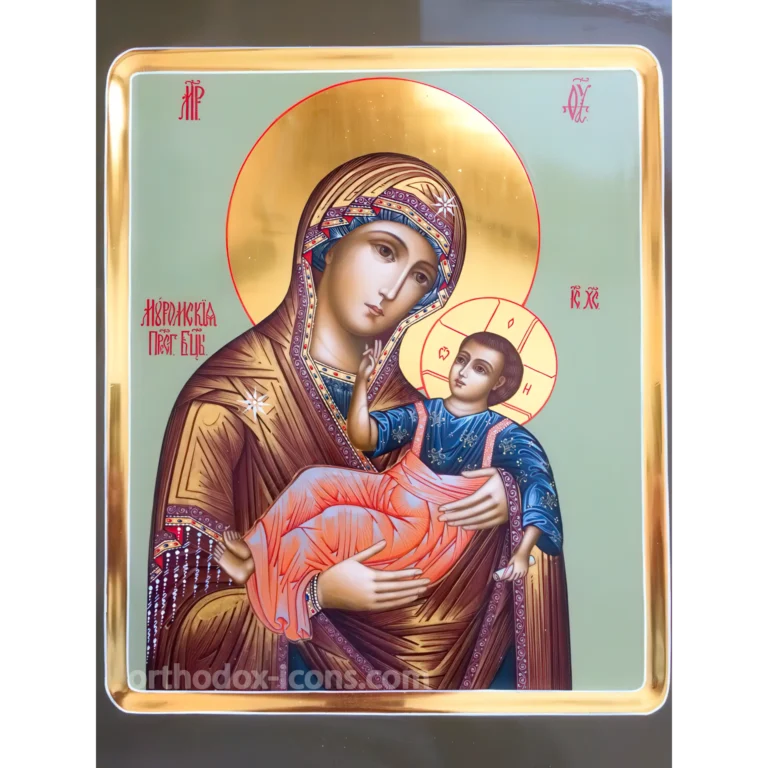
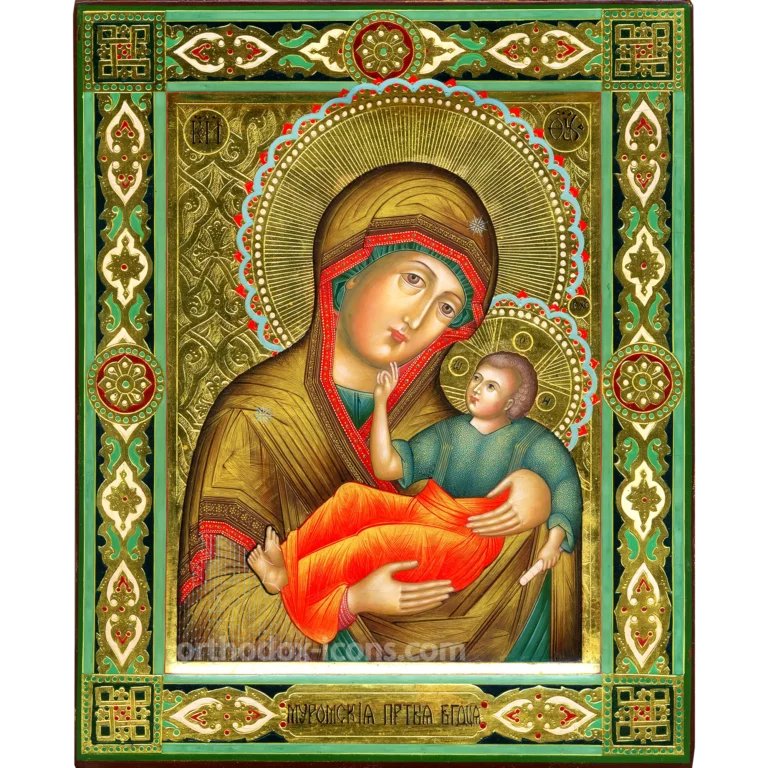
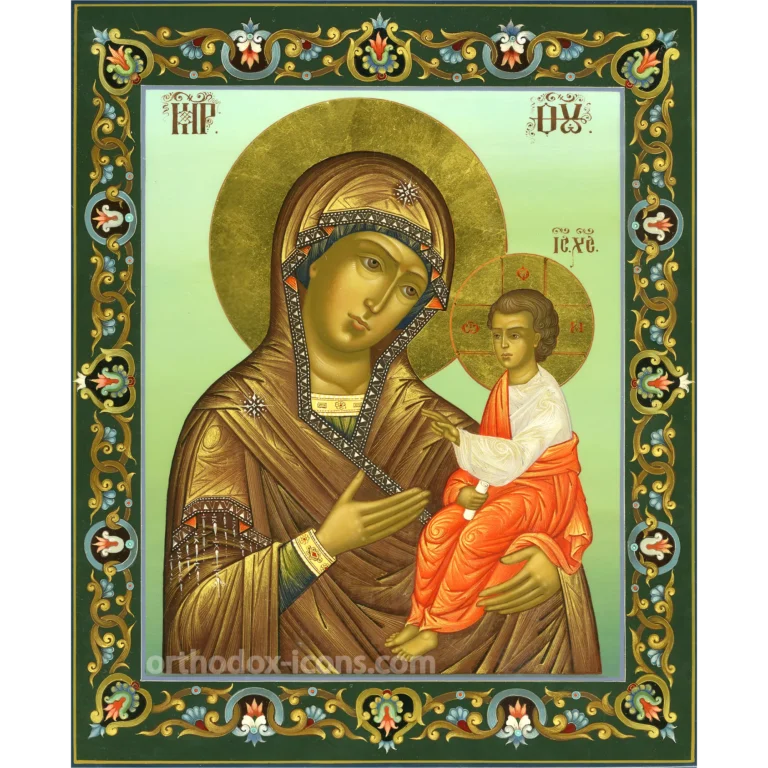
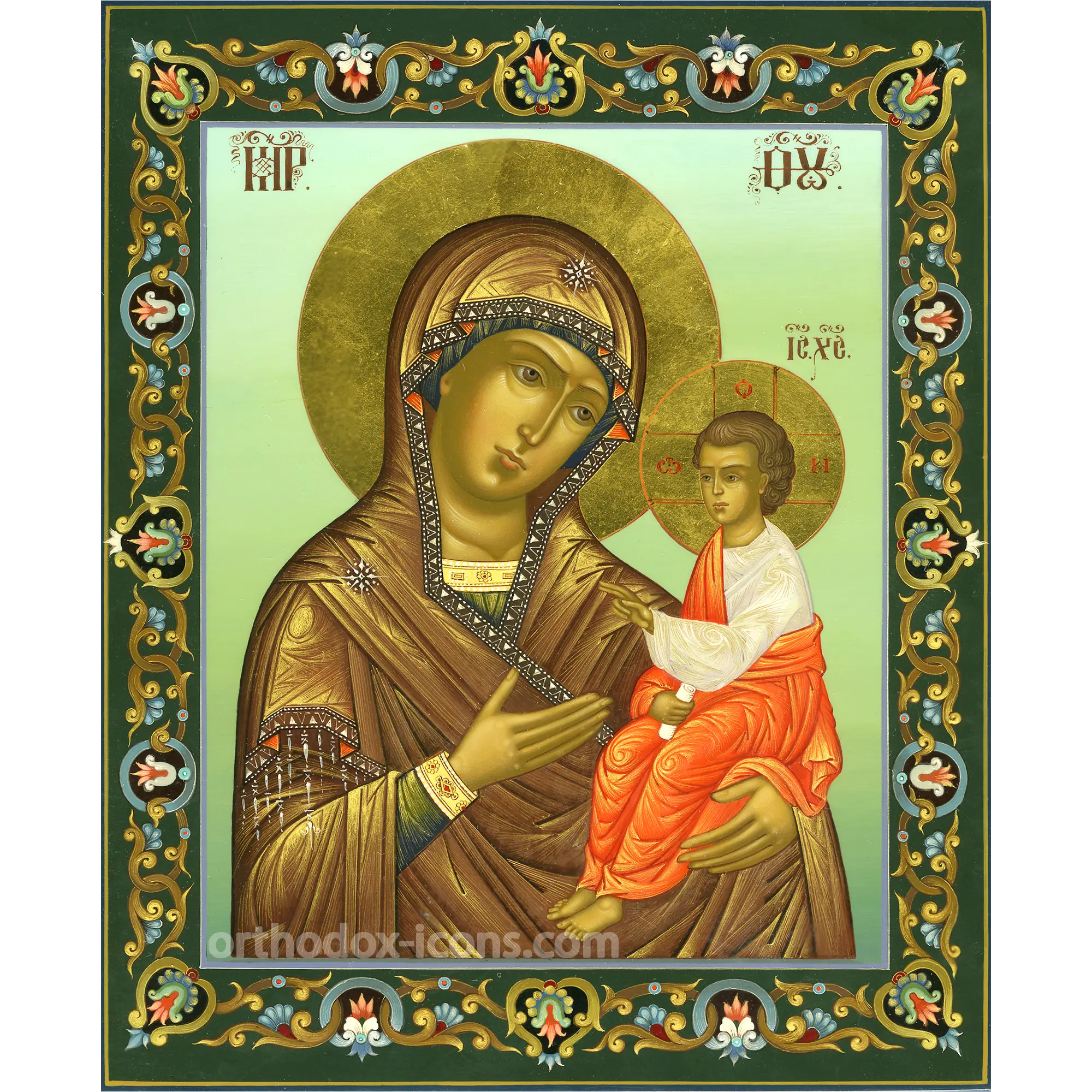
Virgin Mary Orthodox Icon is a hand-painted Kazan Mother of God icon in the shoulder-length Hodegetria type, with an olive-green background, 960 gold halos, and enamel-like floral ornament on the margins.
Available size: 27×31 cm (10.6×12.2 in). Larger church and iconostasis sizes may be discussed before painting.
Materials: linden board with oak braces, linen pavoloka, chalk levkas, 960 gold leaf, mineral egg tempera, colored enamel-style ornament, protective finish.
Technique: hand icon painting in the Mstyora tradition, mineral egg tempera, gold leaf halos, olive-green gradient background, hand-painted floral ornament with enamel colors.
It is possible to paint an image in any size to order
Free shipping worldwide
Virgin Mary Orthodox Icon presents the Kazan Mother of God, one of the most venerated and beloved icons in Russian Orthodox tradition. The Kazan icon is honored as a protector of the faithful, a guardian of the family, and a helper in illness, especially in diseases of the eyes.
This hand-painted icon is made in the Mstyora tradition with a distinctive artistic solution. Instead of a usual gold or ocher background, the icon has a soft olive-green gradient field, symbolizing life, hope, and spiritual renewal. The halos are covered with genuine 960 gold leaf, while the wide margins are decorated by hand with a rich floral ornament using gold accents and bright enamel-like colors.
The result is a prayerful image that is also a family treasure: solemn, warm, and visually refined. The icon is suitable for a home icon corner, a wedding blessing, a meaningful Orthodox gift, or a larger church format by agreement.
Kazan Mother of God: History of the Holy Image
The history of the Kazan Icon begins in the summer of 1579, after a devastating fire in Kazan. The fire destroyed whole districts of the city and left many people without homes. In the midst of this sorrow, the Mother of God appeared in a dream to a nine-year-old girl named Matrona, daughter of the merchant Daniil Onuchin.
The Theotokos commanded the child to go to the place of her burned house and dig in the earth, where her holy image was hidden. At first Matrona’s mother did not take the dream seriously. The vision was repeated three times, and finally mother and daughter went to the ashes and began to dig.
About a meter beneath the ashes and coal, they found a small icon wrapped in old cloth. The image shone with fresh, bright colors, as if newly painted, untouched by the fire. News of the discovery spread quickly, and the icon was carried in procession first to a nearby church and then to the Annunciation Cathedral in the Kazan Kremlin.
The priest Ermolai, later Patriarch Hermogenes of Moscow, took part in that procession and later wrote the account of the miracle. In 1612, during the Time of Troubles, a copy of the Kazan icon was carried with the militia of Kuzma Minin and Dmitry Pozharsky. After prayer and fasting before the icon, Moscow was liberated, and the Kazan icon became a sign of national deliverance and spiritual protection.
Shoulder-Length Hodegetria Iconography
Iconographically, the Kazan icon belongs to the Hodegetria type, the Directress, yet it differs from full classical Byzantine versions such as the Smolensk or Iveron icons. The Mother of God is shown shoulder-length, not waist-length, and her hands are hidden beneath the maphorion.
Her face is inclined toward the Christ Child with quiet humility and luminous sorrow. The Christ Child is shown beside her, on the viewer’s right, in a strict frontal pose. Only part of His figure is visible. His right hand is raised in the ancient two-finger blessing, while His left hand is hidden under the folds of the himation. Unlike many Hodegetria images, He does not hold the usual scroll.
The Mother of God wears a dark cherry-red maphorion with fine gold assist. The three stars on her forehead and shoulders symbolize her ever-virginity: before, during, and after the Nativity of Christ. The Savior wears a white chiton and an orange-red himation, expressing the union of divine and human nature in Him.
Prayer Before the Kazan Icon
The Kazan icon is perhaps the most familiar and beloved family icon in Russian Orthodox devotion. Countless faithful have prayed before it in personal sorrow, family difficulty, illness, and times of national danger.
- For healing of eye diseases: the first miracles after the discovery of the icon were the healings of two blind men, Joseph and Nikita. For this reason, prayers before the Kazan icon are especially connected with sight, both physical and spiritual.
- For family and marriage: parents traditionally bless a bride and groom with the Kazan icon. It is approached for peace in marriage, a good spouse, the prevention of divorce, and the healing of family quarrels.
- For children: the Kazan icon is often kept near a child’s bed. The Mother of God is asked to protect children from illness, danger, bad company, and harmful choices.
- For difficult circumstances: people pray before the Kazan icon before serious operations, during financial crisis, in workplace trouble, and whenever maternal intercession is needed.
Olive-Green Background, Gold Halos, and Ornament
The special beauty of this icon lies in its color design. The olive-green background is not accidental. In icon painting, green can symbolize eternal life, hope, youth, and spiritual flowering. The soft gradient gives the icon depth and makes the faces of the Mother of God and Christ stand out with quiet warmth.
The halos of the Mother of God and Christ are gilded with genuine 960 gold leaf. Real gold does not oxidize, blacken, or darken in ordinary air. It gives the holy figures a restrained radiance and points to divine, uncreated light.
The wide margins are decorated with a complex floral ornament painted by hand. The icon painter uses fine brushes, gold accents, and rich enamel-style colors, including blue, light-blue, and terracotta tones. This gives the icon the appearance of an old precious shrine while remaining a painted devotional work.
Mstyora Technique and Materials
The icon is painted on a well-dried linden board. Oak braces are inserted into the back of the board to help prevent warping and cracking as humidity changes. The front is covered with linen pavoloka and then with ten to fifteen layers of chalk levkas, polished smooth before painting.
The painting is done in mineral egg tempera. The icon painter prepares colors by grinding natural minerals and earths into fine powder and mixing them with egg yolk. This traditional technique gives the icon durable color, a soft matte surface, and depth that remains stable over time.
Characteristics of the Hand-Painted Icon
| Icon name | Kazan Icon of the Most Holy Theotokos |
|---|---|
| Orthodox page title | Virgin Mary Orthodox Icon |
| Iconographic type | Abbreviated Hodegetria, shoulder-length Kazan type |
| Board | Solid linden board, oak braces, linen pavoloka, chalk levkas |
| Painting technique | Hand-painted mineral egg tempera |
| Gilding | Halos covered with genuine 960 gold leaf |
| Margin decoration | Hand-painted floral ornament with enamel-style colors and gold accents |
| Background | Olive-green gradient background |
| Available size | 27×31 cm (10.6×12.2 in) |
| Larger sizes | Large and iconostasis formats may be discussed before painting |
| Shipping | Free international shipping is included; payment is due upon delivery. |
Questions and Answers
Why is the Kazan Icon so deeply venerated?
The Kazan Icon is historically honored as a protector of the Russian land and one of the most beloved family icons. It is connected with the liberation of Moscow in 1612 and is traditionally used to bless marriages and pray for children and the home.
How can the Kazan Icon be recognized visually?
Its main feature is the shoulder-length image of the Mother of God, whose hands are hidden under the maphorion. The Christ Child stands beside her in a strict frontal pose, with His right hand raised in blessing and His left hand hidden beneath His garments.
What do people pray for before the Kazan Icon?
The first miracles after the icon’s discovery in 1579 were healings of the blind, so people pray before it for eye diseases and recovery of sight. It is also approached for family peace, marriage, protection of children, and help in difficult circumstances.
When are the feast days of the Kazan Icon?
The Orthodox Church celebrates the Kazan Icon on July 21, the day of its miraculous discovery in Kazan in 1579, and on November 4, the day connected with the liberation of Moscow and Russia from the Polish intervention in 1612.
Why is the background olive green rather than gold?
The olive-green background is a deliberate artistic choice rooted in older Byzantine and Russian color traditions. Green in iconography can suggest life, hope, renewal, and spiritual flourishing.
How is the ornament on the margins made?
The floral ornament on the broad margins is painted by hand with very fine brushes. Colored enamel-style paints in blue, light-blue, terracotta, and gold accents give the ornament volume, brightness, and a jewel-like appearance.
Will the gold halos darken over time?
No. The halos are gilded with genuine 960 gold leaf. High-purity gold is chemically stable and does not oxidize, blacken, or lose its brightness in ordinary air when the icon is cared for properly.
Why are wooden braces inserted into the back of the board?
These braces are made of hard oak. They stabilize the linden board, helping prevent warping and cracking as humidity changes through the seasons.
What paints are used for this Kazan icon?
The icon is painted in mineral egg tempera. The icon painter grinds natural minerals and earths into fine powder and mixes them with egg yolk, creating durable colors that do not fade easily.
Can this icon be ordered for a church iconostasis?
Yes. The listed size begins at 27×31 cm, which is suitable for a home icon corner or a substantial gift. Larger monumental sizes for a church iconostasis may be discussed before painting.
| Name | Mary |
|---|---|
| Dimensions | 27x31cm (10.6×12.2 in) |