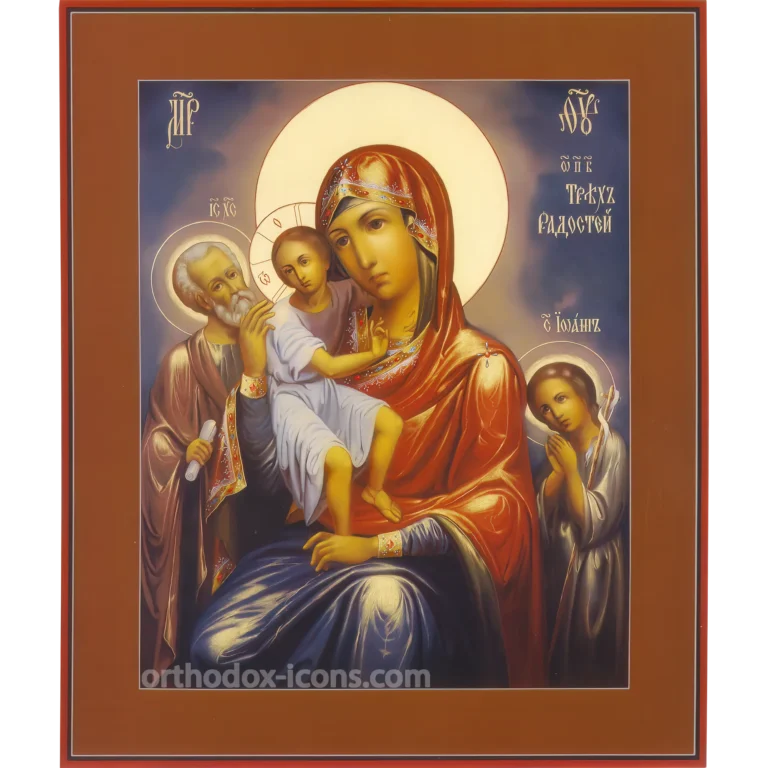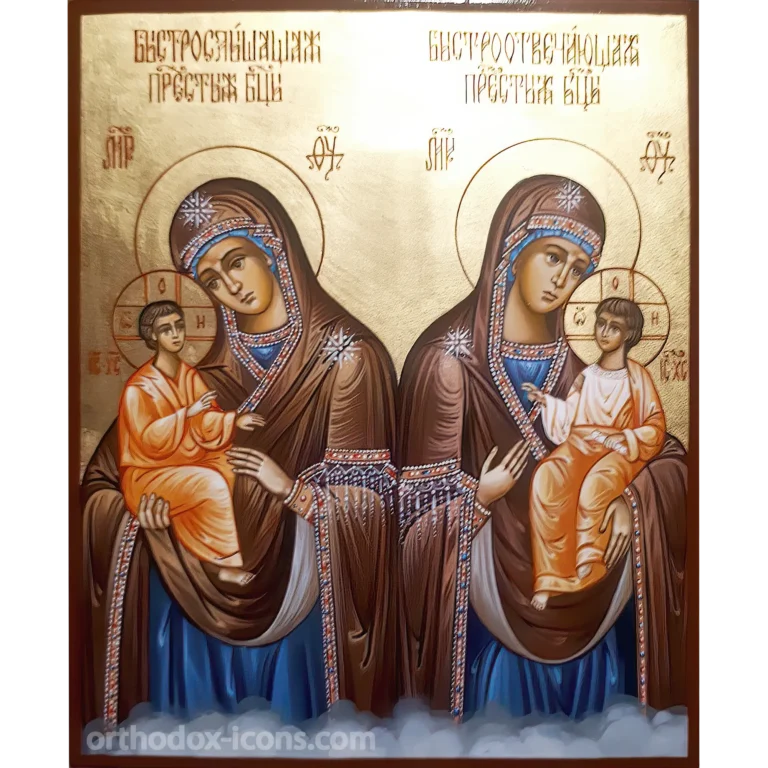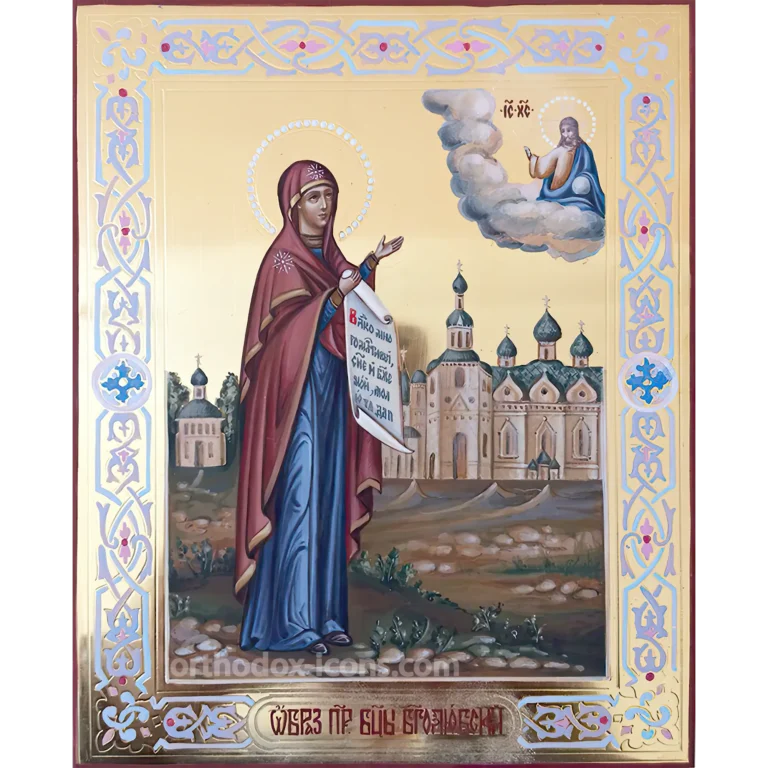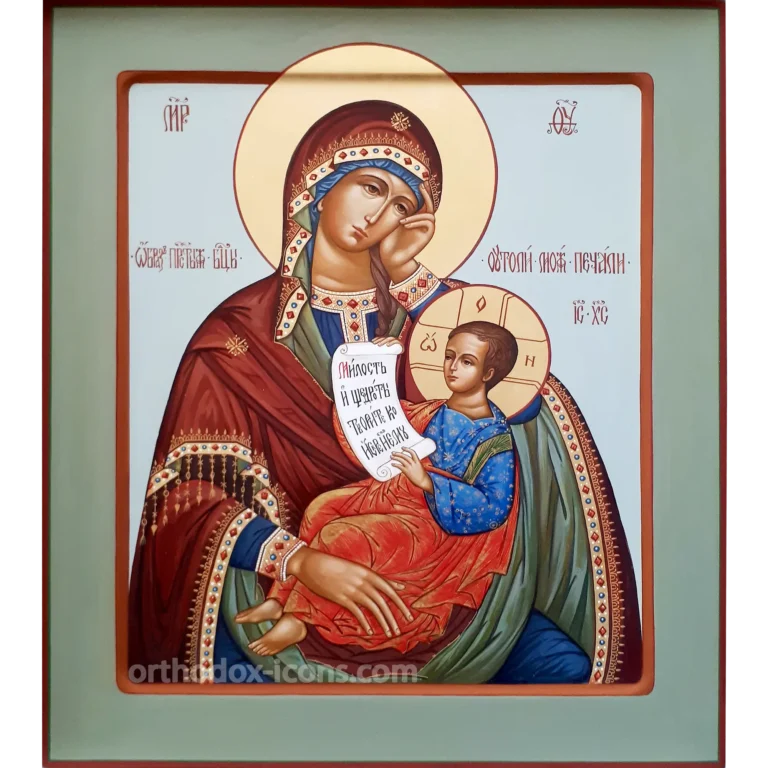
Tikhvin Icon of the Mother of God
Price range: $700 through $2250
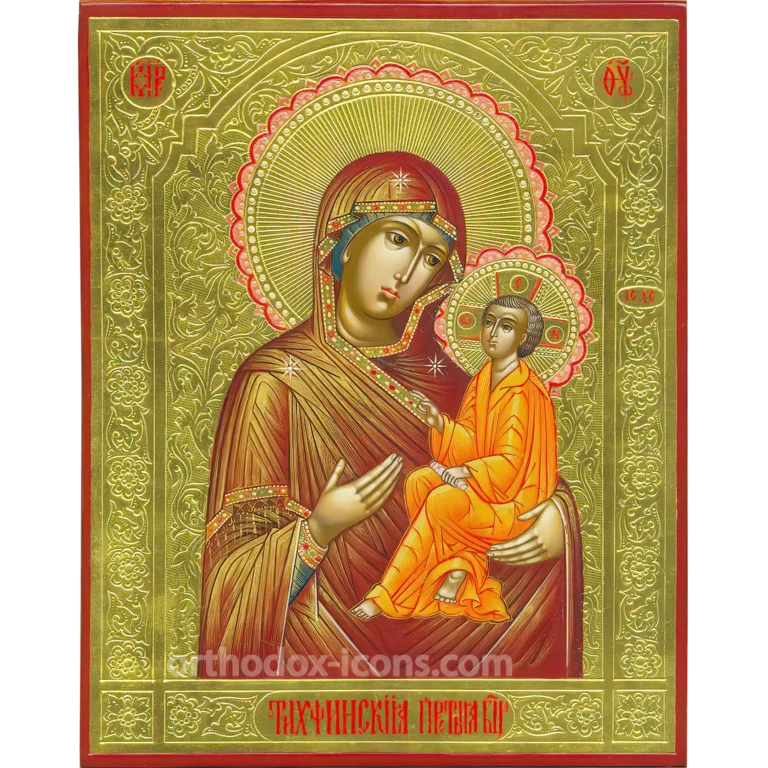
Tikhvin Icon of the Mother of God is a hand-painted Hodegetria icon, historically venerated as a protector of children, families, travelers, and those seeking healing from serious illness.
Available sizes: 17×21 cm (6.7×8.3 in), 20×24 cm (7.9×9.4 in), 27×31 cm (10.6×12.2 in), 30×40 cm (11.8×15.7 in). Larger iconostasis sizes may be discussed before painting.
Materials: linden board with oak braces, linen pavoloka, chalk levkas, 960 gold leaf, mineral egg tempera, protective finish.
Technique: hand icon painting in the Mstyora tradition, full 960 gold leaf on the background, margins, and halos, with hand relief tooling over gold.
It is possible to paint an image in any size to order
Free shipping worldwide
Tikhvin Icon of the Mother of God is a hand-painted Orthodox icon in the Hodegetria type, the Directress. Among the many icons of the Theotokos venerated in Russia, the Tikhvin icon holds an exceptional place. For centuries it has been honored as a spiritual shield of the northern lands, a protector of children, and a source of consolation in illness, family distress, and danger.
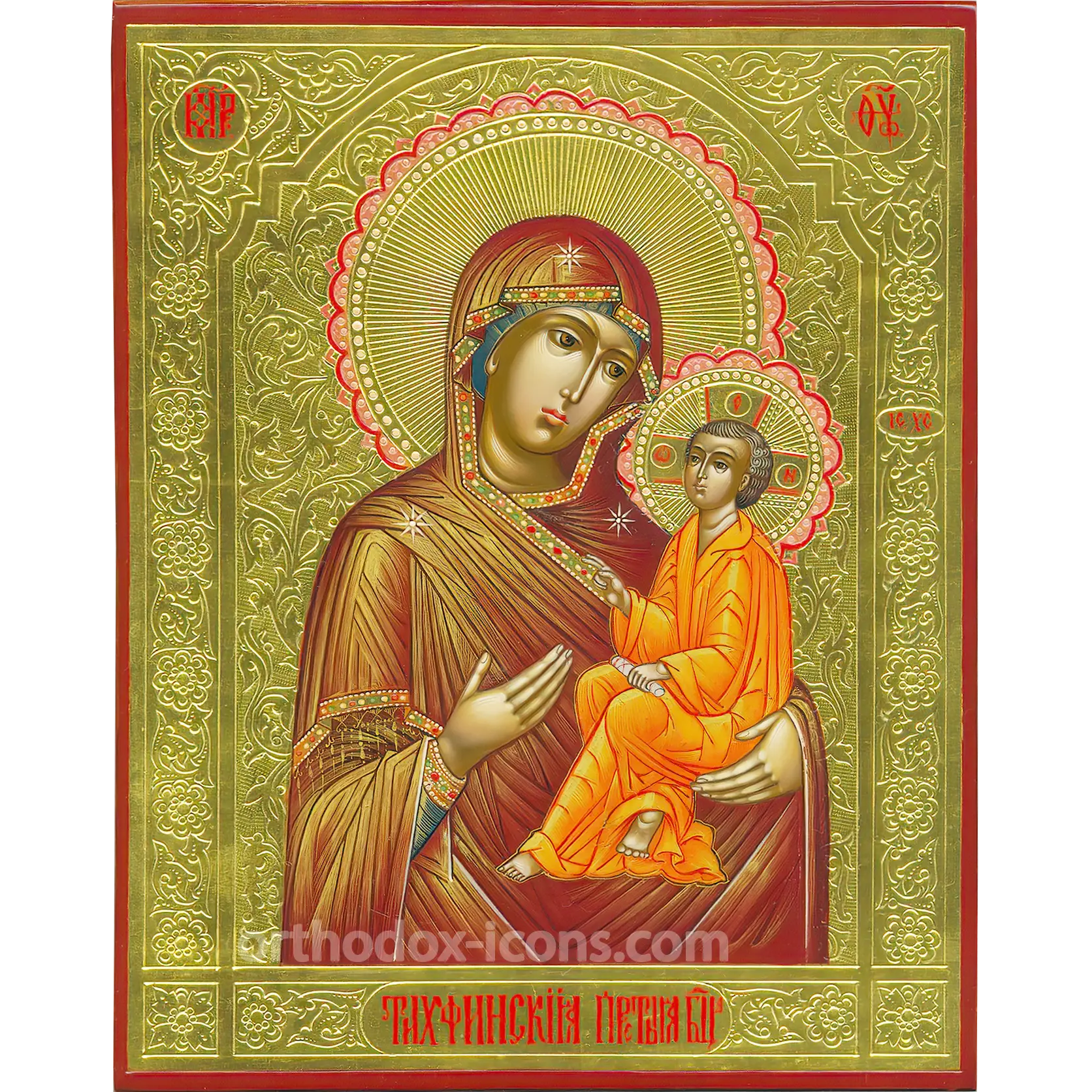
As Hodegetria, the Mother of God points the faithful toward Christ, the only true way to salvation. This icon is filled with inward stillness and royal dignity. The hand-painted version offered here combines deep theological meaning with rich Mstyora craftsmanship: the background, broad margins, and halos are covered with 960 gold leaf and decorated by hand with a relief floral ornament.
The play of light over the tooled gold gives the icon a luminous presence, while the face of the Mother of God remains calm, serious, and compassionate. It is suitable for a home icon corner, a family shrine, or a church iconostasis.
History of the Tikhvin Icon
According to pious church tradition, the prototype of the Tikhvin icon was painted by the holy Apostle and Evangelist Luke during the earthly life of the Most Holy Theotokos. The icon was first kept in Jerusalem and later, in the fifth century, was transferred to Constantinople, where the Blachernae church was built for it. There it was venerated as a protector of the Byzantine Empire.
In 1383, seventy years before the fall of Constantinople, the icon miraculously left Byzantium. Russian chronicles describe its appearance in the Novgorod lands, where it was seen moving through the air, borne by invisible angelic powers. It appeared over Lake Ladoga and near the rivers Oyat and Pasha, gathering the faithful in prayer, before finally coming to rest on the bank of the Tikhvinka River.
Churches were built one after another at the place of its appearance. They burned more than once, yet the icon remained unharmed. In 1515, by order of Grand Prince Vasily III, a stone Dormition Cathedral was founded there. In 1560, by decree of Tsar Ivan the Terrible, the Tikhvin Dormition Monastery was established at the cathedral.
The protection of the Tikhvin Mother of God was especially remembered during the Time of Troubles. In 1613 and 1614, Swedish troops repeatedly tried to destroy the monastery. When the defenders were exhausted, they intended to flee with the icon, but could not move it from its place. Taking this as a sign, they remained. Soon the enemy was seized by panic, as if seeing an enormous Russian army coming to aid the monastery, and fled.
The twentieth-century history of the icon was also dramatic. During the Second World War, the icon was taken from occupied Tikhvin to Pskov, then to Riga, then to Europe, and eventually to the United States. Archbishop John Garklavs, its guardian, instructed that the icon should return to Russia only after the Tikhvin Monastery was restored. Its return took place in 2004 and became a major celebration for the Russian Orthodox Church.
Iconography and Distinctive Detail
The Tikhvin icon belongs to the classic Byzantine Hodegetria type, yet it has its own recognizable features. The Mother of God is shown half-length, with a slight inclination of the head toward the Christ Child. With her right hand she points to the Savior, showing Him as the Way, the Truth, and the Life.
Christ sits on the left arm of the Mother of God as on a throne. In His left hand He holds a scroll, the sign of divine teaching and of Christ as the pre-eternal Word, the Logos. With His right hand He gives a blessing to His Mother and, through her, to all humanity.
The main distinguishing detail of the Tikhvin version is the position of the Child’s feet. His right leg is bent and turned beneath the left so that the bare heel or sole is visible. In theological interpretation, the visible foot emphasizes the true human nature of Christ, His vulnerability, and His future suffering on the Cross, while the golden garments witness to His divine glory.
Prayer Before the Tikhvin Icon
For centuries, the Tikhvin icon has been loved as a swift helper in the heaviest bodily and family sorrows. Its veneration is especially connected with children, healing, family peace, protection in danger, and guidance on the path of life.
- For children: people pray before the Tikhvin icon for the gift of children, safe pregnancy, easy childbirth, healing of infants, calm sleep, and the guidance of difficult teenagers.
- For healing: the icon is approached in serious illnesses, disorders of movement, paralysis, joint diseases, blindness, eye disease, neurological suffering, depression, and panic.
- For the family: as Hodegetria, the Mother of God is asked to guide spouses out of conflict and return peace, love, and understanding to the home.
- For protection in war and travel: remembering the history of the Tikhvin Monastery, the faithful pray for soldiers, the homeland, travelers, and those far from home.
Mstyora Craftsmanship: Gold Leaf and Relief Tooling
This hand-painted Tikhvin icon is made in the Mstyora tradition, using natural materials and careful old techniques. The foundation is a solid linden board. Linden has a soft, even structure well suited to icon painting. Oak braces are inserted into the back of the board to help prevent warping caused by changes in humidity.
The front is covered with linen pavoloka, which strengthens the surface, and then with ten to fifteen layers of hot chalk levkas. After drying, the levkas is polished by hand until it becomes smooth and dense, ready for gilding and painting.
The background, wide margins, and halos are covered with genuine 960 gold leaf. After the gold is fixed, the master works the relief ornament by hand with special tools, pressing a floral pattern into the gilded surface. The ornament catches light from different angles, making the icon appear to glow from within. Real high-purity gold does not oxidize, turn green, or lose its brightness in ordinary air.
The faces and garments are painted in mineral egg tempera. Natural minerals such as lapis tones, malachite, glauconite, cinnabar, and ochres are finely ground and mixed with egg yolk. Tempera gives the icon a deep, velvety surface and a remarkable resistance to fading.
Characteristics of the Hand-Painted Icon
| Icon name | Tikhvin Icon of the Mother of God |
|---|---|
| Iconographic type | Hodegetria, the Directress |
| Gilding | Full 960 gold leaf on the background, margins, and halos |
| Decoration | Hand relief tooling over gold with floral ornament |
| Painting technique | Natural mineral tempera on egg yolk |
| Board | Solid linden board, linen pavoloka, chalk levkas, oak braces |
| Available sizes | 17×21 cm (6.7×8.3 in), 20×24 cm (7.9×9.4 in), 27×31 cm (10.6×12.2 in), 30×40 cm (11.8×15.7 in) |
| Larger sizes | Iconostasis formats may be discussed before painting |
| Shipping | Free international shipping is included; payment is due upon delivery. |
Questions and Answers
What does the name Tikhvin Icon mean?
The icon received its name in 1383 from the place of its miraculous appearance. After appearing above the Novgorod lands, the icon finally came to rest near the Tikhvinka River, where the town of Tikhvin and the Tikhvin Dormition Monastery later arose.
Why is the Tikhvin Icon often called a children’s icon?
Many traditions of prayer before the Tikhvin icon are connected with children. The Mother of God is asked for the gift of children, safe pregnancy and childbirth, healing of infants, calm sleep, and guidance for troubled or restless children.
What is the main distinguishing detail of the Tikhvin icon?
A distinctive feature of the Tikhvin version is the position of the Christ Child’s legs. His right foot is bent and turned under the left so that the bare heel or sole is visible. This points to His true human nature and His future suffering on the Cross.
What help is traditionally sought before the Tikhvin Icon?
In addition to prayers for children, the icon is approached for healing from serious illnesses, paralysis, epilepsy, blindness, joint diseases, neurological suffering, family conflict, protection of soldiers, and safe travel.
When is the feast day of the Tikhvin Icon?
The Orthodox Church celebrates the Tikhvin Icon of the Mother of God on July 9 according to the civil calendar, June 26 according to the old calendar, remembering its miraculous appearance near the Tikhvinka River in 1383.
How is the relief ornament on the gold made?
After the levkas surface is covered with genuine gold leaf, the master uses special metal tools to press a relief pattern into the gilded surface without cutting through the gold. This work makes the gold shimmer as light moves across it.
Will the gold leaf darken over time?
No. The icon is decorated with genuine 960 gold leaf, not imitation metal leaf made from brass or copper. Real high-purity gold does not oxidize, blacken, or lose its brightness in ordinary air when properly cared for.
Why are oak braces inserted into the linden board?
Linden is a natural material that reacts to humidity and temperature. Oak braces inserted into the back of the board serve as a firm stabilizing frame, helping the icon remain flat and protecting the painting from stress.
What is mineral egg tempera?
Mineral egg tempera is the traditional paint medium of Orthodox iconography. Natural mineral pigments are ground into powder and mixed with egg yolk. The result is a durable, velvety paint layer that can keep its color for centuries.
What sizes are available?
The icon can be ordered in 17×21 cm, 20×24 cm, 27×31 cm, and 30×40 cm, with larger monumental and iconostasis sizes available by agreement before painting.
| Dimensions | 17x21cm (6.7×8.3 in), 20x24cm (7.9×9.4 in), 27x31cm (10.6×12.2 in), 30x40cm (11.8×15.7 in) |
|---|---|
| Name | Mary |