Theotokos of Port Arthur Icon
$3750
Available size: 30×50 cm (11.8×19.7 in).
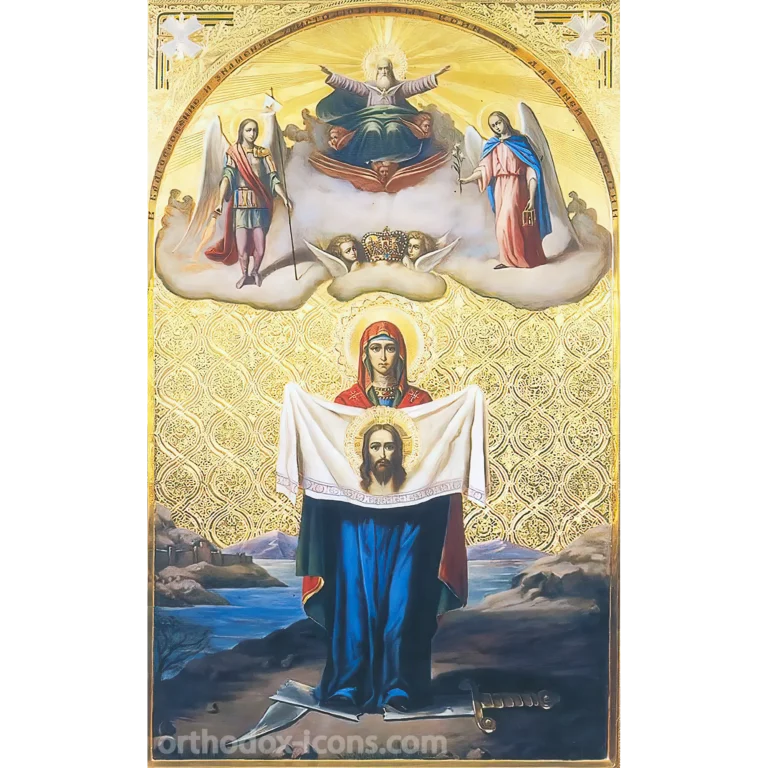
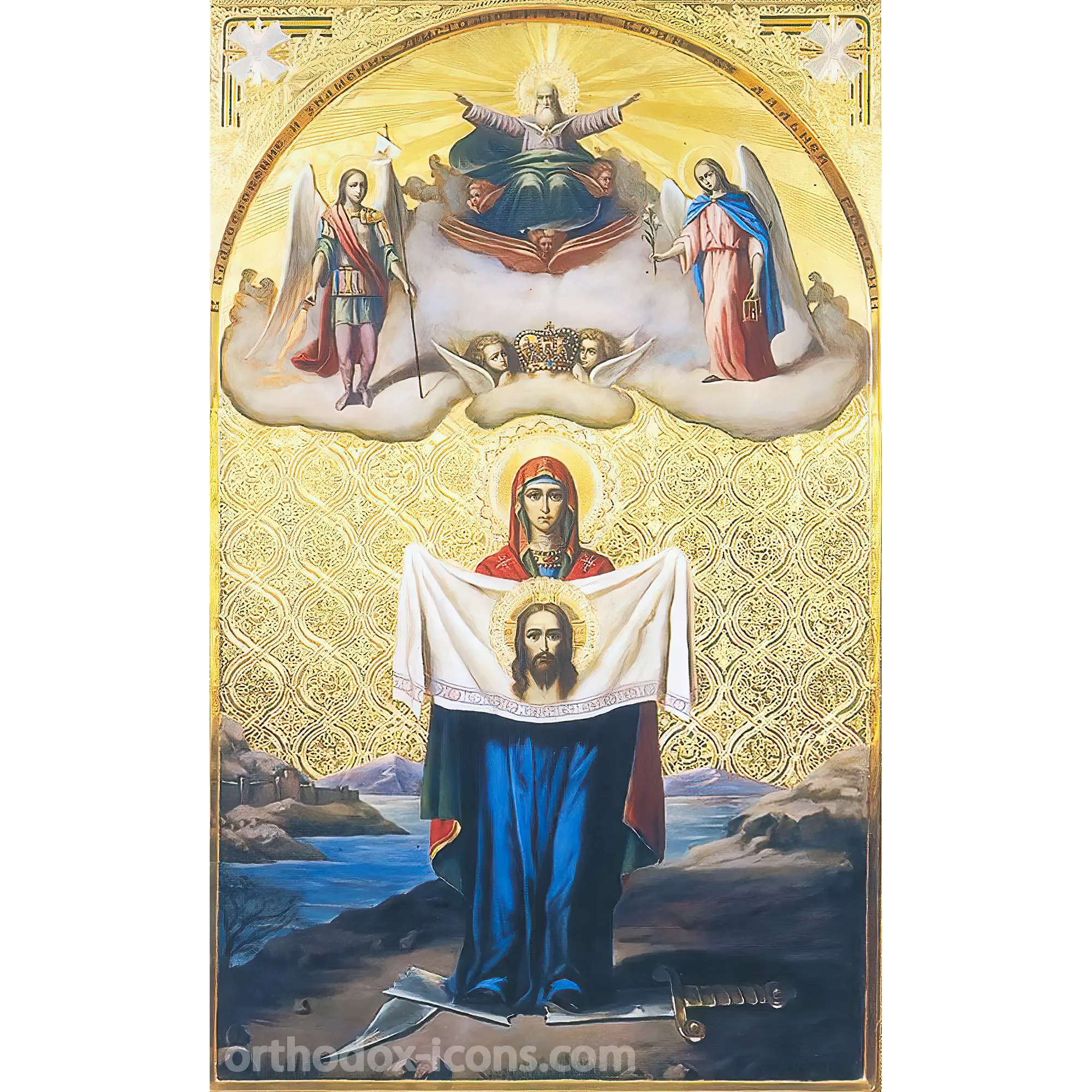
The Theotokos of Port Arthur Icon, also known in Russian tradition as the Triumph of the Most Holy Theotokos, is a rare and highly complex Mother of God icon connected with the Russo-Japanese War and the defense of Port Arthur. The Theotokos is shown full-length, holding the Holy Face of Christ on a white cloth, while broken double-edged swords lie beneath her feet. Above her are God the Father, Archangel Michael, Archangel Gabriel, angels, and an imperial crown. This hand-painted icon is made on a linden board with linen, natural gesso, mineral egg tempera, and 23K gold leaf with a finely tooled geometric gold background. Free international shipping is included; payment is due upon delivery.
It is possible to paint an image in any size to order
Free shipping worldwide
Among the holy images of the Orthodox Church, the Theotokos of Port Arthur Icon holds a very special place. In Russian tradition it is also known as the Triumph of the Most Holy Theotokos. Its history is connected with the anxious beginning of the twentieth century, the Russo-Japanese War of 1904-1905, the defense of Port Arthur, and the fate of the Russian fleet. The icon carries both a warning about suffering and a prayerful promise of mercy, protection, and help from the Mother of God.
This hand-painted icon is a demanding work of Mstyora icon painting. The composition is large, multi-figured, and unusually rich in theological and historical detail. It combines an academic manner of painting with traditional Orthodox materials, gold leaf, and hand-tooled ornament. The icon is intended not as a printed reproduction, but as a serious devotional image for prayer, remembrance, and long-term use in a home, chapel, military church, or iconostasis setting.
Theotokos of Port Arthur Icon – Historical Background
The story of the Port Arthur Icon begins in December 1903, about two months before the beginning of the Russo-Japanese War. The events are connected with the Kiev Caves Lavra and an elderly pilgrim from Bessarabia, the retired sailor Theodore. In his youth he had taken part in the defense of Sevastopol during the Crimean War of 1854-1855.
According to tradition, Theodore received a striking vision during the night. The Most Holy Theotokos appeared to him in a majestic and unusual form. She stood by the shore of a sea bay, holding in her hands a white cloth with the Holy Face of Christ. Her feet stood upon naked double-edged swords. Above her, in heavenly glory, God the Father was enthroned, while Archangel Michael and Archangel Gabriel appeared in the clouds.
The Mother of God revealed that a difficult and bloody war would soon begin and that great sorrow would come on the distant shores of the sea. She commanded Theodore to find the means to have an icon painted exactly as she had appeared and to send the image to the fortress of Port Arthur in the Far East. The promise was that when the icon reached the church in Port Arthur, protection and victory would be granted to the soldiers.
The old sailor told the monks of the Lavra about the vision. Soon afterward, in February 1904, the Japanese fleet attacked Russian ships at Port Arthur, and the prophetic character of the vision became clear to many believers.
The Journey of the Icon
The first Port Arthur Icon was painted by the Kiev artist Pavel Shtronda with funds gathered from the faithful. It was solemnly blessed and sent first to Saint Petersburg, then onward toward the Far East. Empress Maria Feodorovna supported the sending of the icon, and Admiral Nikolai Skrydlov undertook to deliver the holy image to the besieged fortress.
The journey, however, was extremely difficult. Because Port Arthur was blockaded by sea and land, the icon remained for a long time in Vladivostok. In November 1904 an attempt was made to send it to the fortress on a Norwegian steamship, but a severe storm and the actions of the Japanese fleet forced the ship to turn back. The icon never reached Port Arthur before the fortress was surrendered on December 20, 1904 according to the old calendar.
After the war, the traces of the original icon were lost for many decades. Nearly a century later, in 1998, the image was found in an antique shop in Jerusalem and purchased by Russian pilgrims. In May 1998 the Port Arthur Icon returned solemnly to Vladivostok, where it has remained an important holy image connected with the Far Eastern borders and the memory of those who served there.
Iconography of the Theotokos of Port Arthur Icon
The Port Arthur Icon is a rare iconographic type without a direct ordinary parallel in Orthodox tradition. Art historians often connect its style with Russian romantic religious painting of the late nineteenth and early twentieth centuries, close in spirit to the work of Viktor Vasnetsov. The composition also recalls the Western theme of the veil with the face of Christ, but here the cloth is held not by an ordinary woman, but by the Queen of Heaven herself.
The image has a strongly Trinitarian and military character. The composition is divided visually into an earthly lower tier and a heavenly upper tier.
The Lower Tier
In the center stands the Most Holy Theotokos, shown full-length in a blue chiton and a brown-red maphorion. With both hands she holds wide open a white cloth, or ubrus, bearing the Holy Face of Christ. The face of the Savior is calm and majestic. Beneath the feet of the Virgin Mary lie crossed and broken double-edged swords. They symbolize the ending of bloodshed, the defeat of hostile power, and the triumph of divine help over violence.
Behind the Theotokos opens the landscape of Port Arthur: cold waters of the bay, rocky shores, and the outlines of fortress defenses. This landscape grounds the icon in a particular historical moment, while the presence of the Theotokos and the Holy Face of Christ lifts that history into prayer.
The Heavenly Tier
In the upper part of the icon, God the Father is shown enthroned in radiant golden light upon clouds. His hands are extended in blessing, and seraphim appear beneath him. To one side stands Archangel Michael, the leader of the heavenly hosts, holding a spear. To the other side stands Archangel Gabriel, the messenger of divine mysteries, with a branch and a lantern.
Above the head of the Theotokos, two angels hold an imperial crown crowned with a cross. In the original Russian interpretation, this crown speaks of blessing and protection over the state and those who defend it. For an English-speaking Orthodox reader, the same detail may also be understood as a sign that earthly authority and military strength remain dependent on God.
Gold Background and Painting Style
The gold background of this hand-painted version deserves special attention. The central field is richly covered with 23K gold leaf. A fine geometric pattern is tooled by hand into the prepared ground beneath the gilding, creating a woven, carpet-like ornament. The gold is not merely decorative. In Orthodox iconography it points toward divine light, heavenly glory, and the reality of the Kingdom of God.
The faces and garments are painted in a soft academic manner, with careful tonal transitions and expressive modeling. This style is especially fitting for the Port Arthur composition, where historical narrative, heavenly vision, and military symbolism are all present at once.
Prayer and Devotional Meaning
Historically, the Port Arthur Icon has been especially loved as an image of protection for soldiers, sailors, and those serving far from home. Families pray before it for the safety of sons, husbands, fathers, and brothers in military or naval service. It is also a fitting icon for military chapels, veterans, officers, and families whose lives are connected with service, defense, and sacrifice.
The icon is also associated with prayers for peace, courage, and the strengthening of faith in times of trial. The broken swords under the feet of the Theotokos speak not of aggression, but of the hope that warfare, fear, and destructive force may be overcome by divine mercy. The person standing before this icon sees the Mother of God presenting the face of Christ as the true center of protection and consolation.
In a home or chapel, the Theotokos of Port Arthur Icon can become a strong prayer image for the protection of the family, the remembrance of those who serve, and the strengthening of the heart against fear, despondency, and despair.
How This Icon Is Made
The icon is painted on a carefully prepared linden board. The back of the board is strengthened with inserted oak braces to help prevent warping. Linen is applied to the front surface, and a natural chalk gesso ground is built up and polished until it is smooth and stable.
Before gilding, the ornament of the background is worked by hand with special tools. The surface is then covered with 23K gold leaf and polished with an agate burnisher. This gives the gold its deep, noble shine and allows the tooled pattern to catch the light beautifully.
The painting itself is made with mineral egg tempera, using natural pigments on an egg emulsion. The academic character of the image requires precise brushwork, especially in the faces, the folds of the garments, the angelic figures, and the landscape of Port Arthur. When complete, the icon is protected with natural oil varnish, which preserves the paint layer and deepens the colors.
Size and Ordering
The listed size for this icon is 30×50 cm (11.8×19.7 in). Because the composition is complex and includes many figures and details, this is a suitable large format for a home icon corner, study, chapel, or meaningful gift. Larger formats, including 40×60 cm (15.7×23.6 in), 60×80 cm (23.6×31.5 in), and church or iconostasis sizes, can be discussed individually before work begins.
Free international shipping is included; payment is due upon delivery.
Icon Characteristics
| Feature | Description |
|---|---|
| Iconographic type | Theotokos of Port Arthur, also known as the Triumph of the Most Holy Theotokos |
| Composition | Full-length Theotokos holding the Holy Face of Christ, broken swords below, God the Father and archangels above |
| Painting style | Academic Russian icon painting with layered hand painting |
| Board | Linden wood with linen, natural gesso, and inserted oak braces |
| Painting materials | Mineral egg tempera with natural pigments |
| Gold | 23K gold leaf on the background and halos |
| Gold ornament | Hand-tooled geometric pattern in the gilded background |
| Available size | 30×50 cm (11.8×19.7 in) |
| Recommended use | Prayer for protection, soldiers and sailors, family devotion, chapel or church setting |
The Theotokos of Port Arthur Icon is a solemn hand-painted image of faith, courage, remembrance, and hope. It gathers together the Mother of God, the Holy Face of Christ, the heavenly powers, and the memory of a difficult historical trial, offering a powerful Orthodox image for prayer and protection.
Questions and Answers
What makes the Theotokos of Port Arthur Icon unusual?
It is a unique Orthodox iconographic composition. The Mother of God is not shown holding the Christ Child, but holding the Holy Face of Christ on a white cloth, with broken swords beneath her feet and a heavenly tier above her.
Why is it called the Port Arthur Icon?
The name comes from the vision connected with Port Arthur shortly before the Russo-Japanese War of 1904-1905. According to tradition, the icon was to be sent to the fortress of Port Arthur as a sign of protection.
What does the white cloth with the face of Christ mean?
The cloth bears the Holy Face of Christ, also known as the Image Not Made by Hands. In this icon the Theotokos presents the face of the Savior as the central source of hope and divine help.
What do the broken swords under the feet of the Theotokos symbolize?
The broken double-edged swords symbolize the defeat of hostile force, the ending of bloodshed, and the prayerful hope for peace and protection.
Who is shown in the upper part of the icon?
The upper heavenly tier shows God the Father in radiant light, with Archangel Michael, Archangel Gabriel, angels, and a crown above the head of the Mother of God.
What is the historical background of this icon?
The history is connected with an elderly retired sailor named Theodore, who received a vision in the Kiev Caves Lavra in December 1903, shortly before the war began.
What materials are used for this hand-painted icon?
The icon is painted on a linden board prepared with linen and natural gesso. The painting is made with mineral egg tempera, and the gold areas are finished with 23K gold leaf.
Why is a large size recommended for this icon?
The composition includes many figures and details: the Theotokos, the Holy Face, God the Father, archangels, angels, swords, and the Port Arthur landscape. A larger board allows these elements to be painted clearly.
What size is listed for this icon?
The listed size is 30×50 cm (11.8×19.7 in). Larger church, chapel, and iconostasis sizes can be discussed individually before the icon is painted.
Do you ship internationally?
Yes. Free international shipping is included, and payment is due upon delivery.
| Dimensions | 30x50cm (11.8×19.7 in) |
|---|---|
| Name | Mary |