Julia of Carthage Orthodox Icon
$1000
Available size: 18×31 cm (7.1×12.2 in)
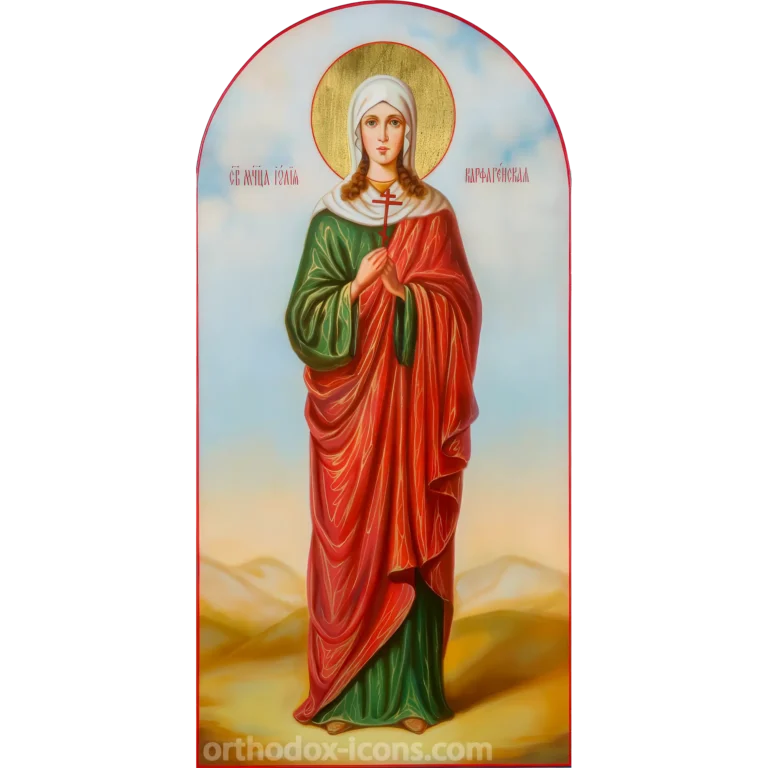
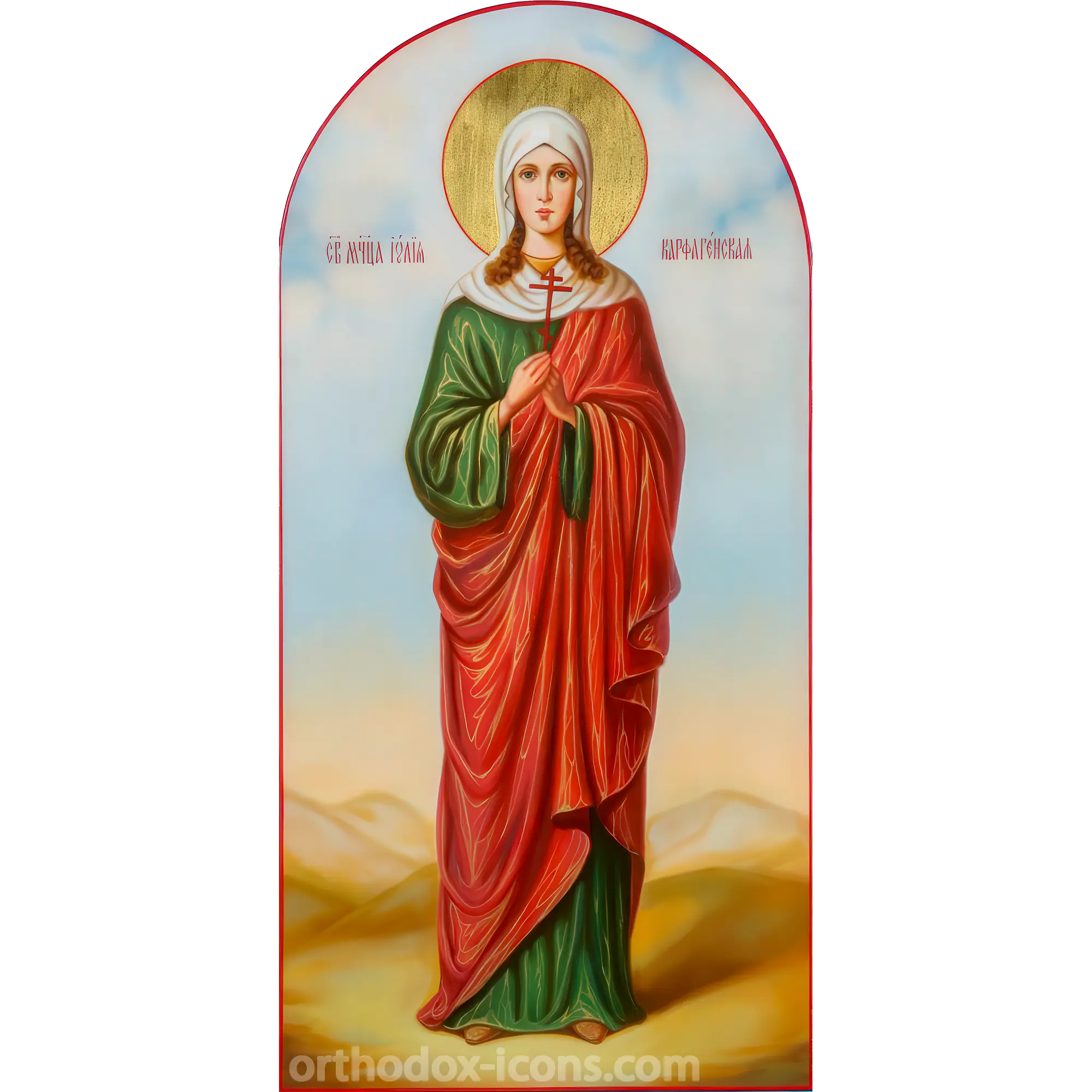
Julia of Carthage Orthodox Icon is a hand-painted full-length image of the holy early Christian martyr, also venerated as Saint Julia of Corsica. The saint is shown in a red maphorion, green tunic, and white head covering, holding the martyr’s cross close to her chest.
The golden halo, soft heavenly background, desert landscape, and calm face emphasize her purity, firmness of faith, and willingness to remain faithful to Christ even before suffering. The elongated vertical format suits the full-length image and keeps the figure, cross, halo, inscriptions, and garments readable.
This icon is suitable as a patron saint icon for women and girls named Julia or Iulia, for baptism, nameday, birthday, home prayer, a chapel, or a church. Free international shipping is included. Payment is made after you receive and approve the icon.
It is possible to paint an image in any size to order
Free shipping worldwide
Julia of Carthage Orthodox Icon is a hand-painted full-length image of the holy early Christian martyr, glorified for firmness of faith, chastity, and courageous confession of Christ. In the Orthodox tradition, she is also venerated as Saint Julia of Corsica, because her martyrdom is connected with the island of Corsica. On the presented icon, Saint Julia is shown standing full-length, holding the martyr’s cross near her chest, wearing a red maphorion, green tunic, and white head covering.
The image is calm, strict, and luminous. It does not focus on outward drama, yet it clearly conveys the saint’s inner resolve. The elongated vertical format is well suited to the full-length image of the holy martyr. The available size, 18×31 cm (7.1×12.2 in), preserves the slender figure, expressive face, fine lines of the hands, folds of the garments, golden halo, and Church Slavonic inscriptions.
This icon is especially appropriate as a patron saint icon for women and girls named Julia or Iulia. It may be ordered for baptism, nameday, birthday, wedding, the beginning of independent life, an important spiritual stage, or as a family blessing. The image of Saint Julia reminds the faithful of loyalty to Christ, purity of heart, and the ability to preserve dignity when circumstances require courage and inward steadiness.
Features of the Presented Icon
On this icon, the holy martyr Julia of Carthage is shown full-length. The composition is frontal and symmetrical: the figure of the saint stands at the center, and her gesture and gaze direct attention toward the prayerful meaning of the image. Julia holds the martyr’s cross before her, the chief sign of her confession of faith and willingness to suffer for Christ.
The upper part of the icon has an arched form. This shape softens the silhouette and suits the full-length image of the saint. A fine red border completes the composition, while the quiet light background with gentle heavenly tones creates a space of silence and prayerful standing.
The saint is painted in a green tunic and red maphorion. In icon painting, green is often associated with life, spiritual renewal, hope, and steadfastness of soul. The red maphorion recalls martyrdom, fervent faith, and love for Christ stronger than fear. The white head covering emphasizes purity, chastity, and inner collectedness.
The golden halo around the saint’s head signifies her glorification in the Kingdom of Heaven. It does not overload the image, but makes the face the compositional center. A fine red line around the halo creates a clear boundary and echoes the red maphorion and border of the icon. Church Slavonic inscriptions near the halo identify the saint as the martyr Julia of Carthage.
In the lower part of the icon, a soft desert landscape with warm hills is shown. This background helps convey the sense of a long path, exile, and witness far from one’s homeland. For the life of Saint Julia, this detail is especially expressive: her earthly path was connected with captivity, service in a foreign land, and martyrly witness among people of another faith.
Who This Icon of Saint Julia Is For
The icon of Saint Julia of Carthage is first of all suitable for women and girls named Julia or Iulia. It is a patron saint icon that may be given for baptism, nameday, birthday, graduation, marriage, or another important event. For a girl, such an icon can become the first personal image of her heavenly patroness, to whom she can turn in prayer from childhood.
For an adult woman, the image of Saint Julia may become a prayerful support in circumstances requiring patience, faithfulness to conscience, the ability to resist pressure, and preservation of inner purity. The life of the saint is especially close to those who experience loneliness, change, distance from home, unfair treatment, or a difficult moral choice.
The icon is also appropriate for a family icon corner when there is a woman named Julia in the household, as well as for a monastic space, chapel, or church. In a larger format, the image may be painted as part of a row of holy women, patron saint icons, or as a separate church icon. The tall vertical composition works well in a kiot, on an analogion, or in a dedicated prayer place.
This icon is also a meaningful gift from parents to a daughter, from godparents to a goddaughter, from a husband to his wife, or from a family to a loved one. It speaks not only of patron saint protection, but also of the spiritual dignity of a woman: faithfulness, purity, quiet strength, and the refusal to abandon truth.
Prayers Before the Icon of Julia of Carthage
Before the icon of the holy martyr Julia of Carthage, Orthodox Christians pray for strengthening of faith, patience in trials, preservation of chastity, inward steadiness, and protection from coercion into sin. Her martyrdom is connected with faithfulness to Christ in a foreign and hostile environment, so people turn to her when it is difficult to preserve oneself, one’s convictions, and spiritual peace.
Saint Julia is asked for prayerful help in strengthening Orthodox faith; patience in sorrow, loneliness, and difficult circumstances; preservation of purity of heart and chastity; protection from humiliation, coercion, and unjust pressure; help for girls and women in difficult moral choices; courage before slander, mockery, and misunderstanding; spiritual firmness far from home and loved ones; and heavenly patronage for women named Julia or Iulia.
Prayer before the image of Saint Julia should not be understood as an expectation of an instant outward solution to every problem. Her life teaches something deeper: even under outward constraint, a person can preserve inner freedom in Christ. She is honored as a martyr who did not betray the faith, did not yield to coercion, and showed that true human dignity is founded not on external status, but on faithfulness to God.
Brief Life of Saint Julia of Carthage
The holy martyr Julia came from Carthage. According to tradition, after the conquest of the city she was taken captive and sold into slavery. Despite outward humiliation and the loss of her former freedom, Julia preserved the Christian faith, purity of life, and meekness. She fulfilled her duties honestly and patiently, yet remained inwardly free because she belonged to Christ.
Later, Julia came to Corsica with her pagan master. During a pagan festival, she was pressured to take part in idol worship and renounce the Christian faith. The saint refused. For her, participation in pagan worship was not an empty formality, but betrayal of Christ. This faithfulness became the cause of her martyrly suffering.
According to the traditional account, the saint was tortured, but she did not turn away from Christ. Her death became a witness that a captive woman, outwardly powerless, was spiritually stronger than those who tried to break her will. For this reason, she holds a cross on the icon: the sign of Christ’s victory and the sign of her own martyrly witness.
The Church honors Saint Julia as a martyr who preserved faithfulness to God in captivity, exile, and violence. Her image is especially meaningful for modern people because it reminds us that the freedom of the soul cannot be destroyed by external pressure when the heart remains faithful to Christ.
Feast Day and Patron Saint Meaning
The memory of the holy martyr Julia of Carthage, also called Julia of Corsica, is commemorated in the Orthodox tradition on July 29 according to the modern calendar. This date may be the nameday for women baptized with the name Julia or Iulia if this saint is chosen as their heavenly patroness.
A patron saint icon of Saint Julia helps a person remember her heavenly intercessor not only on the nameday, but also in daily prayer. The image reminds the believer that a Christian name is connected with a concrete example of holiness. For the name Julia, that example may be the martyr who preserved purity, faith, and dignity in very difficult circumstances.
If the icon is ordered for baptism, nameday, or a family date, it is wise to choose the size and format in advance. The 18×31 cm size is suitable for personal prayer, while a larger version may be chosen for a spacious home icon corner, chapel, or church. Iconostasis formats are discussed separately, taking into account the place of installation and the surrounding icons.
Iconography: Cross, White Head Covering, and Red Garment
The cross in Saint Julia’s hands is the main iconographic sign of her martyrdom. It shows that the saint was victorious not by earthly force, but by faithfulness to Christ. In the hands of a martyr, the cross is a confession: she accepts suffering not from stubbornness or pride, but from love for God and refusal to deny the truth.
The white head covering emphasizes purity and chastity. This detail is especially important in the iconography of women martyrs: it speaks of collectedness, modesty, inner clarity, and dedication to God. The white color is also connected with spiritual light that cannot be extinguished by outward circumstances.
The red maphorion reveals the theme of martyrdom. In icon painting, red can point to blood, sacrifice, fervent faith, and the triumph of life over death. On this icon, the red maphorion surrounds the figure of the saint, creating an expressive silhouette and strengthening the meaning of her confession.
The green tunic balances the red. It brings into the image the motif of hope, spiritual life, and inner renewal. Together, red and green create a strong but not harsh color harmony: the saint’s struggle is shown not as tragedy for its own sake, but as a path toward life in Christ.
The soft heavenly background and hilly ground make the icon luminous and contemplative. They help avoid excessive harshness in the perception of a martyr image. The person praying sees not a scene of suffering, but a glorified saint who now stands in the heavenly peace and intercedes before God.
Materials, Gilding, and Custom Options
The icon of Saint Julia of Carthage is painted on a wooden panel. A prepared board strengthened with splines is used for the hand-painted icon. Natural chalk gesso is applied under the painting; this traditional icon ground creates an even surface for egg tempera.
The image is painted in egg tempera. This technique allows the iconographer to render the transparent light background, soft transitions in the face, red maphorion, green tunic, white head covering, fine lines of the hands, martyr’s cross, ground, Church Slavonic inscriptions, and golden halo. In the presented version, gold leaf is used on the halo, emphasizing the saint’s glorification and the spiritual center of the composition.
For an individual order, the size, upper shape, background tone, degree of gilding, inscriptions, kiot, home icon corner format, or larger church version may be discussed. For iconostasis formats, the board proportions, height of the figure, color solution, visibility of the face from a distance, and relationship with neighboring icons are selected separately.
Choosing the Size of the Icon
The 18×31 cm (7.1×12.2 in) size is a convenient elongated format for the full-length image of the saint. It suits a home icon corner, personal prayer shelf, study, monastic cell, or nameday gift. In this size, the figure of the saint, cross, halo, main colors of the garments, and inscriptions remain readable.
A larger size may be chosen when it is important to show the face, hands, folds of the red maphorion, green tunic, heavenly background, and landscape in greater detail. A larger image looks more solemn and is better suited to a spacious home prayer place, chapel, monastic room, or church.
Iconostasis formats are made by individual agreement. In that case, it is important to determine in advance where the icon will be placed: in a separate kiot, in a row of holy women, on an analogion, or in a church space. Proportions, level of detail, inscriptions, gilding, and overall color are selected accordingly.
Blessing and Care for a Hand-Painted Icon
The icon of the holy martyr Julia of Carthage may be blessed in an Orthodox church after it is received. Once blessed, the image is intended for prayer, thanksgiving, and turning to God through the intercession of the saint.
A hand-painted icon should be placed away from direct sunlight, heaters, dampness, soot, and sudden temperature changes. The surface should not be wiped with wet tissues, alcohol, household chemicals, or rough cloth. The face, hands, cross, golden halo, and inscriptions require especially careful handling.
Dust is best removed with a dry soft brush or dry soft cloth, without pressure. For additional protection, a wooden glazed kiot may be ordered. It helps preserve the icon from accidental touch, dust, moisture, mechanical damage, and environmental exposure.
Questions and Answers
Who is shown on the icon of Julia of Carthage?
The icon shows the holy martyr Julia of Carthage, also venerated as Julia of Corsica. She is honored for her firm confession of Christ and martyrly witness.
Why is Saint Julia called both Carthaginian and Corsican?
She is called Carthaginian because of her origin, and Corsican because her martyrdom is traditionally connected with the island of Corsica. Both names refer to the same saint.
What do Orthodox Christians pray for before Saint Julia’s icon?
People ask Saint Julia for strengthening of faith, patience in trials, chastity, protection from coercion, and help in difficult moral circumstances.
Who is this icon suitable for?
The icon is suitable for women and girls named Julia or Iulia, for baptism, nameday, birthday, a home icon corner, chapel, or church.
When is the feast day of Saint Julia of Carthage?
In the Orthodox tradition, the memory of the holy martyr Julia of Carthage is commemorated on July 29 according to the modern calendar.
What does the cross in Saint Julia’s hands mean?
The cross points to her martyrdom and faithfulness to Christ. It is a sign of confession, spiritual victory, and courage before fear.
Why is Saint Julia shown in a red maphorion?
The red maphorion recalls sacrifice, fervent faith, and the martyr’s willingness to suffer for Christ.
What size is available for this icon?
The listed size is 18×31 cm (7.1×12.2 in). Larger and iconostasis formats may be discussed individually.
Can this icon be ordered for a church?
Yes. The icon may be made in a larger or iconostasis format for a church, chapel, or row of holy women. Size, inscriptions, gilding, kiot, and color solution can be discussed.
How should a hand-painted icon be cared for?
Keep the icon away from moisture, direct sunlight, overheating, soot, and mechanical damage. Dust should be removed with a dry soft brush or cloth, without pressure.
| Dimensions | 18x31cm (7.1×12.2 in) |
|---|---|
| Name | Julia |