The Weeping Virgin Orthodox Icon
Price range: $600 through $1500
Available sizes: 17×21 cm (6.7×8.3 in), 20×24 cm (7.9×9.4 in), 27×31 cm (10.6×12.2 in), 30×40 cm (11.8×15.7 in).
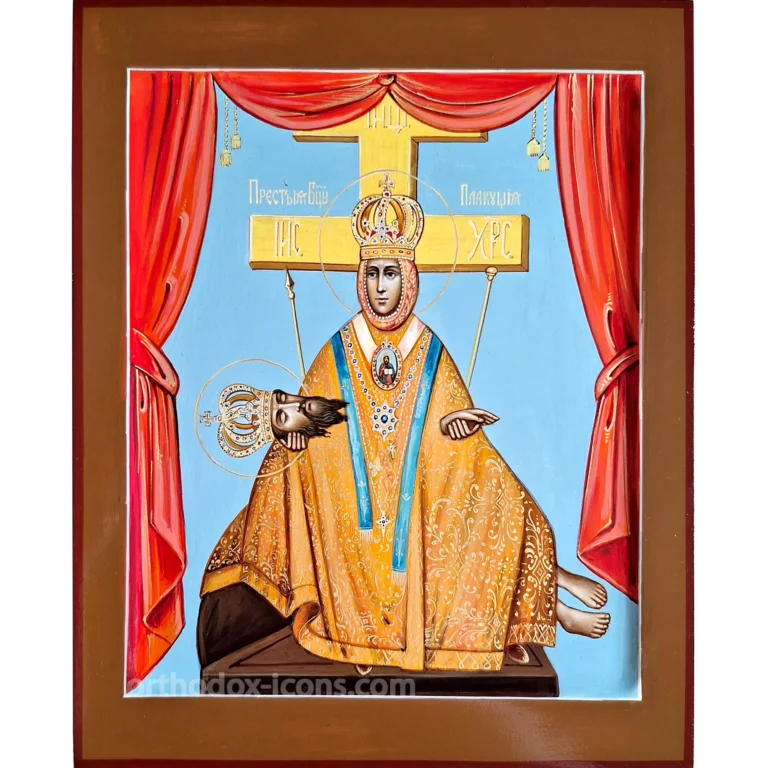
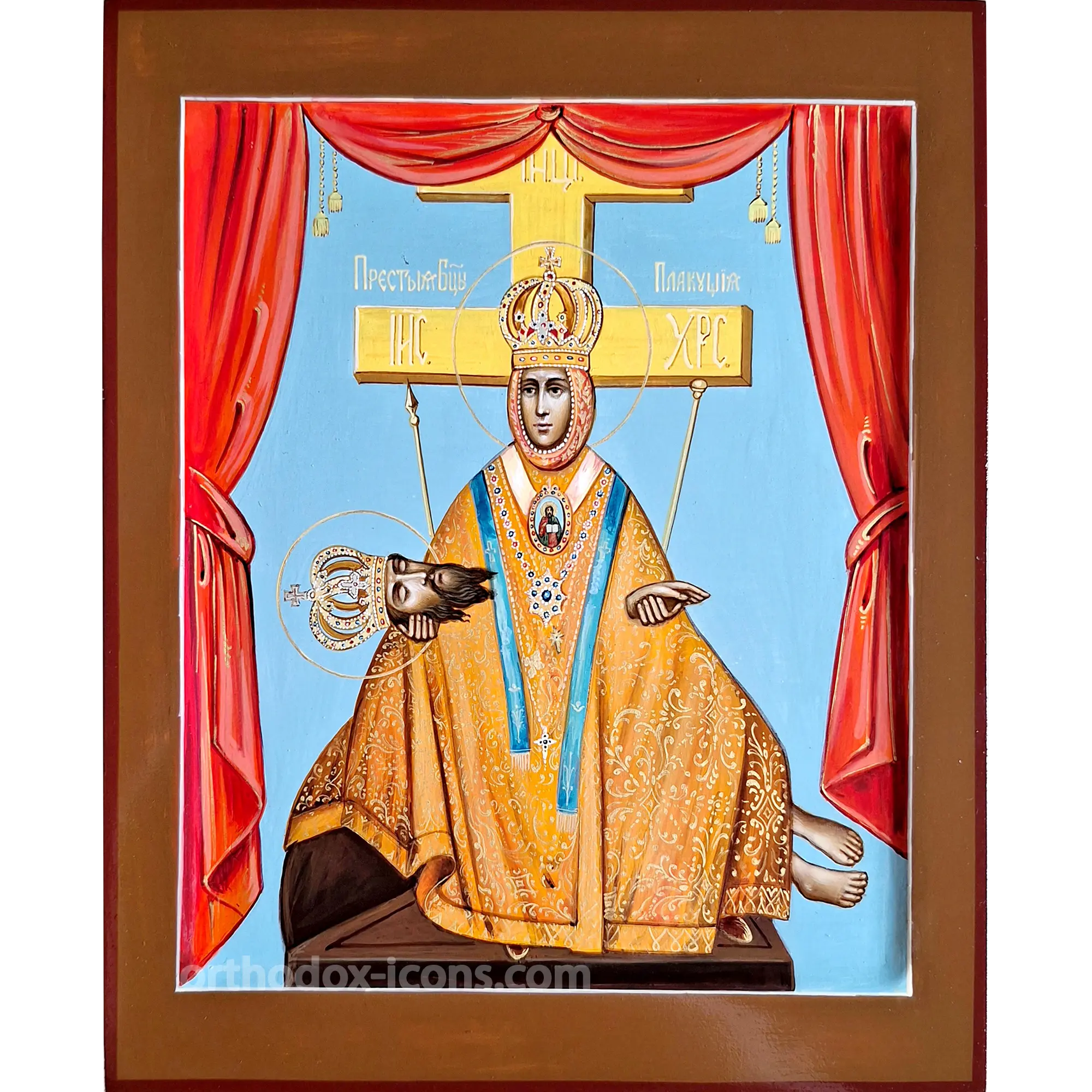
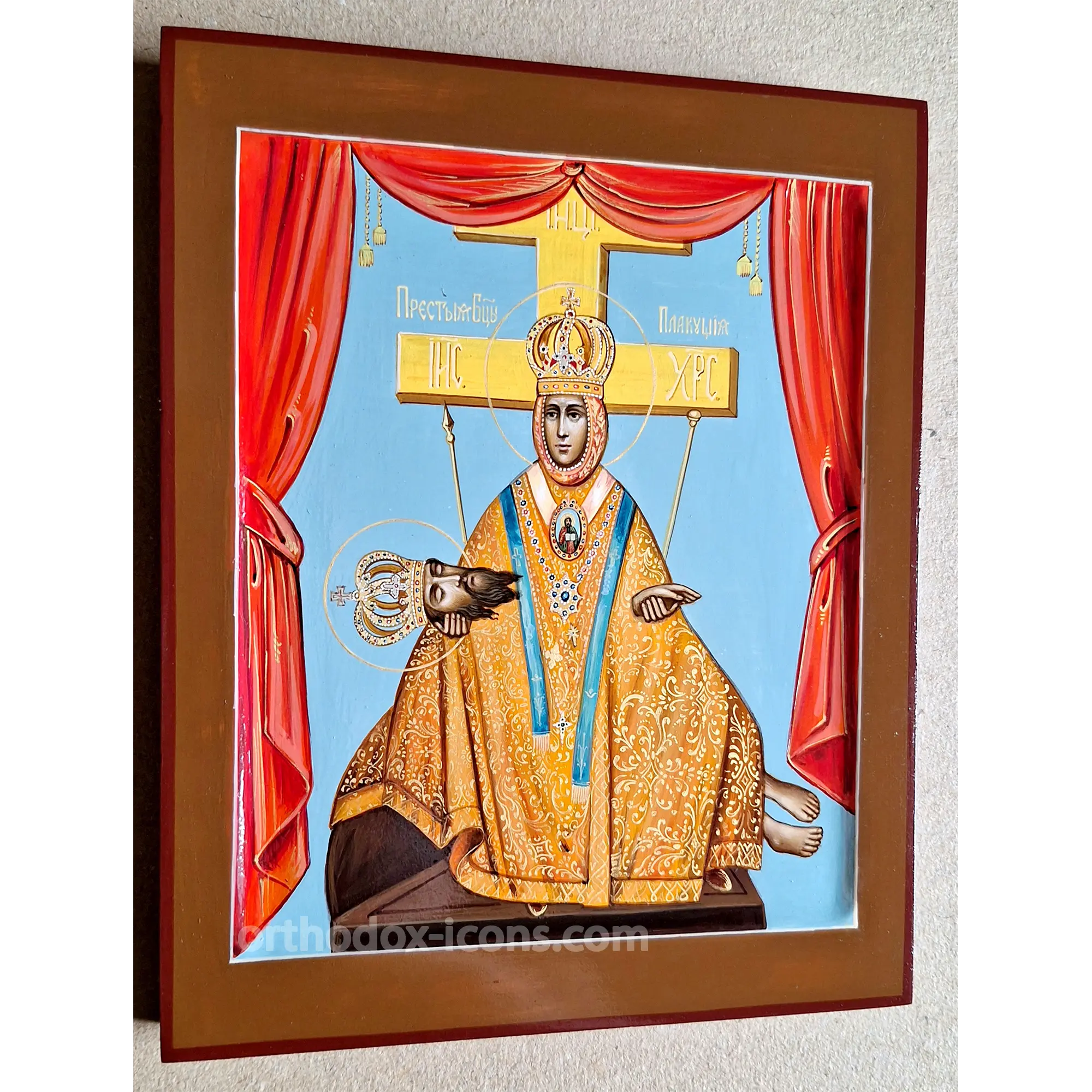
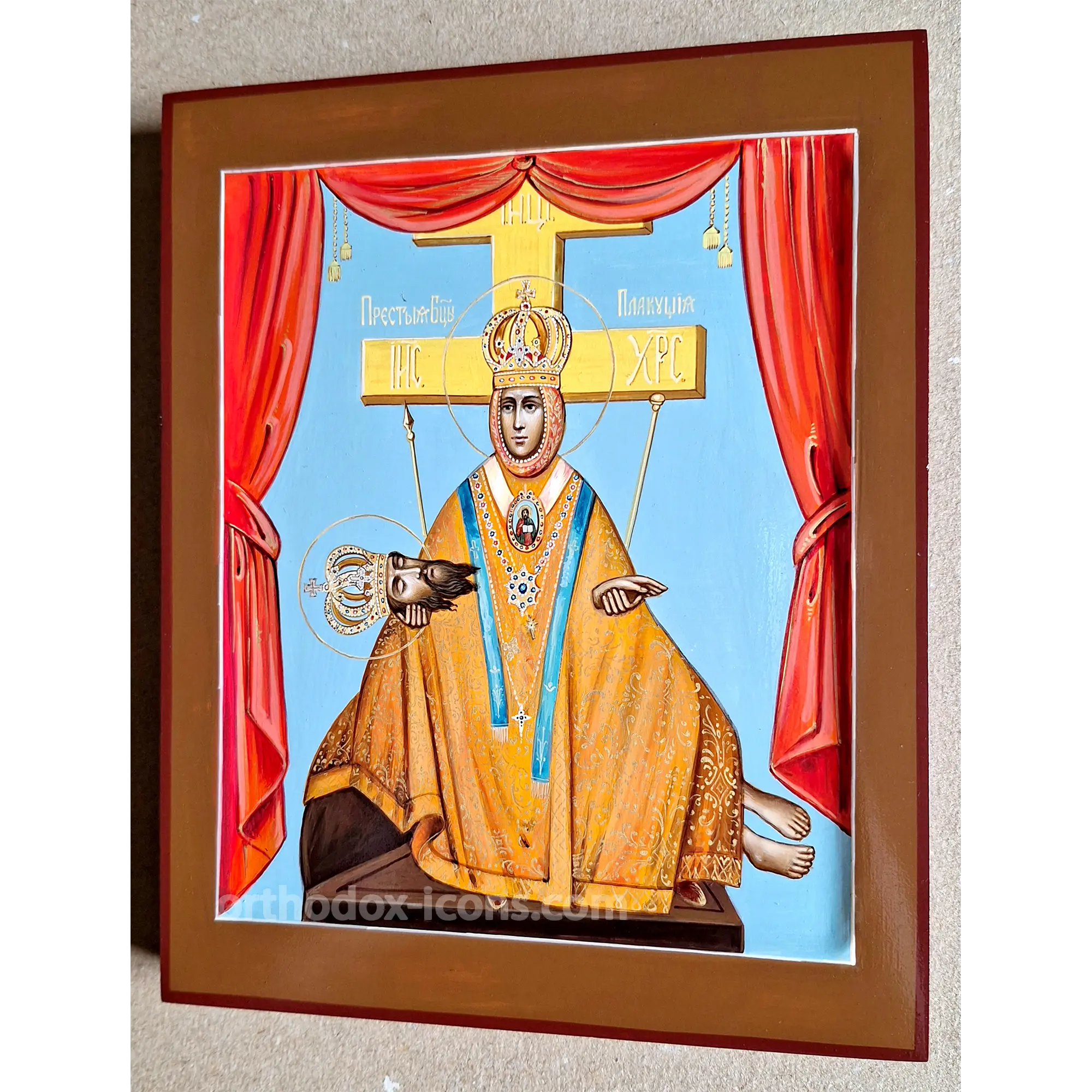
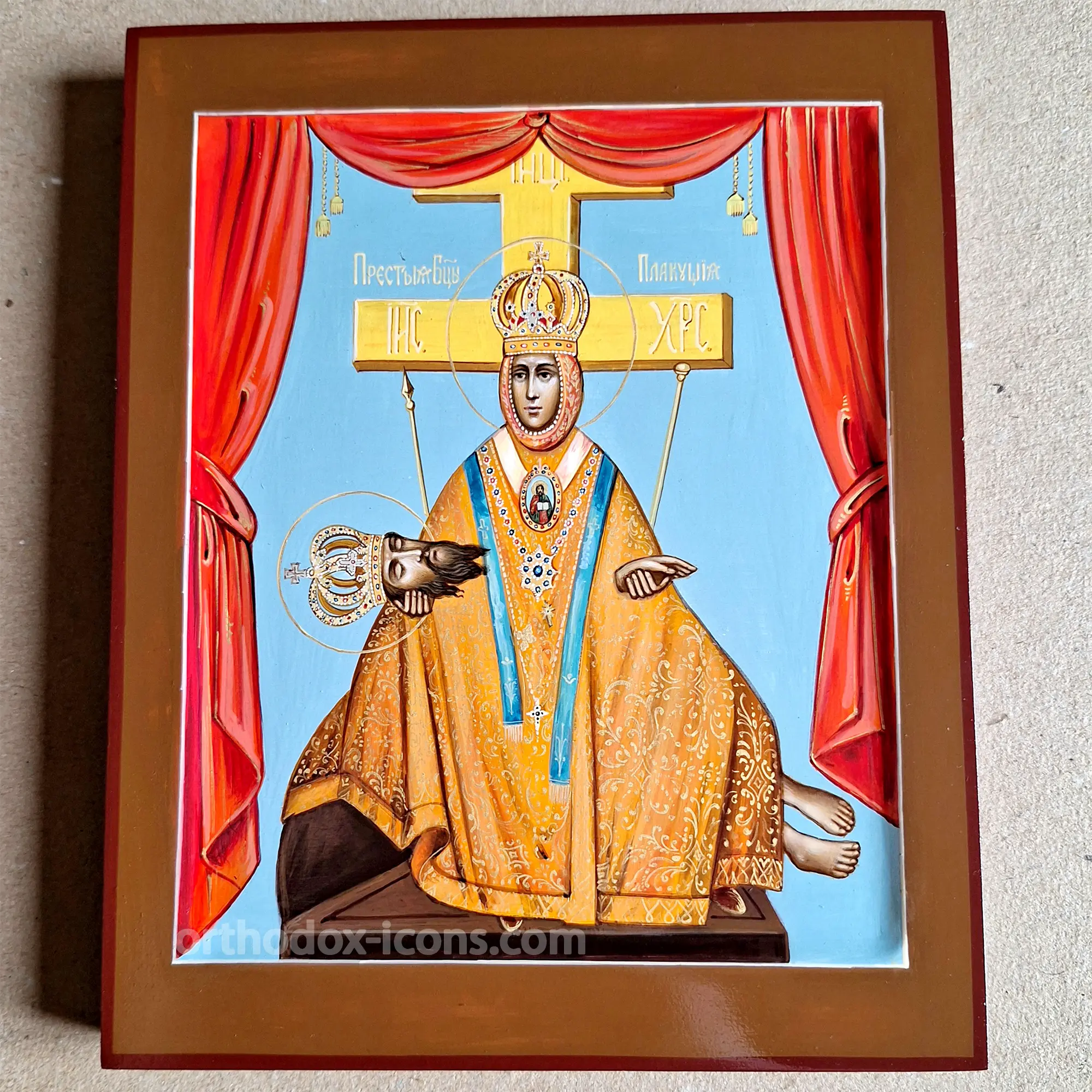
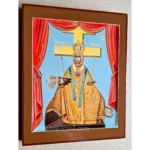
The The Weeping Virgin Orthodox Icon is a rare and deeply sorrowful Mother of God icon connected with the village of Shubino and the deliverance from cholera and drought in 1848. The image combines Orthodox symbolism with a Pieta-like theme: the grieving Theotokos sits at the foot of a gilded Golgotha Cross, framed by a red curtain, holding a crowned severed head interpreted in this rare tradition as a symbolic image connected with Christ’s Passion or, in some variants, Saint John the Forerunner. The icon is hand-painted with mineral egg tempera, 23K gold leaf, a carved kovcheg, rich gold ornament, and a royal crown. Free international shipping is included; payment is due upon delivery.
It is possible to paint an image in any size to order
Free shipping worldwide
Among the many icons of the Mother of God venerated in the Orthodox Church, The Weeping Virgin Orthodox Icon belongs to a rare and deeply sorrowful tradition. It does not present the familiar stillness of a calm Marian image. Instead, it brings the person praying face to face with the grief of the Theotokos, the mystery of Christ’s Passion, and the full weight of maternal sorrow.
This icon is known in Russian as the Mother of God ?Plakushchaya,? the Weeping Mother of God. Its iconography is unusual for the strict Byzantine tradition and is connected with a rare Russian devotional image influenced by the theme of lamentation over Christ. The icon speaks especially to those who stand before God in grief, bereavement, repentance, fear, or spiritual exhaustion.
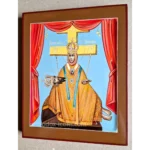
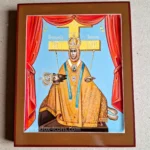
The hand-painted version offered here is made in the Mstyora icon-painting tradition. It shows the grieving Mother of God at the foot of a massive gilded Golgotha Cross, framed by a solemn red curtain. Her garments are richly ornamented with gold, and she wears a royal crown. The scene is sorrowful, but it is not hopeless: the blue sky, the gold, and the Cross all point toward redemption and the Resurrection.
The Weeping Virgin Orthodox Icon – History in Shubino
The historical veneration of the Weeping Icon of the Mother of God is closely connected with the village of Shubino near Moscow, in the Domodedovo district. There stands the old Church of the Dormition of the Most Holy Theotokos, known since the sixteenth century and now connected with the Moscow Novodevichy Monastery.
The exact time when the original Weeping icon appeared in the Dormition church is not known. Based on the painting style, art historians usually date the original image to the turn of the eighteenth and nineteenth centuries. The name ?Weeping? is a popular name; the fuller title of this iconographic version is often given as the Lament of the Mother of God over the Savior after He was taken down from the Cross.
The icon became especially known in 1848. That year, the region suffered from two disasters at once: a severe drought that threatened the harvest and a deadly cholera epidemic that struck whole families. For two months, no rain fell. In desperation, the parishioners of the Dormition church turned to their holy image. For the first time, they carried the Weeping icon out of the church in a procession, praying with tears through the surrounding fields and villages.
According to local testimony, rain began after the moleben and continued from midday until evening. The epidemic also stopped spreading. In memory of this deliverance from drought and cholera, a solemn annual service with procession is traditionally celebrated in Shubino on June 27 according to the new calendar, June 14 according to the old calendar.
Rare Iconography of Sorrow and Redemption
The iconographic type of the Weeping Mother of God is exceptionally rare. It brings together Orthodox symbols, the Western European Pieta-like theme of lamentation, symbolic realism, and theological allegory. Because of this, the image should be described carefully: it is not a standard Marian type such as Hodegetria, Eleusa, or Kazan, but a distinct sorrowful composition centered on the Passion of Christ.
The composition is both majestic and tragic. Against a clear blue sky, symbolizing the Kingdom of Heaven and the future Resurrection, rises the massive Cross of Golgotha, covered with shining gold. At the foot of the Cross, on a rectangular stone base that recalls the tomb of the Lord, sits the Most Holy Theotokos.
Her garments are deliberately regal. The maphorion of the Virgin Mary is painted like heavy precious brocade, covered with complex gold plant ornament. Over it descends a blue omophorion, decorated with jewel-like details and a panagia. On her head is a high imperial crown, emphasizing her dignity as Queen of Heaven even in the midst of grief.
The Crowned Head in the Hand of the Theotokos
The most striking and difficult detail of the icon is what the Mother of God holds in her right hand. In this image it is a crowned severed male head with closed eyes. In different versions of this rare iconography, this detail is interpreted either as an allegorical image of the dead Christ, the Head of the Church who suffered for the world, or as the head of Saint John the Forerunner, whose beheading also prefigures the suffering of the Savior.
Because the tradition itself preserves more than one interpretation, the image is best approached with reverence and restraint. The detail is not decorative or sensational. It belongs to the theological language of the icon, where grief, sacrifice, prophetic suffering, and redemption are gathered into one symbolic scene.
The left hand of the Mother of God is extended forward and downward in a gesture of sorrow, humility, and acceptance of the will of God. The whole figure speaks of maternal grief that is not rebellion, but participation in the mystery of salvation.
The Red Curtain and the Cross
The red curtain, or velum, frames the mystical scene and hangs across the crossbars of the Cross. This curtain has several layers of meaning. In the Old Testament, a veil closed the Holy of Holies in the Temple. At the death of Christ on the Cross, the veil of the Temple was torn in two, revealing that the way to the Kingdom of Heaven had been opened through the redemptive sacrifice of the Savior.
The red color of the curtain also recalls the blood of Christ and the fullness of martyrdom. It presents the mystery of redemption as something partly revealed and partly hidden. The faithful do not simply ?look at? the icon as a dramatic scene; they stand before a sacred image that points toward the cost of salvation and the mercy of God.
Prayer Before the Weeping Icon
As an image born of sorrow and compassion, the Weeping Icon of the Mother of God is especially close to those passing through grief. Parents who have lost children, widows, orphans, and those mourning the death of loved ones may pray before this icon for consolation. The Theotokos, who stood near the Cross of her Son, understands the pain of human loss in a way no ordinary comfort can fully reach.
The historical memory of Shubino also gives this icon a prayerful connection with protection from epidemics, sudden disasters, drought, crop failure, fire, and other calamities. People also pray before it for healing from serious and dangerous illnesses.
The icon is also a strong image for repentance. Seeing the tears and sorrow of the Mother of God over the crucified Savior, the faithful ask for sincere contrition, forgiveness of grave sins, and the softening of a heart that has grown cold or careless. The icon can also be used in prayer for the departed, especially for relatives who died suddenly, without preparation, or in times of war and disaster.
Materials and Mstyora Icon Painting
Creating such a complex icon requires a high level of icon-painting skill. The base is a solid linden board. Oak braces are placed on the back, either inserted or applied, to help protect the wood from warping. On the front of the board, a kovcheg is carved. This recessed central area creates natural raised borders around the image and symbolizes an opening into the spiritual world.
The board is covered with linen and then with up to fifteen layers of natural chalk gesso. The painting is made with traditional mineral egg tempera. The pigments are prepared from natural minerals and related materials and are mixed with egg emulsion. This method allows the color to unite with the gesso ground and remain durable for many years.
Gold is used abundantly in this icon. The Cross, crowns, halos, and complex ornament on the brocade-like garments are finished with 23K gold leaf. The gold assist gives the icon a radiant inner brightness, contrasting with the sorrowful subject and reminding the person praying that the Passion is inseparable from the Resurrection.
Available Sizes
The available sizes are 17×21 cm (6.7×8.3 in), 20×24 cm (7.9×9.4 in), 27×31 cm (10.6×12.2 in), and 30×40 cm (11.8×15.7 in). Because the composition includes many small details, gold ornament, inscriptions, the crowned head, the Cross, and the red curtain, medium and larger formats are especially recommended.
The 20×24 cm size is suitable for a compact home icon corner. The 27×31 cm size is the classic and most balanced home format, allowing the inscriptions, crown details, and ornament to be seen more clearly. The 30×40 cm size is more ceremonial and can be chosen for a larger room, prayer space, or parish setting. Larger church and iconostasis sizes can be discussed individually.
Free international shipping is included; payment is due upon delivery.
Icon Characteristics
| Feature | Description |
|---|---|
| Iconographic type | Weeping Mother of God, rare Lamentation-related type with Pieta-like elements |
| Main composition | The Theotokos at the foot of the Golgotha Cross, with red curtain and crowned head |
| Board | Linden wood with kovcheg, linen, natural gesso, and oak braces |
| Painting | Mineral egg tempera in the Mstyora tradition |
| Gold | 23K gold leaf on the Cross, crowns, halos, and garment ornament |
| Available sizes | 17×21 cm, 20×24 cm, 27×31 cm, 30×40 cm, with larger church formats by agreement |
| Prayer use | Consolation in grief, prayer for the departed, repentance, healing, and protection from sudden disasters |
The The Weeping Virgin Orthodox Icon is a rare and solemn image that reminds the faithful of the price of salvation. It offers a place for prayer when ordinary words fail: in mourning, repentance, danger, and the search for hope in the mercy of God.
Questions and Answers
What is unique about The Weeping Virgin Orthodox Icon?
It is a rare iconographic type that combines Orthodox symbolism with a Pieta-like image of the grieving Mother of God at the foot of the Golgotha Cross.
What historical event is connected with this icon?
The icon is especially connected with Shubino, where in 1848 a procession with the image was associated with deliverance from a severe drought and a cholera epidemic.
What does the red curtain symbolize?
The red curtain recalls the veil of the Temple torn at the death of Christ, the mystery of redemption, and the blood of the Savior shed on the Cross.
What is the crowned head in the hand of the Theotokos?
In this rare iconographic tradition, it is interpreted either as an allegorical image connected with the dead Christ, the Head of the Church, or as the head of Saint John the Forerunner in some variants.
Why is the Mother of God shown with royal ornaments?
The crown and rich gold ornament emphasize her dignity as Queen of Heaven, while the sorrowful scene points to her participation in the mystery of Christ’s Passion.
What are people accustomed to pray for before this icon?
People pray before this icon for consolation in grief, remembrance of the departed, help in repentance, protection from epidemics and disasters, and healing from serious illness.
When is this icon commemorated?
The local commemoration of the Shubino Weeping Icon is celebrated on June 27 according to the new calendar, June 14 according to the old calendar.
What is a kovcheg on an icon board?
A kovcheg is a recessed central area on the front of the icon board, forming natural raised borders around the painted image and symbolizing an opening into the sacred world.
What sizes are available?
The available sizes are 17×21 cm, 20×24 cm, 27×31 cm, and 30×40 cm, with inch equivalents shown on the product page. Larger church sizes can be discussed individually.
Is this icon suitable as a wedding gift?
This icon is primarily an image of grief, repentance, and consolation. For wedding pairs, more traditional Marian icons such as Kazan, Vladimir, or Iveron are usually chosen.
| Dimensions | 17x21cm (6.7×8.3 in), 20x24cm (7.9×9.4 in), 27x31cm (10.6×12.2 in), 30x40cm (11.8×15.7 in) |
|---|---|
| Name | Mary |