In Search of the Perishing Icon
$3000
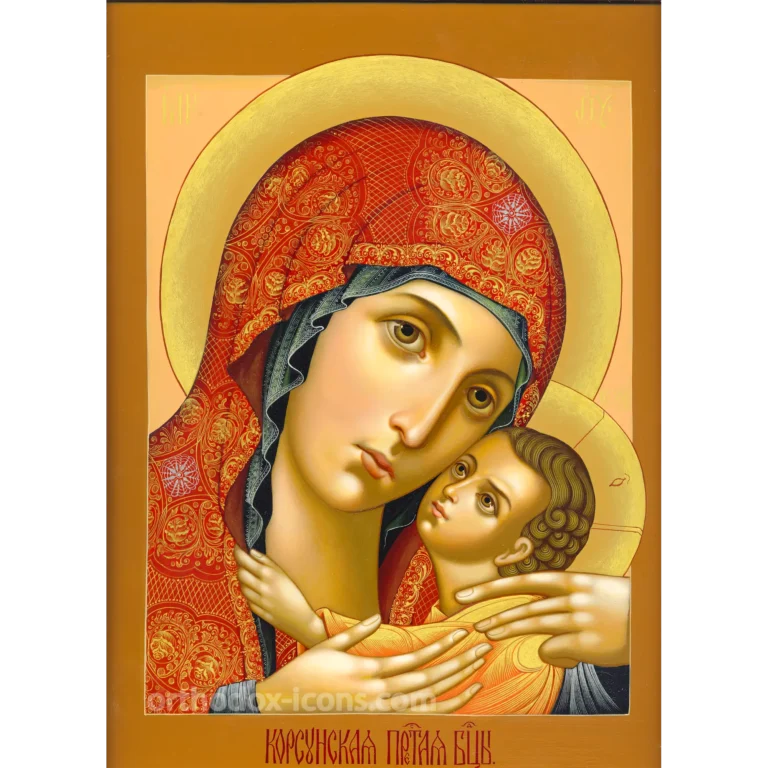
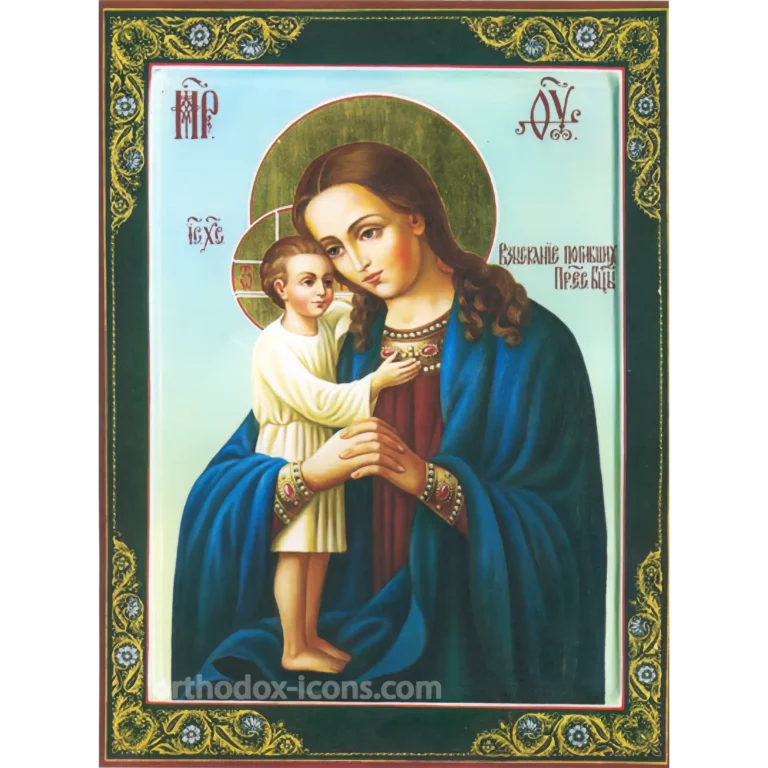
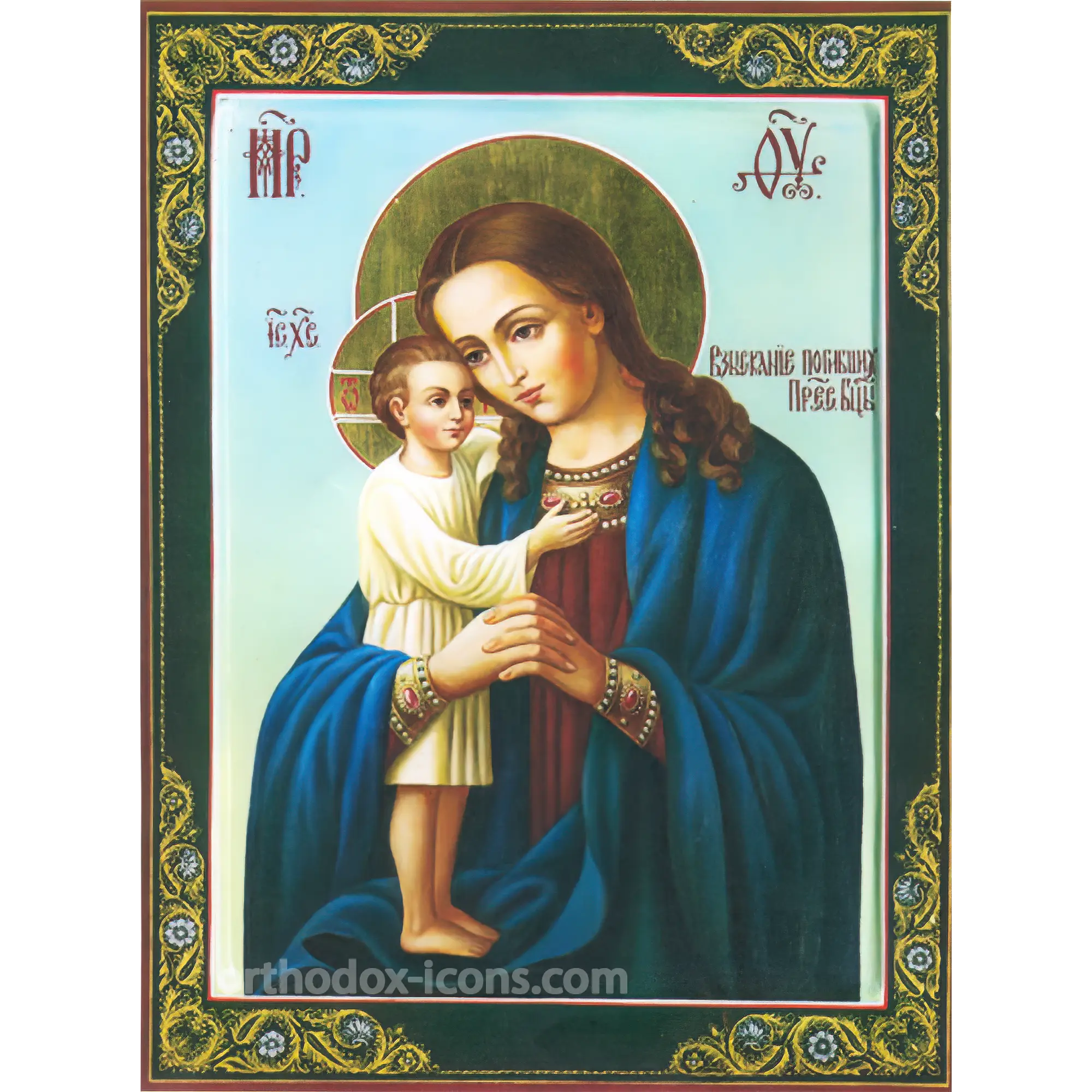
In Search of the Perishing Icon is a hand-painted Orthodox image of Our Lady “Seeking the Lost,” a moving icon of mercy, repentance, and last hope.
Available size: 30×40 cm (11.8×15.7 in). Larger home, church, and iconostasis sizes may be discussed before painting.
Materials: flat linden board without kovcheg, oak braces, linen pavoloka, chalk levkas, layered painting, multicolor ornamental border, and protective lacquer.
Technique: academic-style hand painting on wood with uncovered flowing hair, blue-green mantle, warm ocher-gold background, soft modeling, and enamel-like floral ornament.
It is possible to paint an image in any size to order
Free shipping worldwide
In Search of the Perishing Icon, also known as Our Lady “Seeking the Lost,” is a deeply moving hand-painted Orthodox icon of the Mother of God. Its title sounds like a lifeline for the human soul: in the Church Slavonic sense, “seeking” means not punishment, but the active search for the one who is lost and the desire to save.
This icon is especially close to those who stand at the edge of physical danger, spiritual collapse, grave illness, despair, addiction, family ruin, or deep repentance. The Mother of God is shown not as distant and severe, but as a merciful mother who embraces Christ and intercedes for those who have almost lost hope.
The presented icon is painted in an academic, painterly manner rather than in a strict Byzantine style. It is made on a flat linden board without kovcheg, with oak braces, linen pavoloka, chalk levkas, layered painting, an ocher-gold background, and a multicolor floral border that imitates precious enamel ornament. The listed size is 30×40 cm (11.8×15.7 in).
History: The Repentance of Theophilus and Russian Miracles
The spiritual roots of the title “Seeking the Lost” go back to deep Christian antiquity, to the seventh century. According to an old account, in the Byzantine city of Adana there lived a pious church steward named Theophilus. After he became the victim of slander and injustice, he fell into profound despondency and was spiritually endangered.
The tradition tells how the Mother of God became his merciful intercessor and brought him to repentance. This story made the name “Seeking the Lost” a powerful expression of hope for those who have fallen, wandered, or become trapped in despair.
In Russia this story became widely known, and over time several wonderworking icons appeared under the same title. One of the best-known miracles is connected with the eighteenth century, when the pious peasant Fedot Obukhov was saved during a terrible winter storm after prayer to the Mother of God.
Unique Iconography: Flowing Hair and a Living Face
The presented icon has several unusual features that distinguish it from more ancient and strictly canonical Russian icons. Its academic style makes the image close and understandable to the modern person, while preserving its devotional and Orthodox meaning.
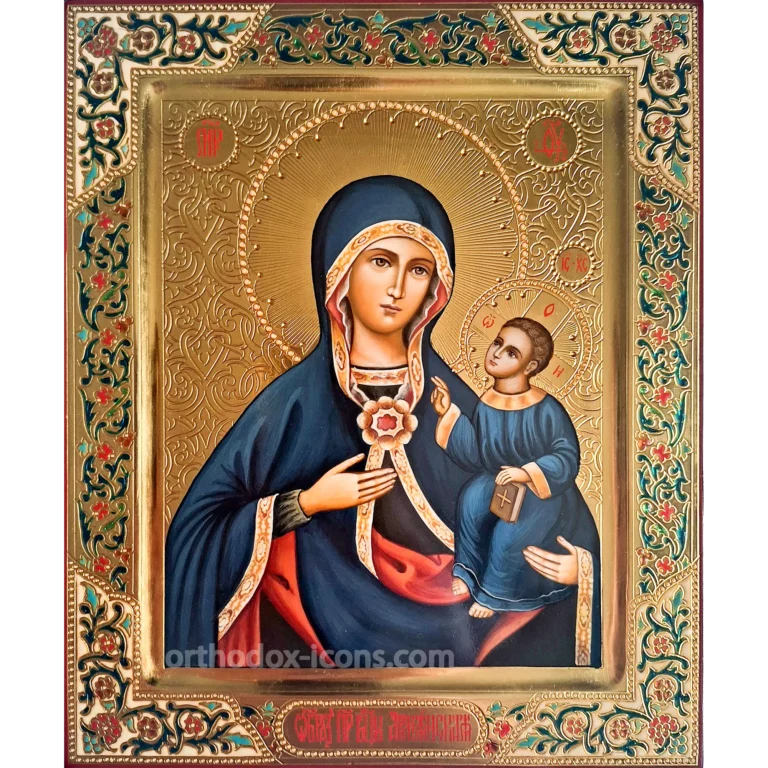
- No maphorion on the head of the Mother of God: the Virgin Mary is shown with an uncovered head and flowing curls over her shoulders. This detail expresses her boundless meekness and maternal closeness to the person praying.
- The embrace of the Son: the Christ Child stands on the knees of the Most Pure Virgin and tenderly embraces her neck, pressing close to her whole body. This belongs to the Tenderness, or Eleusa, language of love between God and humanity.
- Color of the garments: the Mother of God wears a dark red chiton and a luxurious blue-green mantle. The collar of her garment is richly painted with an imitation of precious rubies and pearls.
- The Christ Child: the Savior wears a simple white garment, a sign of purity and divine innocence.
- The background: instead of a traditional gold-leaf ground, the icon painter uses a complex color gradient. A warm ocher-gold halo behind the figures passes into heavenly blue, creating a sense of air and soft radiance.
- The border ornament: the wide fields are decorated with a multicolor floral pattern that skillfully imitates precious cloisonne enamel oklads.
Prayer Before Our Lady Seeking the Lost
The faithful turn to this icon in the most difficult and critical moments of life, when it seems that no earthly help remains. In the context of this image, the “lost” person may be someone in physical danger, but also someone whose soul is collapsing under sin, addiction, despair, or hopelessness.
- For the hopelessly ill: prayer is offered for people suffering from cancer, severe infections, eye diseases, fevers, and conditions when medicine seems powerless.
- For deliverance from addiction: mothers and wives pray with tears for loved ones caught in alcoholism, drug addiction, gambling addiction, and other destructive bondage.
- For those missing or lost: this icon is approached in prayer for missing children, lost travelers, and soldiers who have not returned from battle.
- For protection during disasters: the Mother of God is asked to preserve life during wars, natural disasters, severe epidemics, and extreme cold.
- For salvation of the soul: those who have committed grave sins ask for strength to repent sincerely and return to righteous life.
- For marriage: the icon is also used to bless newly married couples, asking the Mother of God to protect the family from destruction and divorce.
Academic Painting on Wood
Painting an academic-style icon is a demanding process. It requires mastery of painterly technique, understanding of anatomy, light and shadow, and the ability to keep the image prayerful rather than merely sentimental.
The base is a smooth, flat board of solid linden, without a kovcheg. Linden is traditionally used in icon painting because it is soft, even in structure, and resistant to cracking. Oak braces are inset into the back of the board to help preserve its geometry over time.
Before painting begins, the front of the board is covered with pavoloka, a fine linen cloth, and 10 to 15 layers of natural chalk levkas made from chalk and animal glue. This creates a smooth and stable ground for the painted layers.
The icon is painted with high-quality colors in layered glazes. Transparent layers are placed over one another to create the depth of the blue mantle, the soft almost porcelain-like light of the faces, and the warm glow of the ocher-gold background.
Icon Characteristics
| Name | In Search of the Perishing Icon |
|---|---|
| Traditional title | Our Lady “Seeking the Lost” |
| Iconographic type | Eleusa, or Tenderness, in academic painterly style |
| Main meaning | Last hope, repentance, mercy, rescue from physical and spiritual danger |
| Board | Solid linden board, flat surface without kovcheg, inset oak braces |
| Ground | Linen pavoloka and natural multi-layer chalk levkas |
| Painting | Layered academic-style painting with soft light and shadow |
| Border decoration | Hand-painted multicolor floral ornament imitating enamel oklad |
| Visible feature | Mother of God without maphorion, uncovered head and flowing hair |
| Available size | 30×40 cm (11.8×15.7 in) |
| Larger formats | Large church and iconostasis sizes may be discussed before painting |
| Painting time | Approximately 4 to 6 weeks, depending on final size and detail |
| Shipping | Free international shipping is included; payment is due upon delivery. |
A Devotional Image of Mercy and Rescue
This icon is often chosen for prayer when a person or family is passing through danger, illness, grief, addiction, or the fear of losing someone. It can also become a meaningful wedding blessing, because it asks the Mother of God to preserve the new family from ruin and despair.
The academic style, soft modeling of the faces, flowing hair of the Mother of God, and enamel-like border give the icon a distinctive character. Yet the purpose remains Orthodox prayer: to stand before the Mother of God and ask her to seek, gather, and save those who are perishing.
Questions and Answers
Why is the Mother of God shown with loose hair on this icon?
The uncovered head and flowing hair are characteristic of painted academic versions of Seeking the Lost. This detail expresses extreme maternal closeness, meekness, and the absence of cold distance between the Mother of God and the person praying.
What does the title Seeking the Lost mean?
In Church Slavonic, the word means an active search and rescue. The icon is named this way because the Mother of God is venerated as the last hope for those who stand near physical or spiritual ruin.
For whom is this icon a meaningful gift?
It is often given to people suffering from serious illness, to parents whose children have gone astray, and to newly married couples as a blessing for a long and faithful family life.
Is this icon used in prayer for addiction?
Yes. Along with the Inexhaustible Chalice icon, Seeking the Lost is often approached in Orthodox prayer for deliverance of loved ones from destructive addictions such as alcoholism or drug dependence.
How does academic painting differ from strict Byzantine icon painting?
Academic painting developed in Russia under European artistic influence. It uses softer realism, volume, light and shadow, and perspective, while strict Byzantine icon painting is more symbolic and restrained.
Why is there ornament painted on the borders?
The multicolor floral border imitates precious cloisonne enamel oklads. It gives the icon a solemn and finished appearance while remaining painted decoration rather than metal covering.
Can this icon be ordered in a larger church size?
Yes. The listed size is 30×40 cm, and larger iconostasis formats, such as 50×70 cm or larger, may be discussed before painting.
Will the board or painting crack over time?
The icon is painted on solid linden with inset oak braces, pavoloka, and multi-layer chalk levkas. These traditional materials help protect the board and painted surface for many years.
Should this icon be kept in a kiot with glass?
A protective lacquer makes the painted icon reasonably stable, but a wooden kiot with glass is recommended for the best protection from dust, candle soot, and humidity changes.
Is free international shipping included?
Yes. Free international shipping is included; payment is due upon delivery. The icon is painted to order and packed carefully after completion.
| Dimensions | 30x40cm (11.8×15.7 in) |
|---|---|
| Name | Mary |