St. Nino Orthodox Icon
Price range: $500 through $1350
Available sizes: 13×25 cm (5.1×9.8 in), 18×31 cm (7.1×12.2 in), 30×50 cm (11.8×19.7 in), with iconostasis formats available by individual order.
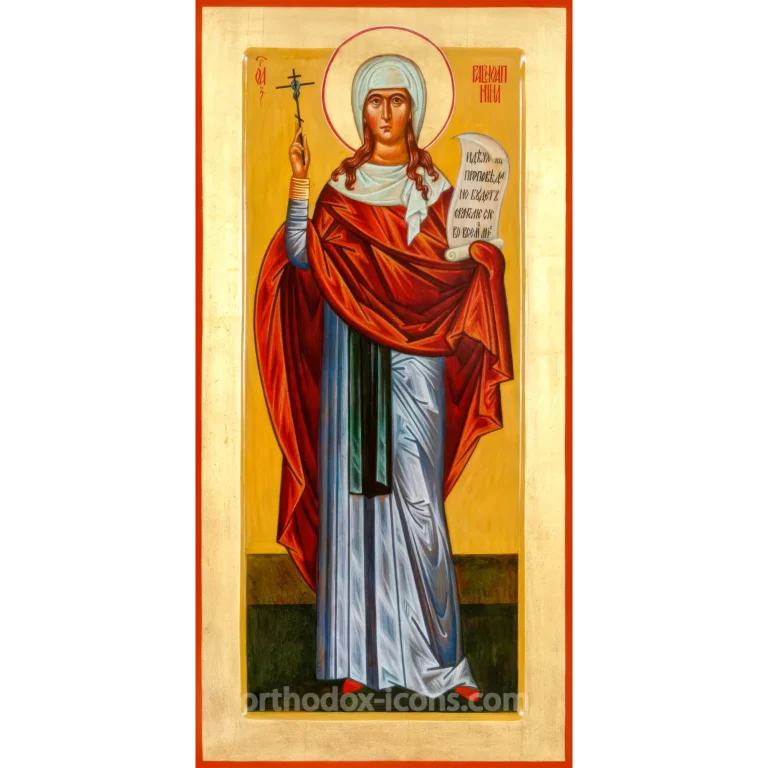
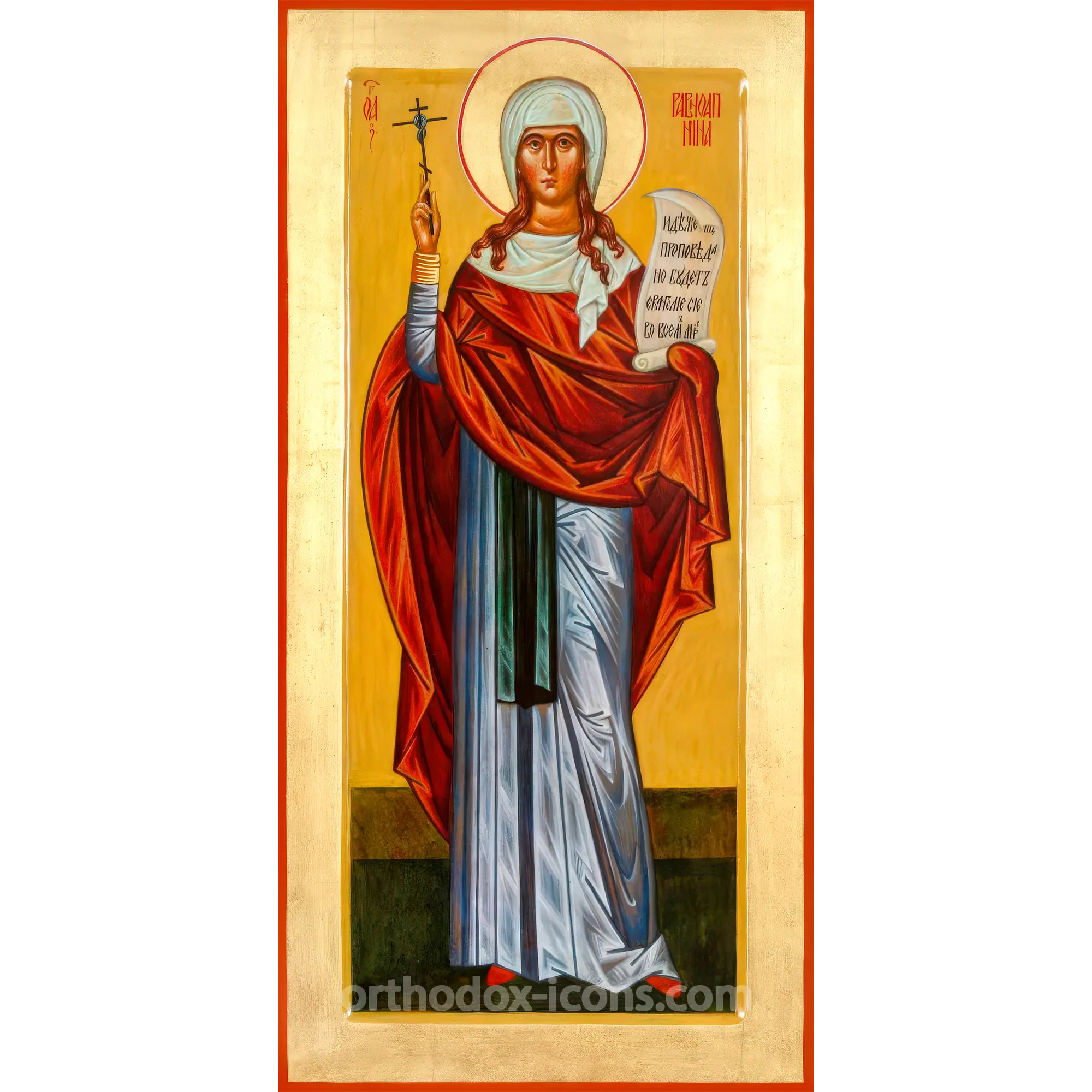
St. Nino Orthodox Icon is a hand-painted full-length icon of Saint Nino, also known as Saint Nina, Equal-to-the-Apostles and Enlightener of Georgia. The saint is shown with her grapevine cross and an open scroll, signs of her apostolic preaching.
Icon details: full-length figure, bright gold background, silver-blue chiton, vivid red maphorion, long hair beneath a white veil, grapevine cross with lowered arms, and a Church Slavonic Gospel text on the scroll.
Prayer focus: strengthening of faith, protection from despondency, help in study and teaching, spiritual enlightenment, children, and prayerful support in illness, especially according to the tradition connected with Saint Nino’s healings.
Materials: linden wood board, oak splines, pavoloka, chalk gesso, egg tempera, 23K gold leaf (960 purity), and protective finish.
It is possible to paint an image in any size to order
Free shipping worldwide
The St. Nino Orthodox Icon is a hand-painted full-length icon of Saint Nino, also known in Slavic usage as Saint Nina, Equal-to-the-Apostles and Enlightener of Georgia. In Orthodox tradition, the title Equal-to-the-Apostles is given to holy women and men whose preaching of the Gospel can be compared with the mission of Christ’s own disciples.
The presented icon shows Saint Nino, enlightener of ancient Iberia, Georgia, in strict Orthodox iconographic form. She stands before a bright gold background, holding her distinctive grapevine cross and an open scroll. The icon is made with natural materials: linden wood, chalk gesso, egg tempera, and 23K gold leaf (960 purity). It is intended for prayer, veneration, and long-term devotional use, not as a printed decoration.
Icon Characteristics
| Holy image | Saint Nino, Equal-to-the-Apostles, Enlightener of Georgia |
| Iconography | Full-length figure with grapevine cross and open scroll |
| Board | Linden wood, oak splines, pavoloka, and chalk gesso |
| Painting technique | Egg tempera with natural mineral pigments |
| Gold work | Full gold background with 23K gold leaf (960 purity) |
| Available sizes | 13×25 cm (5.1×9.8 in), 18×31 cm (7.1×12.2 in), 30×50 cm (11.8×19.7 in) |
Who This Icon Is For
The icon of Saint Nino Equal-to-the-Apostles is filled with the light of faith and missionary labor. It is especially suitable as a patron saint icon for women and girls named Nina or Nino. It is often given for baptism, nameday, or another important life occasion. Having the icon of one’s heavenly patroness at home helps a person remember prayer, ask for help in weakness, and learn firmness of spirit from the saint.
Because Saint Nino dedicated her life to enlightening people with the truth of the Gospel, her icon is also meaningful for teachers, educators, catechists, missionaries, and everyone whose work is connected with teaching and the passing on of knowledge. It can be a grateful and prayerful gift for a teacher or spiritual mentor.
This image is also suitable for people standing before important changes in life, for those seeking their spiritual path, and for those who need strengthening of faith after difficult trials.
Prayer Before Saint Nino
Saint Nino’s life was connected with healing, preaching, and the spiritual transformation of an entire land. Orthodox Christians pray before her icon for strengthening of faith, deliverance from despondency, spiritual enlightenment, help in study and teaching, protection of children, and the ability to speak the truth with gentleness and courage.
Believers also ask her intercession during illness, remembering the healings connected with her life, including the healing of Queen Nana of Georgia. Such prayer should be understood reverently: it is not a mechanical promise of healing and does not replace medical care when needed. It is an appeal to God through the prayers of the saint.
Parents may pray before this icon for their children: for diligence in study, clarity of mind, protection from harmful influences, and growth in faith. Missionaries, catechists, and teachers may ask for humility, patience, and a clear word.
Life of Saint Nino, Enlightener of Georgia
Saint Nino was born around the year 280 in Cappadocia, in Asia Minor, into a noble and pious Christian family. From childhood she was raised in the faith. After hearing about the distant land of Iberia, Georgia, where the Robe of the Lord was kept while the people still remained in pagan darkness, she desired to bring the light of the Gospel there.
In answer to her fervent prayers, the Most Holy Theotokos appeared to her, blessed her apostolic labor, and gave her a wondrous cross woven from grapevine branches. When Nino awoke, she found the cross in her hands and bound it with a strand of her own hair so that the vine branches would not fall apart. This cross became the central symbol of her life and mission.
After escaping death during persecutions against Christians in Armenia, Saint Nino reached Georgia around the year 319. She settled in Mtskheta and began her preaching not by force, but by meekness, love, and miraculous healings. The healing of Queen Nana became one of the decisive events; after it the queen received baptism.
Soon King Mirian, who had been blinded while hunting during an eclipse, regained sight after praying to the God of Nino and came to believe in Christ. In 324 Christianity was proclaimed the state religion of Georgia. Saint Nino preached throughout the land and reposed peacefully around the year 335.
Feast Day of Saint Nino
The Orthodox Church, including both the Russian and Georgian Churches, solemnly commemorates Saint Nino Equal-to-the-Apostles on January 27 according to the civil calendar, or January 14 according to the old calendar. This day is a nameday for Orthodox women baptized with the name Nina.
If the icon is intended as a gift for this feast, it is best to order it in advance. A full-length image with detailed clothing, an open scroll, and a gold background requires careful, unhurried hand work.
Features of This St. Nino Icon
Full-length icons have a special sense of dignity and monumentality. Saint Nino stands upright, her figure directed upward. The image is strict, warm, and alive at the same time. The saint’s face is written delicately: large attentive eyes look toward the person praying, expressing both the meekness of a virgin and the firmness of an apostolic preacher.
Long chestnut hair falls from beneath the white veil, an important detail connected with the tradition of the grapevine cross. The lower chiton is painted in light silver-blue tones, with straight firm folds that suggest spiritual purity and heavenly peace.
Over the chiton lies a broad vivid red maphorion. In icon painting, red can signify divine life, ardent faith, love for God, and apostolic zeal. Here it expresses the spiritual fire with which Saint Nino carried the word of God to those who did not yet know Christ.
The whole figure stands against an even, shining gold background. Gold in icon painting does not signify earthly wealth; it points to the uncreated divine light and the Kingdom of Heaven in which the saint now abides.
Iconography: Grapevine Cross and Scroll
The iconography of Saint Nino is unique and immediately recognizable because of the two main attributes in her hands. In her right hand, raised toward her chest, she holds a cross of a special form. Its horizontal arms are lowered rather than straight. This is the famous Cross of Saint Nino, or Georgian cross, traditionally woven from grapevine branches.
According to tradition, the Mother of God gave this cross to Saint Nino before her mission to Iberia. The lowered vine branches were bound with the saint’s own hair. In iconography, this cross is a visible sign of God’s blessing for the enlightenment of the Georgian people and a symbol of living, fruit-bearing faith, because the vine is also a symbol of Christ.
In her left hand Saint Nino holds an open white scroll. The scroll is a classic attribute of prophets and apostles. The Church Slavonic text on it says, in meaning: “Wherever this Gospel is preached in the whole world…” These words point directly to the essence of her labor: she fulfilled the command of the Savior to preach the Gospel to all nations.
Materials, Gold Leaf, and Custom Options
The full-length icon is painted on a solid dried linden wood board. Oak splines are set into the back of the board to help prevent warping as humidity changes. The front is covered with pavoloka, a linen cloth, and several layers of chalk gesso, polished until smooth.
The gold background around the saint is made with thin sheets of 23K gold leaf (960 purity). The painting is executed in egg tempera. Natural dry pigments are mixed with egg emulsion, producing colors that remain clear and stable over time. The finished icon receives a protective finish.
For an individual order, the size, level of gilding, inscription, kiot, or church and iconostasis format can be discussed. Free international shipping is included. Payment is made after you receive and approve the icon.
How to Choose the Size
Because the full-length figure of Saint Nino is vertically elongated, this icon is offered in harmonious narrow formats. The 13×25 cm (5.1×9.8 in) size is slender and elegant, suitable as a patron saint gift for a goddaughter, daughter, or a small home prayer shelf.
The 18×31 cm (7.1×12.2 in) size is a classic home or analogion format. In this size the text on the scroll, the grapevine cross, and the folds of the vestments are already clearly visible.
The 30×50 cm (11.8×19.7 in) size is a larger gift or church format. It is a solemn icon for an important anniversary, a spacious home prayer corner, or a donation to a church. Larger iconostasis formats can be discussed individually.
Blessing and Care
Before beginning to pray before a newly painted icon, it may be blessed in an Orthodox church. You may bring the icon to your parish for blessing after receiving it.
A hand-painted icon with gold leaf should be treated with care. Never wipe it with a wet cloth or damp tissue, because moisture can damage the gesso and gilding. Dust should be removed only with a dry, very soft brush. Keep the icon away from direct sunlight, window sills, radiators, strong heat, and sudden temperature changes.
For long-term protection of the painting and gold leaf, a glazed wooden kiot is recommended. It helps protect the icon from dust, drafts, accidental scratches, and changes in the surrounding environment.
Questions and Answers
Why is Saint Nino called Equal-to-the-Apostles?
The title Equal-to-the-Apostles is given to saints whose preaching brought the Gospel to entire peoples and lands. Through Saint Nino’s mission, Georgia received the Christian faith.
Who is this icon especially suitable for?
It is especially suitable as a patron saint icon for women and girls named Nina or Nino. It is also meaningful for teachers, catechists, missionaries, and those connected with education and the spreading of the Gospel.
Why is the cross in Saint Nino’s hand unusual?
It is Saint Nino’s grapevine cross, also known as the Georgian cross. According to tradition, the Mother of God gave it to her, and Saint Nino bound the lowered vine branches with her own hair.
What is written on the scroll?
The scroll contains Church Slavonic Gospel words meaning: wherever this Gospel is preached in the whole world. The text points directly to Saint Nino’s apostolic mission.
What does the red garment mean?
The vivid red maphorion signifies living faith, love for God, divine life, and apostolic zeal with which Saint Nino brought the word of Christ to Georgia.
When do people pray to Saint Nino for health?
Believers ask Saint Nino’s intercession in illness, remembering the healings connected with her life, including the healing of the Georgian queen. This prayer is offered with faith and should not replace medical care when needed.
When is the feast day of Saint Nino?
Saint Nino, Equal-to-the-Apostles, is commemorated on January 27 in the civil calendar, corresponding to January 14 in the old calendar.
What are oak splines and why are they used?
Oak splines are wooden supports set into the back of the linden board. They help the board remain stable as wood naturally reacts to changes in humidity.
How should the gold background be cared for?
Gold leaf is very delicate. It should not be rubbed with wet cloths or fingers. Dust should only be removed lightly with a dry soft brush.
Can this full-length icon be hung on a wall?
Yes. The back of the icon board usually has a hanging recess. For better protection of the painting and gold leaf, a glazed wooden kiot is recommended.
| Dimensions | 13x25cm (5.1×9.8 in), 18x31cm (7.1×12.2 in), 30x50cm (11.8×19.7 in) |
|---|---|
| Name | Nino |