Virgin Mary Icon of the Three Joys
$1750
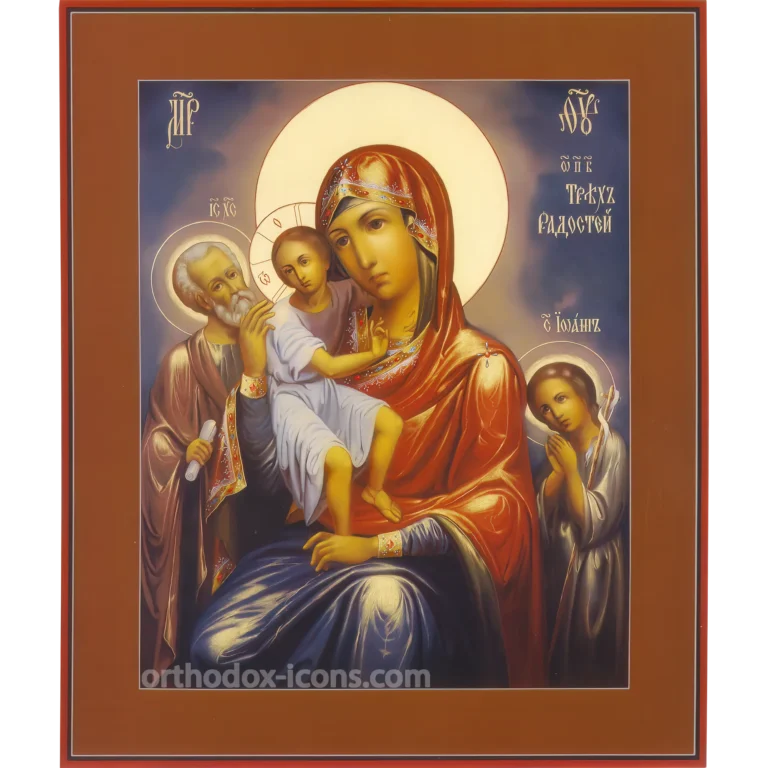
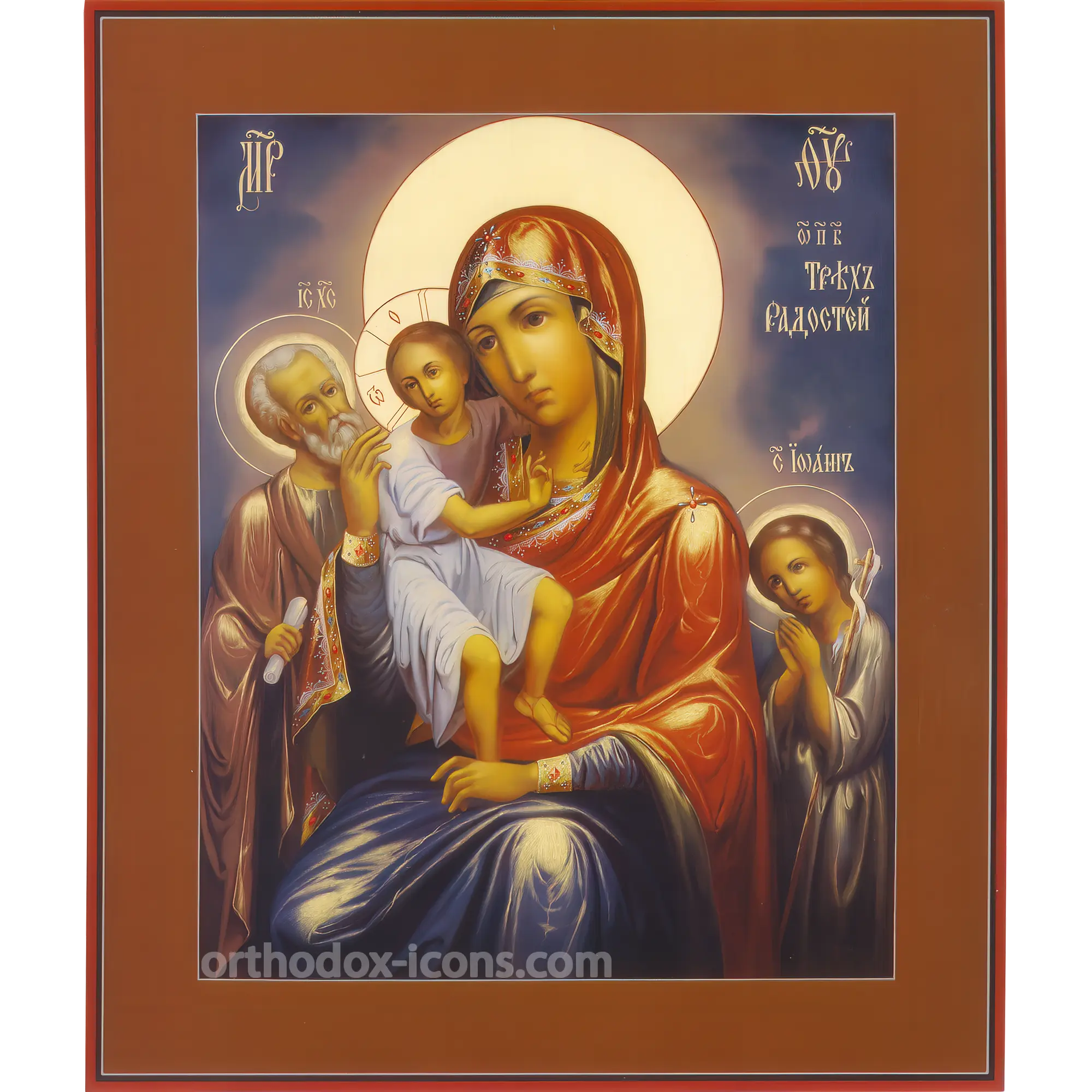
Virgin Mary Icon of the Three Joys is a hand-painted academic-style icon of the Mother of God with Christ, righteous Joseph, and young John the Forerunner, known for prayer in difficult family and legal situations.
Listed size: 27×31 cm (10.6×12.2 in); larger formats by agreement. The image has warm realistic modeling, living movement, a brown-to-blue heavenly gradient background, fine gold garment ornament, and a linden board with kovcheg. Free international shipping, with payment after delivery.
It is possible to paint an image in any size to order
Free shipping worldwide
Virgin Mary Icon of the Three Joys is one of the most unusual and tender images in Orthodox devotion. Its history shows how a Western Renaissance image of the Holy Family entered Russian spiritual life and became a beloved Orthodox icon of consolation, return, justice, and family peace.
The composition is painted in an academic, pictorial style rather than in the strict Byzantine manner. The Mother of God is shown with the Christ Child, righteous Joseph the Betrothed, and the young John the Forerunner. The scene feels alive, warm, and deeply human.
The listed size is 27×31 cm (10.6×12.2 in). Larger church and iconostasis formats may be discussed individually. This icon is especially meaningful for prayer for loved ones in military service, captivity, legal trouble, family crisis, and difficult life situations.
A Rare Image in Orthodox Tradition
Among Orthodox icons, the Three Joys occupies a special place. It does not look like a typical ancient Byzantine composition. Instead of severe symmetry and a flat gold field, the viewer sees a living family scene filled with tenderness, movement, and human warmth.
The icon shows the Holy Family in a way that speaks directly to the heart: the Mother of God holds Christ, Joseph stands nearby, and young John the Forerunner is present as a child. The emphasis is not abstract doctrine alone, but love, care, and the fragile joy of family life.
This is why the image became so close to ordinary believers. It speaks about home, separation, danger, justice, and the return of joy after sorrow.
From Renaissance Painting to Russian Devotion
The roots of the Three Joys icon go back to the early eighteenth century, during the time of Peter the Great. Many talented Russian painters were then sent abroad to study painting.
One such artist, while studying in Italy, was deeply impressed by a Holy Family painting connected in tradition with Raphael Santi. Other sources mention Annibale Carracci. The Russian artist made a copy of the image and brought it back to Russia.
After returning home, he left the painting to a relative who served as rector of the Trinity Church on Gryazi in Moscow. After the artist’s death, the priest did not keep the image at home but donated it to the church.
Because it was painted in a Western manner, the image was not placed in the altar. It was hung on the porch or entrance area of the church, where it remained for many years before becoming known through a miracle.
The Miracle of the Three Joys
Tradition tells of a noble Moscow woman who was suddenly struck by three terrible sorrows. Her husband was falsely accused and exiled, the family estate was confiscated, and her only beloved son was taken captive during war.
In despair, she prayed fervently to the Mother of God. In a dream, she heard a voice telling her to find the icon of the Holy Family and pray before it.
She searched through Moscow for a long time and finally found the image on the porch of the Trinity Church. After her tearful prayer, she received three joyful pieces of news: her husband was cleared, the estate was restored, and her son was released from captivity.
From that time, the people began to call the icon Three Joys.
The Holy Family Composition
In the center of the icon is the Mother of God with the pre-eternal Child on her lap. Righteous Joseph the Betrothed stands beside her as the earthly guardian of the Holy Family and protector of Mary’s virginity.
The young John the Forerunner is also present. In Russian versions of the icon, Joseph and John may appear on different sides of the Mother of God, while in Western originals the arrangement could differ.
The presence of Joseph and John makes the icon especially family-centered. It is an image of kinship, care, trust, and the hidden domestic life surrounding the Incarnation.
Living Movement and Human Tenderness
The Christ Child is shown in a natural and lively pose. Sitting on His Mother’s lap, He reaches toward righteous Joseph with His hand.
This movement gives the composition its special warmth. It emphasizes the reality of Christ’s human nature and the atmosphere of love in the family where He was raised.
The image does not deny Orthodox theology. Rather, it reveals the Incarnation through a scene that feels close to human experience: a child, a mother, a guardian, and loving attention within the family.
The White Radiance Behind the Mother of God
One of the striking features of this version is the treatment of light. Instead of traditional solid gold halos, the icon uses a soft luminous white glow behind the head of the Mother of God.
This radiance spreads through the scene and lights the whole composition with gentle, diffused brightness. It can be understood as an image of divine, Taboric light.
Thin halo outlines may appear around Christ and John, but the overall effect is more pictorial and atmospheric than strict and graphic.
Prayer for Return From War or Captivity
Because the first miracle of the Three Joys involved the return of a son from captivity, the icon became especially important for families waiting for loved ones in danger.
Mothers and wives pray before this icon for sons, husbands, and relatives serving in the army, living through war, or exposed to dangerous service.
In earlier times, the icon was especially loved among Don and Kuban Cossack families. Women prayed before it when sending husbands and sons into military campaigns, asking the Mother of God to bring them home alive and unharmed.
Prayer for Justice and Family Peace
The icon is also approached in prayer for people who have been slandered, falsely accused, or treated unjustly. The story of the cleared husband gives the image a special connection with court cases and disputes.
People pray before the Three Joys for a just resolution of trials, protection from false accusations, and the return of property taken unjustly.
Because the icon shows the Holy Family, it is also used in prayer for peace at home, reconciliation between spouses, help in raising children, and healing of family crises.
Academic Painting Style
This icon is painted in an academic or pictorial manner. That means the faces are modeled with soft light and shadow, natural volume, warm skin tones, and living expression.
This differs from strict Old Russian or Byzantine icon painting, where forms are more symbolic, flat, and hieratic. The academic style is closer to classical painting, with natural movement and emotional warmth.
In this icon, the academic style serves the subject well. The Three Joys is an image of family tenderness and consolation, so the soft modeling of faces and gestures helps express its meaning.
Color, Background, and Decorative Detail
Instead of a traditional flat gold background, this version has a deep color gradient, moving from warm brown tones into a heavenly blue space.
This background gives the scene depth, air, and a sense of breathing space. It makes the icon feel less enclosed and more open, while still keeping a sacred atmosphere.
The garments of the Mother of God and the cuffs of the Christ Child are decorated with fine gold painting and colored dots. These details imitate embroidery with precious stones such as rubies and sapphires.
Materials and Craftsmanship
The icon is painted on a solid linden board with kovcheg, linen, chalk gesso, and inserted oak splines. These traditional materials help the image remain stable and suitable for long-term preservation.
The painting uses multilayer work, glazes, and natural pigments. The soft transitions of color require careful control, because the faces must remain alive and expressive without becoming merely secular portraiture.
The result is a hand-painted Orthodox icon in the academic tradition, suitable for prayer, family remembrance, and a significant gift.
Icon Characteristics
| Name | Virgin Mary Icon of the Three Joys |
| Iconographic subject | Holy Family / Three Joys |
| Figures | Mother of God, Christ Child, righteous Joseph the Betrothed, and young John the Forerunner |
| Listed size | 27×31 cm (10.6×12.2 in); larger church and iconostasis formats by agreement |
| Style | Academic painting, with natural volume and soft light |
| Background | Color gradient from warm brown to deep heavenly blue |
| Decoration | Fine gold garment ornament with colored dot details imitating precious embroidery |
| Board | Linden board with kovcheg, linen, chalk gesso, and oak splines |
| Purpose | Prayer for return from war or captivity, justice in court, family peace, and consolation in sorrows |
Care and Preservation
The icon should be kept away from moisture, direct sunlight, heat, and sudden humidity changes. Do not wipe it with wet cloths or use household cleaners.
Dust may be removed only with a very soft dry brush. A glazed wooden kiot is recommended for better preservation, especially because the background and faces are painted with subtle layered transitions.
Ordering, Shipping, and Payment
The listed size is 27×31 cm (10.6×12.2 in). Larger church and iconostasis formats may be discussed individually. Free international shipping is included, with payment after delivery.
Questions and Answers
Why is this icon called the Three Joys?
The name comes from a Moscow miracle in which a woman received three joyful news after prayer: her husband was cleared, her estate restored, and her son freed from captivity.
Why does this Orthodox icon have a Western style?
The Russian icon tradition received this image through an eighteenth-century copy or adaptation of a Western Holy Family painting associated with Raphael or Annibale Carracci.
Who is shown in the Three Joys icon?
The Mother of God with Christ is shown together with righteous Joseph the Betrothed and the young John the Forerunner.
What do people pray for before this icon?
They pray for the safe return of loved ones from war, captivity, or military service, for just court decisions, restoration of property, and peace in the family.
Why was this icon loved by Cossack families?
Because one of its main miracles involved a son’s return from captivity, mothers and wives prayed before it for men serving in dangerous military campaigns.
What is academic icon painting?
Academic painting uses natural volume, soft light and shadow, living movement, and warmer human expression than strict Byzantine icon style.
What does the white glow behind the Mother of God mean?
The soft white radiance replaces a sharply defined gold halo and suggests divine, Taboric light spreading through the whole composition.
What size is listed for this icon?
The listed size is 27×31 cm (10.6×12.2 in). Larger church and iconostasis formats may be discussed individually.
What materials are used?
The icon is painted with multilayer painting and natural pigments on a linden board with kovcheg, linen, chalk gesso, and oak splines.
How are shipping and payment arranged?
Free international shipping is included, with payment after delivery.
| Dimensions | 27x31cm (10.6×12.2 in) |
|---|---|
| Name | Mary |