Do Not Mourn Me Mother Icon
Price range: $600 through $1600
Available sizes: 17×21 cm (6.7×8.3 in), 20×24 cm (7.9×9.4 in), 27×31 cm (10.6×12.2 in), 30×40 cm (11.8×15.7 in).
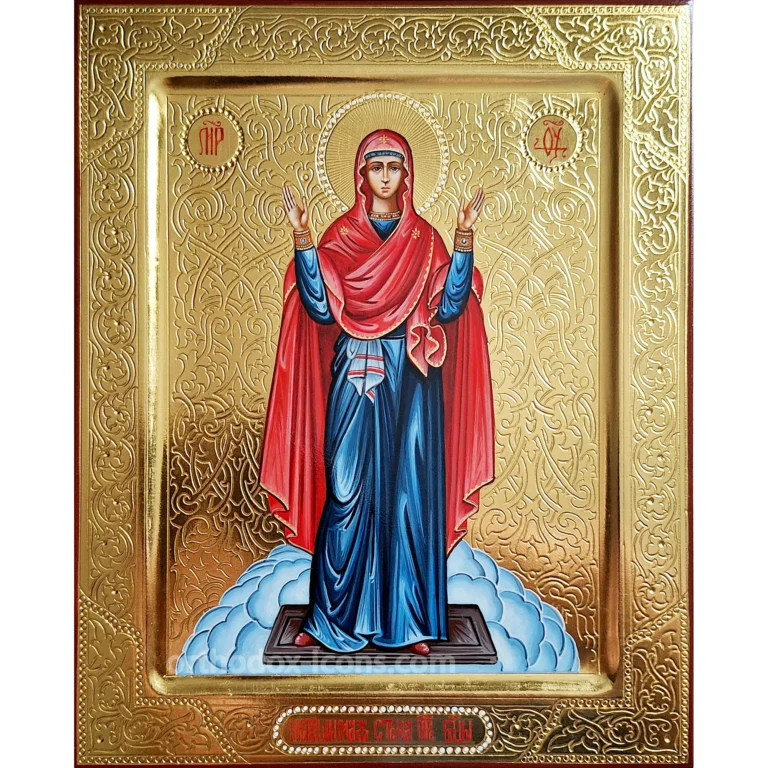
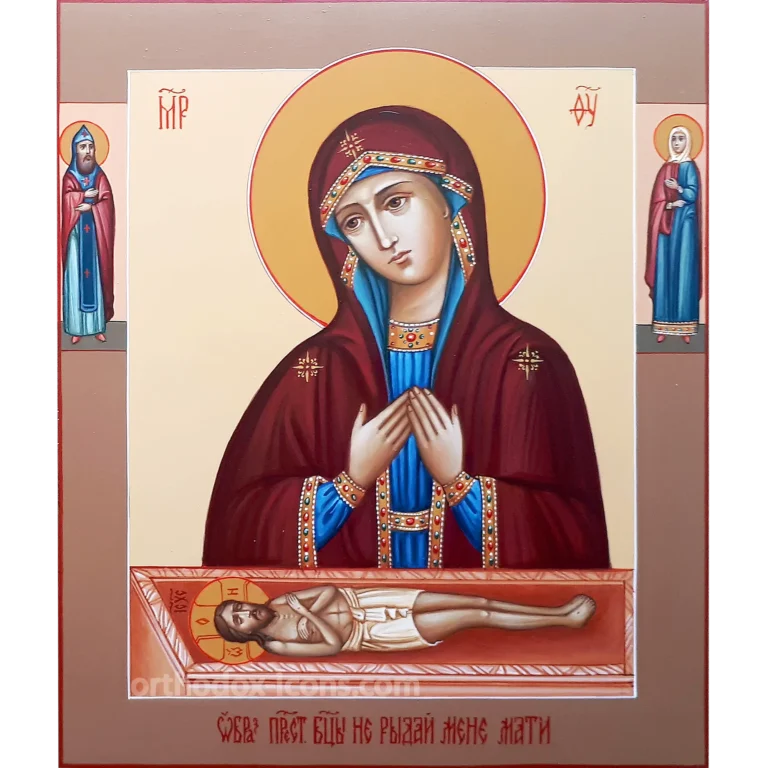
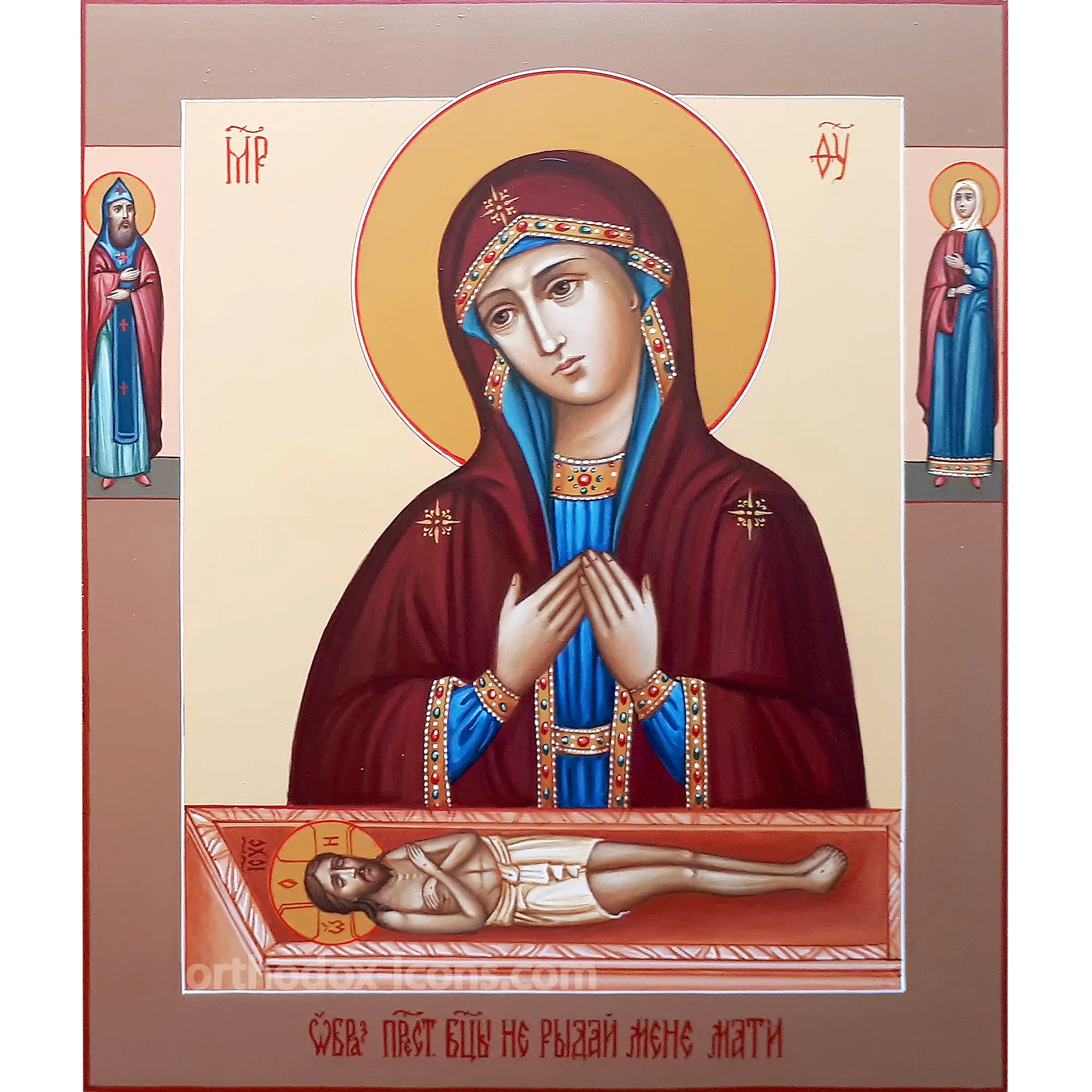
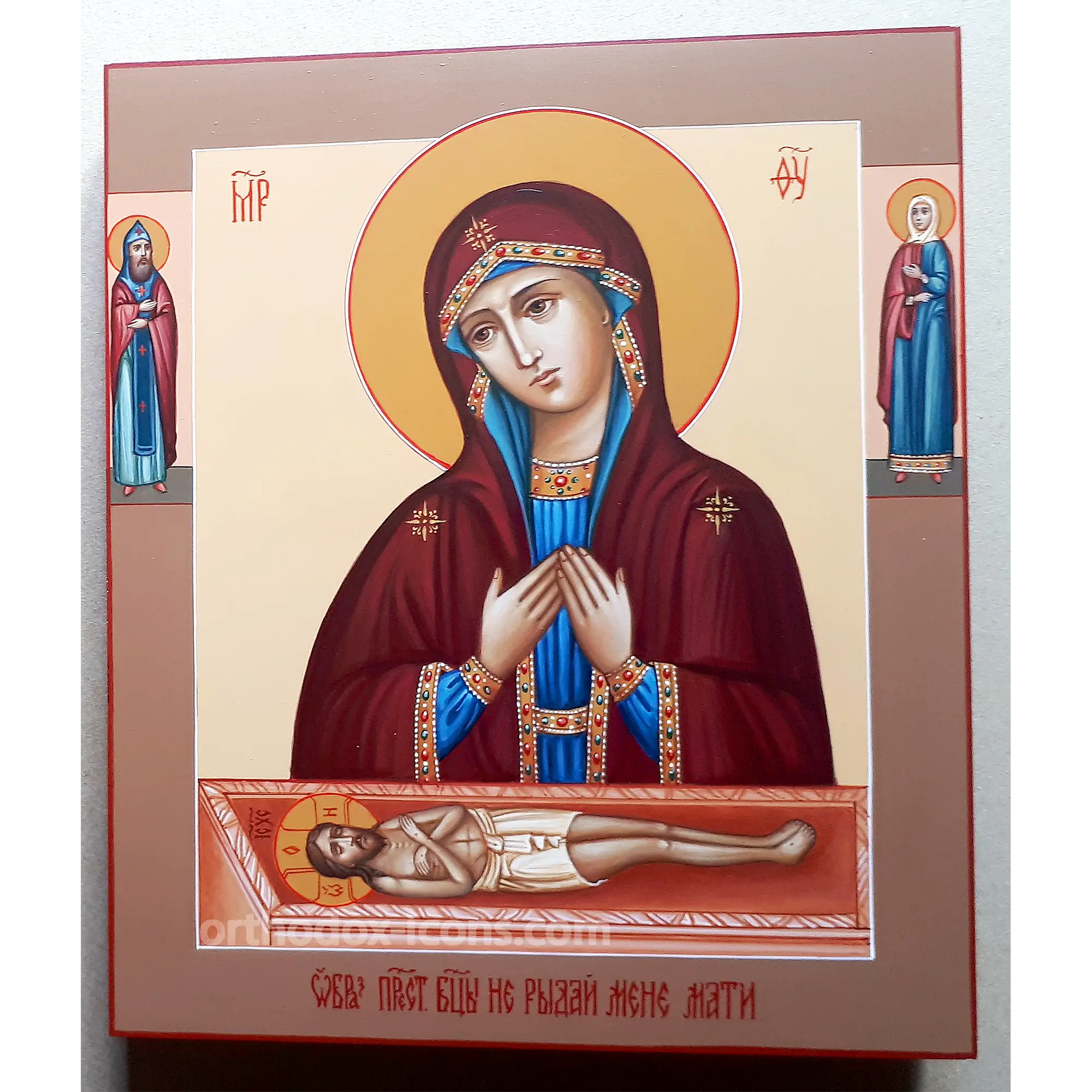
Do Not Mourn Me Mother Icon is a hand-painted Orthodox icon of Great Saturday, showing the Mother of God standing in prayer above the tomb of Christ. The title comes from the hymn of Holy Saturday, where the crucified Lord comforts His Mother with the promise of the Resurrection.
The icon is painted in mineral egg tempera on a linden board, with 23K gold leaf (960 purity), gold assist, and ornamental decoration imitating precious stones on the maphorion of the Mother of God. Free international shipping is included, with payment due upon delivery.
It is possible to paint an image in any size to order
Free shipping worldwide
Do Not Mourn Me Mother Icon is one of the most moving images in Orthodox iconography. It belongs to the spiritual world of Great Saturday, when the body of Christ rests in the tomb and the Church stands between the sorrow of the Cross and the joy of the Resurrection. The icon is not only an image of mourning. It is a confession that death has been entered by the Lord Himself and will be overcome by His rising.
In this hand-painted icon, the Mother of God stands at the center of the composition, dressed in a dark cherry maphorion. Her hands are folded on her breast in prayer, and her face is filled with silent maternal grief. Below her, in the tomb, lies the body of the dead Savior. His eyes are closed, His hands are folded crosswise, and the wounds of the Passion are visible. Behind the Mother of God, the Cross is not shown directly, yet its presence is understood through the whole meaning of the image.
Do Not Mourn Me Mother Icon – Meaning of the Title
The title comes from the hymn of Great Saturday, from the irmos of the ninth ode of the canon attributed to Saint Cosmas of Maiuma. In this hymn, the crucified and buried Christ speaks to His Mother and comforts her: He tells her not to weep over Him in the tomb, because He will rise and be glorified.
This is why the sorrow in the icon is unlike hopeless despair. The Mother of God truly grieves for her Son, and the icon does not lessen the reality of His death. Yet the hymn and the icon both point beyond the tomb. The death of Christ is voluntary and saving, and His burial already contains the promise of the Resurrection.
Great Saturday and the Orthodox Meaning of the Image
The icon presents the highest point of Holy Week in a concentrated form. Christ has been crucified and laid in the tomb. His body rests in death, while His divine soul descends into Hades to destroy the power of death. Orthodox tradition therefore sees this image not only as a scene of lamentation, but also as a proclamation of victory hidden beneath silence.
In Western Christian art, a related subject is often called the Pieta. The Orthodox icon has a different spiritual emphasis. It avoids theatrical despair and naturalistic suffering. Instead, it shows sacred grief purified by faith. The Mother of God stands in sorrow, but she does not collapse into hopelessness. She listens to the word of her Son: He will rise.
Iconography of the Presented Icon
In the lower part of the icon, Christ is shown in the tomb. His body is bare except for the loincloth, and the wounds of the Crucifixion are visible on His hands and side. His closed eyes and folded hands underline the reality of His human death. This detail is important: the icon confesses that the Son of God truly suffered and truly died for the salvation of the world.
The Mother of God rises above the tomb. She is dressed in a deep cherry, almost burgundy maphorion, a color that carries both royal dignity and maternal suffering. Her hands are folded in humble prayer. The face of the Theotokos is written with restrained psychological depth: grief, love, obedience, and hope are all present together.
A distinctive feature of this particular icon is the presence of saints on the side borders: a holy bishop and a righteous woman. In an individual order, such side figures may be replaced with personal patron saints, making the icon a family or commemorative shrine. The warm ocher background, fine gold assist, and ornamental decoration imitating pearls, rubies, and emeralds on the border of the Mother of God’s maphorion give the icon ceremonial dignity without weakening its sober Passion meaning.
Prayer Before This Icon
The Do Not Mourn Me Mother icon is especially close to those who are living through grief. People pray before it for consolation after the death of loved ones, especially when a parent mourns a child. The sorrow of the Mother of God standing before the dead Christ helps the grieving person remember that in God, death is not the final word.
The icon is also a support in times of severe trial: illness, persecution, injustice, poverty, fear, or collapse of ordinary life. Prayer before this image helps a person resist bitterness and despair, carry the cross of suffering with faith, and keep hope in the Resurrection.
Mothers also pray before this icon for children who are in danger, especially sons in military service, hazardous work, or destructive surroundings. Since the icon shows the Mother of God enduring the suffering of her Son, it speaks strongly to parental prayer, anxiety, and trust in God’s providence.
Because the image is centered on the saving Passion of Christ, people also pray before it for forgiveness of grave sins, deliverance from passions, a peaceful Christian death, and the hope of the Kingdom of Heaven.
Materials and Mstyora Icon Painting
This icon is made in the traditions of the Mstyora school of icon painting. The base is a seasoned linden board strengthened with oak braces. Linen cloth is applied to the front surface, and layers of natural chalk gesso are built up and polished to create a smooth and durable ground.
The painting is made with natural mineral egg tempera. The iconographer grinds mineral and earth pigments into fine powder and mixes them with an egg-based emulsion. This traditional technique gives the colors depth and stability and allows the painted surface to remain clear for many years when cared for properly.
The halos of Christ and the Mother of God are gilded with 23K gold leaf (960 purity). Gold assist is used in fine lines on the garments and halos as a sign of divine light. The maphorion border of the Mother of God is decorated with ornament that imitates precious stones, including pearls, rubies, and emeralds.
Available Sizes
Available sizes: 17×21 cm (6.7×8.3 in), 20×24 cm (7.9×9.4 in), 27×31 cm (10.6×12.2 in), and 30×40 cm (11.8×15.7 in). Larger church and iconostasis formats may be made by individual agreement. Free international shipping is included, with payment due upon delivery.
Icon Characteristics
| Name | Do Not Mourn Me Mother Icon |
| Traditional theme | Great Saturday, the Mother of God before Christ in the tomb |
| Composition | The Mother of God standing in prayer above the tomb of Christ; patron saints on the side borders |
| Board | Linden wood, linen cloth, natural gesso, oak braces |
| Painting | Mineral egg tempera |
| Gold | 23K gold leaf (960 purity), gold assist |
| Decoration | Ornament imitating precious stones on the maphorion border |
| Available sizes | 17×21, 20×24, 27×31, and 30×40 cm |
| Main prayer themes | Comfort in grief, strengthening of faith, protection of children, forgiveness, hope in the Resurrection |
Questions and Answers
Where does the title Do Not Mourn Me Mother come from?
The title comes from the irmos of the ninth ode of the canon of Great Saturday, attributed to Saint Cosmas of Maiuma. In the hymn, Christ comforts His Mother and speaks of His coming Resurrection.
What moment does this icon show?
The icon is connected with Great Saturday: the body of Christ rests in the tomb, while His victory over death is already approaching. The image holds together grief over the Passion and hope in the Resurrection.
Who is shown in the lower part of the icon?
The lower part shows the dead Christ in the tomb. His eyes are closed, His hands are folded upon His chest, and the wounds of the Crucifixion are visible.
How is the Mother of God shown?
The Mother of God stands in the center above the tomb of her Son. She wears a dark cherry maphorion, folds her hands in prayer, and expresses deep maternal sorrow without despair.
Is this icon similar to the Pieta?
The subject is related to the Western Pieta, but the Orthodox icon has a different emphasis. It does not focus on despair or naturalistic suffering, but on Christ’s voluntary sacrifice and the hope of the Resurrection.
Who are the saints on the side borders?
The side borders show patron saints: a holy bishop and a righteous woman. In individual orders, such saints may be replaced by the customer’s heavenly patrons.
What do people pray for before this icon?
People pray for comfort after the death of loved ones, strengthening of faith during trials, protection of children in danger, forgiveness of sins, and hope in eternal life.
What materials are used for this icon?
The icon is painted on a linden board prepared with linen cloth and gesso. The image is made with mineral egg tempera, and the halos and decorative details use 23K gold leaf and gold assist.
What sizes are available?
The icon is available in 17×21, 20×24, 27×31, and 30×40 cm. Larger church or iconostasis sizes may be discussed individually.
Why is the icon especially connected with Holy Week?
The icon is closely tied to Great Friday and Great Saturday, when the Church contemplates the burial of Christ and awaits the joy of the Resurrection.
| Dimensions | 17x21cm (6.7×8.3 in), 20x24cm (7.9×9.4 in), 27x31cm (10.6×12.2 in), 30x40cm (11.8×15.7 in) |
|---|---|
| Name | Jesus, Mary |