Nicetas the Confessor Orthodox Icon
$1000
Available size: 18×31 cm (7.1×12.2 in). Larger and iconostasis sizes can be made by agreement.
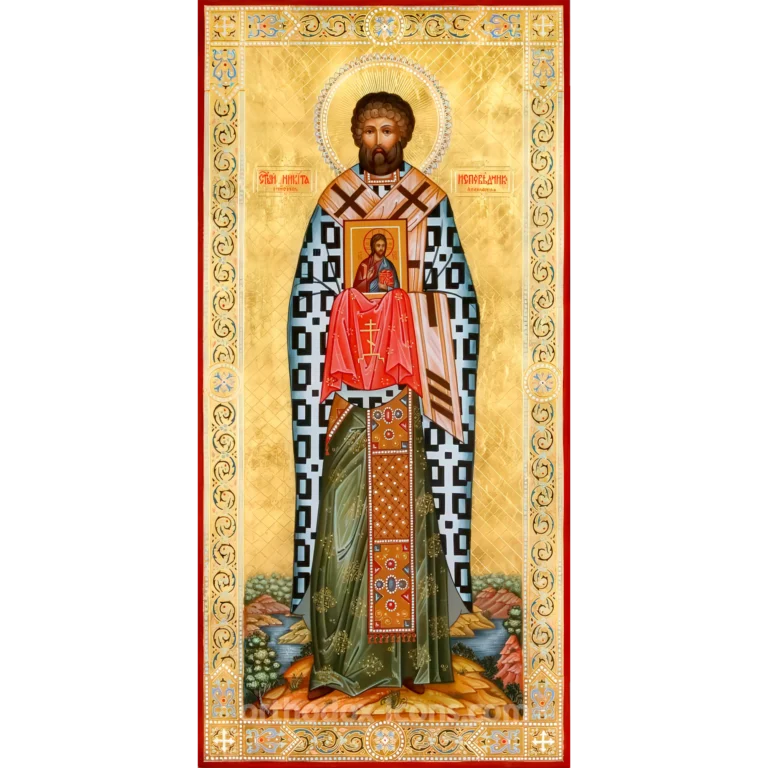
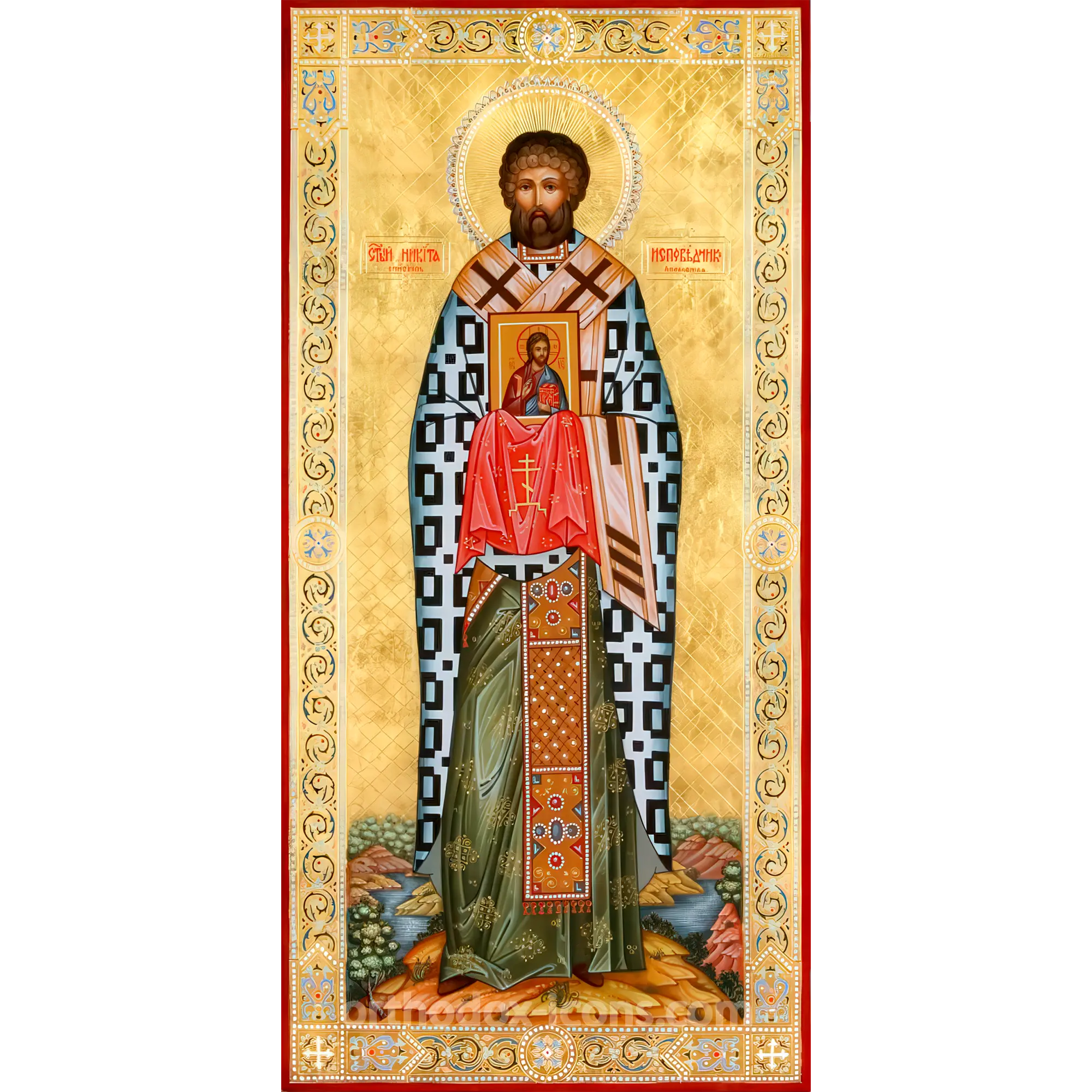
This hand-painted Nicetas the Confessor Orthodox Icon shows Saint Nicetas of Apolloniada as a full-length hierarch and confessor of the Orthodox faith. He is painted in episcopal vestments with an omophorion, holding an icon of Christ covered with a red veil, a direct reminder of his defense of holy icons during the iconoclast persecutions.
The icon is painted on a linden wood board with oak braces, gesso, egg tempera, mineral pigments, 23K gold leaf (960 purity), cold enamel details, and a protective finish. It is suitable for a home iconostasis, chapel, church, or as a patron saint gift for a man or boy named Nikita or Nicetas. Free international shipping is included. Payment is made after you receive and approve the icon.
It is possible to paint an image in any size to order
Free shipping worldwide
This hand-painted Nicetas the Confessor Orthodox Icon is a solemn full-length image of Saint Nicetas of Apolloniada, an Orthodox archbishop honored for his faithfulness to the Church and his defense of holy icons during the iconoclast persecutions. Saint Nicetas is venerated as a confessor because he did not accept false teaching, did not abandon the tradition of the Church, and remained firm in the Orthodox veneration of sacred images, for which he was exiled and ended his earthly life in confinement.
Because of this history, the icon is especially meaningful for those who pray for firmness in faith, spiritual discernment, courage under pressure, preservation of truth, and help in difficult circumstances when conscience must not be betrayed. The image is not aggressive or polemical; it presents the saint in calm, prayerful strength, as a hierarch whose steadfastness is rooted in Christ and the Church.
In this icon Saint Nicetas is shown full-length in episcopal vestments. He stands directly and solemnly against a light gilded background. The omophorion with crosses marks his episcopal dignity, while the icon of Christ in his hands, covered with a red veil, is the central theological detail of the composition. This is not simply a portrait of a bishop. It is an icon of a confessor who defended the Church’s prayer before holy icons and bore witness to the Orthodox understanding of the image of Christ.
The available size is 18×31 cm (7.1×12.2 in). Larger and iconostasis sizes can be made by agreement. The narrow vertical format suits the full-length figure well: the vestments, face, halo, omophorion, icon of Christ, red veil, inscriptions, gold background, and ornamental borders remain clear and balanced. A larger size can reveal more of the fine painting, gilding, color work, and decorative detail.
This icon is suitable as a patron saint image for a man or boy named Nikita or Nicetas. It may be given for baptism, name day, birthday, graduation, the beginning of independent life, ordination, church service, or an important family occasion. It is also appropriate for clergy, teachers, mentors, theologians, church workers, and people whose life often requires the defense of truth with patience and faith.
Features of This Icon
The main feature of this icon is the full-length image of Saint Nicetas in episcopal vestments, holding an icon of the Savior. This form expresses his confession very directly. Saint Nicetas of Apolloniada is honored not only as a pious bishop, but as a defender of holy icons in an age when icon veneration itself was persecuted. For this reason, the image of Christ in his hands becomes the central focus of the whole composition.
The face of the saint is painted with seriousness and attention. Large eyes, a calm gaze, dark hair, a rounded beard, and a restrained expression convey the spiritual collectedness of an archpastor. There is no harshness in the image. Saint Nicetas appears as a confessor firm in truth and inwardly rooted in faith. His stance is quiet but unshakable, which is especially fitting for a saint who suffered for the veneration of icons.
The episcopal vestments are painted richly and decoratively. The omophorion with large crosses lies over the garments and immediately identifies the saint as a bishop. The lower green garment is ornamented with fine light lines and small decorative elements. The red vertical section with a cross and additional ornament makes the figure especially expressive. Green, blue, red, white, and gold tones create a solemn but harmonious color scheme.
In the saint’s hands are the icon of Christ and a red veil. In Orthodox icon painting, red often points to sacrifice, love, confession, and spiritual victory. Here the red veil draws attention to the holy image of Christ and reminds the viewer that for Saint Nicetas the defense of icons was not an abstract argument, but an act of faithfulness to the Lord Himself.
The gilded background and large halo strengthen the solemn character of the icon. Behind the figure is a light gold field with fine texture, while the wide borders are decorated with ornament and colored details. The side borders and the upper and lower parts of the image include plant and geometric ornament. At the bottom is a quiet landscape base with earth, water, stones, and greenery. It gives the full-length figure visual stability without distracting from the saint.
Iconography of Saint Nicetas the Confessor
Saint Nicetas the Confessor of Apolloniada is depicted as an archbishop and defender of Orthodox faith. His episcopal clothing recalls his service to the Church, while his confession is expressed through the image of Christ that he holds in his hands. For a saint who suffered during the iconoclast period, this detail is especially powerful. It shows that in Orthodox tradition a holy icon is not a decoration or a mere picture, but a witness to the Incarnation and a way for the faithful to turn toward the prototype.
The omophorion is one of the chief signs of episcopal dignity. It points to pastoral responsibility, care for the Church, and service to the people of God. The crosses on the omophorion remind us that a bishop’s ministry is not worldly authority, but a cross-bearing path. For Saint Nicetas this meaning is especially clear: his episcopal service ended in confession, exile, and death in confinement.
The icon of the Savior in the saint’s hands can be understood as a painted testimony to his fidelity to Orthodox teaching. During the iconoclast controversies, defenders of holy icons confessed the truth that the Son of God truly became incarnate, became visible as man, and therefore His human image can be depicted. In this composition, Saint Nicetas stands as a guardian of Church tradition.
The gold background reveals the heavenly meaning of the image. In an Orthodox icon, gold is not a sign of earthly luxury, but of divine light. Here gold surrounds the saint, the icon of Christ, the halo, and the decorative borders, showing that the confession of Saint Nicetas belongs not only to history, but also to the living memory of the Church.
Prayer Before the Icon
Before an icon of Saint Nicetas the Confessor of Apolloniada, Orthodox Christians may pray for strengthening of faith, spiritual steadiness, wisdom, protection from error, and help in circumstances where truth must be preserved. His life is closely connected with the defense of holy icons, so this image is especially close to those who cherish Church tradition, seek theological clarity, and ask God for help not to be shaken by confusion, pressure, or false teaching.
People may also pray for clergy, teachers, mentors, and those who carry responsibility for others. The icon can support prayer for men and boys named Nikita or Nicetas, for peace of soul during trials, for firmness in prayer, and for those who endure injustice, exile, misunderstanding, or pressure because of conscience.
The witness of Saint Nicetas reminds us that confession of faith is not always expressed in loud words. Often it appears as calm fidelity, refusal to accept falsehood, readiness not to betray what is holy, and patience under pressure. This icon teaches that kind of strength: not anger, not argument for its own sake, but faithfulness to Christ and His Church.
Who This Icon Is For
This icon is especially appropriate for a man or boy named Nikita or Nicetas. It is a patron saint icon that may be given for baptism, name day, birthday, completion of studies, a new stage of life, or an important spiritual date. The name Nikita is connected with victory, and Saint Nicetas reveals victory in a spiritual sense: the victory of faith, truth, and steadfastness.
The icon is also suitable for a priest, teacher, mentor, theologian, church worker, or anyone whose life involves responsibility for truth and spiritual clarity. It can be placed in a home iconostasis, a personal prayer corner, a classroom, a chapel, a church, or a dedicated icon case.
Brief Life of Saint Nicetas
According to Orthodox tradition, Saint Nicetas served as archbishop of Apolloniada during the time of the iconoclast controversy. When the veneration of holy icons was attacked, he remained faithful to the teaching of the Church. He refused to reject the sacred images and suffered for his confession. His exile and confinement became the final seal of his witness.
The Church remembers him as a confessor because he bore witness to the truth without shedding blood as a martyr, yet with real suffering and endurance. His life shows that fidelity to the Church may require sacrifice, patience, and the willingness to stand alone when truth is opposed.
Materials and Technique
The icon is hand-painted on a linden wood board strengthened with oak braces. The prepared surface is covered with gesso, then painted in egg tempera with mineral pigments. The gold background, halo, and sacred accents are made with 23K gold leaf (960 purity). Cold enamel details and ornamental elements enrich the borders and decorative areas. A protective finish is applied after painting.
Because this is a hand-painted icon, small differences in the tone of gold, color accents, inscriptions, ornamental details, and fine facial painting are natural. These differences do not change the iconographic meaning of the image. They show that the icon is a painted devotional work rather than a printed reproduction.
Choosing the Size
The listed size, 18×31 cm (7.1×12.2 in), is well suited to the narrow full-length composition. It allows the figure of the saint to remain elegant and readable while preserving the vertical solemnity of the image. For a church, chapel, large home iconostasis, or special icon case, a larger or iconostasis size may be discussed before the icon is painted.
Placement and Care
The icon should be placed in a clean and dignified area, away from moisture, direct sunlight, overheating, soot, and mechanical damage. Dust should be removed only with a soft dry brush, without pressure. An icon case is recommended when extra protection is needed.
Free international shipping is included. Payment is made after you receive and approve the icon.
Questions and Answers
Who is shown in the Nicetas the Confessor Orthodox Icon?
The icon shows Saint Nicetas the Confessor of Apolloniada, an Orthodox archbishop honored for his firm defense of holy icons during the iconoclast persecutions.
Why is Saint Nicetas called the Confessor?
He is called the Confessor because he remained faithful to Orthodox icon veneration, refused false teaching, was exiled for the faith, and ended his earthly life in confinement.
Why does Saint Nicetas hold an icon of Christ?
The icon of Christ in his hands points directly to his confession of Orthodox teaching on holy icons and his defense of the Church’s veneration of sacred images.
What does the omophorion mean in this icon?
The omophorion with crosses is a sign of episcopal dignity and pastoral responsibility. It identifies Saint Nicetas as a hierarch of the Church.
What are the main features of this icon?
Saint Nicetas is shown full-length in episcopal vestments, with an omophorion, an icon of Christ, a red veil, a large gilded halo, a gold background, ornamental borders, and a quiet landscape base.
What do people pray for before an icon of Saint Nicetas?
People may pray for stronger faith, spiritual steadiness, wisdom, protection from error, courage under pressure, help in confessing truth, and fidelity to Orthodox tradition.
Who is this icon suitable for as a gift?
It is especially suitable for a man or boy named Nikita or Nicetas, and also for a priest, teacher, mentor, theologian, or anyone who values firmness in faith and truth.
When is Saint Nicetas the Confessor of Apolloniada commemorated?
Saint Nicetas the Confessor of Apolloniada is commemorated on April 2 according to the civil calendar used for fixed feasts in many Orthodox calendars.
What size is available for this icon?
The listed size is 18×31 cm. Larger sizes and iconostasis formats can be discussed before the icon is painted.
How should a hand-painted icon be cared for?
Keep the icon away from moisture, direct sunlight, overheating, soot, and mechanical damage. Dust it only with a soft dry brush, and use an icon case if extra protection is needed.
| Dimensions | 18x31cm (7.1×12.2 in) |
|---|---|
| Name | Nikita, Nicetas |