


The Transfiguration of Christ Orthodox Icon
Price range: $850 through $1750
20 x 24 cm, 27 x 31 cm, 30 x 40 cm and iconostasis formats.
The Transfiguration of Christ Orthodox Icon is a hand-painted feast icon revealing the divine glory of Christ, the uncreated light of Mount Tabor, and the calling of the human person to spiritual transformation.
Painted on a linden wood board with oak splines and kovcheg, traditional gesso, mineral egg tempera, and genuine 960-grade gold leaf. Free international shipping. Payment after receiving.
It is possible to paint an image in any size to order
Free shipping worldwide
The Transfiguration of Christ Orthodox Icon is one of the most significant Gospel feast images in Orthodox iconography. It reveals the divine glory of Christ, the mystery of uncreated light, and the calling of every Christian to inner spiritual transformation.
Before this icon, Orthodox Christians pray for enlightenment of the mind, strengthening of faith, help in spiritual life, peace of heart, and inner clarity in difficult circumstances. The icon is especially appropriate for a home iconostasis, as a gift for the great feast of the Transfiguration, and for a church or iconostasis setting.
Briefly About the Icon
- Icon name: The Transfiguration of Christ Orthodox Icon
- Feast meaning: the revelation of Christ’s divine glory on Mount Tabor
- Main theological emphasis: uncreated light, the transformation of the human person, strengthening of faith
- Chosen for: home prayer, feast-day gifts, family iconostasis, church and iconostasis use
- Available sizes: 20 x 24 cm, 27 x 31 cm, 30 x 40 cm, and larger iconostasis formats by request
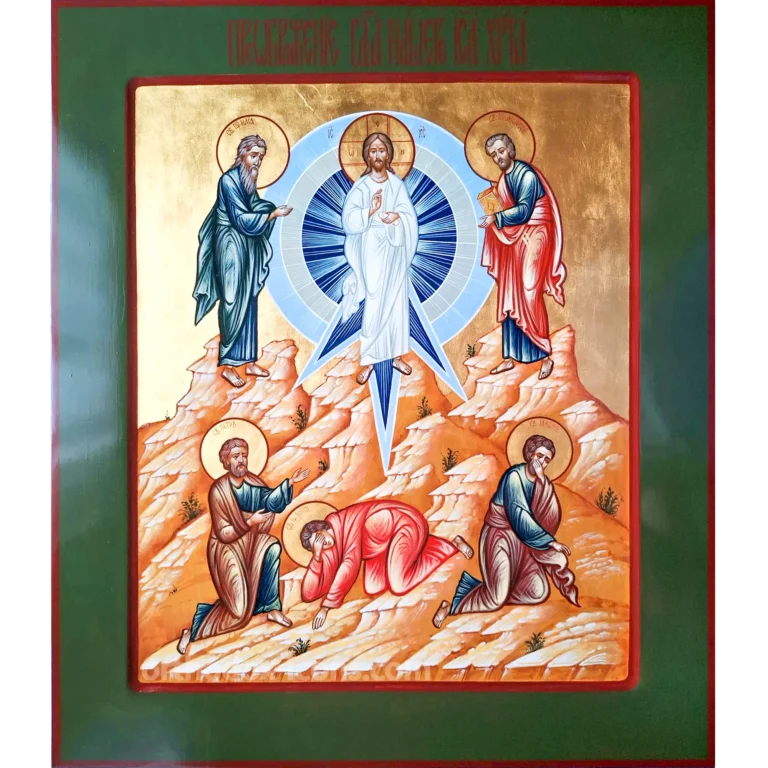
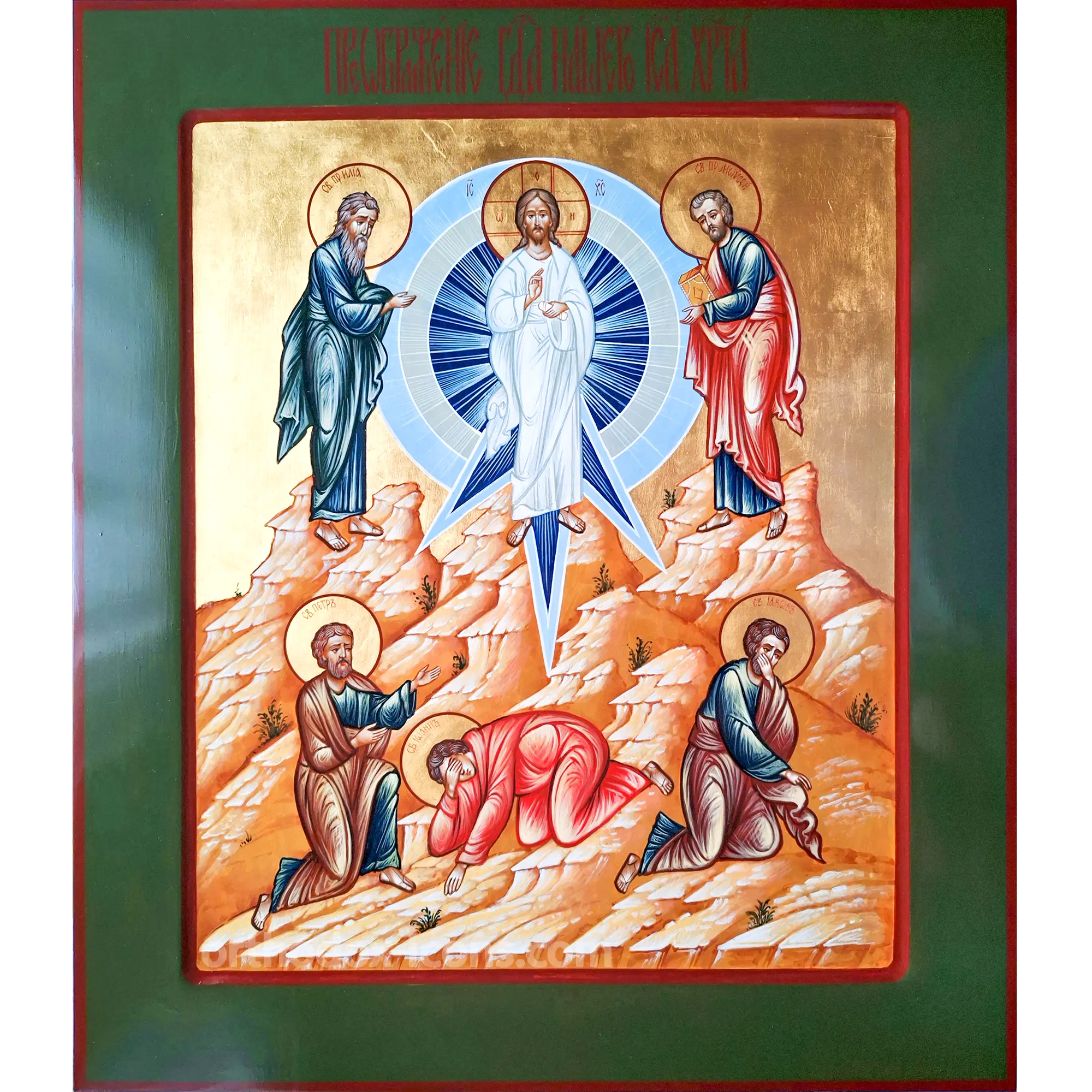
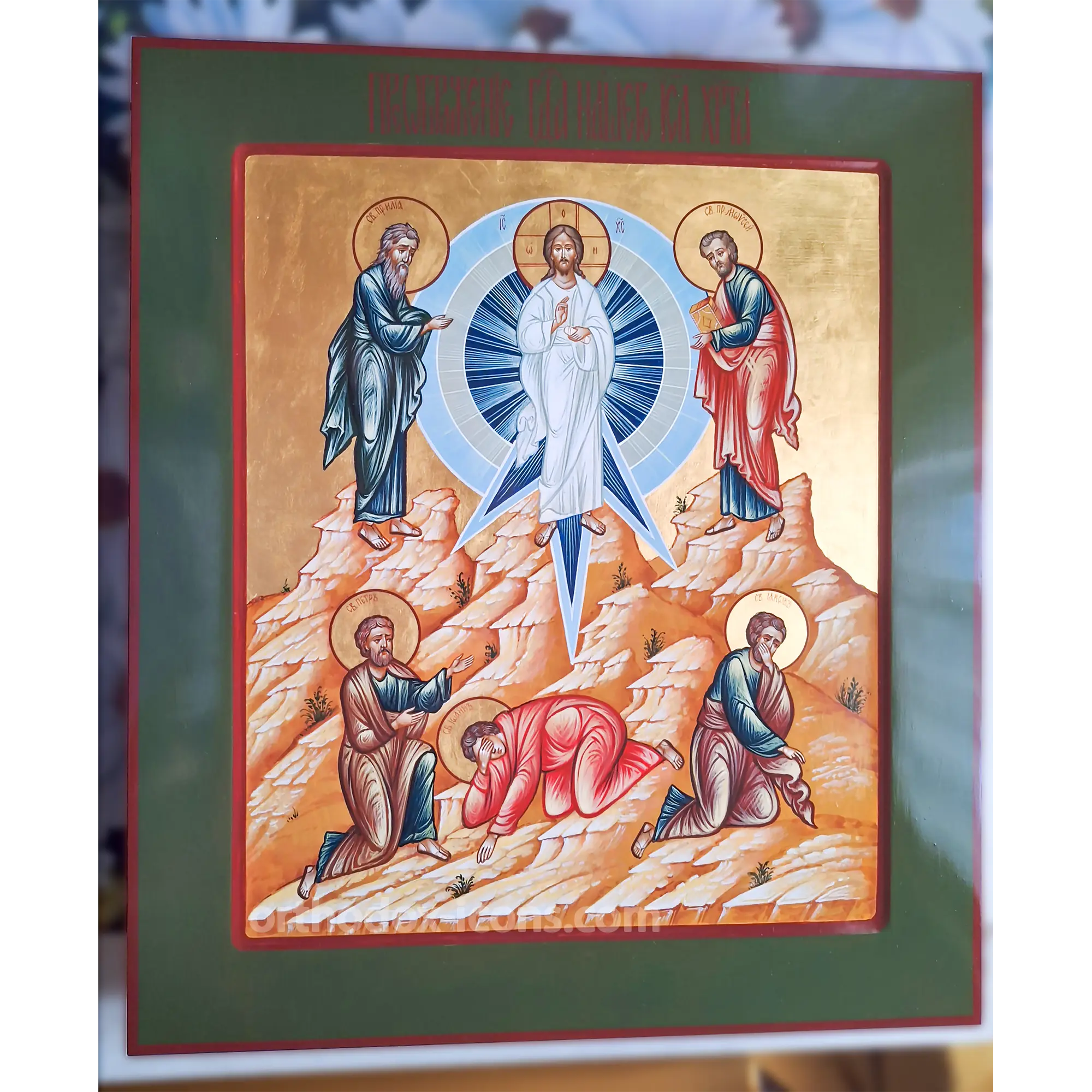
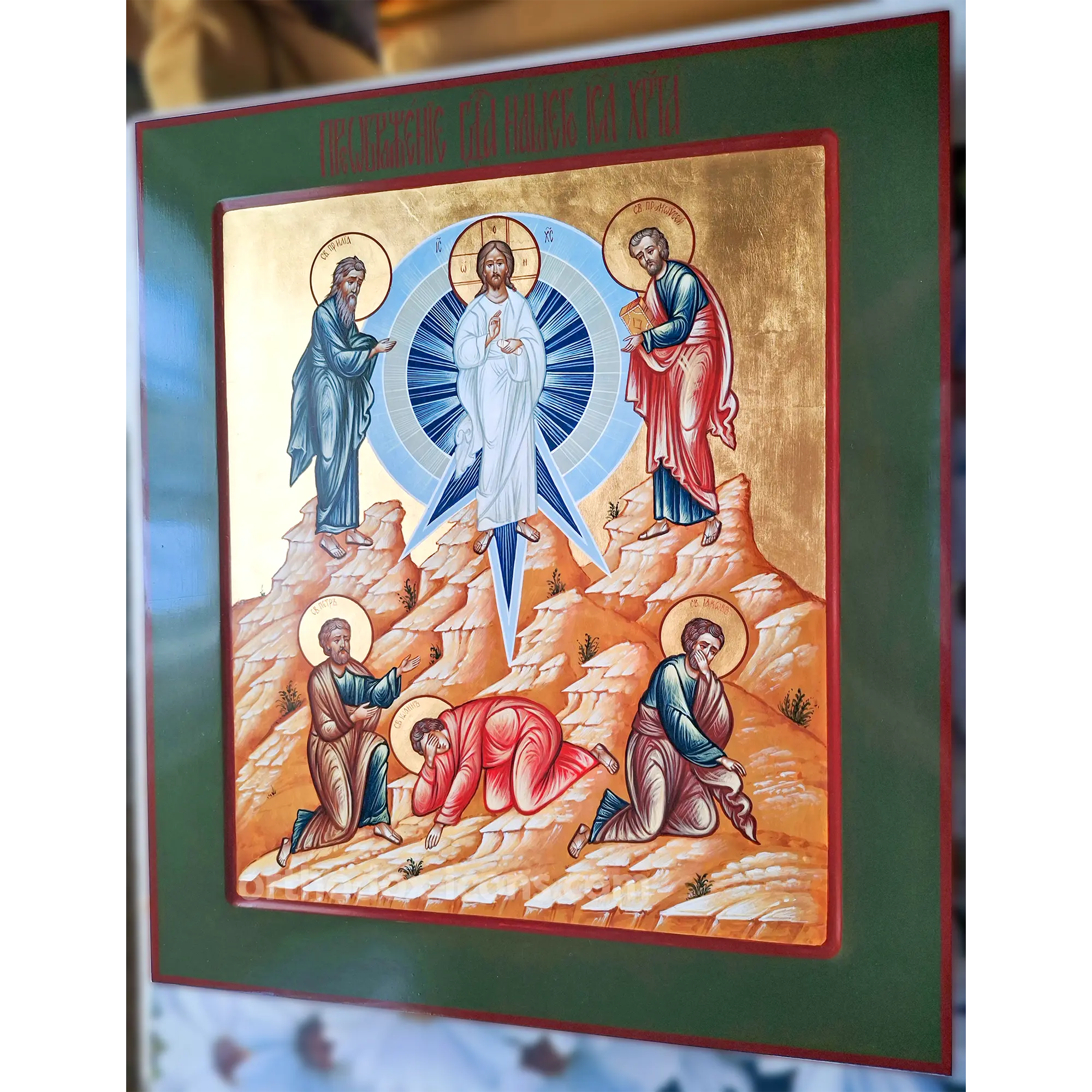
The composition follows the classical iconography of the feast. At the center stands Christ in shining white garments, surrounded by a radiant blue mandorla that reveals the manifestation of divine light. On either side of the Savior stand Moses and Elijah, appearing on Mount Tabor as witnesses of Christ’s glory. Below are the apostles Peter, James, and John, overcome by the vision and filled with holy awe.
Against the gold central field, the deep green borders, warm mountain ochres, blue rays of the mandorla, and the white garment of Christ create a solemn and luminous image. This icon unites festive beauty with profound theological meaning: it is not only a memory of one Gospel event, but a spiritual reminder that Christian life is a path toward purification, illumination, and participation in divine grace.
The Gospel Story of the Transfiguration
The Transfiguration is described in the Gospels and occupies an important place in the memory of the Church. The Lord Jesus Christ took three disciples, Peter, James, and John, and went up a high mountain, traditionally identified with Mount Tabor. There, while He prayed, Christ was transfigured before them: His face shone like the sun, and His garments became white as light.
Moses and Elijah appeared and spoke with the Savior. The disciples were filled with fear and amazement, and then they heard the voice of God the Father: “This is My beloved Son; listen to Him.” This event strengthened the apostles before the Passion and revealed that Jesus Christ is not only Teacher and Prophet, but the true Son of God, in whom divine glory dwells.
In Orthodox tradition, the Transfiguration also points to the future of the human person. It reveals that humanity is not called to darkness and corruption, but to renewal, sanctification, and the light of God.
Why This Feast Icon Is Especially Important
- it reveals the divine glory of Christ;
- it strengthens faith and speaks of the uncreated light of grace;
- it is connected with one of the most important Gospel events;
- it reminds the believer of the calling to inner spiritual transformation.
Theological Meaning of the Transfiguration Icon
The main theological meaning of the Transfiguration icon is the revelation of Christ’s divine glory. On Mount Tabor, the disciples were allowed to see what is normally hidden: divine light shining in the human nature of the Savior. This is not an external effect or decorative symbol, but a revelation of Christ Himself as God and Lord.
The presence of Moses and Elijah shows the connection between the Old and New Testaments. Moses is associated with the Law, and Elijah with prophecy and messianic expectation. Their presence beside Christ proclaims that in Him the Law and the Prophets are fulfilled.
The icon also reveals the final calling of the human person. In Orthodox theology, this is connected with the teaching of theosis: the human person is called to live in God, to be purified, sanctified, and illumined by divine grace. For this reason, the Transfiguration icon is an icon of hope.
The apostles at the foot of the mountain express fear, wonder, and the human inability to contain divine glory without humility and spiritual readiness. This gives the icon a deep ascetic meaning and makes it especially important for those who seek not only a beautiful feast image, but a serious reminder of the purpose of Christian life.
Prayer Before the Transfiguration Icon
Before the Transfiguration icon, believers pray for enlightenment of the mind, strengthening of faith, purification of the heart, help in spiritual struggle, and the gift of inner peace. The icon is especially close to those seeking clarity, wisdom, and strength in difficult times.
Common prayers before this icon include prayers:
- for spiritual enlightenment and strengthening of faith;
- for peace of heart and inner clarity;
- for help in overcoming doubt, fear, and despondency;
- for grace-filled change of life and purification of the soul;
- for wisdom and right choices in difficult circumstances;
- for the ability to see and follow the will of God;
- for help in spiritual growth and Christian transformation.
When This Icon Is Especially Appropriate
- for a home iconostasis and feast-day prayer;
- as a gift for a church feast, anniversary, or important spiritual occasion;
- for prayer for spiritual enlightenment and strengthening of faith;
- for a chapel, church, or iconostasis in a larger size;
- as an icon with strong theological and liturgical meaning.
Artistic Features of the Image
The presented Transfiguration icon has a clear, solemn, and theologically balanced composition. Christ is painted in radiant white garments, immediately becoming the visual and spiritual center of the icon. Around Him is a deep blue mandorla, whose rays extend outward and emphasize the revelation of uncreated light.
The color harmony is especially expressive. The gold background creates a sense of heavenly reality and feast-day radiance. The cool blue tones of the mandorla, the white garment of Christ, the red and blue garments of the prophets, and the warm ochre-pink mountain landscape form a solemn and spiritually strong image. The deep green borders with a red inner frame make the icon feel monumental and gathered.
The movements of the apostles are also important. One covers his face, another falls to the ground, and another reaches toward the Savior. These gestures show the drama of the event and the human response to divine glory, making the icon both artistically alive and prayerfully serious.
Technique of Creating the Icon
The hand-painted icon is made on a natural linden wood board. Linden is valued in icon painting for its stability, even structure, and ability to receive the ground and painted layers well. Oak splines help strengthen the board and reduce the risk of deformation.
The central kovcheg is formed to mark the sacred space of the image. The prepared surface is covered with traditional gesso, creating a smooth and durable ground for painting. The icon is then painted with mineral egg tempera, a traditional technique that gives depth, refined color, and long-lasting beauty.
Genuine 960-grade gold leaf is used for gilding. In the Transfiguration icon, gold is especially meaningful: it does not simply indicate material value, but the light of the Kingdom of Heaven and the divine glory revealed on Mount Tabor.
Icon Characteristics
| Icon name | The Transfiguration of Christ Orthodox Icon |
| Feast meaning | The revelation of Christ’s glory and uncreated light on Mount Tabor |
| Main spiritual emphasis | Enlightenment, strengthening of faith, spiritual transformation |
| Base | Natural linden wood board |
| Board reinforcement | Oak splines |
| Construction | Kovcheg |
| Ground | Traditional gesso |
| Painting | Mineral egg tempera |
| Gilding | Genuine 960-grade gold leaf |
| Sizes | 20 x 24 cm, 27 x 31 cm, 30 x 40 cm, and iconostasis formats |
| Purpose | For home, family prayer, gifts, chapel, church, and iconostasis |
Why This Icon Is Important for Home and Church
The Transfiguration of Christ Orthodox Icon unites festive beauty with deep spiritual meaning. For the home, it is a reminder that Christian life should move toward light, purification, and inner renewal. For the family, it is an image before which one may pray for peace of heart, wisdom, faith, and the light of Christ in daily life.
For a church or iconostasis, this is one of the essential feast icons. The available sizes make it suitable both for a home icon corner and for a larger sacred space. The traditional materials and technique give the icon true church, artistic, and long-term value.
Shipping and Payment
Free international shipping is included. The icon is carefully packed to protect the painted surface and gilded details. Payment is made after receiving the icon.
Questions and Answers
What is shown in The Transfiguration of Christ Orthodox Icon?
The icon shows Christ transfigured on Mount Tabor, standing in radiant white garments within a blue mandorla, with Moses and Elijah beside Him and the apostles Peter, James, and John below in awe.
What is the spiritual meaning of the Transfiguration?
The Transfiguration reveals the divine glory of Christ, the mystery of uncreated light, and the calling of the human person to spiritual transformation and participation in divine grace.
Why are Moses and Elijah shown beside Christ?
Moses represents the Law and Elijah represents the Prophets. Their presence shows that Christ is the fulfillment of the Old Testament and the center of God’s saving plan.
Why are the apostles shown falling or covering their faces?
Peter, James, and John are overwhelmed by the revelation of divine glory. Their gestures show reverent fear and the human inability to fully contain the mystery of God’s light.
What do Orthodox Christians pray for before this icon?
Before this icon believers pray for enlightenment of the mind, strengthening of faith, peace of heart, wisdom in difficult circumstances, and spiritual renewal.
What materials are used?
The icon is painted on a linden wood board with oak splines and kovcheg, traditional gesso, mineral egg tempera, and genuine 960-grade gold leaf.
What sizes are available?
The available sizes are 20 x 24 cm, 27 x 31 cm, and 30 x 40 cm. Larger iconostasis formats can be discussed individually.
Is this icon suitable as a gift?
Yes. It is suitable as a gift for the feast of the Transfiguration, for a home iconostasis, a family prayer space, a chapel, or a church.
How should the icon be cared for?
Keep the icon away from direct sunlight, moisture, heat, and sudden temperature changes. Dust it gently with a dry soft brush; do not use water or cleaning products.
Do you offer international shipping and when is payment made?
Yes. Free international shipping is included, and payment is made after receiving the icon.
| Dimensions | 20x24cm (7.9×9.4 in), 27x31cm (10.6×12.2 in), 30x40cm (11.8×15.7 in) |
|---|---|
| Name | Jesus |