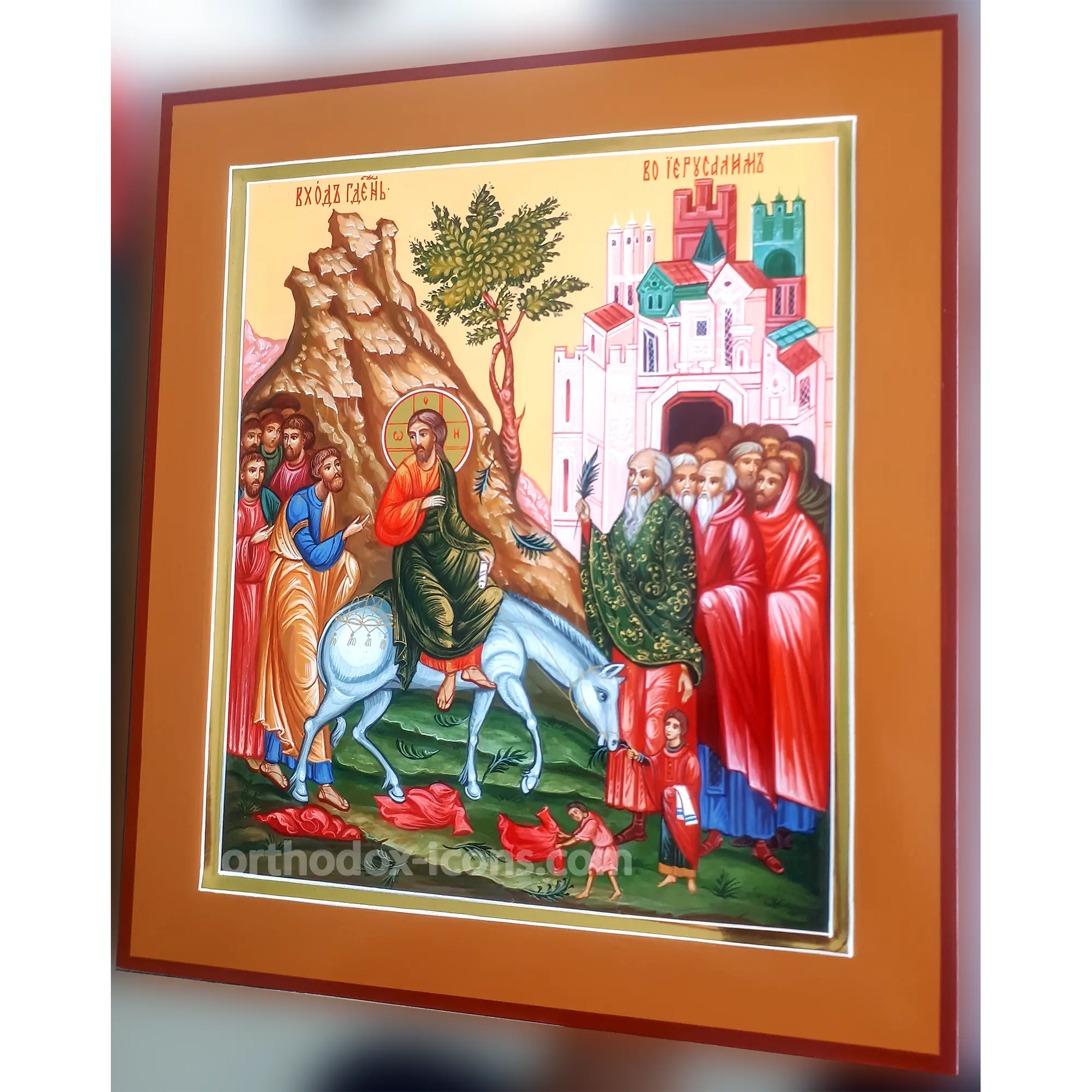
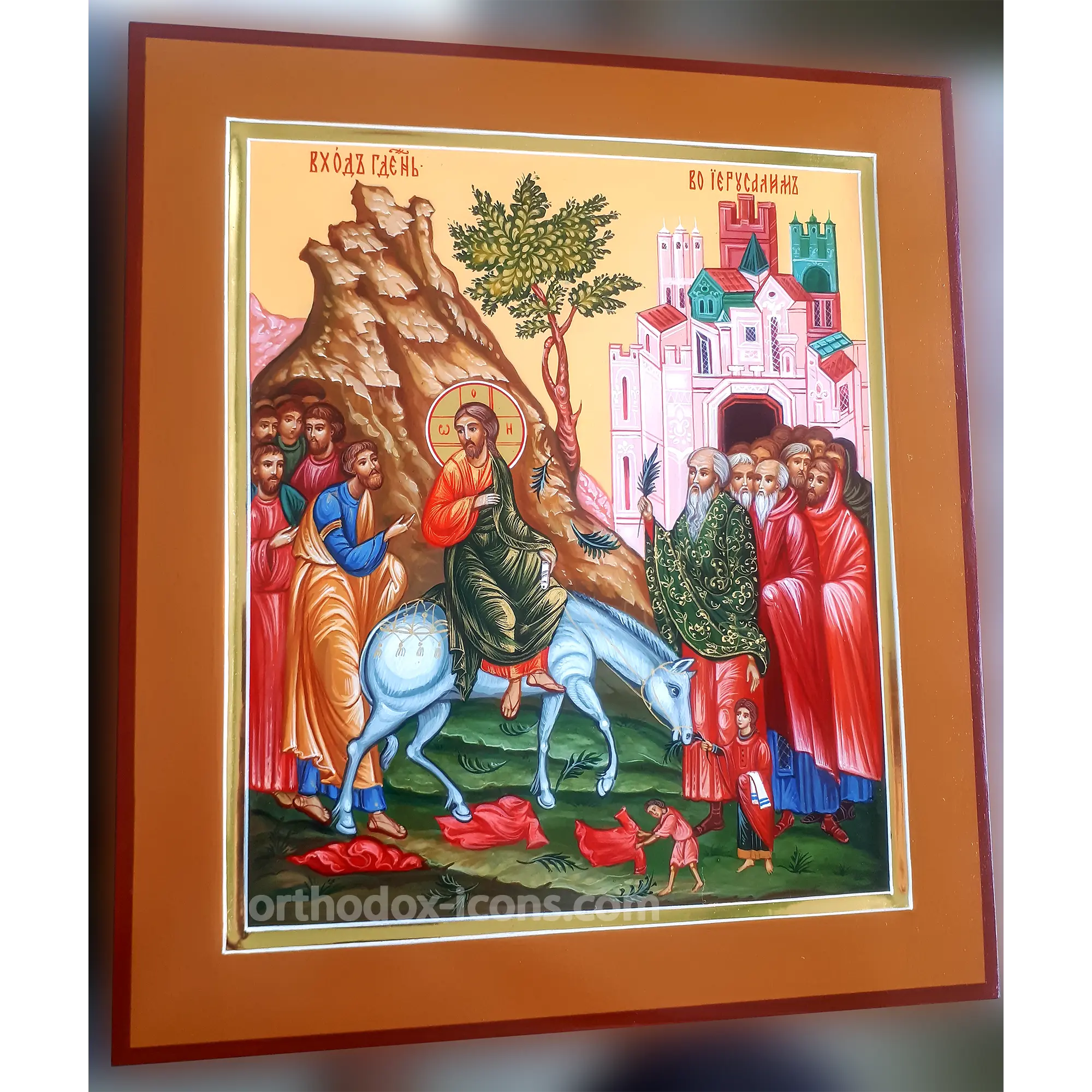
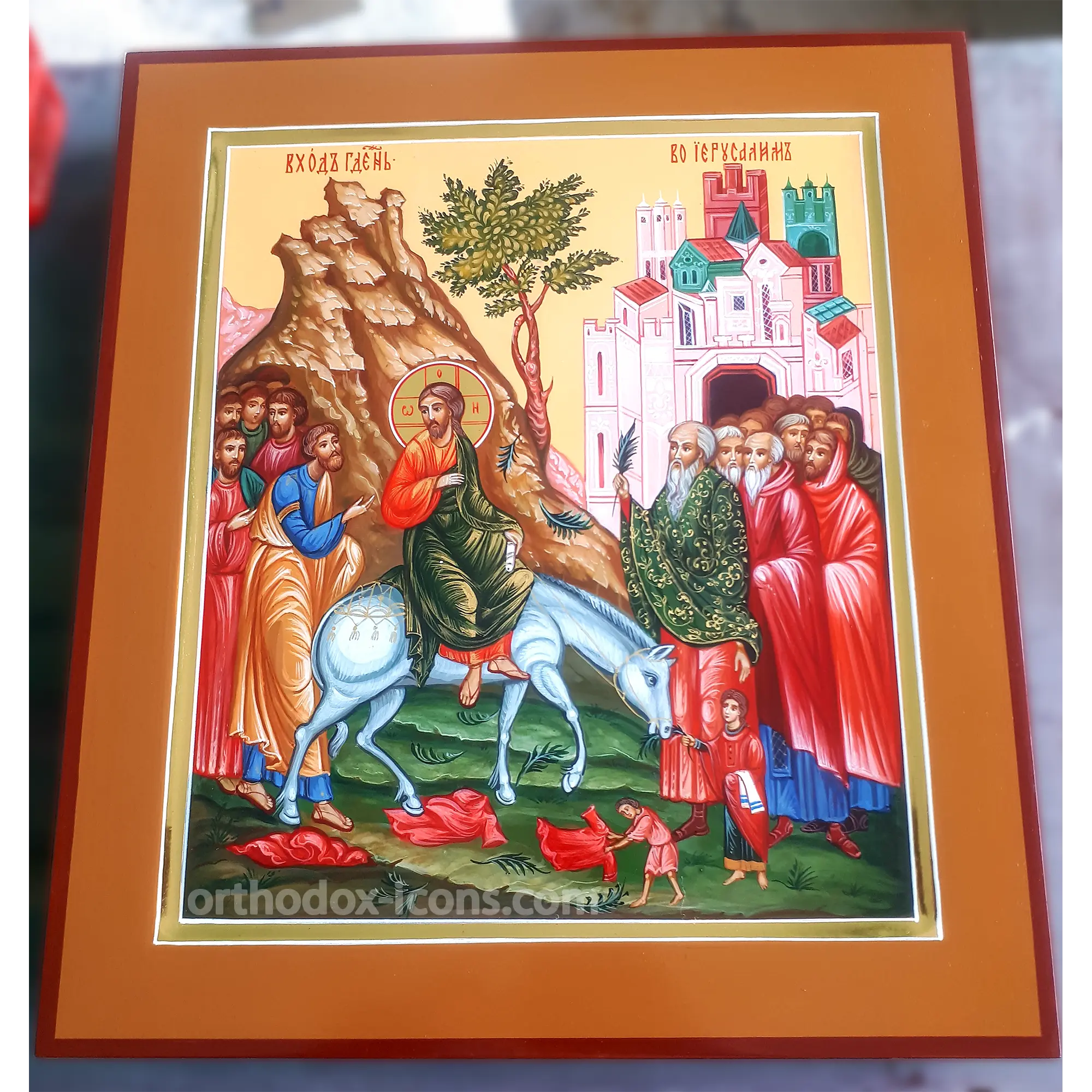
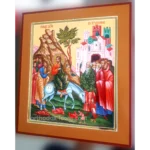
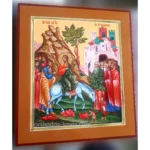
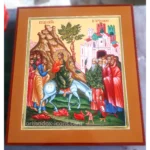
The Entry into Jerusalem Orthodox Icon
Price range: $850 through $1750
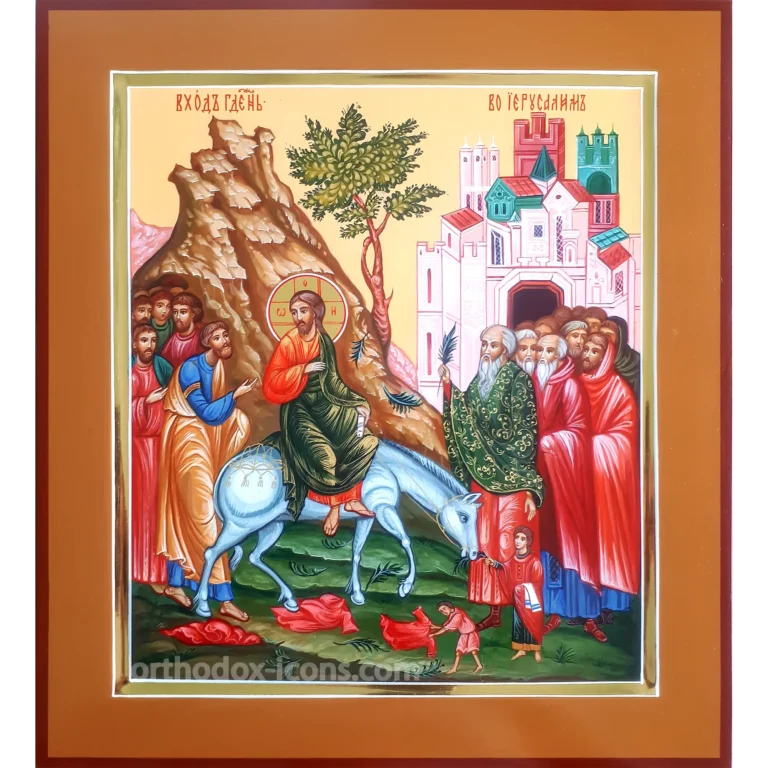
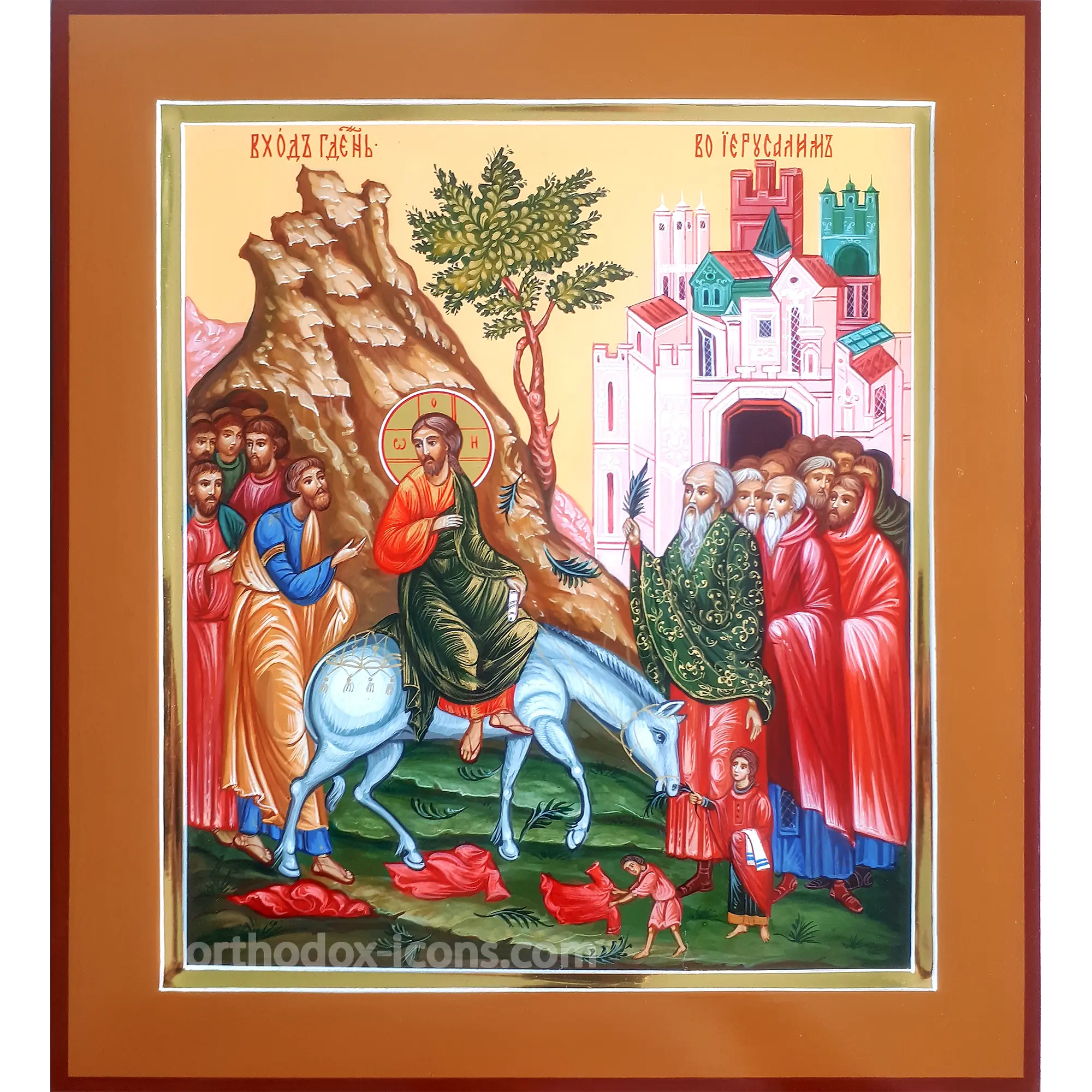
The Entry into Jerusalem Orthodox Icon is a hand-painted feast icon of Palm Sunday, made in the Mstyora tradition on a linden wood board with kovcheg.
Materials: linden wood board with oak splines, linen pavoloka, chalk gesso, mineral egg tempera, natural pigments, and genuine 960-grade gold leaf on halos and kovcheg borders.
Available sizes: 20 x 24 cm, 27 x 31 cm, 30 x 40 cm. Free international shipping. Payment after receiving.
It is possible to paint an image in any size to order
Free shipping worldwide
Among the rich cycle of Orthodox feast icons, The Entry into Jerusalem Orthodox Icon stands out for its solemn joy and quiet dramatic depth. It shows the moment when the Savior enters Jerusalem, welcomed by the people as the true King, while already moving toward His voluntary Passion.
In the Mstyora icon-painting tradition, this image is created with special reverence. The goal is not only to portray a historical event, but to express the spiritual joy, humility, and stillness brought into the world by the meek King of Glory.
Mstyora Painting Technique: Faithfulness to Tradition
Each icon is painted by hand with natural materials and traditional methods. This is not a printed decoration, but a genuine work of church art made with the skill of the iconographer, the gilder, and the painter of faces and garments.
The icon is made on a prepared linden wood board with kovcheg. Linen pavoloka, chalk gesso, mineral egg tempera, and 960-grade gold leaf are used. The layered painting and careful drawing give the icon depth, clarity, and long-term value as a family or church sacred image.
Theological Meaning and Composition
The Entry of the Lord into Jerusalem, celebrated on Palm Sunday, fulfills the ancient prophecy of Zechariah: “Behold, your King is coming to you… humble and mounted on a donkey.” Christ is shown seated on a young donkey. His figure is turned toward the disciples, while His gaze is directed toward Jerusalem and Golgotha, emphasizing the voluntary nature of His sacrifice.
The composition includes groups of apostles, townspeople with branches, and children spreading garments before the Savior. The architectural background, the walls of Jerusalem, and the stylized mountains give the icon both narrative richness and a clear Orthodox structure. Jerusalem also points beyond the earthly city toward the heavenly Kingdom.
Painting, Gold, and Sacred Light
This icon is built on a refined balance between color and light. Unlike icons with a fully gilded background, the painterly landscape and architecture are preserved, while gold is used to mark the sacred centers of the image:
- Painted background: the landscape and architecture are painted in mineral egg tempera, creating deep, breathing color transitions and a noble sense of space.
- Gilded halos and borders: genuine 960-grade gold leaf is used for the halo of the Lord and for the borders of the kovcheg, forming a radiant sacred frame.
- Gold assist: fine lines of gold may be applied to the garments of Christ, symbolizing divine energy and His royal dignity.
From Board to Finished Icon
The creation of the icon begins with the preparation of the kovcheg, the recessed central field of the linden board. Linden wood is chosen for its stability and suitability for icon painting. The board is strengthened with oak splines, covered with linen pavoloka, and prepared with multiple layers of gesso polished to a smooth surface.
Only after this preparation does the iconographer begin the drawing and the layered painting. Every line, every fold of a garment, every branch, and every gold accent is the result of focused work and knowledge of Orthodox canon. The finished icon is protected so that it can remain a prayerful image for many years.
Sizes and Versions
The Entry into Jerusalem Orthodox Icon is available in several sizes, allowing the image to be chosen for different spaces:
- 20 x 24 cm: a compact format for a home icon corner or personal prayer space
- 27 x 31 cm: a lectern-size format where the details of Mstyora painting are more fully visible
- 30 x 40 cm and larger formats: suitable for feast rows, church interiors, and larger prayer spaces
Icon Characteristics
| Parameter | Description |
|---|---|
| Icon subject | The Entry of the Lord into Jerusalem, Palm Sunday |
| School | Mstyora icon-painting tradition |
| Base | Linden wood board with oak splines and kovcheg |
| Painting technique | Mineral egg tempera on traditional gesso |
| Gilding | 960-grade gold leaf on halos and kovcheg borders |
| Available sizes | 20 x 24, 27 x 31, 30 x 40 cm and larger formats by request |
| Purpose | Feast icon, Orthodox gift, home icon corner, church image |
Shipping and Payment
Free international shipping is included. The icon is packed carefully to protect the painted surface and gilded details. Payment is made after receiving the icon.
Questions and Answers
What feast is shown in The Entry into Jerusalem Orthodox Icon?
The icon shows the Entry of the Lord into Jerusalem, also known as Palm Sunday, one of the Twelve Great Feasts of the Orthodox Church.
What is the spiritual meaning of Christ entering Jerusalem on a donkey?
Christ enters Jerusalem as the true King, but in humility rather than earthly power. The icon points toward His voluntary Passion and the mystery of Holy Week.
Why are people holding branches in the icon?
The branches symbolize the joyful greeting of Christ by the people of Jerusalem. In Orthodox tradition this feast is associated with palms or willow branches, depending on local custom.
Why are children shown in the composition?
Children spreading garments and branches before Christ express pure praise and the joyful recognition of the Savior as King.
Why is the background painted rather than fully gilded?
The painted background allows the iconographer to show the landscape, city walls, and architecture of Jerusalem. Gold is used selectively for halos, borders, and sacred accents.
What materials are used?
The icon is painted on a linden wood board with oak splines and kovcheg, linen pavoloka, traditional gesso, mineral egg tempera, and genuine 960-grade gold leaf.
What sizes are available?
The available sizes are 20 x 24 cm, 27 x 31 cm, and 30 x 40 cm. Larger church and iconostasis formats can be discussed individually.
Is this icon suitable as a gift?
Yes. It is suitable for Palm Sunday, house blessing, a family icon corner, a parish gift, or a church feast icon.
How should the icon be cared for?
Keep the icon away from direct sunlight, moisture, heat, and sudden temperature changes. Dust gently with a dry soft brush, especially around gilded areas.
Do you offer international shipping and when is payment made?
Yes. Free international shipping is included, and payment is made after receiving the icon.
| Dimensions | 20x24cm (7.9×9.4 in), 27x31cm (10.6×12.2 in), 30x40cm (11.8×15.7 in) |
|---|---|
| Name | Jesus |