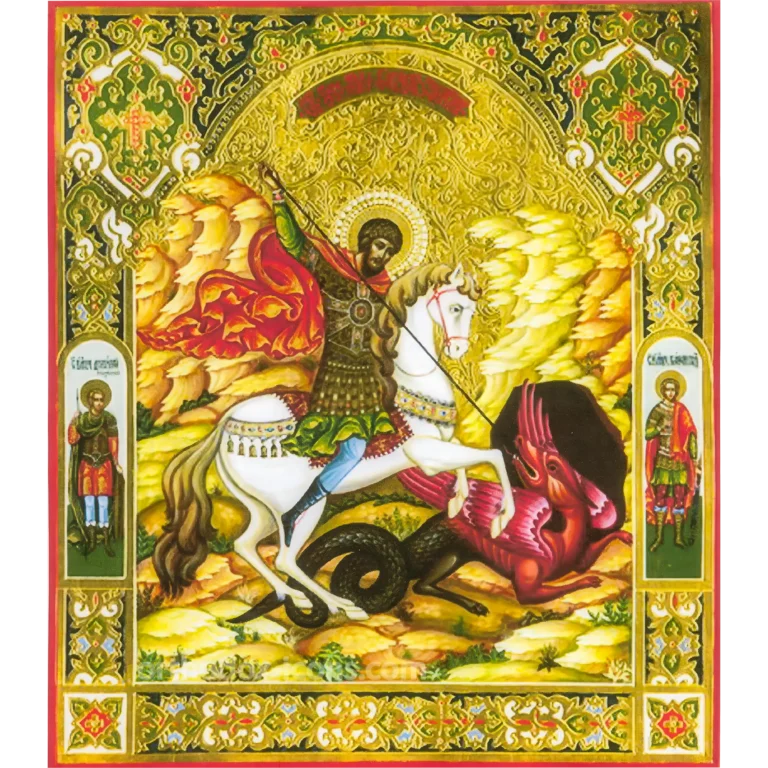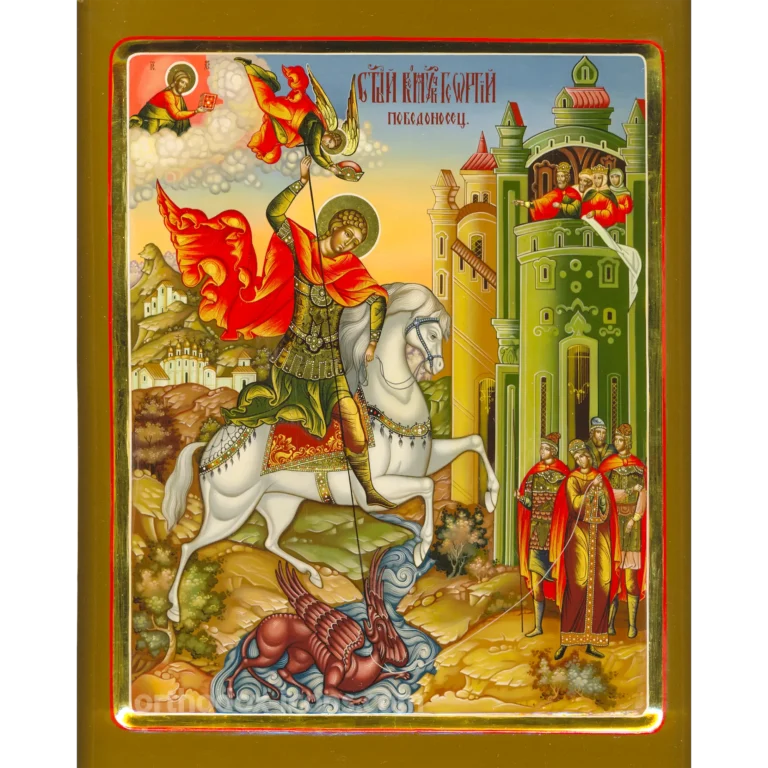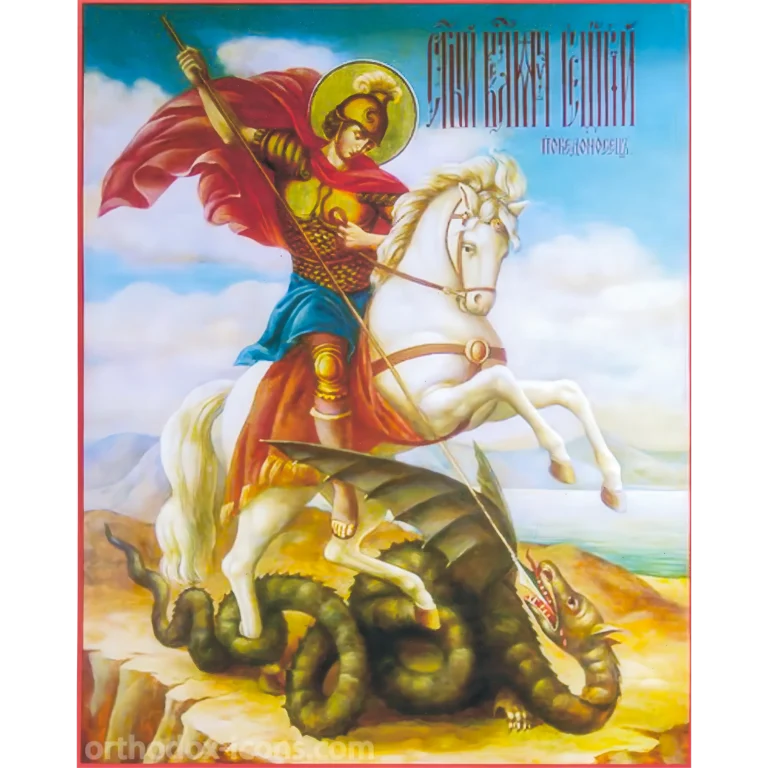
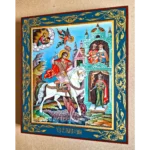
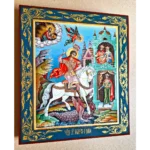
Orthodox Icon St. George and the Dragon
Price range: $1500 through $2250
Available sizes: 27×31 cm (10.6×12.2 in), 30×40 cm (11.8×15.7 in), and larger church or iconostasis sizes by individual commission.
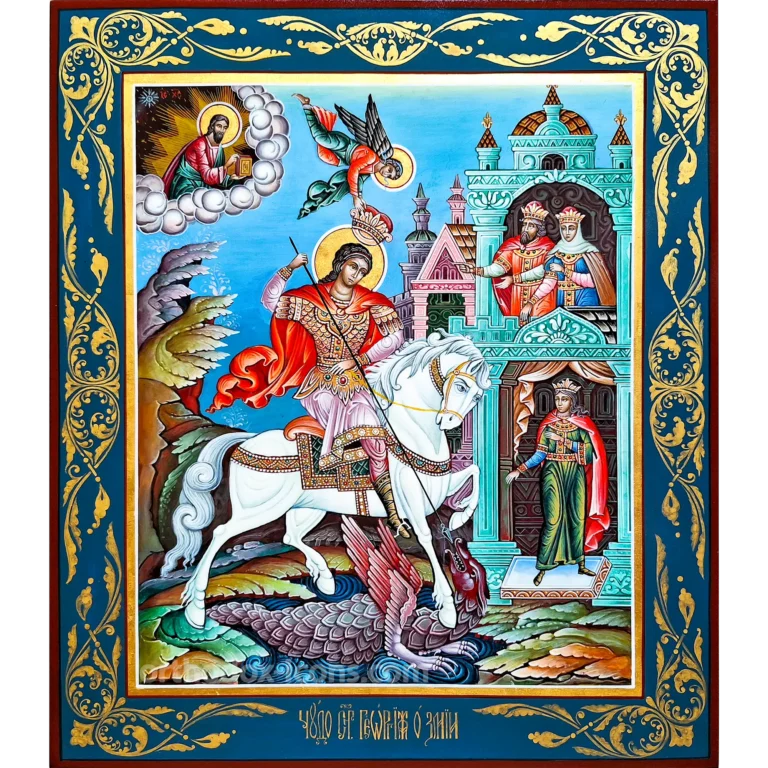
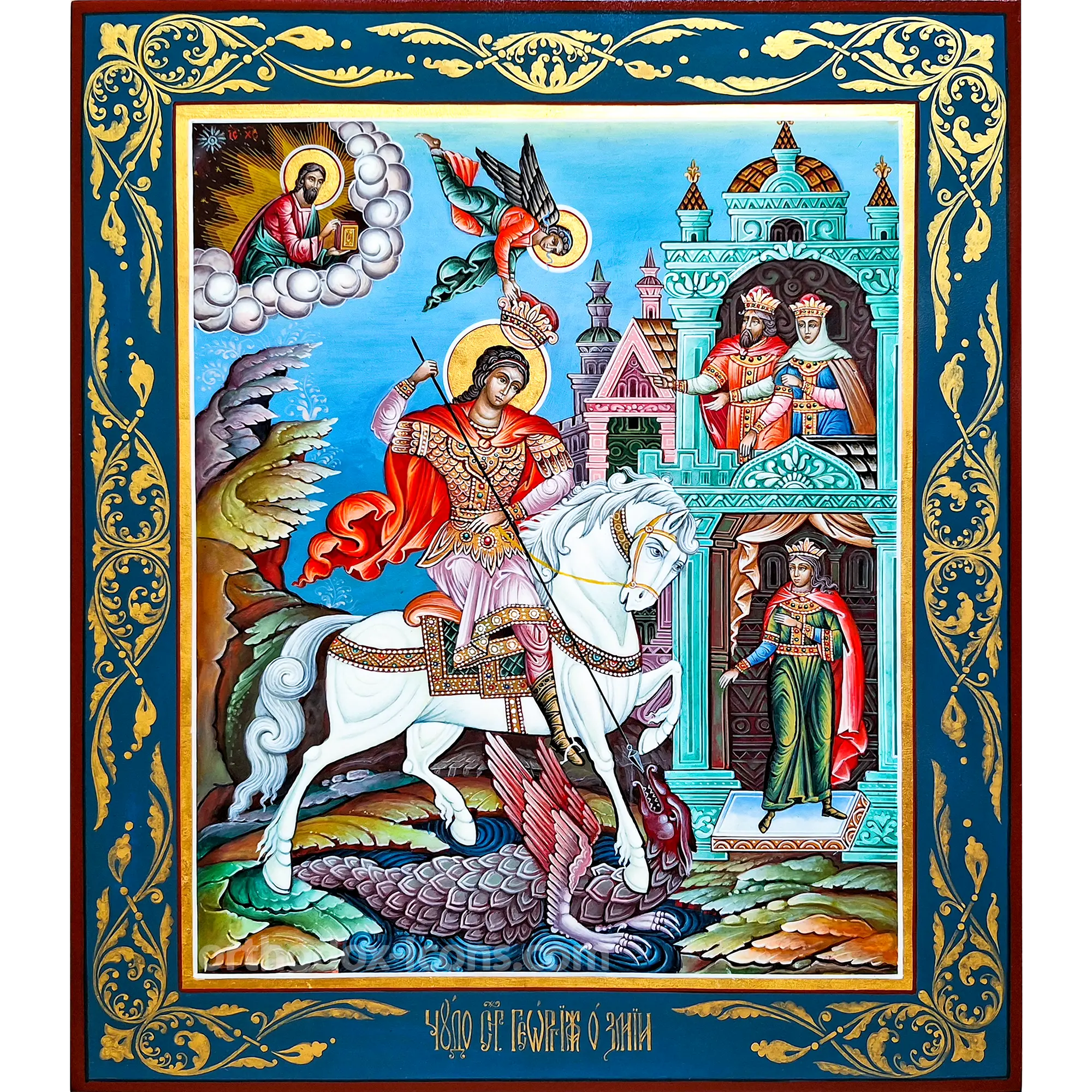
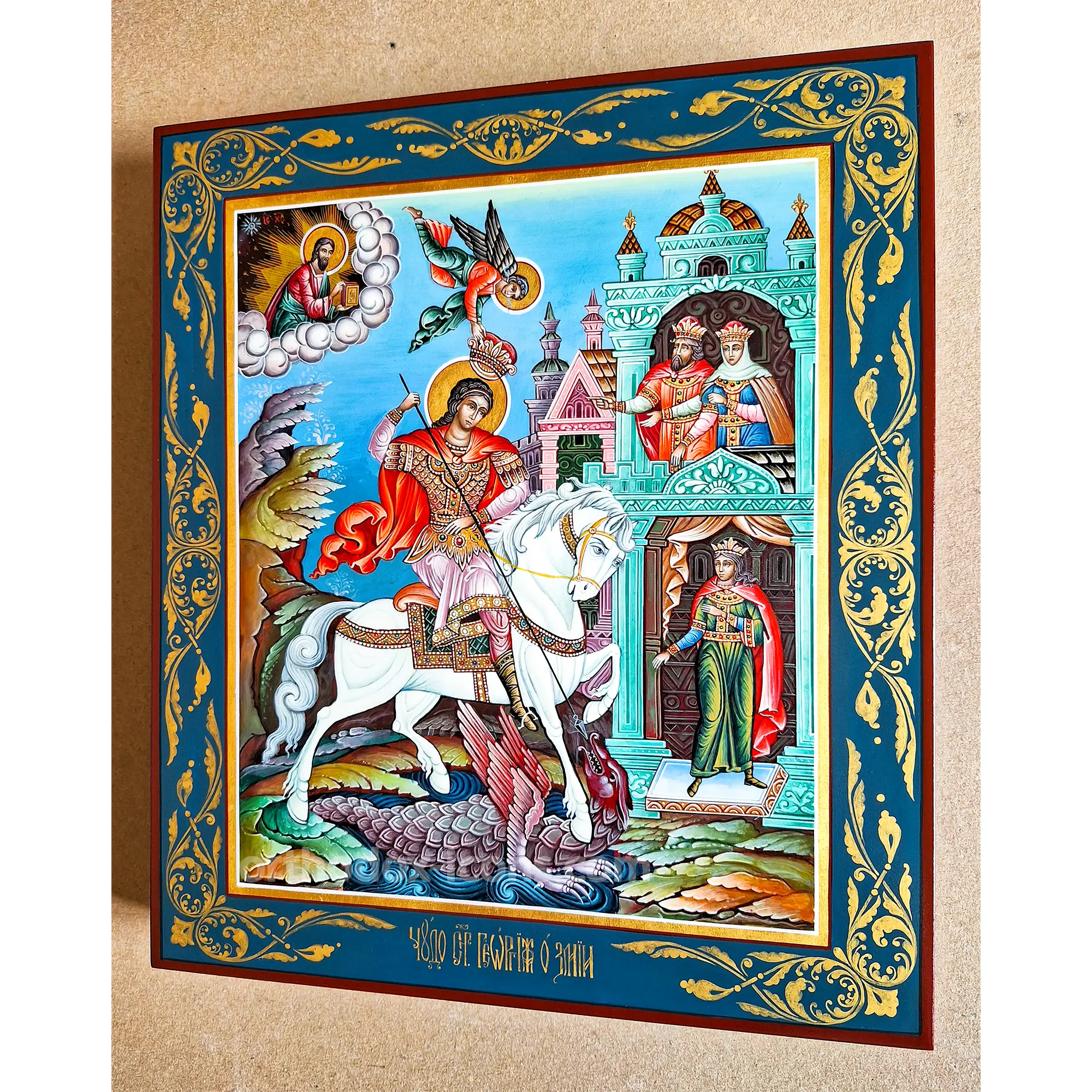
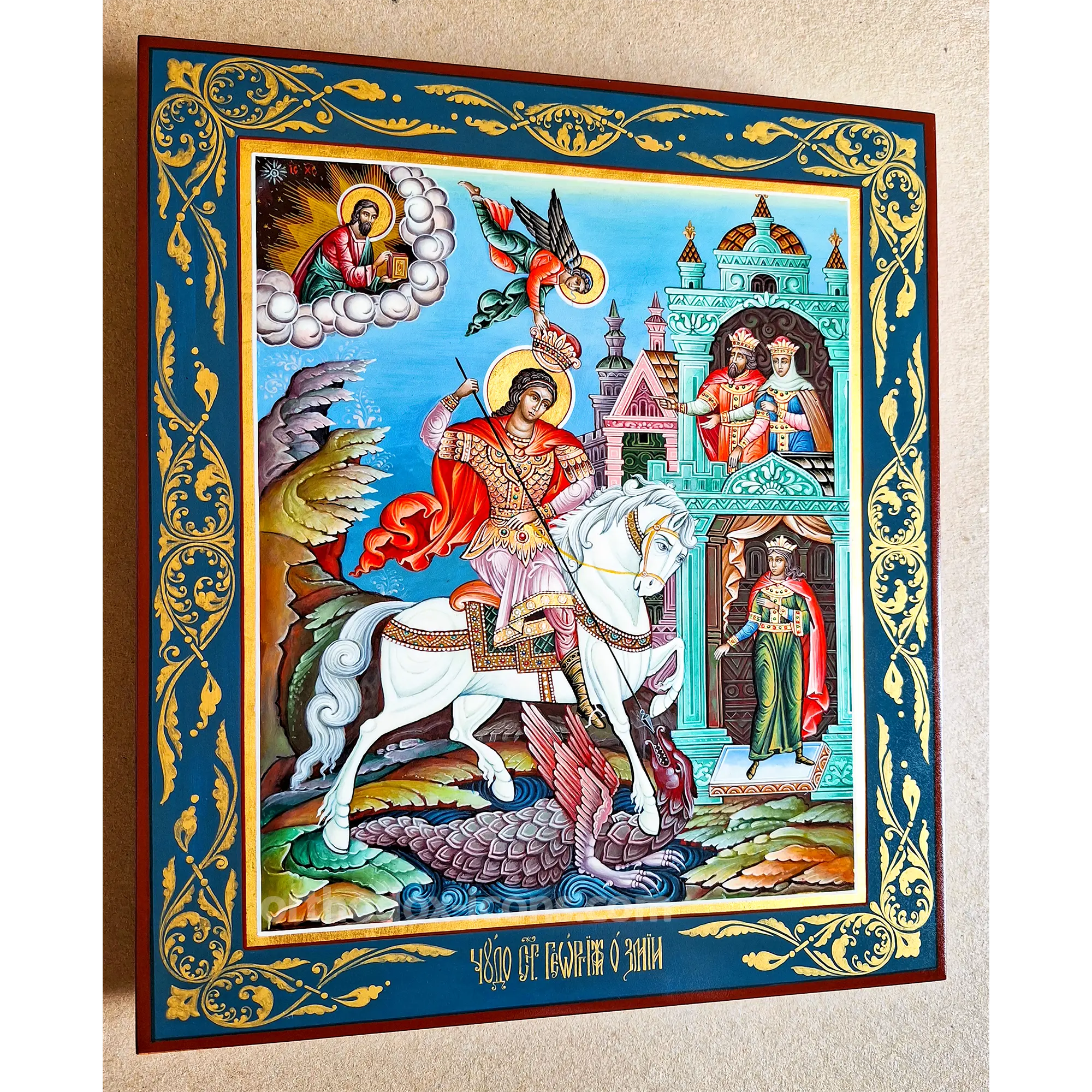
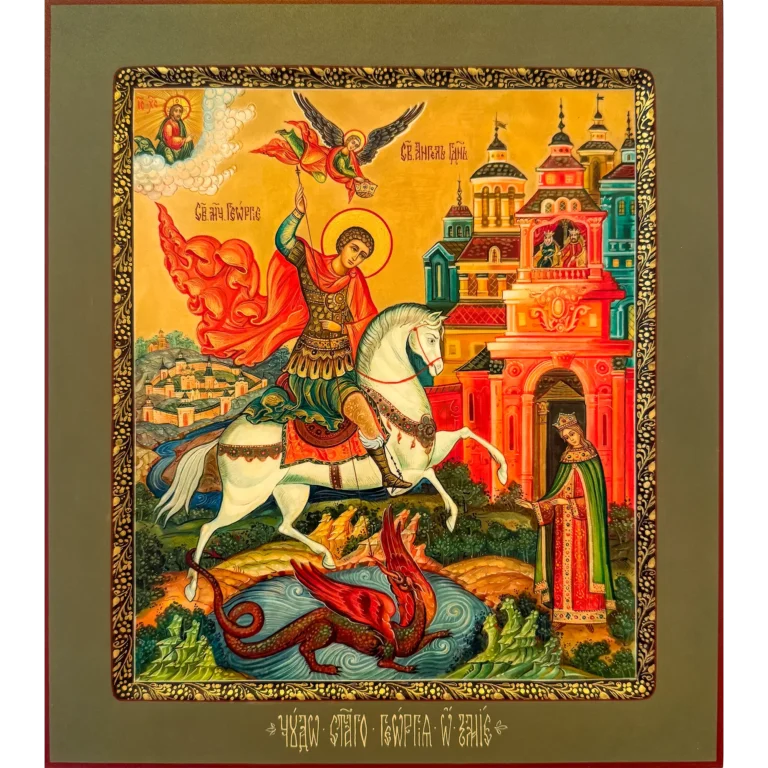
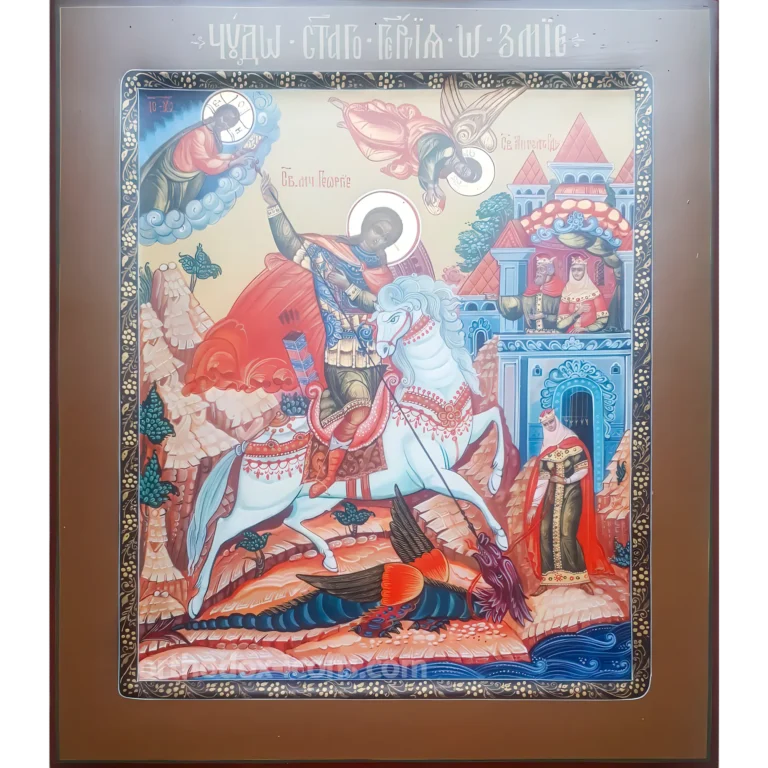
Orthodox Icon St. George and the Dragon is a hand-painted icon of the Holy Great Martyr George’s miracle over the dragon. Saint George rides a white horse, strikes the dragon with a spear, frees the princess, and receives heavenly blessing from Christ and an angel with the crown of victory. This multi-figure icon has broad blue borders with gold floral ornament and is painted on linden wood with oak splines, levkas, mineral egg tempera, and 23K gold leaf (960 purity). Free international shipping is included, with payment after receiving and approving the icon.
It is possible to paint an image in any size to order
Free shipping worldwide
Orthodox Icon St. George and the Dragon is a hand-painted image of the Holy Great Martyr George the Victory-Bearer and his miracle over the dragon. The icon speaks of the victory of faith over evil, courage over fear, and God’s help in circumstances that seem stronger than human strength.
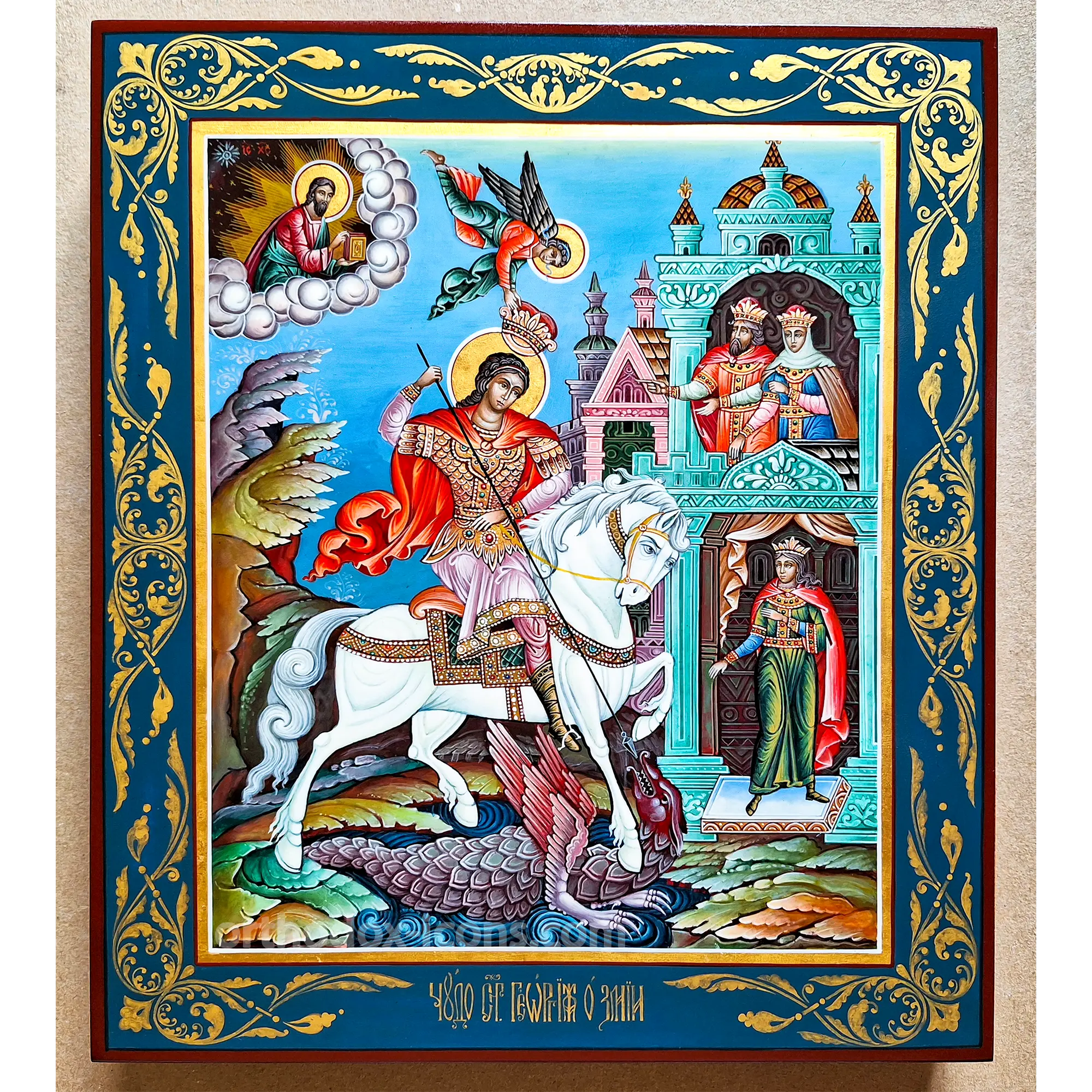
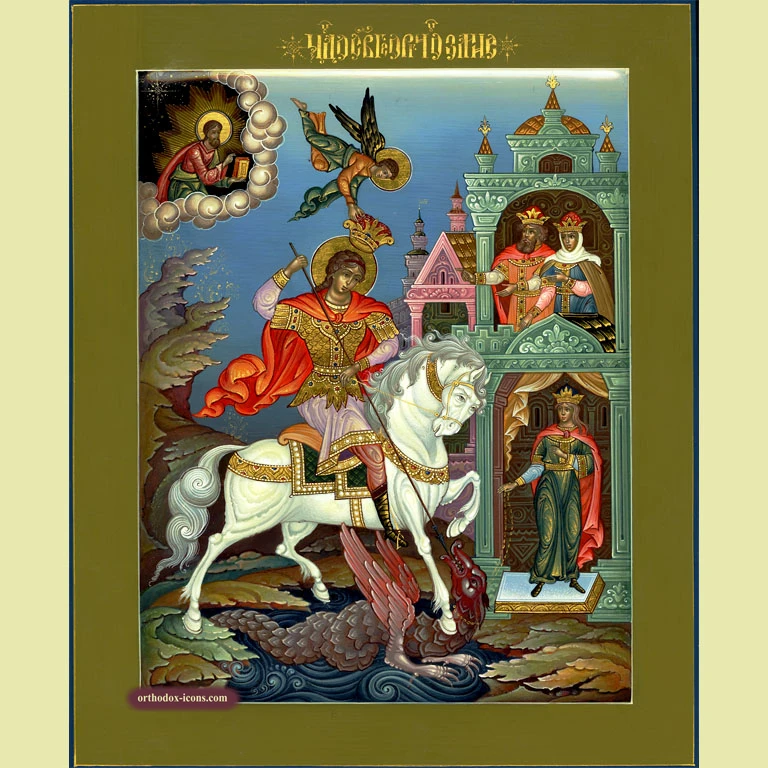
In this icon Saint George is shown riding a white horse. He strikes the dragon with a spear, freeing the princess and bearing witness to the power of Christ’s truth. The composition is rich and narrative: Christ the Savior appears in heavenly radiance on the left, an angel brings the crown of victory from above, and on the right the city opens with royal chambers, witnesses of the miracle, and the princess.
The broad blue borders are decorated with gold floral ornament, giving the icon a solemn and festive character. The image is painted on a linden wood board with oak splines, natural chalk levkas, mineral egg tempera, and 23K gold leaf (960 purity).
Brief Description of the Icon
| Name | Orthodox Icon St. George and the Dragon |
| Saint depicted | Holy Great Martyr George the Victory-Bearer |
| Subject | The miracle of Saint George defeating the dragon and freeing the princess |
| Main meaning | Victory of faith over evil, courage, protection, and divine help in trials |
| Available sizes | 27×31 cm (10.6×12.2 in), 30×40 cm (11.8×15.7 in), and larger church or iconostasis sizes by individual commission |
| Visual features | White horse, dragon, princess, city, angel with crown, Christ blessing, and blue borders with gold floral ornament |
Saint George and the Miracle of the Dragon
Saint George is one of the most honored saints in the Orthodox Church. He is remembered as a soldier, martyr, and confessor of Christ. His earthly life was connected with military service, but his greatest victory was his faithfulness to Christ. When he was ordered to deny the Lord during persecution, he did not hide his confession and accepted martyrdom.
The miracle of Saint George and the dragon became one of the most recognizable subjects in Orthodox iconography. According to the tradition, a terrible dragon held a city in fear and demanded human victims. When the princess was sent to her death, Saint George appeared, defeated the dragon by the power of God, and delivered the city from terror.
In the icon this story is not read as an ordinary heroic legend. It is a spiritual image: Christ’s faith frees the human person from fear, and evil, however strong it appears, does not have the last word. This is why Saint George is called the Victory-Bearer. His victory is not only the defeat of the dragon, but also victory over unbelief, cowardice, fear of death, and spiritual captivity.
Theological Meaning
The central theme of the icon is the victory of light over darkness. Saint George rides a white horse, and the white color is important. It speaks of purity, victory, spiritual clarity, and divine help. The horse moves forward, but the saint remains collected and calm. His victory is not shown as blind rage, but as the fulfillment of God’s truth.
The spear of Saint George is directed into the dragon. In the icon it is more than a military weapon; it is a sign of the resolve to oppose evil. The dragon in the lower part of the image is dark, tense, winged, and defeated. It recalls the forces that try to destroy the human person: fear, sin, envy, hostility, injustice, spiritual dependence, and despair.
The princess is also essential to the meaning of the icon. She recalls the soul awaiting deliverance, the person who cannot overcome disaster alone, and the vulnerable one who needs help. Saint George acts not for his own glory, but for the rescue of another. In Christian understanding, true strength is inseparable from mercy, protection, and responsibility for one’s neighbor.
The heavenly blessing in the upper part of the icon completes the theology of the image. Christ the Savior holds the Gospel in the clouds, while an angel brings a crown to Saint George. The crown points to martyrdom and heavenly glorification. The presence of Christ shows that the saint acts as a faithful warrior of the Heavenly King.
Prayer Before the Icon
Before the icon of Saint George the Victory-Bearer, Orthodox Christians pray for protection, help in danger, strengthening of faith, and victory over fear. The icon is often chosen for men, soldiers, protectors, people in dangerous professions, and those who must make firm and responsible decisions.
The prayerful meaning of the icon is wider than military service. People turn to Saint George in family anxieties, injustice, threats, difficult life circumstances, and inner confusion. They pray for protection of the home, children, and loved ones; for courage and endurance; for deliverance from hostility, slander, and evil influence; and for faithfulness to Christ in trials.
This icon is also a strong patron saint image for George, Georgi, Yuri, and Egor. It can be given for baptism, a name day, birthday, jubilee, entering service, taking a military oath, returning from service, house blessing, or another important life stage.
Features of This Particular Icon
This icon has a rich, multi-part composition. Saint George on the white horse occupies the center. He is shown in military clothing, with armor, spear, and a red cloak. The red cloak immediately draws the eye and emphasizes courage, martyrdom, and spiritual resolve.
The dragon is written large and expressive in the lower part of the icon. Its dark body, wings, open mouth, and tense curve create the sense of danger. Yet its position is already subordinate to the movement of Saint George. Evil is defeated; its force has been broken by God’s help.
The right side of the icon opens into a city scene. High royal chambers, towers, architectural details, the figures of the king and queen, and the princess in rich clothing make the icon narrative. The viewer sees not only the saint and the dragon, but also those for whose sake the miracle is performed. The city may be understood as human society, community, family, and the world needing deliverance from fear.
The upper part is especially important. Christ the Savior appears in the clouds at the left, holding the Gospel and surrounded by light. Above Saint George flies the angel carrying the crown. Heaven and earth are joined in one event, and the victory over the dragon becomes a visible sign of divine power.
The broad blue borders with gold floral ornament give the icon a noble and festive appearance. The deep blue creates a rich field where the gold is especially expressive. The ornament frames the central narrative like a precious sacred image.
What Is Seen on This Icon
- Saint George is shown on a white horse, striking the dragon with a spear.
- The dragon is dark, winged, and defeated in the lower part of the composition.
- The princess stands near the city in rich clothing.
- The city includes royal chambers, towers, and witnesses of the miracle.
- Christ the Savior appears in the clouds with the Gospel.
- An angel brings the heavenly crown to Saint George.
- The central scene is framed by wide blue borders with gold floral ornament.
Materials and Technique
The icon is painted on a natural linden wood board. Linden is traditionally used in icon painting because of its even structure, stability, and ability to receive the ground well. Oak splines help preserve the shape of the board and reduce the risk of warping as humidity and temperature change.
The board is covered with natural chalk levkas, a traditional multi-layered icon ground. This creates a strong, light, and even surface for painting. In a complex composition like this, the quality of the ground is especially important because of the many small details: the saint’s face, horse, dragon, princess, city architecture, heavenly figures, ornamental borders, inscriptions, and decorative elements.
The painting is executed in mineral egg tempera. This technique is valued for its noble matte surface, depth of color, and durability. The icon painter gradually develops the image from broad color areas to highlights and fine details, preserving both the movement of the story and the prayerful stillness of an Orthodox icon.
The gilding is made with 23K gold leaf (960 purity). Gold is used in decorative elements, halos, ornament, and framing. In Orthodox iconography, gold symbolizes divine light, heavenly glory, and the presence of the Kingdom of God, rather than earthly luxury.
Icon Characteristics
| Name | Orthodox Icon St. George and the Dragon |
| Full icon name | Hand-painted icon of the Holy Great Martyr George the Victory-Bearer, The Miracle of Saint George and the Dragon |
| Saint | Holy Great Martyr George the Victory-Bearer |
| Subject | Saint George strikes the dragon and frees the princess |
| Board | Solid linden wood |
| Board reinforcement | Oak splines |
| Ground | Natural chalk levkas |
| Painting | Mineral egg tempera |
| Gilding | 23K gold leaf (960 purity) |
| Available sizes | 27×31 cm (10.6×12.2 in), 30×40 cm (11.8×15.7 in), and larger church or iconostasis sizes by individual commission |
| Purpose | For home prayer, patron saint gift, church, chapel, or iconostasis |
Who This Icon Is Suitable For
This icon is especially suitable as a patron saint image for George, Georgi, Yuri, or Egor. It may be given to soldiers, protectors, men, godsons, sons, leaders, and families praying for the intercession of Saint George.
It is also appropriate for a family where prayers are offered for protection, children, men in service, travelers, people with serious responsibilities, and anyone passing through trials. In a home icon corner, the image of Saint George reminds the family of courage, faithfulness, and hope in God’s help.
For a custom order, the icon may be made in 27×31 cm (10.6×12.2 in), 30×40 cm (11.8×15.7 in), or a larger church size. The larger the format, the more fully the details can be seen: the city architecture, angel, Christ in the clouds, princess, dragon, horse harness, ornamental borders, and faces.
Questions and Answers
Who is depicted in the Orthodox Icon St. George and the Dragon?
The icon depicts the Holy Great Martyr George the Victory-Bearer, shown on a white horse as he strikes the dragon with a spear and frees the princess.
What does the dragon symbolize?
The dragon symbolizes evil, sin, fear, spiritual darkness, and destructive power from which the human person seeks God’s help and protection.
What can people pray for before this icon?
People pray for protection, courage, help in danger, strengthening of faith, victory over fear, protection of the family, and support for soldiers and protectors.
Why is Saint George shown on a white horse?
The white horse symbolizes purity, light, victory, spiritual clarity, and divine help in the struggle against evil.
What does the princess mean in this icon?
The princess recalls the soul or person awaiting deliverance from fear, danger, and the power of evil. She also shows that true courage protects the vulnerable.
Who is shown in the upper part of the icon?
Christ the Savior is shown in the clouds, and an angel brings a crown to Saint George as a sign of heavenly glorification and martyrdom.
Is this icon suitable as a patron saint icon for George?
Yes. It is a strong patron saint icon for George, Georgi, Yuri, and Egor, and may be given for baptism, a name day, birthday, or jubilee.
Can this icon be given to a soldier or protector?
Yes. Icons of Saint George are often given to soldiers, protectors, people in dangerous professions, and their families as prayerful images of courage and protection.
What materials are used to make the icon?
The icon is painted on a linden wood board with oak splines and levkas ground, using mineral egg tempera and 23K gold leaf (960 purity).
Which sizes are available?
Available sizes are 27×31 cm (10.6×12.2 in), 30×40 cm (11.8×15.7 in), and larger church or iconostasis sizes by individual commission.
| Name | George, Georgi |
|---|---|
| Dimensions | 27x31cm (10.6×12.2 in), 30x40cm (11.8×15.7 in) |
Related products
Hand-Painted Icon of Saint George the Trophy-Bearer
Available on backorder
Price range: $750 through $2250