St. George and the Dragon Orthodox Icon
Price range: $1250 through $1850
Available sizes: 27×31 cm (10.6×12.2 in), 30×40 cm (11.8×15.7 in), and larger church or iconostasis sizes by individual commission.
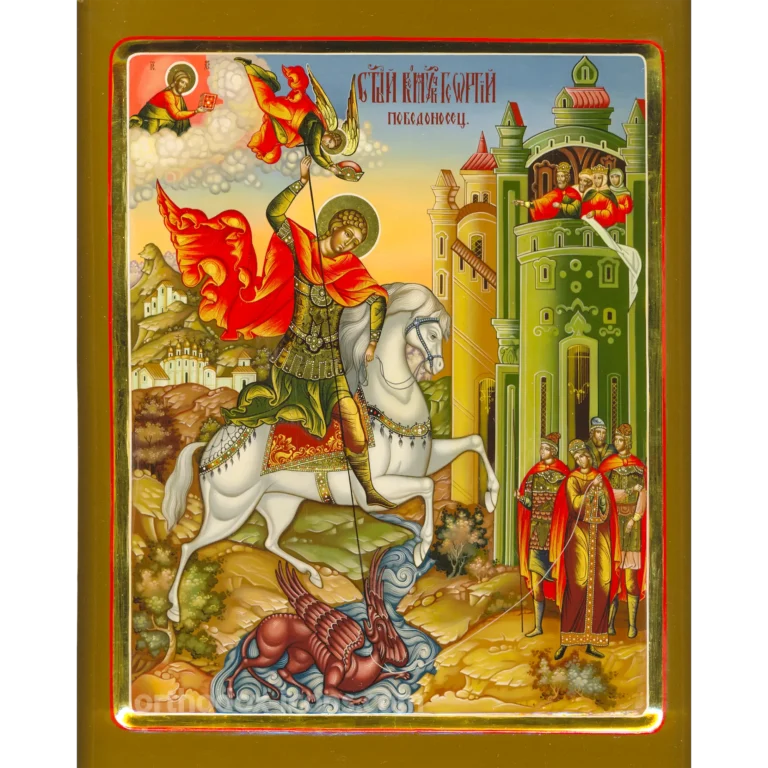
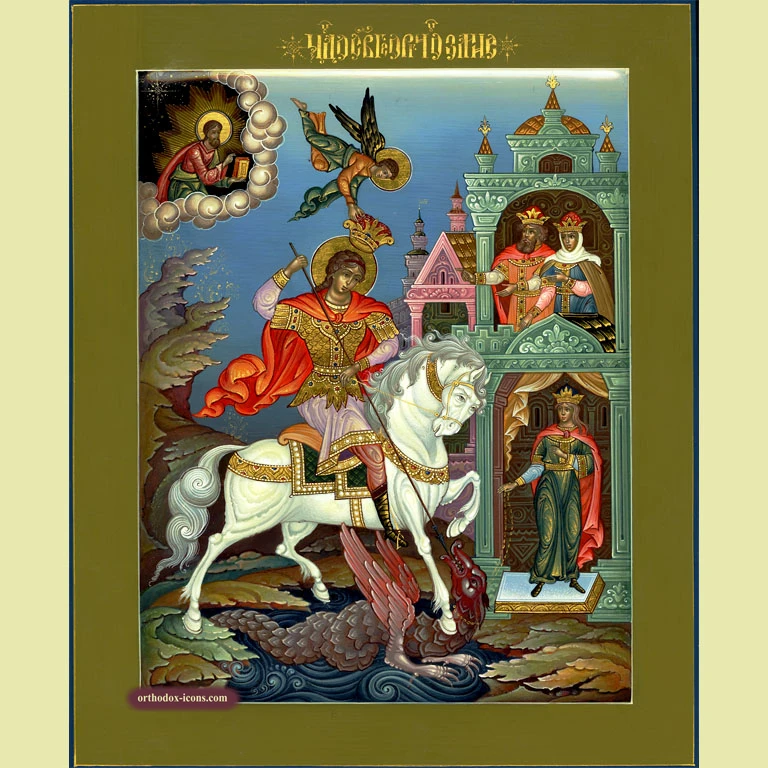
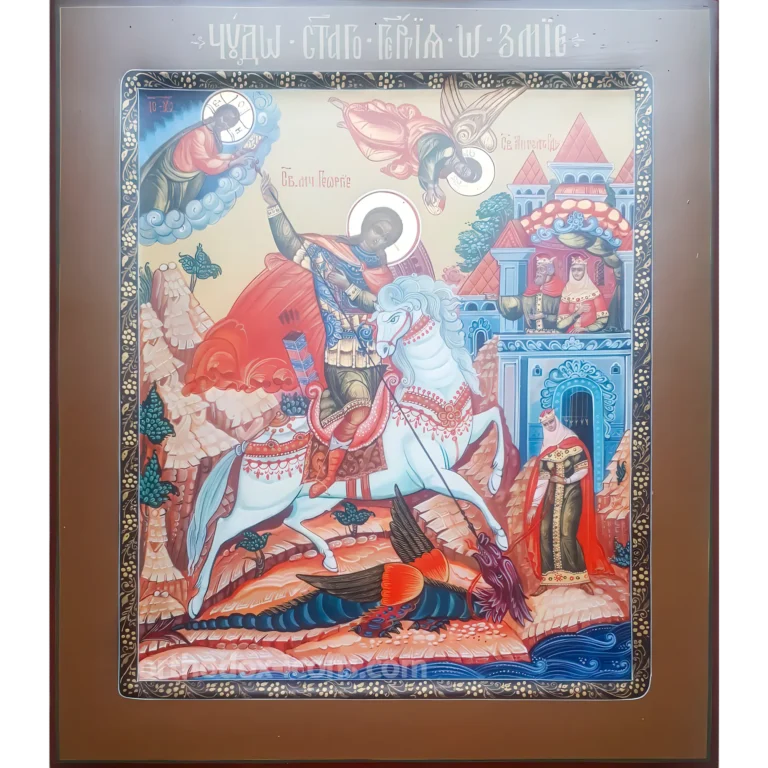
St. George and the Dragon Orthodox Icon is a hand-painted multi-figure icon of the Holy Great Martyr George’s most famous miracle. Saint George rides a white horse, strikes the winged dragon, and saves Princess Elisava, while the city rulers watch from the palace and Christ blesses from heaven. The icon is painted in the Palekh and Mstyora miniature tradition with mineral egg tempera, gold assist, vivid blue sky, olive landscape, and rich architectural details. Free international shipping is included, with payment after receiving and approving the icon.
It is possible to paint an image in any size to order
Free shipping worldwide
St. George and the Dragon Orthodox Icon is a hand-painted multi-figure icon of the most famous miracle of the Holy Great Martyr George the Victory-Bearer. This is not a simple portrait of the saint, but a detailed narrative image: Saint George rides a white horse, strikes the winged dragon, saves Princess Elisava, and receives heavenly blessing.
The icon is painted in the spirit of the Palekh and Mstyora miniature traditions. It combines a vivid blue sky, olive landscape tones, a bright red cloak, a white horse, richly colored architecture, and fine gold assist on the armor, horse harness, and palace details. The composition reads almost like an illustrated sacred book, where every figure and detail participates in the story of victory over evil.
Saint George is one of the most venerated saints in the Christian world. He suffered for Christ during the persecution under Emperor Diocletian in 303. The miracle of the dragon became the best-known sign of his heavenly intercession after his martyrdom, showing that the victory of the saint is not only military, but spiritual.
Brief Description of the Icon
| Name | St. George and the Dragon Orthodox Icon |
| Saint depicted | Holy Great Martyr George the Victory-Bearer |
| Subject | The miracle of Saint George defeating the dragon and saving Princess Elisava |
| Main meaning | Victory of good over evil, divine help, courage, protection, and faithful service |
| Available sizes | 27×31 cm (10.6×12.2 in), 30×40 cm (11.8×15.7 in), and larger church or iconostasis sizes by individual commission |
| Technique | Mineral egg tempera, gold assist, levkas, linden wood board, oak splines, protective oil and varnish |
The Miracle of Saint George and the Dragon
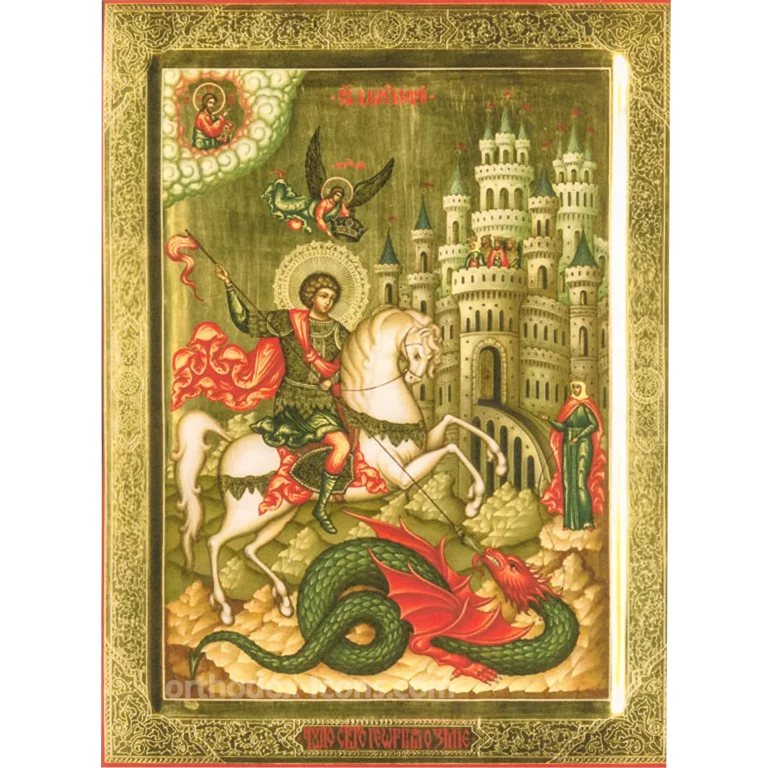
According to church tradition, the miracle took place near the city of Lasia, associated in different retellings with places in the eastern Mediterranean world. A terrible dragon lived near the city and demanded human victims. To save the people from destruction, the pagan ruler Selvius was forced to send his only daughter, Princess Elisava, to the dragon.
As the princess waited for death in tears, a young warrior appeared on a white horse: Saint George. In the name of Christ he struck the monster with his spear, saved the princess, and through this miracle brought many people to faith. The story is not merely a legend of a heroic warrior. In Orthodox iconography it becomes an image of spiritual liberation.
The dragon represents evil, death, fear, demonic deception, and pagan darkness. The white horse represents purity, truth, light, and divine help. The princess represents the soul or the human person awaiting rescue. Saint George’s victory is therefore a sign that evil, however terrifying it appears, is not stronger than the grace of God.
Iconography and Symbolism
This version of the icon includes the main elements of the traditional narrative. Saint George appears in the center on a rearing white horse. He wears golden Roman armor and a flowing scarlet cloak, the color of martyrdom and noble courage. With his right hand he drives a slender spear into the open mouth of the winged dragon rising from the dark waters.
Princess Elisava stands at the lower right near the city gate. She wears a green dress and a crown, and holds the dragon with a thin leash, traditionally understood as her silk belt. This detail is important: in the tradition, the dragon is not immediately destroyed, but first humbled and led into the city, where the people see the power of God and come to faith.
Above the princess rises the richly decorated city of Lasia, shown as a many-tiered palace with turquoise, rose, and golden towers. On the balcony, the princess’s parents, the king and queen, watch the miracle in reverence. This makes the icon a multi-figure scene of public conversion, not only a private rescue.
In the upper part of the icon, an angel descends from heaven carrying the golden crown of victory and martyrdom. In the opened clouds at the left, Christ the Savior blesses Saint George and holds the Gospel. These heavenly images make clear that the victory is accomplished not by human skill alone, but by divine grace.
Prayer Before the Icon
For centuries, Saint George on horseback defeating the dragon has been a powerful image of courage, protection, and victory. Orthodox Christians pray before this icon for soldiers, officers, protectors, and all who face danger. Families pray that Saint George may protect those serving in difficult places, preserve them from harm, give them physical and spiritual courage, and bring them home safely.
Leaders, military officers, and public servants may pray for sober judgment and wisdom in difficult decisions. The icon is also meaningful for men and boys named George, Georgi, Yuri, or Egor, and may be given as a patron saint icon for baptism, a name day, birthday, or jubilee.
Saint George is also connected with the land, since his name is traditionally associated with one who works the earth. Farmers, gardeners, and rural families ask his intercession for the protection of fields, crops, animals, and households. In a spiritual sense, every Christian can pray before this icon for victory over an inner dragon: fear, despair, addiction, envy, anger, or any destructive passion.
Artistic Features
This icon is a complex miniature-style composition. The deep blue sky gradually passes into olive tones of the fields, while the bright red cloak of Saint George creates a strong visual center against the white horse. The line of the spear, the curve of the horse, and the body of the dragon lead the eye through the entire scene.
Fine gold assist covers Saint George’s armor, the horse harness, and selected architectural details. Assist is a traditional technique of applying delicate lines of gold over the painted surface. It symbolizes the presence and radiance of divine light within the material world, while also adding refinement to the miniature painting.
The architecture of the city is richly colored and detailed. The towers, balconies, palace forms, and small figures help the viewer understand the miracle as an event witnessed by a whole city. The landscape, water, horse, dragon, princess, rulers, angel, and Christ above are all joined into one sacred story.
What Is Seen on This Icon
- Saint George rides a white horse and strikes the winged dragon with a spear.
- The dragon rises from dark waters and symbolizes evil and spiritual darkness.
- Princess Elisava stands near the city gate with a crown and green garment.
- The princess holds the humbled dragon with a thin leash or belt.
- The city of Lasia is shown as a many-tiered palace with bright towers.
- The king and queen watch the miracle from the balcony.
- An angel descends from heaven with the crown of victory.
- Christ the Savior blesses Saint George from the opened clouds.
- Gold assist enriches the armor, horse harness, and architectural details.
Materials and Technique
The icon is painted on a linden wood board that has been naturally dried and strengthened with oak splines on the back. The wood is covered with linen cloth and then with several layers of chalk levkas. After sanding, the surface becomes smooth and bright, suitable for miniature icon painting.
The painting is executed in natural mineral egg tempera. The icon painter uses ground mineral pigments such as lapis tones, ochre, cinnabar, and related colors mixed with egg emulsion. This gives the icon its depth, clarity, and long-lasting beauty.
Gold assist is applied with very fine lines over the painted areas. On this icon it is used especially on the armor of Saint George, the harness of the white horse, and parts of the palace architecture. The completed icon is protected with natural oil and icon varnish, giving depth to the colors and helping protect the surface from dust and humidity.
Icon Characteristics
| Name | St. George and the Dragon Orthodox Icon |
| Saint | Holy Great Martyr George the Victory-Bearer |
| Subject | Saint George defeats the dragon and saves Princess Elisava |
| Icon type | Multi-figure narrative icon in the Palekh and Mstyora miniature tradition |
| Main spiritual meaning | Victory of good over evil, courage, protection, and divine help |
| Board | Solid linden wood |
| Board reinforcement | Inset oak splines |
| Ground | Linen cloth and chalk levkas |
| Painting | Natural mineral egg tempera |
| Gold work | Gold assist made with 23K gold leaf (960 purity) |
| Available sizes | 27×31 cm (10.6×12.2 in), 30×40 cm (11.8×15.7 in), and larger church or iconostasis sizes by individual commission |
| Purpose | For home prayer, patron saint gift, military gift, church, chapel, or iconostasis |
Who This Icon Is Suitable For
This icon is a solemn gift for soldiers, officers, military academy students, emergency responders, and people in protective service. It can also be given to men and boys named George, Georgi, Yuri, or Egor as a patron saint icon for baptism, a name day, birthday, or jubilee.
Because Saint George is also connected with the care of land and animals, this icon may be meaningful for farmers, rural families, and those who work in agriculture. In the larger sizes, the many miniature details become easier to see: the dragon, the princess, the city, the rulers, the angel, Christ, the horse, and the gold assist.
Care for the Icon
A multi-layered tempera icon should not be wiped with wet cloths or cleaned with household chemicals. Dust should be removed gently with a very soft dry brush. For the best long-term preservation, especially with a detailed miniature-style icon, a wooden kiot with protective glass is recommended.
Questions and Answers
Where did the miracle of Saint George and the dragon take place?
According to church tradition, the miracle took place near the city of Lasia, also associated in some traditions with Lydda, Beirut, or the eastern Mediterranean region.
Why does the dragon have wings?
The winged dragon is a biblical and iconographic symbol of evil, death, demonic deception, and pagan darkness. The wings underline its spiritual and destructive nature.
Who is the crowned woman near the city gate?
She is Princess Elisava, the daughter of the local pagan ruler, who was to be sacrificed to the dragon before Saint George saved her.
Why does the princess hold the dragon on a leash?
In the tradition, Saint George first weakens the dragon with his spear and tells the princess to bind it with her belt. The humbled dragon is then led into the city before the people come to faith.
What does the angel bring to Saint George?
The angel brings a golden crown, the crown of victory and martyrdom, showing that Saint George’s triumph is granted by God.
Who is shown in the clouds above the scene?
Christ the Savior is shown in the opened heavens, blessing Saint George and revealing that the victory over evil is accomplished by divine grace.
What can people pray for before this icon?
People pray for protection, courage, help for soldiers and protectors, victory over fear and evil, wise decisions, protection of the home, and help in farming or rural life.
What is gold assist on this icon?
Gold assist is a technique of applying very fine lines of gold over painted areas. Here it enriches Saint George’s armor, the horse harness, and architectural details.
What materials are used to paint the icon?
The icon is painted on a linden wood board with oak splines, linen cloth, levkas, natural mineral egg tempera, gold assist, protective oil, and icon varnish.
Which sizes are available?
Available sizes are 27×31 cm (10.6×12.2 in), 30×40 cm (11.8×15.7 in), and larger church or iconostasis sizes by individual commission.
| Name | George, Georgi, Yuri |
|---|---|
| Dimensions | 27x31cm (10.6×12.2 in), 30x40cm (11.8×15.7 in) |
Related products
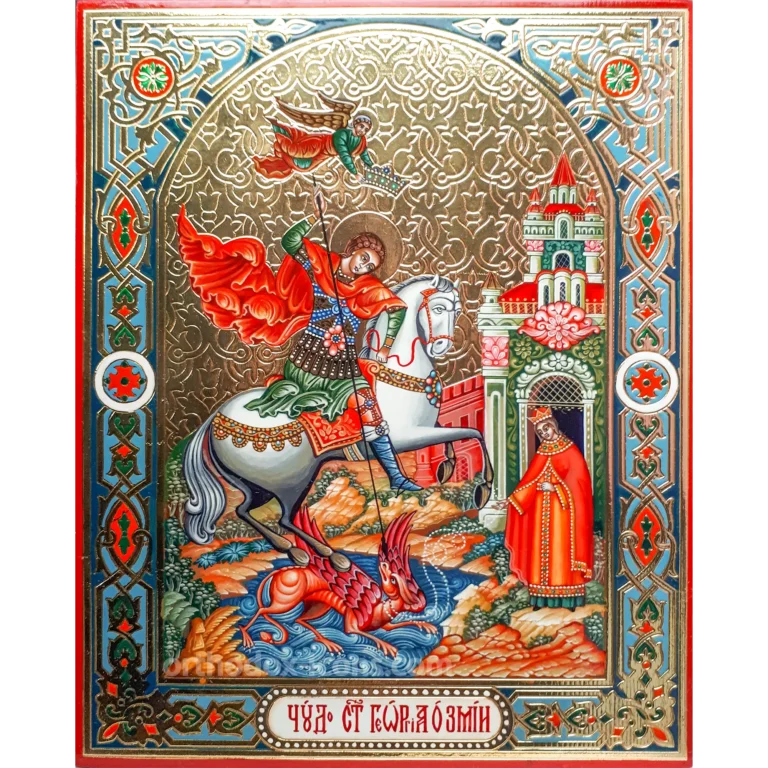
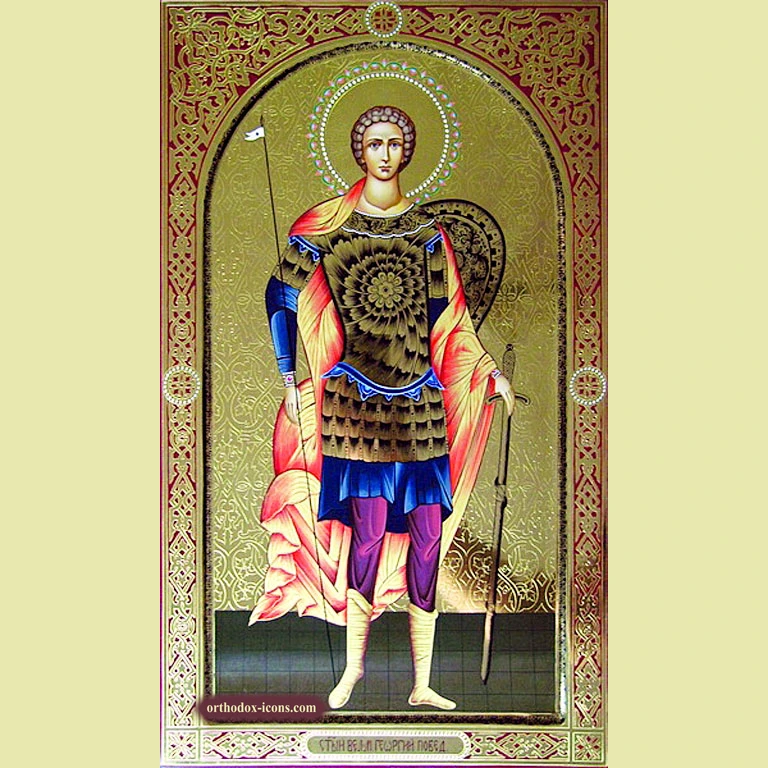
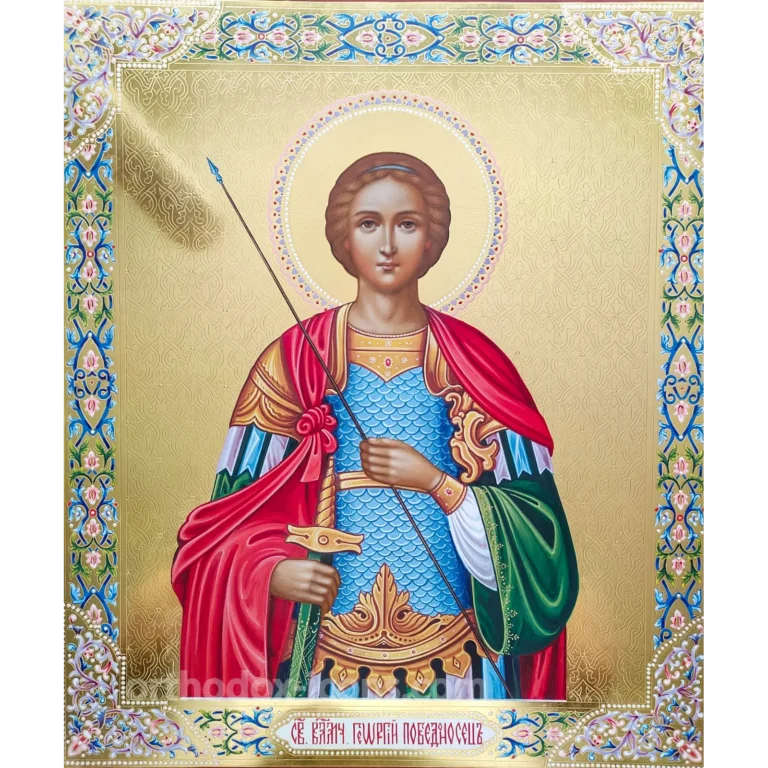
Hand-Painted Icon of Saint George the Trophy-Bearer
Available on backorder
Price range: $750 through $2250