St. George and the Dragon Icon
$3000
Available size: 30×40 cm (11.8×15.7 in) and larger; larger and iconostasis formats can be made by individual request.
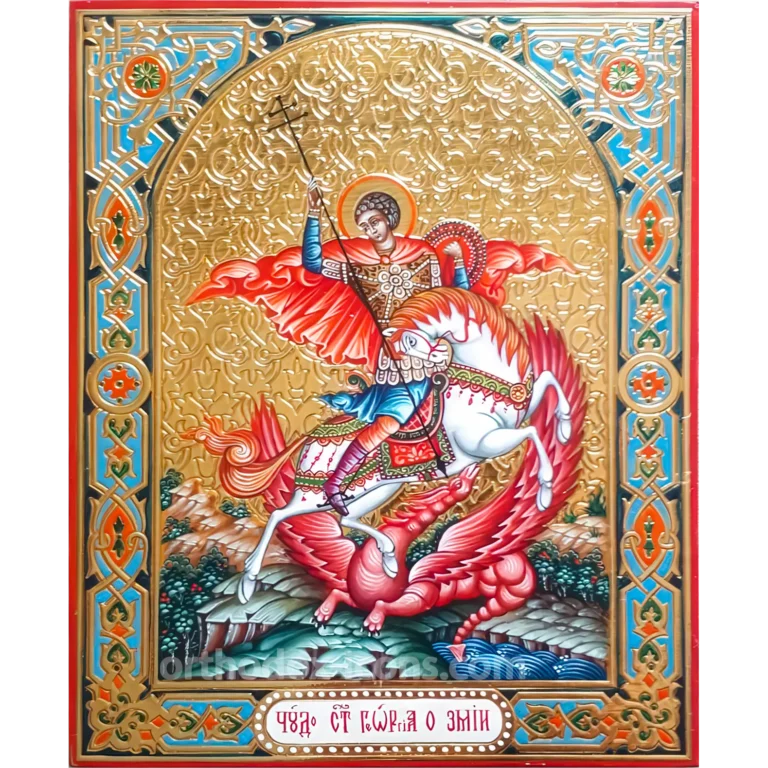
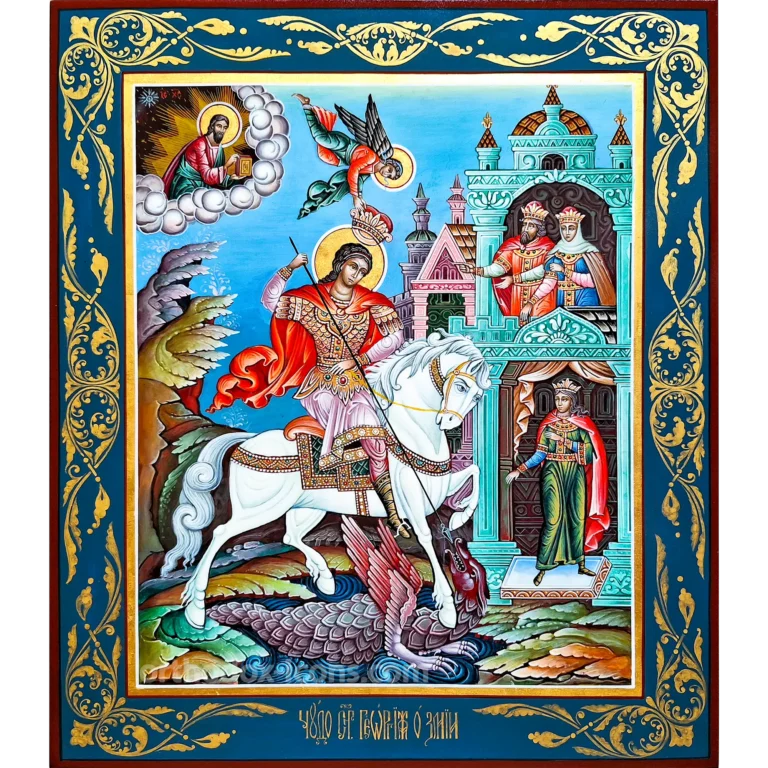
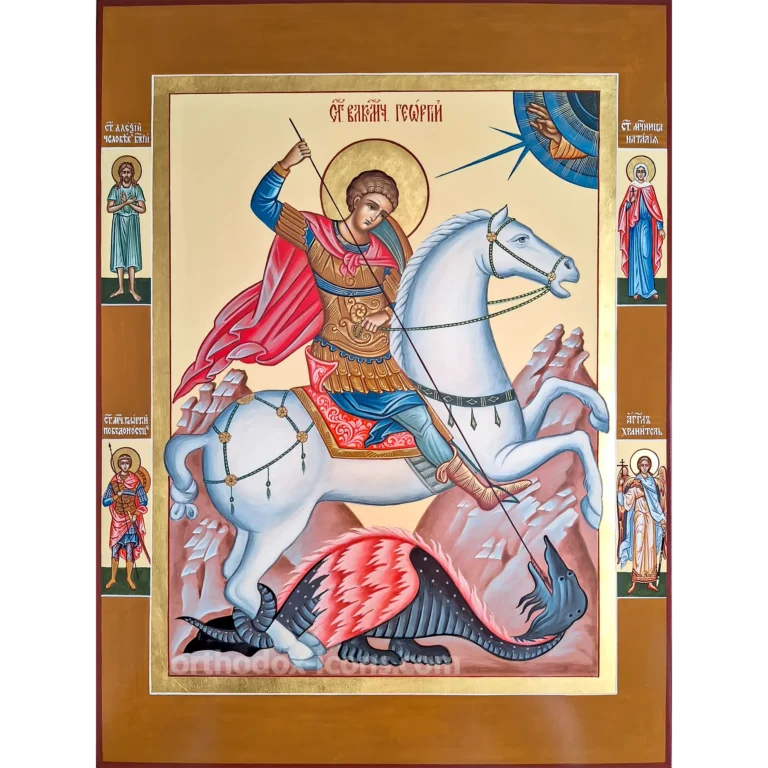
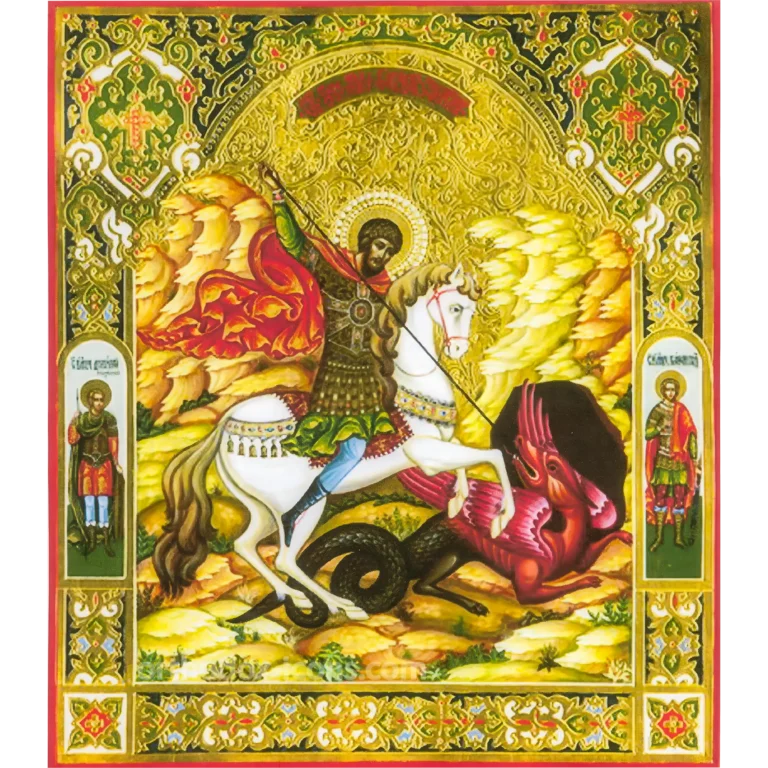
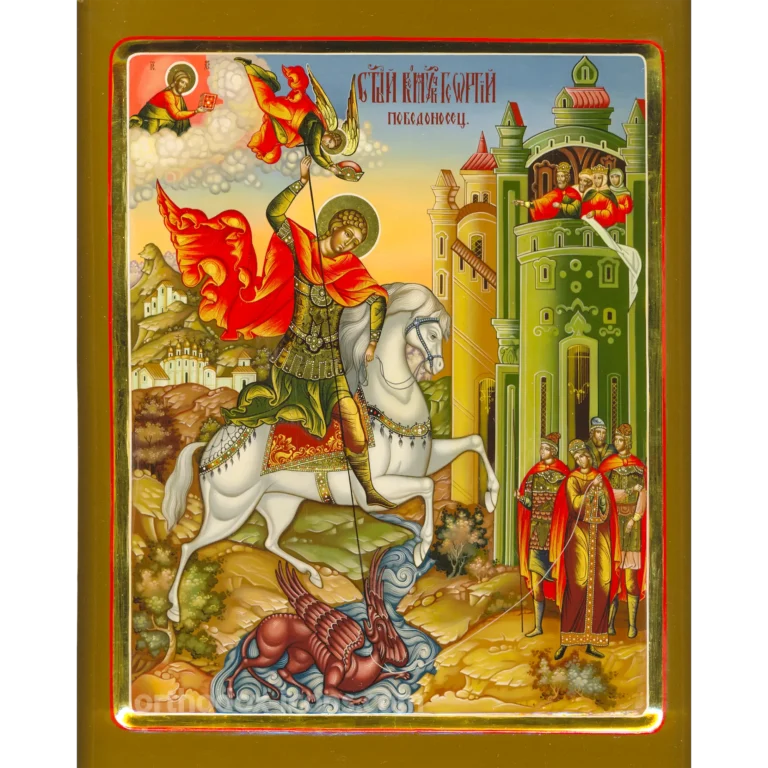
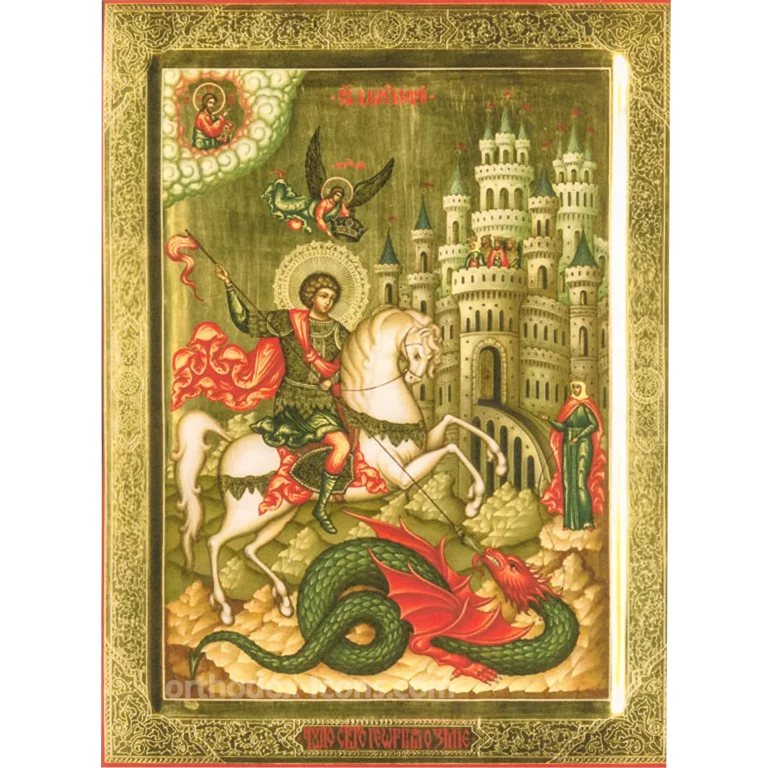
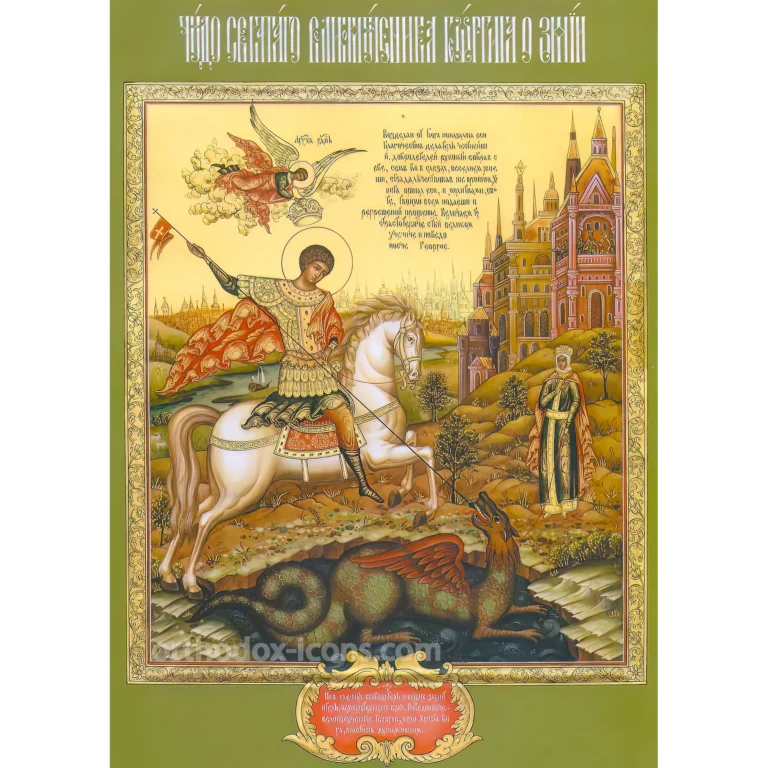
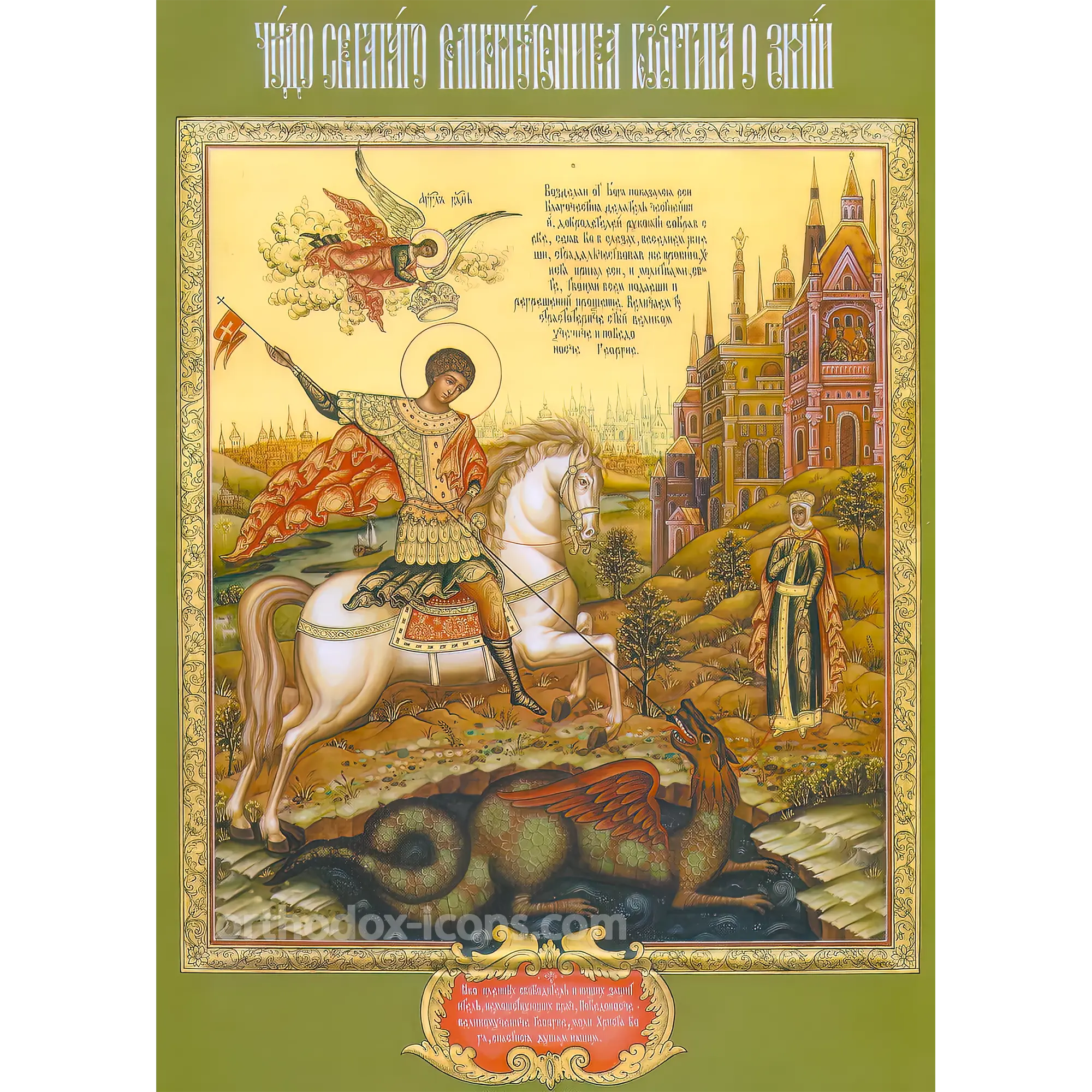
St. George and the Dragon Icon is a hand-painted narrative icon of the Holy Great Martyr George the Victory-Bearer, revealing the victory of Christian faith over evil. Saint George is shown on a white horse, striking the dragon with a spear; beside the scene are the princess, city architecture, an angel with a crown, decorative fields, and inscription details.
Prayer focus: strengthening of faith, courage, protection of family, help in trials, victory over fear, steadfastness, blessing for soldiers, and support for men named George.
Materials: linden wood board, oak support slats, natural chalk gesso, egg tempera; gold leaf gilding and decorative finish are selected according to the chosen version.
Best suited for: men and boys named George, soldiers, leaders, Orthodox families, churches, chapels, military spaces, schools, or memorial prayer spaces.
It is possible to paint an image in any size to order
Free shipping worldwide
St. George and the Dragon Icon is one of the most expressive and recognizable images of the Holy Great Martyr George the Victory-Bearer. In this iconographic scene Saint George is shown not only as a warrior and martyr, but as the conqueror of evil, protector of the innocent, and witness to the power of faith in Christ.
The story of Saint George striking the dragon reveals a spiritual meaning: evil may appear strong and terrifying, but it is overcome not by human courage alone, but by faithfulness to God, purity of heart, and readiness to serve the truth. This icon is therefore not simply a dramatic scene, but a prayerful image of spiritual victory.
In the presented icon Saint George is shown on a white horse, striking the dragon with a spear. The princess stands nearby, while city architecture opens behind her: towers, walls, chambers, and church forms. In the upper part of the composition an angel carries a crown. Inscriptions, decorative fields, and rich ornament complete the image. Because this is a complex narrative icon, it is best revealed in 30×40 cm (11.8×15.7 in) and larger formats, including church and iconostasis sizes.
Icon Characteristics
| Full name | St. George and the Dragon Icon |
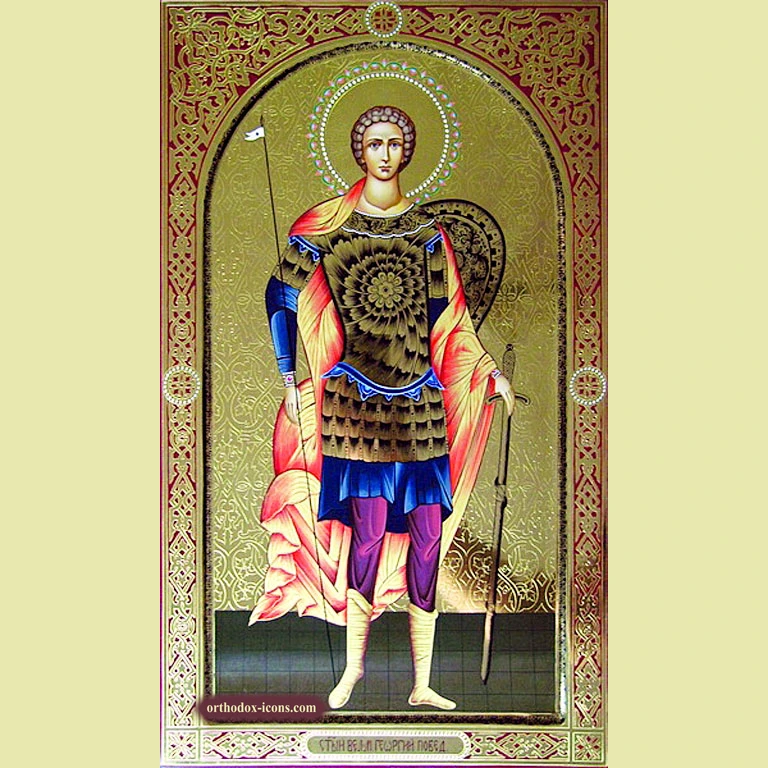
| Saint depicted | Holy Great Martyr George the Victory-Bearer |
| Iconographic type | Narrative icon of the Miracle of Saint George and the Dragon |
| Visible features | Saint George on horseback, dragon, spear, princess, angel with crown, city architecture, inscriptions, ornamental fields |
| Commemoration days | May 6 / April 23 according to the old calendar; also November 16 / November 3 and December 9 / November 26 according to the old calendar |
| Available size | 30×40 cm (11.8×15.7 in) and larger; iconostasis sizes by request |
Who This Icon Is For
The icon of Saint George the Victory-Bearer is especially suitable for men and boys named George. It may be ordered for baptism, name day, patron saint day, birthday, coming of age, military oath, jubilee, or another important family occasion. Such a gift unites personal heavenly patronage, the theme of courage, and the Christian meaning of the victory of good over evil.
The image of Saint George is often chosen for soldiers, cadets, people in protective professions, leaders, fathers, and those whose lives are connected with responsibility, service, and difficult decisions. Yet the icon is not limited to military symbolism. It is first of all an image of a holy martyr who conquered evil through faithfulness to Christ and did not renounce the faith before suffering.
For a church, chapel, military unit, Orthodox school, or memorial prayer space, the scene of Saint George and the Dragon is especially expressive. It contains a central saintly image and a whole symbolic panorama: horse, dragon, princess, city, angel, inscriptions, and decorative fields. A larger size allows the viewer to see not only the figure of the saint, but all the meaningful details of the composition.
Prayer Before the Icon of Saint George
Before the icon of Saint George the Victory-Bearer, Orthodox Christians pray for strengthening of faith, courage, protection of family, steadfastness in trials, help in difficult circumstances, victory over fear, preservation of honor, and faithfulness to the Christian path. People named George, their parents and relatives, soldiers, travelers, leaders, and families in anxious circumstances may turn to him in prayer.
- strengthening of faith and faithfulness to Christ;
- courage, steadfastness, and overcoming fear;
- protection of family, home, and loved ones;
- support for soldiers and people in dangerous professions;
- help for men and boys named George;
- wisdom in difficult choices and responsible decisions;
- overcoming temptation, despondency, and inner weakness;
- victory over evil, first of all within one’s own heart.
An Orthodox icon is not a charm or an external sign of luck. Prayer before Saint George is a turning to God through the intercession of the great martyr. The scene of the dragon reminds the person praying that spiritual battle begins not only in outward circumstances, but also within the heart: in the struggle against fear, sin, cowardice, falsehood, pride, and despair.
Brief Life of Saint George the Victory-Bearer
Saint George lived at the end of the third and beginning of the fourth century and was a soldier of high rank. He came from a Christian family and, according to Church tradition, was known for courage, nobility, and faithfulness to Christ. During the persecutions under Emperor Diocletian, George openly confessed his faith, refused to sacrifice to pagan gods, and did not turn away even under threat of torture.
For confessing Christ, Saint George endured severe suffering and accepted a martyr’s death. His veneration quickly spread throughout the Christian world, and in Church tradition he became one of the most beloved warrior saints. The title Victory-Bearer refers not only to military courage, but above all to the victory of faith over the fear of death, pagan violence, and evil.
The scene of Saint George and the Dragon is not a direct historical image of his martyrdom, but a spiritual and symbolic icon. According to tradition, Saint George saved a princess and a city from a terrible dragon, after which many people turned to Christ. In iconography this story became a visible image of the victory of Christian faith over dark power.
Commemoration Days
The main commemoration of the Holy Great Martyr George the Victory-Bearer is May 6 according to the new calendar, or April 23 according to the old calendar. This date is especially important for people named George, their families, godparents, and all who choose a patron saint icon.
The Orthodox calendar also includes commemorations connected with Saint George on November 16 / November 3 according to the old calendar, and December 9 / November 26 according to the old calendar. These dates may be considered when choosing an icon for a name day, baptism, family celebration, church gift, or memorial occasion.
Features of the Presented Icon
The presented icon has a complex narrative composition. In the center Saint George is shown on a white horse. His figure is full of movement: the cloak flows behind him, the spear is directed toward the dragon, and the horse stands confidently above the defeated dark power. Yet the face of the saint remains calm and collected. The icon does not show crude military violence; George’s victory is presented as the action of God’s power.
The dragon is painted in the lower part of the icon. Its large form emphasizes the danger facing the city and the princess. At the same time, its place is already subordinate within the composition: it lies below the spear of the saint, while George, the horse, the angel, and the upper space create an upward movement. Thus the icon shows the victory of light over darkness, faith over fear, and life over destruction.
The princess is shown near the city. Her presence reveals the meaning of George’s act as the protection of an innocent person and of the whole city. The architecture in the background – towers, walls, chambers, and churches – creates the sense of a populated world in need of deliverance. This background is not merely decorative; it shows that the saint’s act concerns an entire community.
In the upper part an angel holds a crown. This detail lifts the scene beyond an ordinary battle. The crown points to the heavenly glory of Saint George and to the fact that his true victory is the victory of a martyr faithful to Christ to the end. Decorative fields, inscriptions, and ornament strengthen the solemnity of the image and make it especially expressive in a larger format.
Iconography: Horse, Dragon, Spear, Princess, and Angel
The white horse in the icon of Saint George is connected with purity, victory, and noble service. It helps reveal the saint as a warrior of Christ, not merely as a historical rider. The white color strengthens the contrast between light and the dark power represented by the dragon.
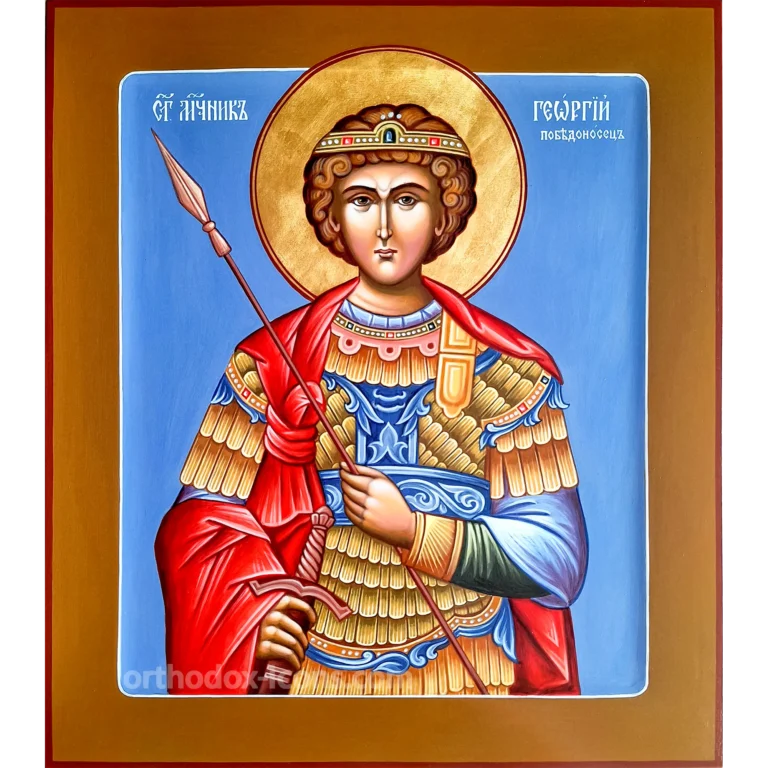
The spear in the saint’s hand points to the defeat of evil. In the iconography of Saint George and the Dragon, it is not merely a weapon, but a sign of spiritual victory. George does not act from himself; his deed is grounded in faith, prayer, and God’s help. For this reason the spear is directed with calm precision, and the saint is shown without agitation or anger.
The dragon symbolizes evil, sin, fear, pagan violence, and the destructive force that enslaves the human person. In simple retellings the story may sound like a tale of a monster, but in the icon it has a deeper meaning: evil is overcome not by outward spectacle, but by holiness, faith, and obedience to God.
The princess recalls the soul in need of salvation and the innocent person who requires protection. Her presence makes the image deeply human: Saint George acts not for his own glory, but for the salvation of another. The angel with the crown confirms the heavenly meaning of the saint’s victory and connects the scene with his martyr’s glory.
Materials, Gilding, and Finish Options
The icon of Saint George and the Dragon is painted on a solid linden wood board with oak support slats. Linden is well suited to hand-painted iconography because of its even structure and ability to receive a carefully prepared gesso ground. Oak slats help strengthen the board and preserve its shape during natural changes in humidity and temperature.
A natural chalk gesso ground is applied before painting. The image is painted in egg tempera, a traditional technique that allows the iconographer to render a complex multi-part composition: the face of Saint George, the white horse, dragon, princess, angel, architecture, inscriptions, ornamental fields, color transitions, and small details of the narrative background. Depending on the chosen finish, gold leaf may be used on halos, background, decorative fields, inscriptions, or separate details.
Because the icon is rich in details, it is recommended in 30×40 cm (11.8×15.7 in) and larger sizes. In a larger format, Saint George, the horse, dragon, princess, city, angel, inscriptions, color depth, and ornament can be seen more clearly. Iconostasis sizes are chosen individually for a church, chapel, or other prayer space.
How to Choose the Size and Format
The 30×40 cm (11.8×15.7 in) size can be considered the minimum comfortable format for such a complex narrative icon. It preserves the expressiveness of the central scene and keeps the main details readable: horse, dragon, spear, princess, architecture, and angel.
Larger sizes allow finer painting. They better reveal the architectural background, ornamental fields, inscriptions, angel, saint’s face, horse, and dragon. A large format is especially appropriate for a church, chapel, military space, Orthodox school, or family home with a separate prayer area.
Iconostasis sizes are agreed separately. For church placement, the height of the row, viewing distance, lighting, neighboring icons, overall style of the iconostasis, and level of detail are considered. Gilding, field decoration, inscriptions, and compositional emphasis can also be discussed.
Blessing and Care
The icon of Saint George and the Dragon may be blessed in an Orthodox church after it is received, or brought for blessing at your parish. A blessed icon is not a decorative historical scene, but a holy image for prayer, thanksgiving, and turning to God through the intercession of the Holy Great Martyr George.
A hand-painted icon should be cared for carefully. Dust may be removed with a dry soft brush or a dry cloth without pressure. The icon should not be wiped with a wet cloth or placed in direct sunlight, near a heater, humidifier, hot lamp, or source of sudden temperature changes. Special care should be taken with gilded areas, inscription fields, small figures, architectural details, and the painted surface. For a large icon, a wooden kiot may be considered.
Free international shipping is included. Payment is made after you receive and approve the icon.
Questions and Answers
Who is shown on the St. George and the Dragon Icon?
The icon shows the Holy Great Martyr George on horseback, striking the dragon with a spear. The princess, city, angel with a crown, and inscriptions are also part of the scene.
What does the dragon mean in this icon?
The dragon symbolizes evil, sin, fear, destructive power, and spiritual danger. Saint George’s victory reveals the triumph of faith in Christ over evil.
Why is Saint George shown on a white horse?
The white horse signifies purity, victory, and noble service. It helps show Saint George’s action as a spiritual victory, not merely a battle scene.
What do Orthodox Christians pray for before this icon?
People pray for strengthened faith, courage, protection of family, help in trials, steadfastness, victory over fear, and support for soldiers and men named George.
Who is this icon suitable for?
It is suitable for men and boys named George, soldiers, leaders, Orthodox families, churches, chapels, military units, and memorial prayer spaces.
When is Saint George commemorated?
The main commemoration of the Holy Great Martyr George is May 6 according to the new calendar, or April 23 according to the old calendar.
Why is this icon best ordered from 30×40 cm?
The composition has many details: Saint George, horse, dragon, princess, angel, city, inscriptions, and ornament. These read best in 30×40 cm and larger sizes.
Can this icon be ordered for a church?
Yes. It can be painted in larger or iconostasis formats, with size, detail, gilding, and border decoration agreed individually.
What does the angel with the crown mean?
The angel with the crown points to Saint George’s heavenly glory and to the fact that his victory is a spiritual witness of faithfulness to Christ.
How should this hand-painted icon be cared for?
Keep the icon away from moisture, direct sunlight, heat, and sudden temperature changes. Dust it gently with a dry soft brush or dry cloth without pressure.
| Dimensions | 30x40cm (11.8×15.7 in) |
|---|---|
| Name | George, Georgi |