Saint George the Victorious Icon
$2000
Available size: 27×31 cm (10.6×12.2 in) and larger iconostasis sizes by request.
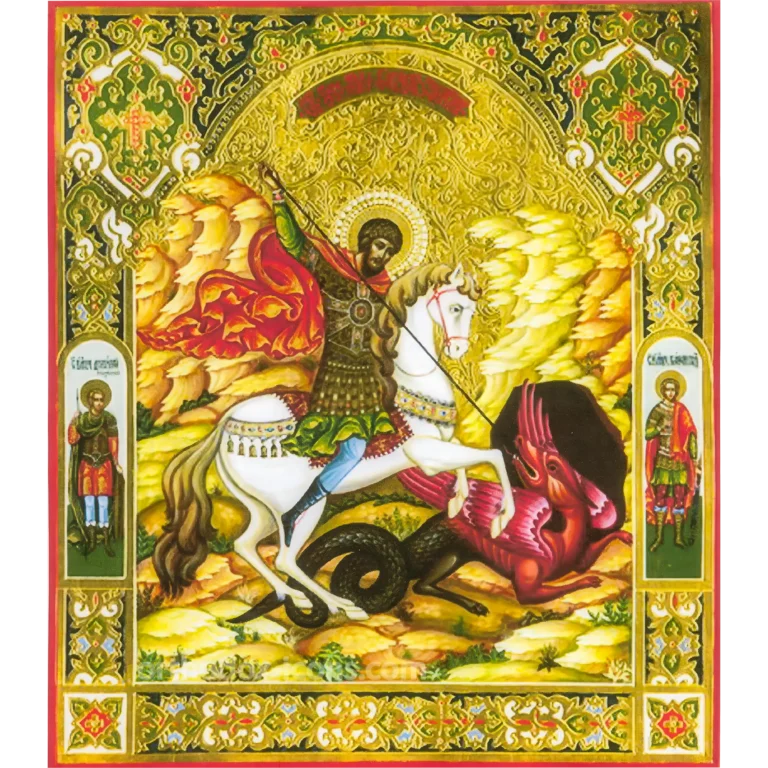
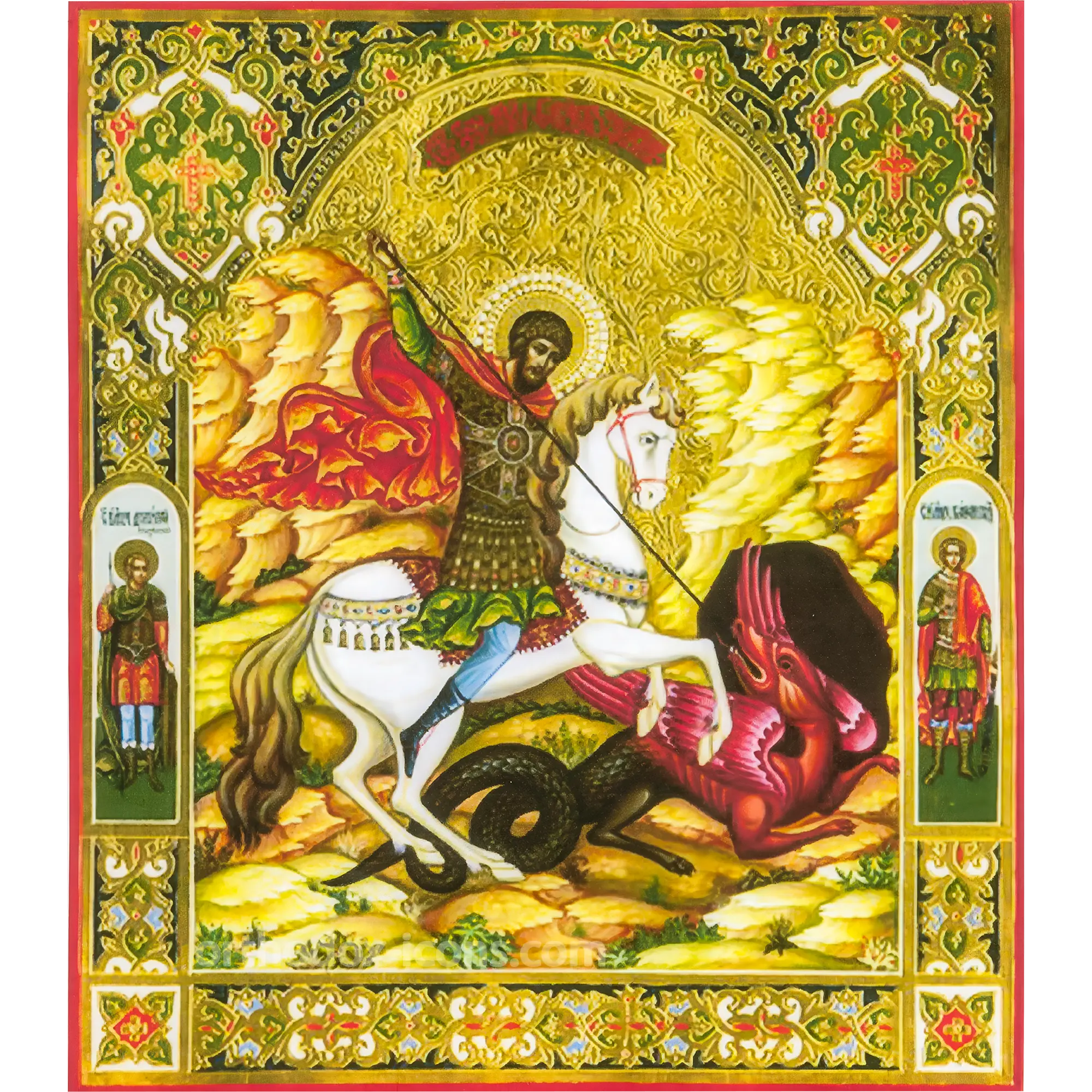
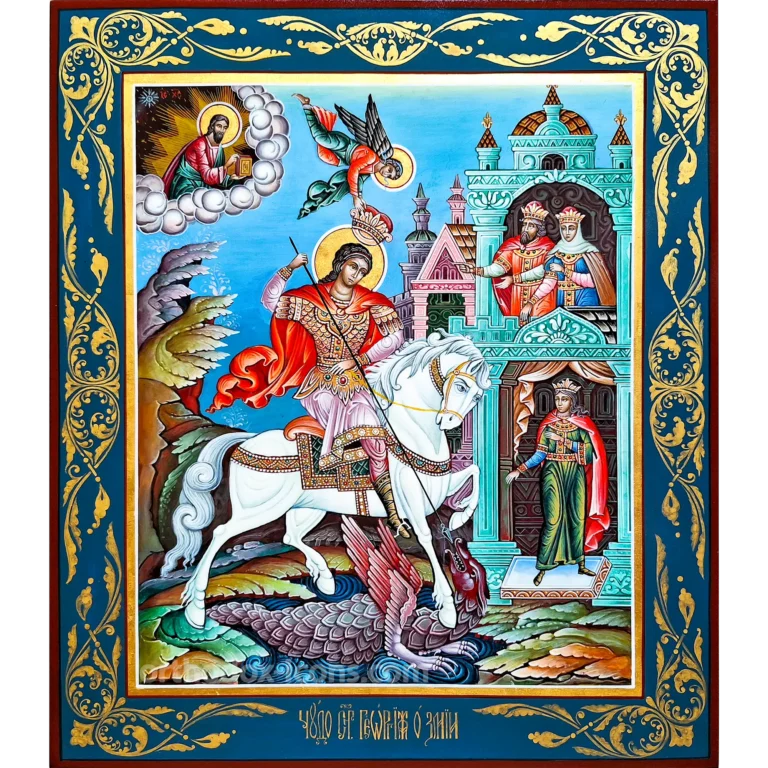
This hand-painted icon of the Holy Great Martyr George the Victory-Bearer is painted in the iconography of the miracle of Saint George and the dragon. The saint is shown on a white horse, striking the dragon with a spear. The image is a spiritual symbol of faith overcoming evil, courage overcoming fear, and divine help overcoming darkness.
The icon has a solemn decorative execution: a gilded background with ornamental tooling, a mountain landscape, the white horse, Saint George’s red cloak, side panels with saints, and a rich border with colored ornament. It is suitable for a home icon corner, church, chapel, office, or as a meaningful named icon for someone called George or Georgi.
Materials: linden wood panel, oak support battens, gesso ground, egg tempera, gold leaf, cold enamel details, and protective finish.
Free international shipping is included. Payment is made after you receive and approve the icon.
It is possible to paint an image in any size to order
Free shipping worldwide
This hand-painted icon of the Holy Great Martyr George the Victory-Bearer is a solemn image of one of the most venerated Christian warrior saints and heavenly protectors. Saint George is shown in the famous iconography of the miracle of the dragon: riding a white horse and striking the dragon with a spear. This scene is recognizable not only as a victory of a warrior, but above all as a spiritual image of faith overcoming evil, courage overcoming fear, light overcoming darkness, and Christian steadfastness overcoming violence.
In this icon, Saint George is painted in dynamic movement. The white horse steps forward, the saint leans toward the dragon, and the spear is directed into the dragon’s open mouth. The red cloak streams behind him, intensifying the sense of resolve and victorious action. The central scene is placed against a golden ornamental field and a mountain landscape, so the icon feels both bright and prayerfully solemn.
The icon is richly decorated. The gilded background and borders include tooled ornament, plant motifs, colored inserts, and a festive red-green color harmony. Small side panels with saints are placed beside the central composition, giving the image additional depth and the character of a feast-day church icon. The size 27×31 cm (10.6×12.2 in) and larger allows the armor, horse, dragon, mountain landscape, goldwork, and ornamental frame to be seen clearly.
This icon may be chosen for a home icon corner, church, chapel, office, military unit, or family prayer space. It is often given to men and boys named George or Georgi, to soldiers, protectors, people in dangerous professions, leaders, and those passing through difficult circumstances who seek prayerful support, courage, and spiritual steadiness.
Features of This Saint George the Victory-Bearer Icon
The main feature of this icon is the combination of a dynamic narrative scene with rich ornamental decoration. The central composition is built around movement: Saint George on the white horse advances, the spear forms a strong diagonal toward the defeated dragon, and the folds of the red cloak emphasize the tension of the moment. The image is not static, yet it preserves canonical order and a prayerful tone.
Saint George is shown as a warrior martyr. His armor, spear, white horse, and victorious gesture reveal the earthly image of a soldier, but the meaning of the icon is not limited to military action. In Orthodox tradition, George the Victory-Bearer is venerated as one who conquered not only an external enemy, but above all fear before suffering and death. The dragon therefore stands for evil, sin, violence, temptation, and spiritual darkness.
The white horse is central to the composition. In iconographic symbolism, white is associated with purity, light, and victory. The horse is not merely carrying the saint; it becomes part of the victorious movement, a sign of divine help and spiritual strength. Its bright figure contrasts with the dark body of the dragon, making the meaning of the struggle immediately clear.
The dragon is shown large and dark, with red wings and an open mouth. Visually it is opposed to the saint and the horse: the dragon lies below, close to the earth, while George and the white horse are higher, moving in light. This contrast strengthens the theological meaning of the icon: evil is frightening, but already defeated; it may threaten, but it does not have the final word before the power of God.
The Miracle of Saint George and the Dragon
The iconography of Saint George striking the dragon is connected with the tradition of saving a city from a monster. According to the account, a dragon appeared near a city, and the people were forced to send victims to it. When the lot fell on the king’s daughter, Saint George appeared on a white horse, struck the dragon with his spear, and delivered the people from danger. After this, many came to faith in Christ.
For this reason, the miracle of Saint George and the dragon is understood in the Church not simply as a legend about bravery, but as an image of faith and Christian witness. The diagonal of the spear is especially important. It connects the saint with the defeated dragon and shows that victory is accomplished not by pride or brute force, but through the grace of God.
Saint George acts as a warrior of Christ. His courage comes from faith, fidelity, and readiness to protect the weak. The red cloak has several meanings: martyrdom, royal dignity, spiritual strength, and the victory of life over death. For Saint George this color is especially fitting, because he was not only a warrior, but also a martyr who suffered for confessing Christ.
The mountain landscape around the central scene gives the icon a sense of space and adds drama. Stones, ledges, and golden hills recall a harsh place of trial. Yet the golden background and the saint’s shining halo show that this path is not abandoned by God.
Gold, Ornament, and Side Panels
The decoration of this icon deserves special attention. The central scene is surrounded by a rich gilded ornament. The background and borders include plant motifs, rhythmic scrolls, colored elements, red accents, and green and blue inserts. This gives the icon a festive character and makes it especially expressive in a larger size.
Gold in an icon is not merely decorative. In Orthodox iconography, gilding is connected with divine light, heavenly glory, and the world transfigured by grace. In the icon of Saint George, gold helps reveal the victorious meaning of the image: the struggle takes place on earth, but the saint’s victory has a spiritual dimension.
The side panels with saints complement the central image and place Saint George within the wider context of Christian witness, confession, and fidelity to Christ. They make the icon more visually and spiritually full, especially when the icon is viewed closely.
The ornamental borders with colored decorative details give the icon a solemn and festive appearance. Red, green, blue, white, and golden details work as one whole: they frame the central scene and keep the composition visually united.
Prayer Before the Icon of Saint George
Before the icon of the Holy Great Martyr George the Victory-Bearer, Orthodox Christians pray for protection, courage, spiritual firmness, and help in difficult circumstances. His image is especially close to those who face danger, injustice, fear, outside pressure, or inner struggle.
People ask Saint George for protection from danger and evil circumstances; courage and firmness of spirit; help in the struggle with fear and despondency; protection of family, home, and loved ones; intercession for soldiers and defenders; help for people in dangerous professions; a just resolution of difficult situations; strength against temptation, evil, and inner weakness; support for men and boys named George; and preservation of faith in trials.
Prayer before this icon should not be understood as a request for outward power for the sake of pride or domination. In Orthodox understanding, Saint George helps a person seek courage, honesty, endurance, and the strength to act according to conscience. His icon is therefore meaningful not only for soldiers, but for anyone engaged in an inner struggle against sin, fear, weakness, and injustice.
Who This Icon Is Suitable For
An icon of Saint George the Victory-Bearer is suitable for a home icon corner, church, chapel, office, family prayer place, or memorable gift. It is often chosen as a named icon for men and boys baptized with the name George or Georgi.
The icon is also appropriate for soldiers, members of protective services, rescuers, travelers, leaders, and people whose life involves responsibility, risk, or defending others. It can be given for a birthday, name day, baptism, beginning of service, important life milestone, new home, or family occasion.
For a family, the icon may become an image of prayerful protection of the home. Saint George is asked for peace, safety, help in hard circumstances, protection from evil, and strengthening of courage among loved ones.
In a church setting, a large icon of Saint George is especially expressive. Iconostasis sizes should be selected individually, taking into account lighting, installation height, neighboring icons, degree of detail, and visibility of the central scene from a distance.
Brief Life of Saint George the Victory-Bearer
The Holy Great Martyr George lived at the end of the third and beginning of the fourth century and came from a noble Christian family. He was a soldier and held a high position in service, but during the persecution of Christians he openly confessed his faith in Christ. When he was ordered to renounce Christianity and offer sacrifice to pagan gods, George refused, choosing suffering rather than earthly glory and safety.
For his confession of faith, Saint George endured severe tortures but did not deny Christ. His steadfastness astonished witnesses and became a cause for others to turn toward the Christian faith. The Church therefore venerates him not only as a warrior, but above all as a great martyr: a person who conquered fear, pain, and the threat of death for the sake of faithfulness to God.
The title Victory-Bearer is connected not only with the miracle of the dragon. The main victory of George is spiritual: he conquered fear before persecutors, preserved the faith, and became a witness of Christ. This is why he strikes the dragon in the icon not as a hero of earthly epic, but as a holy warrior through whom the victory of God’s power over evil is revealed.
The main feast of the Holy Great Martyr George is celebrated on April 23 / May 6 in the Orthodox calendar. Other days of commemoration connected with Saint George also exist, but May 6 is often used when choosing a named icon for someone called George.
Materials, Gold Leaf, and Versions
The hand-painted icon of Saint George is made on a linden wood panel prepared with a traditional icon ground. Oak support battens may be used for stability. Gesso is applied to create a smooth surface for painting. The face of the saint, horse, dragon, mountain landscape, side panels, inscriptions, and decorative details are painted in egg tempera.
Gilding and ornamental decoration are especially important in this image. The background and borders are decorated with gold leaf, tooling, and colored ornament. Along the edges are deep green, red, blue, white, and golden elements that create a festive frame. This kind of work requires careful hand craftsmanship and is especially effective in the size 27×31 cm (10.6×12.2 in) and larger.
For an individual order, the size, degree of gilding, character of ornament, icon case, home or church format, and iconostasis version may be discussed. For a large icon, the place of installation should be considered beforehand so that the central scene, side panels, gold ornament, and colored details can be perceived harmoniously.
Choosing the Size of the Icon
The size 27×31 cm (10.6×12.2 in) is an expressive format for a home icon corner or gift icon. It allows the figure of Saint George, the white horse, dragon, spear, mountain landscape, and decorative border to be seen clearly. A larger size is appropriate if the icon will be placed in a spacious home, office, chapel, church, or separate icon case.
Iconostasis sizes are selected individually. For this composition, the central scene must remain readable: Saint George, the horse, and the dragon should be clearly visible even from a distance. The side panels, inscriptions, and ornament should also be considered when choosing the final size.
Placement, Blessing, and Care
The icon of Saint George the Victory-Bearer may be placed in a home icon corner, prayer area, office, church, or chapel. The place should be reverent and protected from moisture, direct sunlight, and sudden temperature changes. After receiving the icon, it may be blessed in an Orthodox church.
A hand-painted icon should be protected from moisture, overheating, soot, mechanical damage, and household chemicals. The surface should not be wiped with wet cloths, alcohol, or rough fabric. Special care is needed around the gilded background, ornamental borders, side panels, the face of the saint, fine lines of the spear, the horse, and decorative details.
Dust should be removed with a dry soft brush, without pressure. To protect the painting, gilding, and colored ornament, a wooden glazed icon case is recommended, especially if the icon is placed in a home where candles or lamps are often used.
Icon Characteristics
| Name | Saint George the Victorious Icon |
| Saint | Holy Great Martyr George the Victory-Bearer |
| Icon type | Miracle of Saint George and the dragon |
| Visible details | White horse, spear, dragon, red cloak, mountain landscape, side panels with saints, gilded ornamental background |
| Available size | 27×31 cm (10.6×12.2 in); larger iconostasis sizes by request |
| Technique | Hand-painted egg tempera on a prepared linden wood panel |
| Decoration | Gold leaf, tooled ornament, colored decorative elements, cold enamel details, protective finish |
| Purpose | Named icon, home prayer, church or chapel, gift for soldiers, protectors, leaders, and Orthodox families |
| Shipping | Free international shipping; payment after receiving and approving the icon |
Questions and Answers
Who is depicted on this Saint George icon?
The icon depicts the Holy Great Martyr George the Victory-Bearer, a Christian warrior and martyr, shown striking the dragon with a spear.
What does Saint George slaying the dragon mean?
The scene symbolizes the victory of faith over evil, courage over fear, and God’s power over spiritual darkness.
Why is Saint George shown on a white horse?
The white horse points to purity, light, and victory, and contrasts with the dark dragon below.
What do Orthodox Christians pray for before this icon?
People ask Saint George for protection, courage, help in difficult circumstances, support for soldiers and defenders, and strength against fear and evil.
Who may receive this icon as a gift?
It is suitable for men and boys named George or Georgi, soldiers, protectors, people in dangerous professions, leaders, and Orthodox families.
What do the side panels on the icon mean?
The side panels with saints broaden the meaning of the icon and place Saint George within the wider context of Christian witness and martyrdom.
What size is this icon?
The listed size is 27×31 cm (10.6×12.2 in). Larger and iconostasis sizes can also be discussed for a custom order.
When is Saint George commemorated?
The main feast of the Holy Great Martyr George is celebrated on April 23 / May 6 in the Orthodox calendar.
Is gold used in this icon?
Yes. This version uses gold leaf, ornamental gilding, and decorative work on the background and borders.
How should this hand-painted Saint George icon be cared for?
Keep it away from direct sunlight, moisture, heat, soot, and harsh cleaners. Dust it gently with a dry soft brush, and use an icon case when possible.
| Dimensions | 27x31cm (10.6×12.2 in) |
|---|---|
| Name | George, Georgi |
Related products
Hand-Painted Icon of Saint George the Trophy-Bearer
Available on backorder
Price range: $750 through $2250