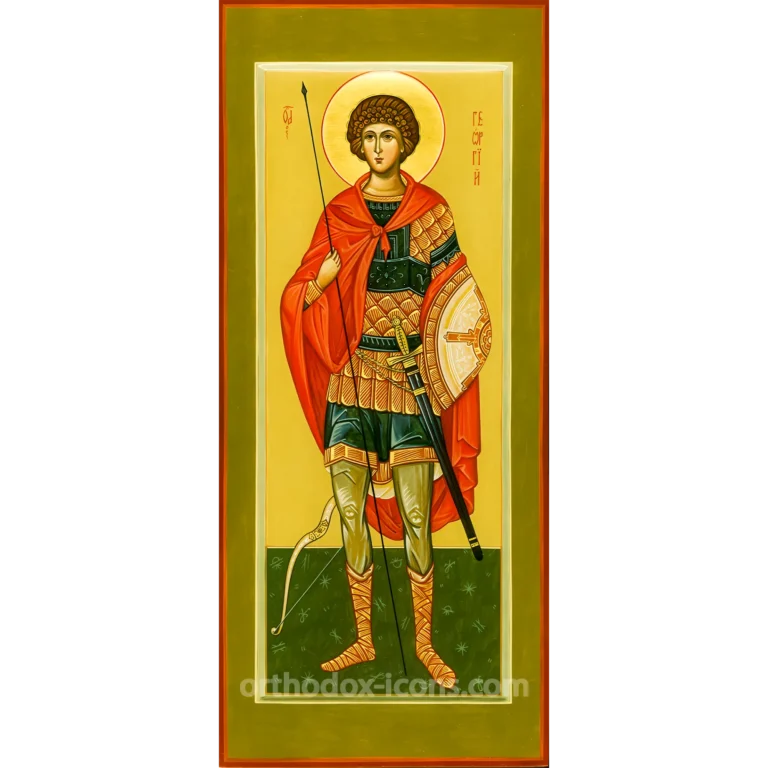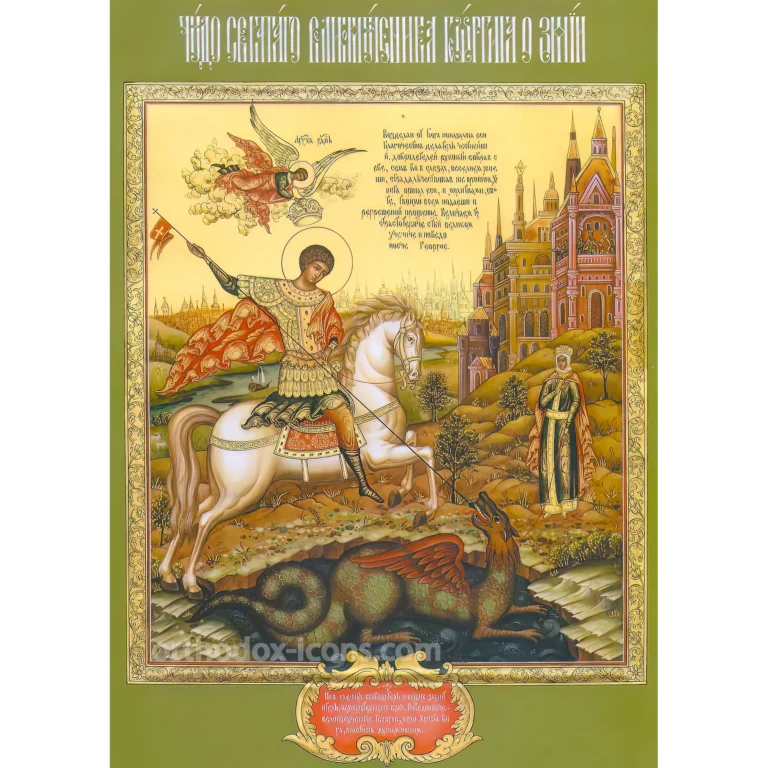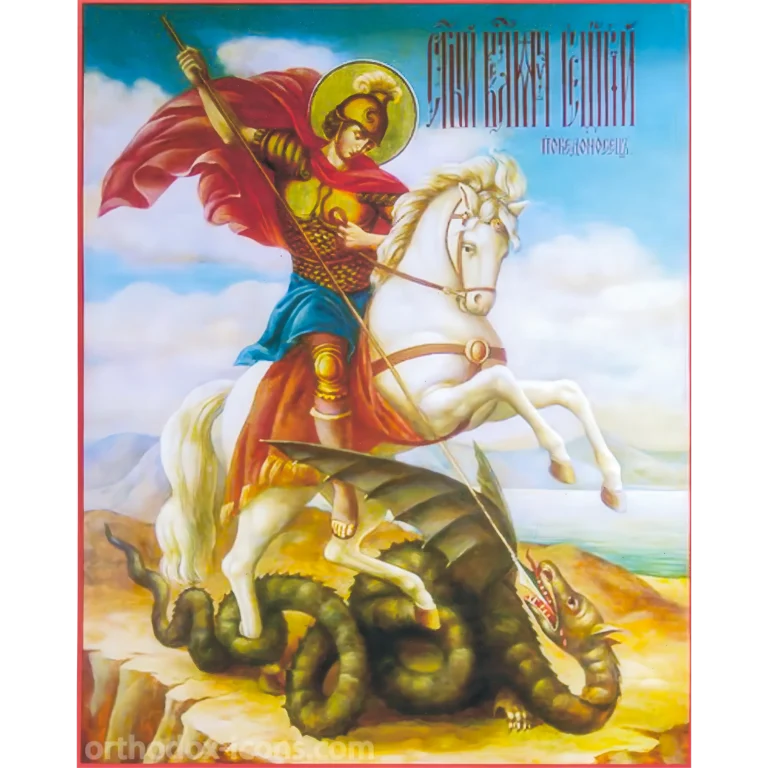
St. George Orthodox Icon
Price range: $1500 through $2250
Available sizes: 27×31 cm (10.6×12.2 in), 30×40 cm (11.8×15.7 in), and larger church or iconostasis sizes by individual commission.
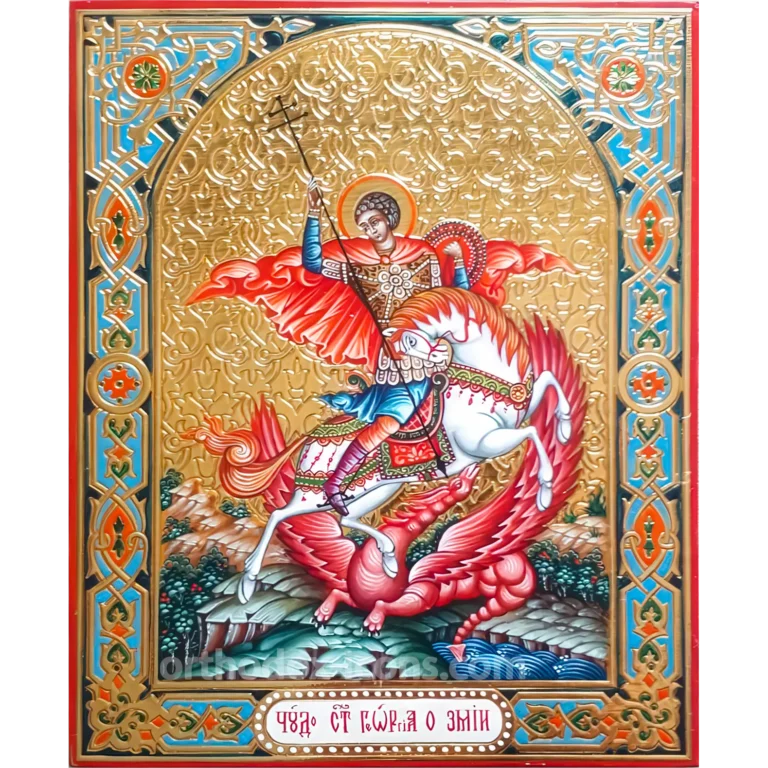
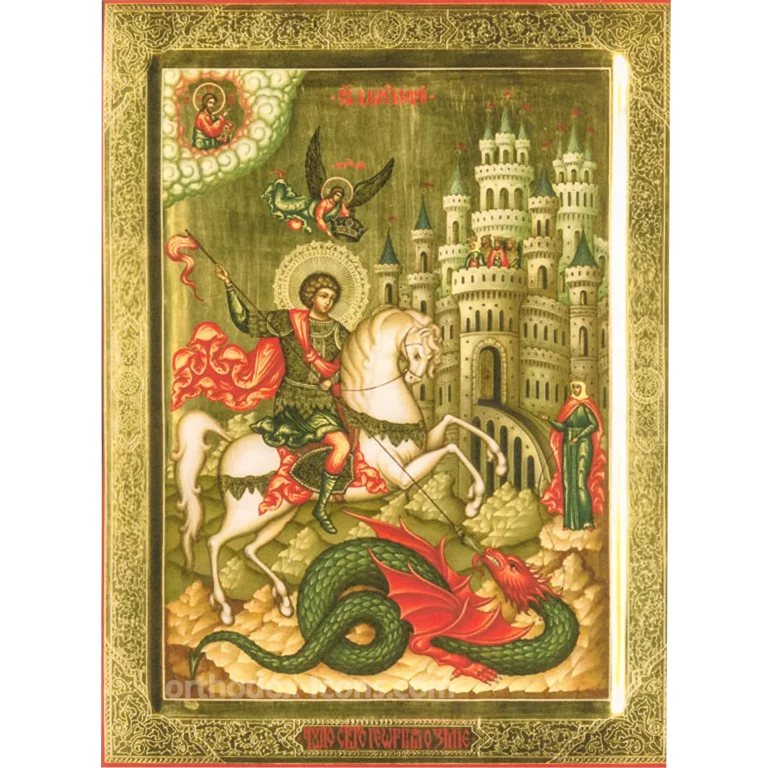
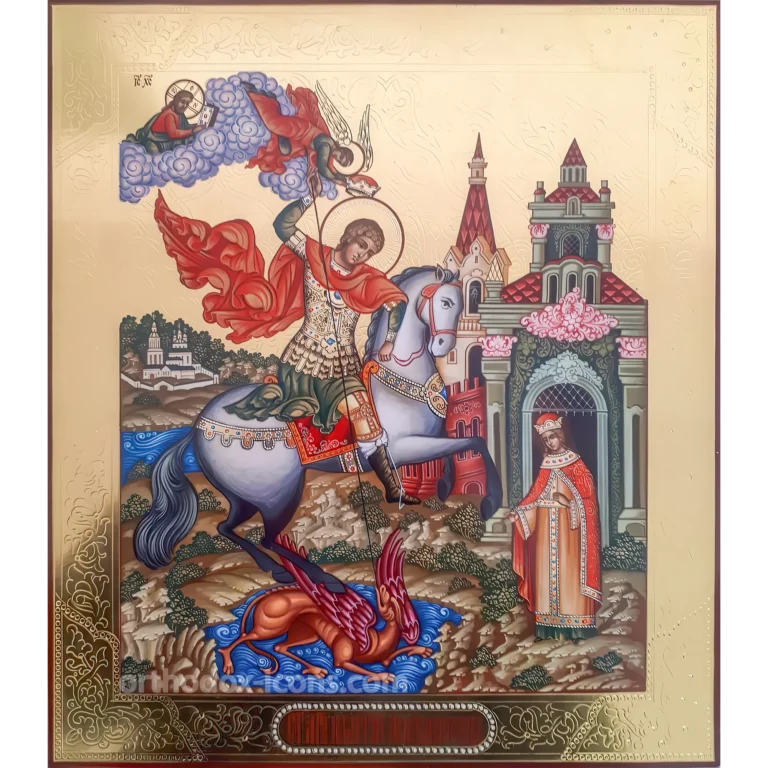
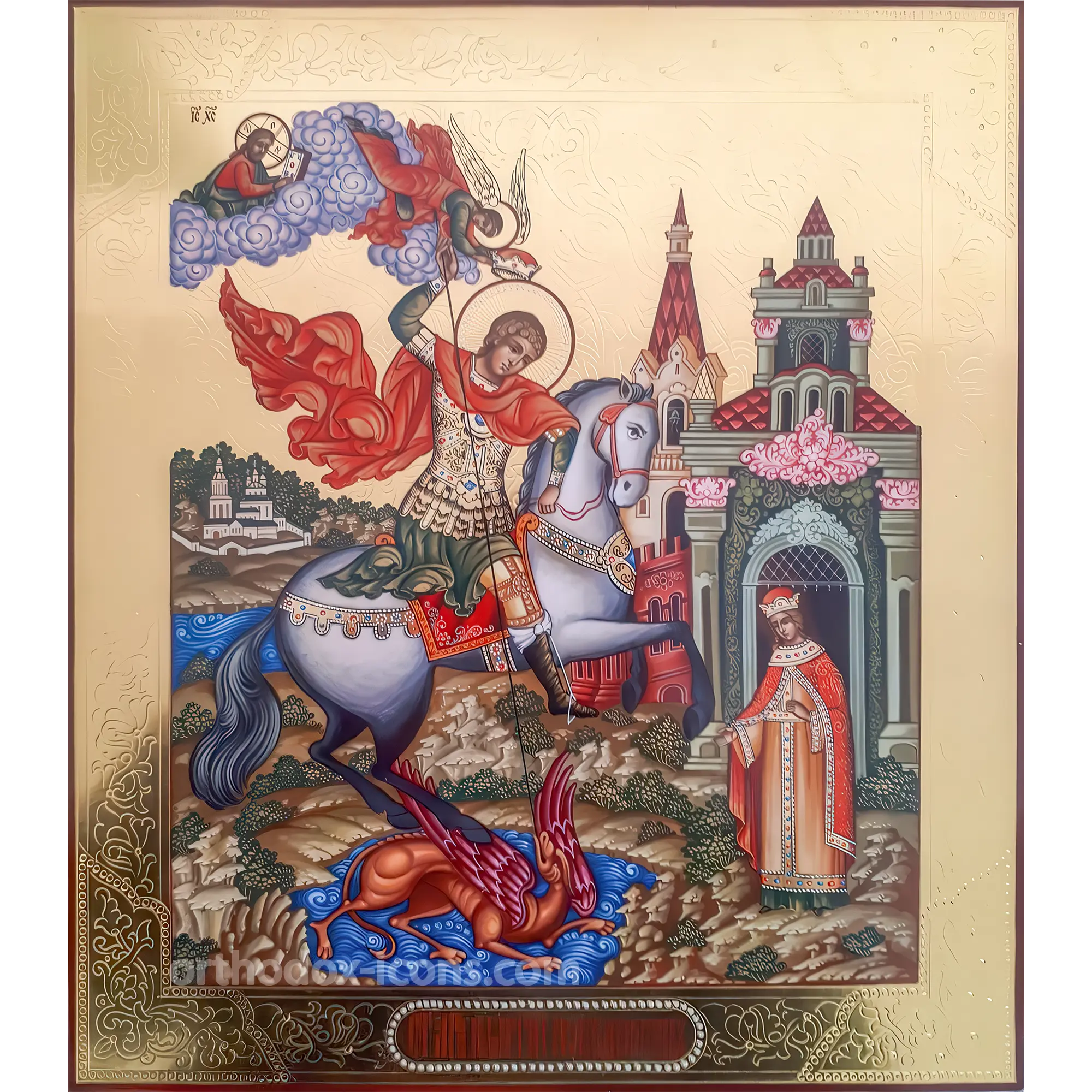
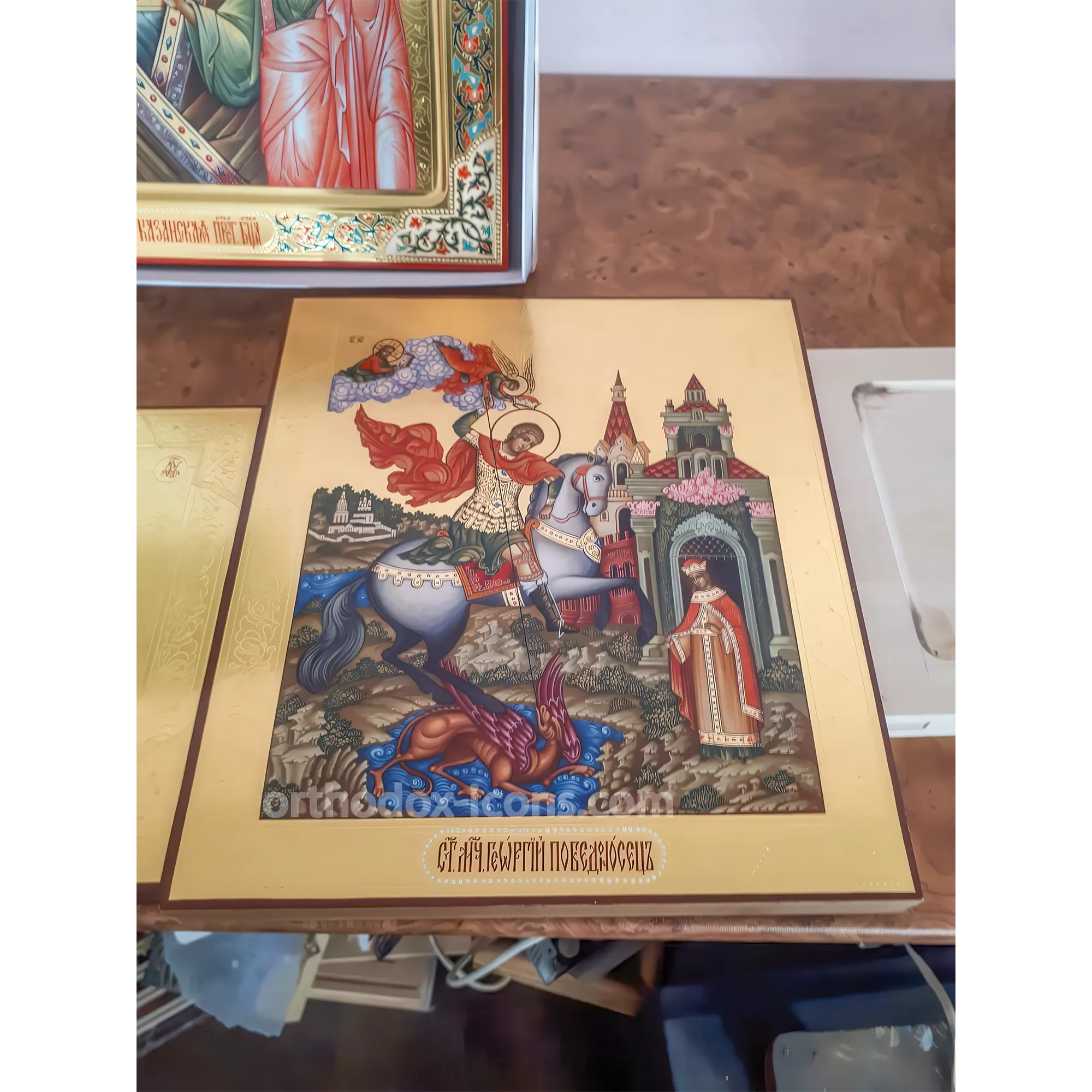
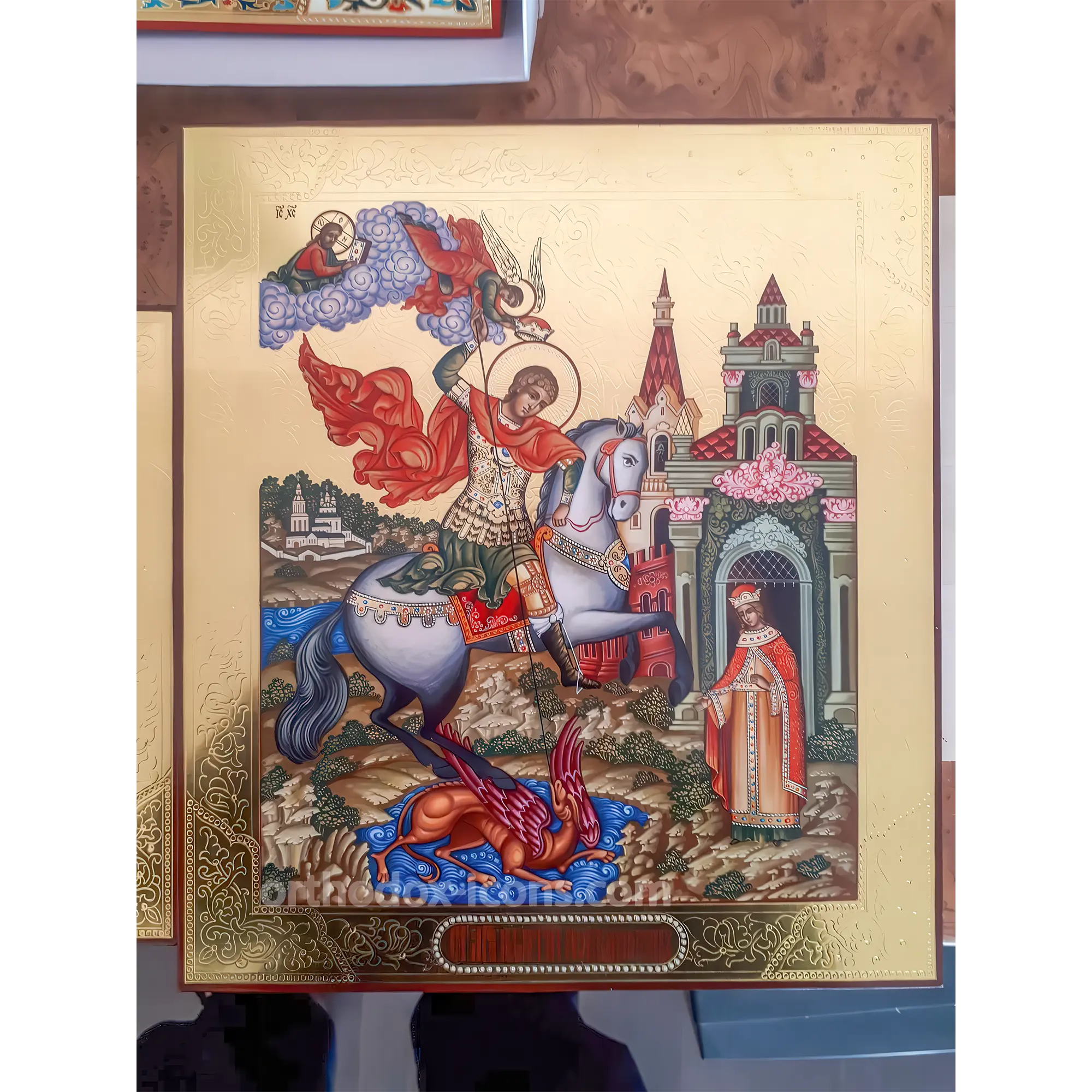
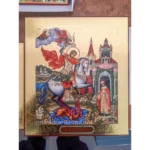
St. George Orthodox Icon is a richly decorated hand-painted icon of the Miracle of Saint George and the Dragon. Saint George rides a gray-blue horse, strikes the red-orange dragon, and saves Princess Elisava near the city of Lasia. The entire sky and broad borders are covered with 23K gold leaf (960 purity) and deep hand-tooled floral ornament, with a red cartouche naming the saint. The icon is painted on a linden wood board with oak splines, levkas, mineral egg tempera, full gilding, and protective varnish. Free international shipping is included, with payment after receiving and approving the icon.
It is possible to paint an image in any size to order
Free shipping worldwide
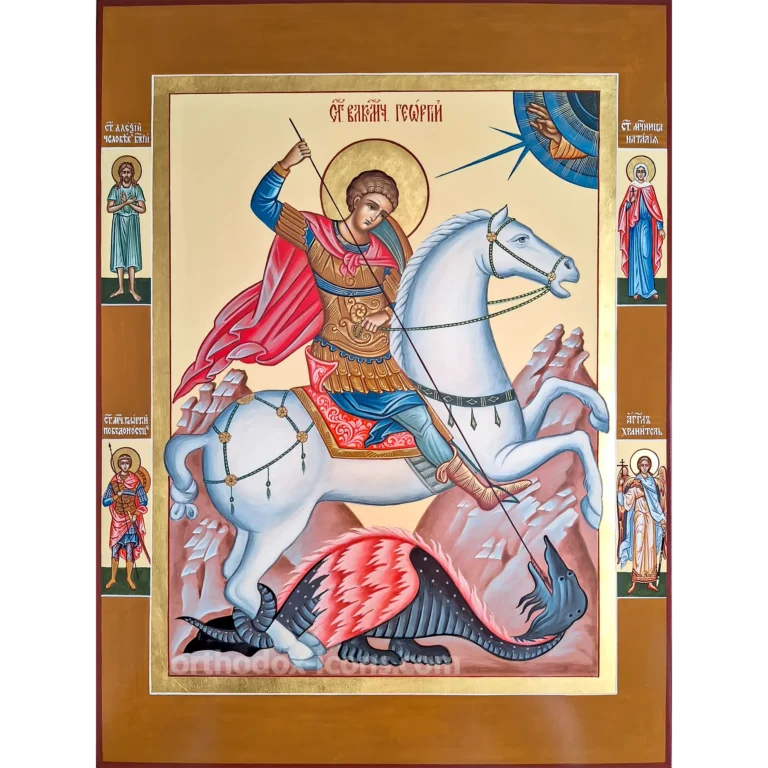
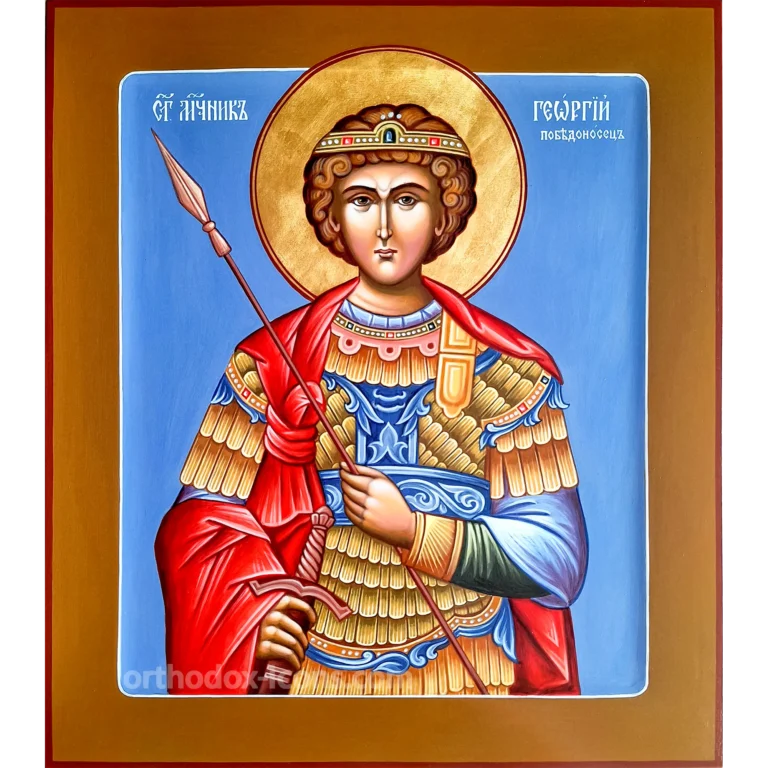
St. George Orthodox Icon is a richly decorated hand-painted image of the Miracle of Saint George and the Dragon. It shows the Holy Great Martyr George the Victory-Bearer as the radiant horseman who defeats the dragon, saves Princess Elisava, and turns the city away from fear and idolatry toward Christ.
This icon is especially striking because of its luxurious gold decoration. The entire open surface of the board, including the sky and broad borders, is covered with 23K gold leaf (960 purity). Over the gold, the master creates deep hand-tooled relief ornament in the form of interlacing plants and geometric details. In the lower part of the border, a red cartouche bears the name of the saint in gold lettering.
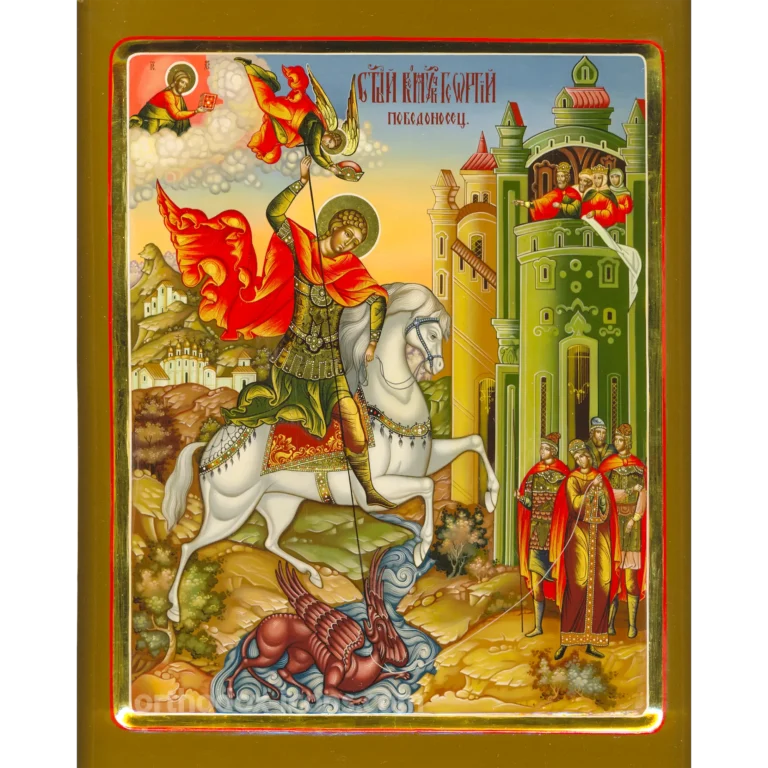
The icon combines narrative, prayer, and decorative solemnity. Saint George rides a gray-blue horse, his scarlet cloak flying behind him. The red-orange dragon lies below among rocks and blue water, while Princess Elisava stands near the fantasy architecture of the city of Lasia. Christ the Savior blesses from the upper left clouds, and an angel brings the golden crown of victory and martyrdom.
Brief Description of the Icon
| Name | St. George Orthodox Icon |
| Saint depicted | Holy Great Martyr George the Victory-Bearer |
| Subject | The Miracle of Saint George and the Dragon with Princess Elisava and the city of Lasia |
| Main meaning | Victory over evil, courage, protection, divine help, and faithfulness to Christ |
| Available sizes | 27×31 cm (10.6×12.2 in), 30×40 cm (11.8×15.7 in), and larger church or iconostasis sizes by individual commission |
| Decoration | Full gold leaf, deep hand-tooled floral ornament, red cartouche, mineral egg tempera, and protective varnish |
Saint George and the Miracle of the Dragon
Saint George is one of the brightest and most beloved saints in Orthodox tradition. He was a brave Roman officer who accepted suffering and death for faith in Christ in 303 under Emperor Diocletian. The most famous sign of his heavenly intercession became the posthumous Miracle of the Dragon.
According to tradition, a fierce dragon lived in a lake near the city of Lasia. The people brought human victims to it, and when the turn came to the royal daughter Elisava, Saint George appeared as a shining horseman. In the name of God, he struck the monster with his spear, saved the princess, and led the city away from pagan idols toward faith in Christ.
In Orthodox iconography, this story is not only a heroic legend. The dragon represents the devil, death, pagan darkness, fear, and the destructive powers that enslave the human person. Saint George’s victory shows that evil, however terrifying it appears, can be overcome by the grace of God.
Iconography and Symbolism
The composition is dynamic and full of bright contrasts. Saint George is shown in the center on a powerful gray-blue horse. The traditional white horse symbolizes purity and light, but in this icon the painter uses a more complex steel-blue tone, creating a strong color contrast with the scarlet cloak of the saint and the red-orange dragon below.
Saint George wears shining golden Roman armor and dark green garments. Behind him, the bright red cloak moves like wings in the wind. Red speaks of royal dignity and of the blood shed by the martyr for Christ. The spear is directed into the mouth of the dragon, a sign of truth piercing spiritual darkness.
The dragon is painted in rich red-orange and purple tones among rocky ledges and blue waters. Its color and movement create a sharp contrast with the cool tone of the horse. This gives the whole image special energy while keeping the icon’s prayerful order.
Princess Elisava stands on the right near the gates of the fantastic city of Lasia. She wears royal clothing: a long red mantle with ermine-like edging over a patterned dress, and a crown on her head. Behind her are stylized palatial forms with pink arches and towers, a traditional way of showing sacred city architecture in Russian icon painting.
In the upper left corner, Christ the Savior appears in opened blue clouds with the Gospel, blessing Saint George. From the same heavenly space an angel descends in red garments, carrying the golden martyr’s crown. In the distance, on a hill, a white stone monastery recalls the protection of holy places and the Christian land.
Prayer Before the Icon
Saint George the Victory-Bearer is a heavenly protector of soldiers, officers, and all who serve in danger. Mothers, wives, and servicemen pray before his icon for the preservation of life and health, courage, endurance, deliverance from captivity, and safe return home.
Leaders, officers, and public servants may also ask Saint George for wisdom, sober judgment, and protection from internal and external threats. His image reminds those in authority that true strength must be joined with responsibility, justice, and faithfulness to God.
The help of Saint George is not limited to military life. Since his name is connected with working the land, farmers, gardeners, and livestock keepers also turn to him in prayer for the protection of fields, harvest, animals, and rural households. In personal spiritual life, the icon helps the believer pray for victory over fear, despair, addiction, envy, and destructive influence.
Gold, Tooling, and Decorative Meaning
This icon belongs to a highly complex decorative type. The sky and broad borders are fully gilded with 23K gold leaf (960 purity), then worked by hand with deep relief ornament. The result is a dense carpet of interwoven plants and geometric forms that catches the light from many angles.
This technique is often called basma-style decoration or hand tooling over levkas and gold. It gives the icon the visual character of a precious liturgical object. The gold does not serve as ordinary luxury; in Orthodox iconography it symbolizes divine light, heavenly glory, and the transfigured world of the Kingdom of God.
The red cartouche at the bottom is woven into the ornamental field. It contains the name or title of the saint in gold lettering, traditionally naming Saint George the Great Martyr and Victory-Bearer. This detail helps the decoration remain connected with the prayerful identity of the icon.
What Is Seen on This Icon
- Saint George rides a gray-blue horse rather than a purely white horse.
- He wears golden armor, dark green garments, and a bright scarlet cloak.
- The red-orange dragon lies below among rocks and blue water.
- Princess Elisava stands near the fantastic city of Lasia in royal clothing.
- Christ the Savior blesses from the opened clouds with the Gospel.
- An angel descends with the golden crown of victory and martyrdom.
- A white stone monastery is visible on a distant hill.
- The sky and broad borders are fully gilded and covered with deep hand-tooled ornament.
- A red cartouche at the bottom names the saint in gold lettering.
Materials and Technique
The icon is made on a thick, well-dried linden wood board. Oak splines are set into the back to help prevent warping over time. The board is covered with linen cloth and more than ten layers of chalk levkas, then polished to a smooth surface suitable for both painting and relief ornament.
The open areas are gilded with 23K gold leaf (960 purity), often in a double layer, and polished with agate for brightness. Over the gilded surface, the master works by hand with fine tools, creating a deep raised floral ornament. This is a slow and demanding process that requires jewel-like precision.
The painted part of the icon is executed in natural mineral egg tempera. Ground mineral pigments are mixed with egg emulsion, giving the colors depth, clarity, and long life. The finished image is protected with a natural varnish layer.
Icon Characteristics
| Name | St. George Orthodox Icon |
| Saint | Holy Great Martyr George the Victory-Bearer |
| Subject | The Miracle of Saint George and the Dragon |
| Icon type | Richly gilded narrative icon with basma-style hand-tooled ornament |
| Main spiritual meaning | Protection, courage, victory over evil, and divine help |
| Board | Thick linden wood board |
| Board reinforcement | Inset oak splines |
| Ground | Linen cloth and chalk levkas |
| Gilding | Full gilding with 23K gold leaf (960 purity) |
| Decoration | Deep hand-tooled floral relief ornament over gold leaf |
| Painting | Natural mineral egg tempera |
| Available sizes | 27×31 cm (10.6×12.2 in), 30×40 cm (11.8×15.7 in), and larger church or iconostasis sizes by individual commission |
| Purpose | For home prayer, patron saint gift, officer’s office, church, chapel, or iconostasis |
Who This Icon Is Suitable For
Because of its full gilding and complex hand-tooled ornament, this icon has a solemn and prestigious character. It is suitable as a meaningful gift for officers, veterans, leaders, and people whose lives are connected with service, responsibility, and protection.
It is also a rich patron saint icon for men and boys named George, Georgi, Yuri, or Egor. It may be given for baptism, a name day, birthday, jubilee, military service, a promotion, or another important life event. The 27×31 cm (10.6×12.2 in) size is suitable for the home, while the 30×40 cm (11.8×15.7 in) format can become a strong spiritual contribution to a church or chapel.
Care for a Gilded and Tooled Icon
Gold leaf of 960 purity does not darken with time, but the relief surface can be damaged by rough cleaning. The icon should not be washed with water or chemicals. Dust should be removed only with a very soft dry brush. For long-term preservation, a wooden kiot with protective glass is recommended.
Questions and Answers
Why is Saint George’s horse gray-blue instead of white?
The white horse is the usual symbol of purity and light, but Mstyora and Palekh-style icons may use more complex gray-blue tones to create a richer contrast with the red cloak and the orange dragon.
What is the deep pattern on the gold background?
It is hand-tooled relief ornament over levkas and gold leaf, often called basma-style decoration. The raised floral pattern gives the icon the appearance of a precious liturgical object.
What does the defeated dragon symbolize?
The dragon symbolizes the devil, evil, death, pagan darkness, fear, and every destructive power overcome by the grace of God.
Why does the city behind the princess look unusual?
The city of Lasia is shown in the traditional iconographic manner as palatial architecture, with stylized arches and towers that emphasize the miraculous and sacred character of the event.
Who is shown in the clouds?
Christ the Savior appears in the clouds with the Gospel, blessing Saint George, while an angel brings the golden crown of victory and martyrdom.
What can people pray for before this icon?
People pray for soldiers, protection of life and health, courage, victory over fear and enemies, protection of the home, and help in farming, livestock, and rural work.
Why is the price of such an icon higher?
Full gilding and dense hand-tooled gold ornament require many hours of highly skilled work, so the final cost depends on size, ornament complexity, and workshop schedule.
What materials are used to make the icon?
The icon is painted on a thick linden wood board with oak splines, linen cloth, levkas, full gilding with 23K gold leaf (960 purity), hand-tooled ornament, mineral egg tempera, and protective varnish.
What is written in the red cartouche at the bottom?
The red cartouche contains the saint’s name or icon title in gold lettering, traditionally naming Saint George the Great Martyr and Victory-Bearer.
How should a gilded and tooled icon be cared for?
It should not be washed with water or chemicals. Dust should be removed only with a very soft dry brush, and a protective kiot with glass is recommended.
| Dimensions | 27x31cm (10.6×12.2 in), 30x40cm (11.8×15.7 in) |
|---|---|
| Name | George, Georgi |