Sacred Image of Saints Peter and Fevronia
$950
Available size: 17×21 cm (6.7×8.3 in). The production time for this filigree icon is about 2 months.
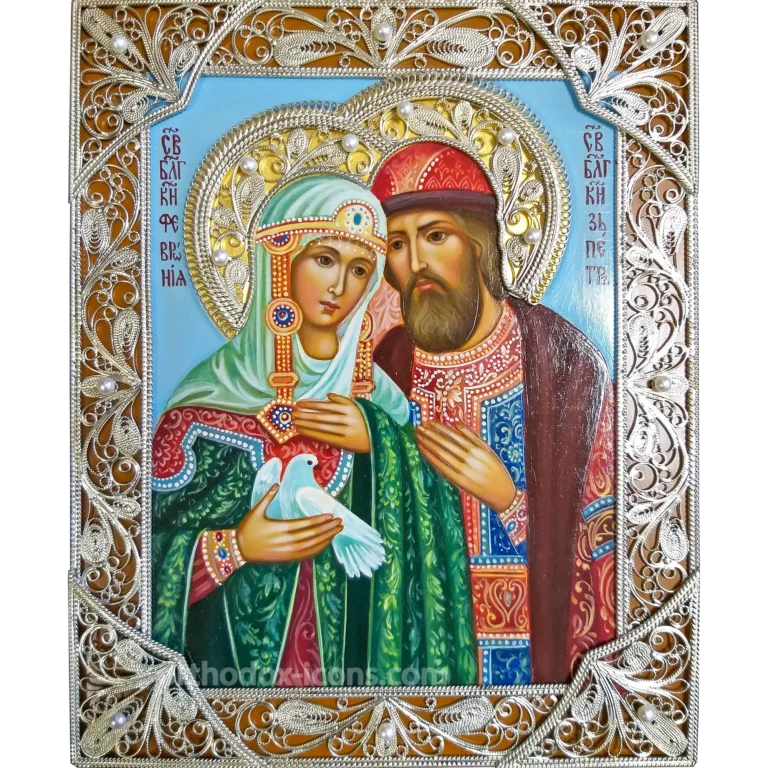
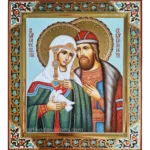
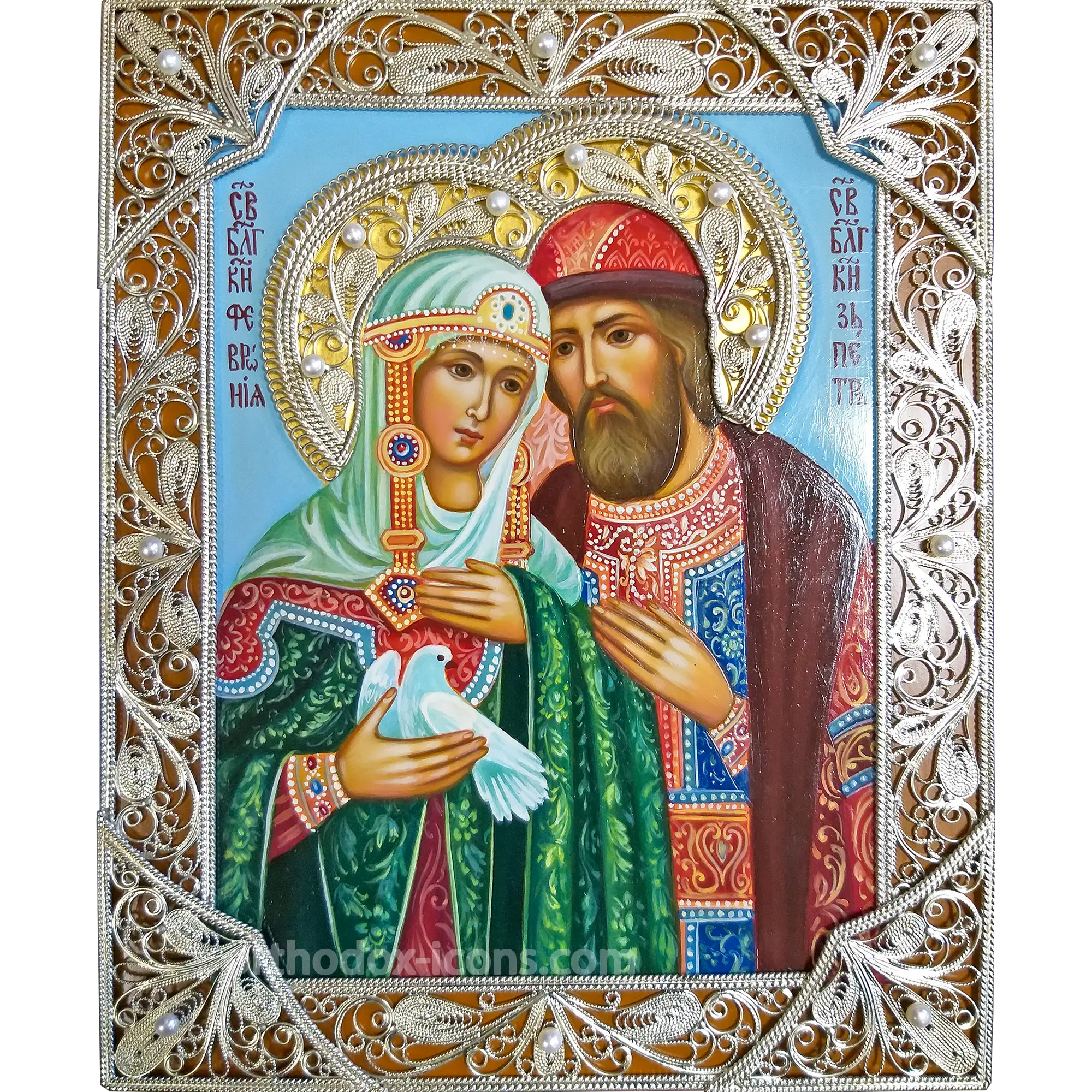
This hand-painted filigree icon of Saints Peter and Fevronia of Murom is a richly decorated image of the beloved Orthodox patrons of marriage, family peace, fidelity, and Christian love. The saints are shown half-length in princely garments on a soft blue background. Peter looks toward Fevronia, while Fevronia gently holds a white dove, a symbol of peace, purity, fidelity, and the grace of the Holy Spirit.
The special feature of this icon is the openwork filigree cover: the borders and halos are decorated with fine silver-colored metal lace and pearl-like inlay. The icon is painted in egg tempera on a linden wood panel and finished with gold leaf and careful hand ornament.
Free international shipping is included. Payment is made after you receive and approve the icon.
It is possible to paint an image in any size to order
Free shipping worldwide
This hand-painted filigree icon of the holy right-believing Prince Peter and Princess Fevronia of Murom is a richly decorated Orthodox image of the beloved patrons of marriage, family peace, fidelity, and Christian love. It is not only a canonical icon of the holy spouses, but also a refined work of sacred craftsmanship, where the beauty of their spiritual union is emphasized by openwork filigree and pearl-like ornament.
The icon is made by hand in the Mstyora tradition. The faces and garments are painted in natural egg tempera on a prepared linden wood panel, while the borders and halos are adorned with fine metal filigree, like delicate lace. This combination of icon painting, gold leaf, silver-colored metalwork, and pearl detail gives the icon a festive and precious character, making it especially meaningful as a wedding, anniversary, or family gift.
The listed size is 17×21 cm (6.7×8.3 in). The production time for this filigree icon is about 2 months.
Iconography: The Dove as a Symbol of Love and Fidelity
The composition is built around the deep inner unity of the holy spouses. Peter and Fevronia are shown half-length, standing close to one another. Peter, a noble and dignified prince, turns his gaze toward his wife with tenderness, gratitude, and protective love. Fevronia’s face is meek and peaceful, and her eyes are lowered toward the symbol held in her hands.
At the center of the composition is a white dove, which Fevronia gently holds to her breast with both hands. In Christian symbolism the dove carries several meanings. It is a visible sign associated with the Holy Spirit, whose grace sanctifies Christian marriage. It is also a traditional symbol of peace, purity, and faithful love. Because doves are often associated with lifelong pairing, the image naturally speaks of marital fidelity and harmony in the family.
The garments of the saints emphasize both their princely dignity and spiritual beauty. Peter wears a rich red garment with gold ornament and a cherry-colored princely mantle. On his head is a traditional princely cap. Fevronia is dressed in an emerald-green garment decorated with gold and pearl-like ornament; her head is covered and crowned with a jeweled headdress. The contrast of red and green creates a vivid harmony against the pure blue background.
Filigree and Pearl Ornament
The main artistic feature of this icon is its exterior decoration. The borders and halos are adorned with filigree, also known as skan in Russian icon craft. Filigree is an ancient ornamental technique in which the master twists fine metal wires, both smooth and braided, and joins them into complex openwork patterns.
On this icon, the filigree creates a transparent, raised, lace-like plant ornament. The silver-colored metalwork frames the painted image without covering the faces, gestures, or central symbol of the dove. In the openwork pattern are round white pearl or mother-of-pearl style beads. In Orthodox decorative tradition, pearls are associated with purity, joy, and the beauty of the Kingdom of Heaven.
This kind of decoration makes the icon especially suitable as a solemn gift. It has the character of a family heirloom: intimate in size, but visually festive and richly finished.
Who This Icon Is Suitable For
Saints Peter and Fevronia are among the most beloved Orthodox patrons of family life. In this richly decorated form, the icon is especially appropriate for a church wedding, marriage, or anniversary. It can become a first family icon for newlyweds and a prayerful reminder that the strength of marriage is built on fidelity, patience, forgiveness, and turning toward God.
The icon is also meaningful for a silver wedding or pearl wedding. The silver-colored filigree and pearl-like inlay naturally echo those anniversary themes, while the image itself points to the deeper spiritual meaning of long married life.
It may also be given to a couple passing through a difficult time as a sign of hope for reconciliation, wisdom, and renewed peace. Young people who hope to form a Christian family may also pray before Saints Peter and Fevronia, asking for guidance and a worthy spouse.
Prayer Before Saints Peter and Fevronia
Before the icon of Saints Peter and Fevronia of Murom, Orthodox Christians pray for family peace, preservation of marriage, fidelity, mutual understanding, patience, and help in raising children. Their life speaks to the real difficulties of family life: illness, social pressure, exile, misunderstanding, and the need to choose faithfulness over comfort or status.
People ask the saints for the strengthening of marital bonds; protection of the family from betrayal, coldness, envy, and division; peace and mutual understanding between husband and wife; the ability to forgive offenses and yield to one another; health and support in illness; and God’s blessing on the desire to have children.
Prayer before this icon should not be treated as a simple guarantee of results. In Orthodox life, the saints are asked for intercession before God, while spouses themselves are called to honest speech, responsibility, patience, repentance, and active love.
Brief Life of the Holy Spouses
The story of Peter and Fevronia, preserved in the sixteenth-century account by the monk Ermolai-Erasmus, is one of the most poetic pages of Russian holiness. Prince Peter, brother of the ruler of Murom, became seriously ill. In a dream it was revealed to him that he could be healed by Fevronia, the daughter of a beekeeper from the Ryazan village of Laskovo, known for wisdom and knowledge of herbs.
Fevronia healed the prince after he promised to marry her. At first Peter broke his word because of her humble birth, and the illness returned. Realizing his sin, he repented, was healed again, and joyfully took Fevronia as his wife.
When Peter became prince of Murom, proud boyars and their wives hated the new princess because she was of simple origin. They demanded that Peter either dismiss his wife or leave the city. Peter chose love and fidelity to his lawful wife. He gave up the princely throne, wealth, and power, and departed from Murom with Fevronia in a simple boat. Fevronia comforted and supported him in exile.
Soon disorder came upon Murom. The boyars fought among themselves for power, and the people begged Peter and Fevronia to return. They came back, forgave their enemies, and ruled the city with justice and mercy. In old age, the spouses received monastic tonsure with the names David and Euphrosyne. They prayed to depart to the Lord on the same day and asked to be buried together. According to tradition, their prayer was heard, and they reposed on July 8, 1228.
Mstyora Materials and Technique
The icon is made according to the discipline of the Mstyora icon-painting school. The base is a solid linden wood panel strengthened on the back with oak support battens. The front is prepared with layers of gesso over the traditional ground, creating a smooth surface for painting.
The painting is executed in egg tempera, using natural mineral pigments. This technique gives the faces, garments, and blue background depth, clarity, and durability. Gold leaf is used in the sacred ornament and luminous details of the image.
After the painting and protective finish are completed, the filigree cover is attached and decorated with pearl-like inlay. This is delicate manual work, and every icon of this type has the character of an individual crafted piece.
Characteristics and Size
| Holy images | Right-believing Prince Peter and Princess Fevronia of Murom |
| Iconography | Half-length paired image with a white dove |
| Decoration | Handmade openwork filigree, pearl or mother-of-pearl style beads |
| Panel | Solid linden wood, oak support battens, gesso ground |
| Painting materials | Natural mineral egg tempera, gold leaf |
| Available size | 17×21 cm (6.7×8.3 in) |
| Production time | About 2 months |
Blessing and Care
The icon may be blessed in an Orthodox church before shipping if this is requested when the order is arranged. A blessed icon is intended for prayer, thanksgiving to God, and turning to Saints Peter and Fevronia as heavenly intercessors for family life.
Icons with filigree require especially careful handling. The metal lace and pearl details should not be wiped with wet cloths, polishing agents, or chemical cleaners. Moisture can damage the metalwork, and pearl-like ornament can lose its beauty.
Dust should be removed only with a dry, soft, fluffy brush, without pressure. For long-term preservation, a wooden glazed icon case is strongly recommended. It protects the painting, metal filigree, pearls, and wooden panel from dust, soot, humidity, and accidental touch.
Questions and Answers
What does the white dove in Fevronia’s hands mean?
The dove is a symbol of peace, purity, marital fidelity, and the grace of the Holy Spirit that sanctifies Christian marriage.
What is filigree on an icon?
Filigree is an openwork ornamental technique made from fine twisted metal wire. On this icon it decorates the borders and halos like delicate metal lace.
Are the pearl details real?
The filigree decoration uses pearl or high-quality mother-of-pearl style beads, a traditional ornamental detail associated with purity and heavenly beauty.
Why are Peter and Fevronia patrons of family life?
Their life shows fidelity, mutual support, humility, and love that remained stronger than power, social pressure, and hardship.
Is this icon suitable as a church wedding gift?
Yes. It is especially suitable as a church wedding, marriage, anniversary, silver wedding, or pearl wedding gift.
Can unmarried people pray before this icon?
Yes. Orthodox Christians may ask Saints Peter and Fevronia for guidance in forming a faithful Christian family and finding a worthy spouse.
How should an icon with filigree be cared for?
Avoid moisture, polishing agents, and chemical cleaners. Dust the painting, metalwork, and pearl details only with a dry soft brush, without pressure.
Do egg tempera colors fade over time?
Natural egg tempera with mineral pigments is valued for its durability and depth when the icon is kept in proper conditions.
Why is Peter shown in a princely cap and Fevronia in a crown?
Their clothing emphasizes their dignity as the holy right-believing rulers of Murom, while also showing the spiritual beauty of their married life.
Can the icon be blessed before shipping?
The icon may be blessed in an Orthodox church before shipping if this is requested when the order is arranged.
| Dimensions | 17x21cm (6.7×8.3 in) |
|---|---|
| Name | Fevronia, Peter |
Related products
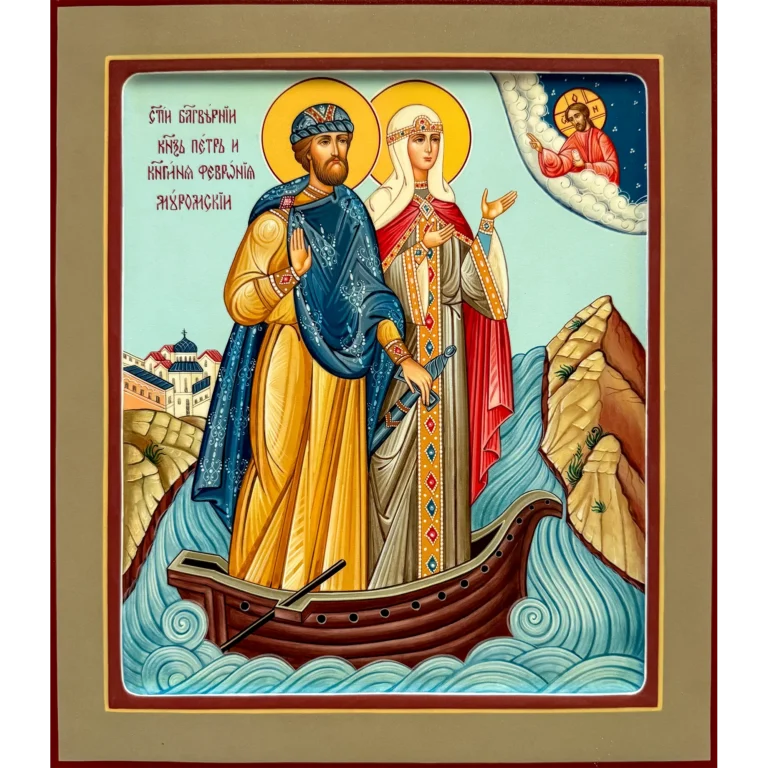
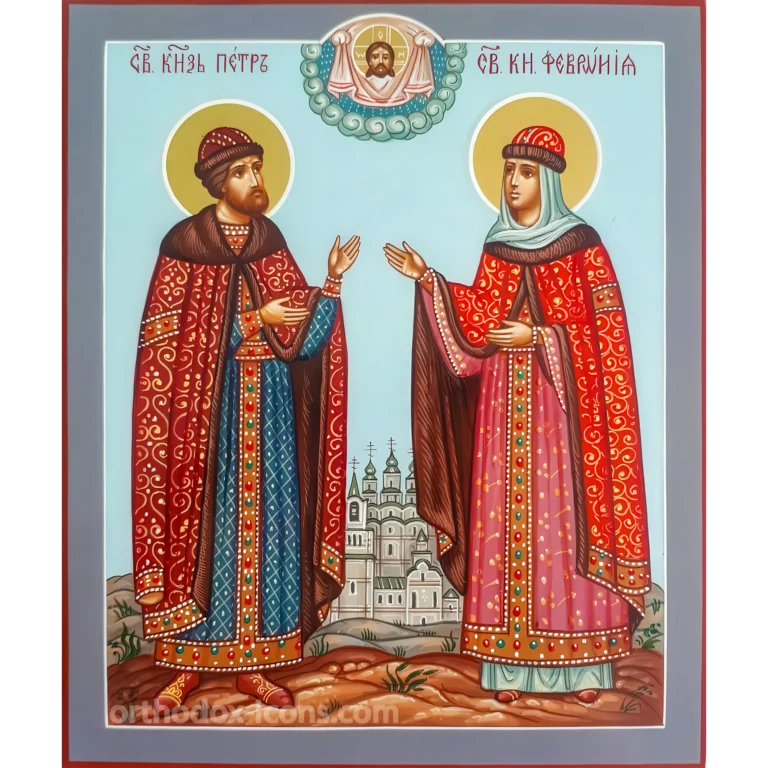
Hand-Painted Icon of Saints Peter and Fevronia of Murom
Available on backorder
Price range: $550 through $1600