
Kazan Filigree Icon of Virgin Mary
$950
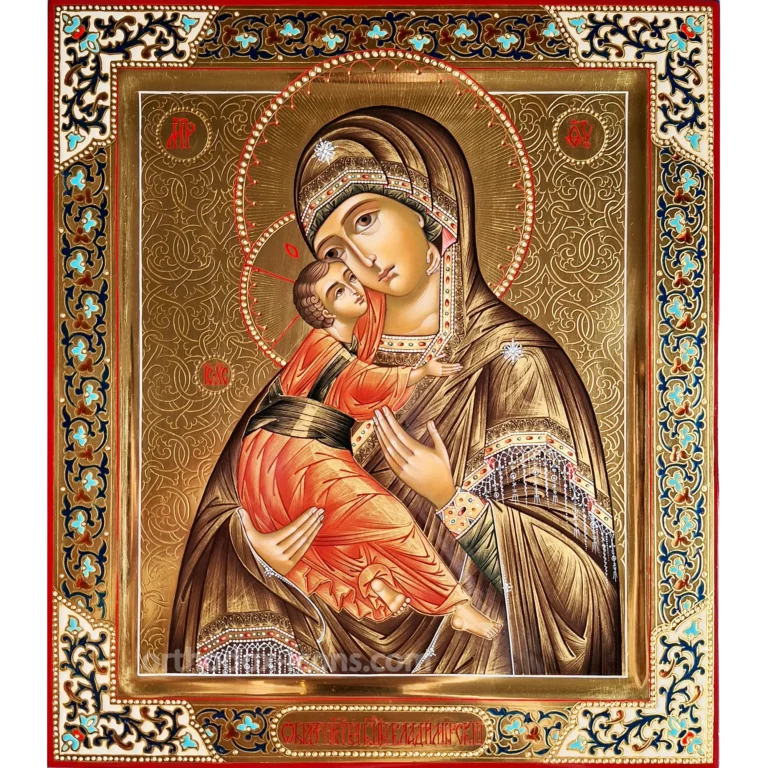
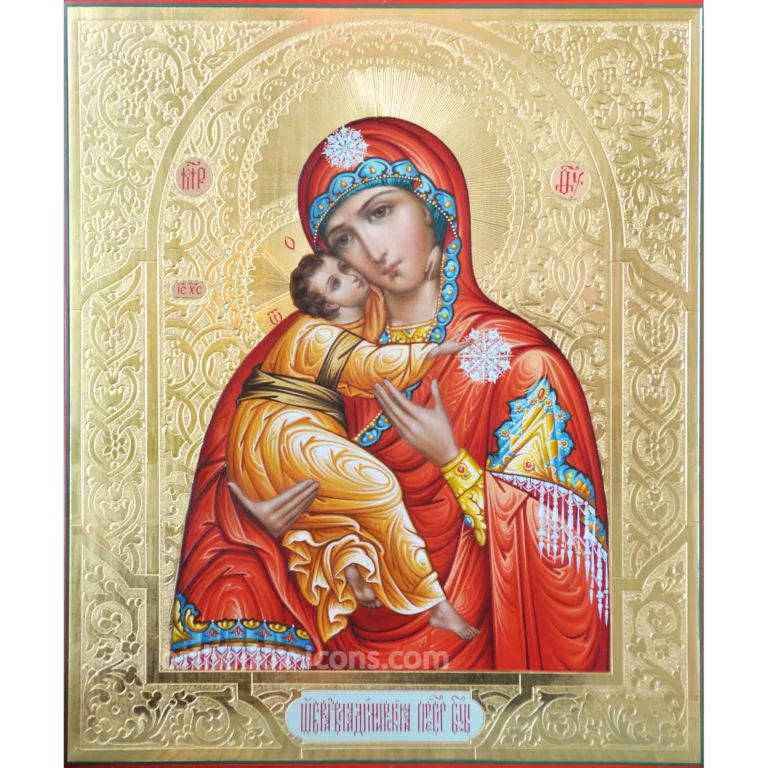
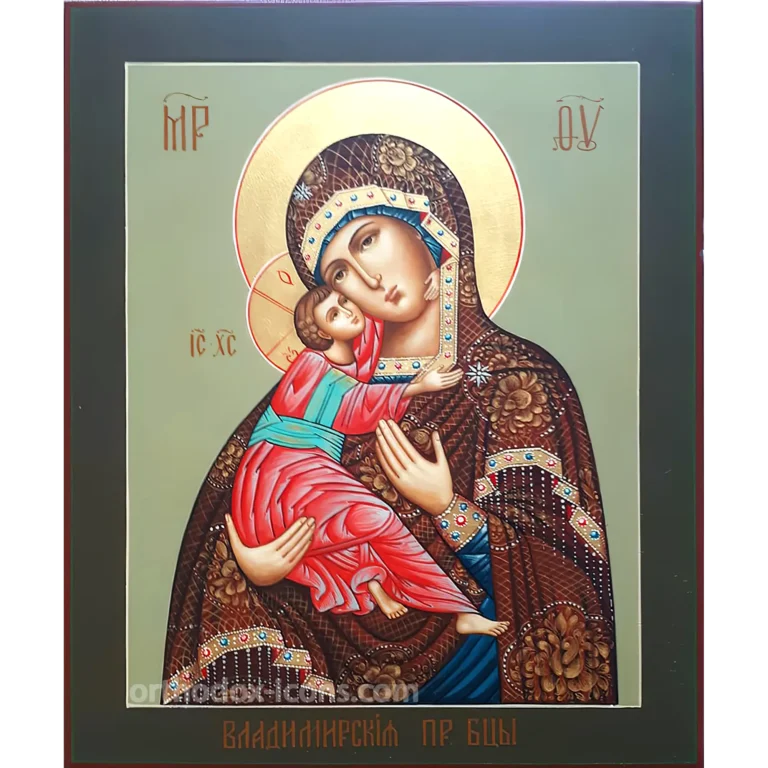
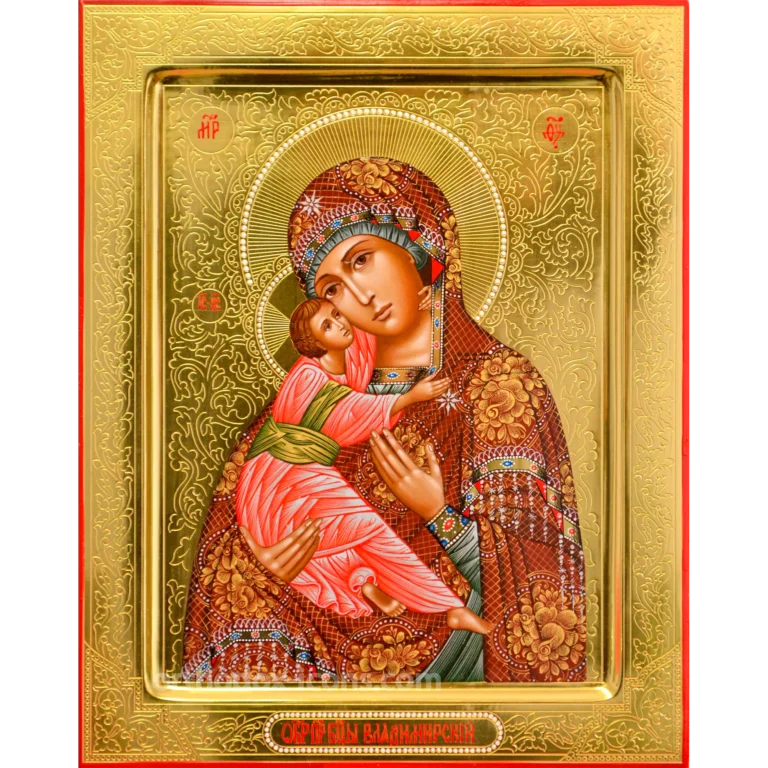
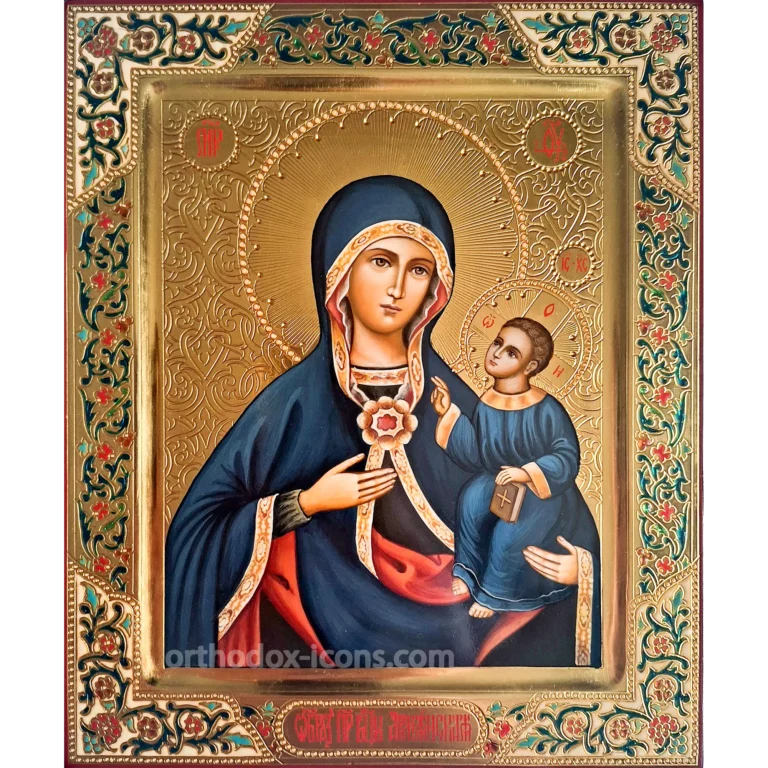
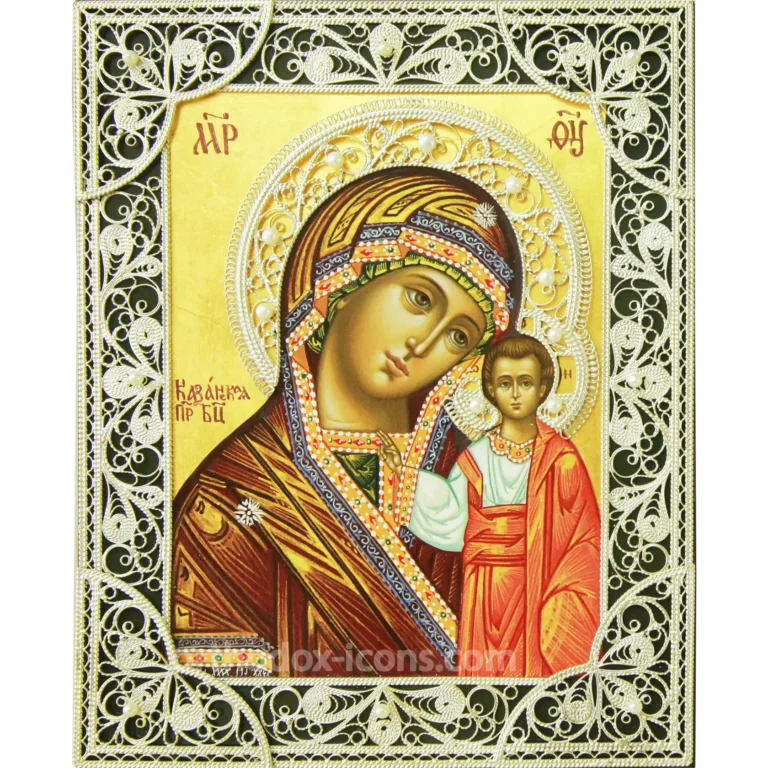
Kazan Filigree Icon of Virgin Mary is a hand-painted Kazan Mother of God icon in the Hodegetria type, made with a gold background and solemn silver-tone filigree framing.
Available size: 17×21 cm (6.7×8.3 in). Larger church and iconostasis sizes may be discussed before painting.
Materials: linden board with oak braces, kovcheg, chalk levkas, mineral egg tempera, 960 gold leaf, filigree ornament, and protective lacquer.
Technique: fully hand-painted Orthodox icon on wood with warm Kazan palette, gilded background, filigree border, and traditional Mstyora icon painting.
It is possible to paint an image in any size to order
Free shipping worldwide
Kazan Filigree Icon of Virgin Mary is a hand-painted Kazan Icon of the Mother of God in a solemn decorative filigree setting. This is one of the most expressive versions of the famous Kazan image, venerated in Orthodox tradition as an icon of family protection, maternal intercession, and help in difficult circumstances.
The Kazan Icon is especially loved in Orthodox homes because its meaning is close to daily family life. Before this image the faithful pray for peace in the home, blessing of children, preservation of marriage, protection from trouble, and spiritual consolation in sorrow.
This version is distinguished by the union of canonical painting, a radiant gold background, and a delicate silver-tone filigree frame. The ornament gives the icon a festive and reverent beauty, making it suitable both for home prayer and as a valuable Orthodox gift for important church and family occasions.
Brief Description of the Icon
| Name | Kazan Filigree Icon of Virgin Mary |
|---|---|
| Traditional title | Kazan Icon of the Mother of God in filigree |
| Iconographic type | Hodegetria |
| Distinctive feature | Decorative filigree frame with openwork ornament |
| Prayer use | Home, family, protection, wedding blessing, and important church occasions |
| Available size | 17×21 cm (6.7×8.3 in) |
| Larger formats | Larger and iconostasis sizes may be discussed before painting |
The Kazan Icon of the Mother of God is one of the most recognizable and beloved images in Russian Orthodox tradition. It is venerated as an icon of intercession, family blessing, peace in the home, and spiritual comfort. For many believers, the Kazan image becomes the central Mother of God icon in the family prayer corner.
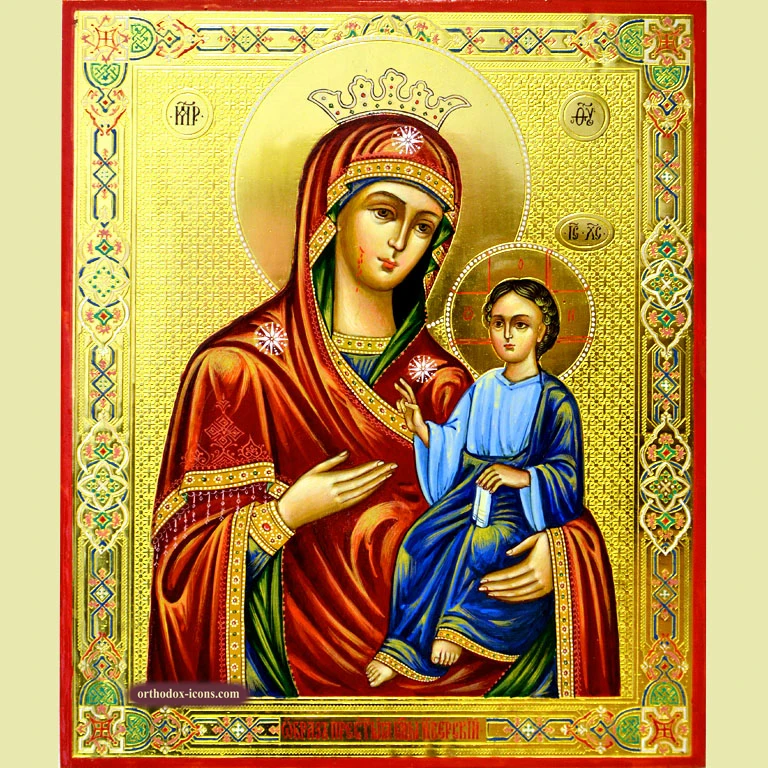
The presented icon makes a strong visual impression through the combination of a bright gold background, complex openwork silver-tone ornament on the fields, and a warm, saturated painted palette. The maphorion of the Most Holy Theotokos is painted in deep brown-cherry and golden tones, while the garments of the Christ Child include rich red-orange colors.
History of the Kazan Icon of the Mother of God
The history of the Kazan Icon goes back to the sixteenth century and is connected with the miraculous finding of the image in the city of Kazan. After a severe fire destroyed many homes, a young girl named Matrona was shown in a dream where the hidden icon of the Most Holy Theotokos lay beneath the ground.
The holy image was found, and over time the Kazan Icon became one of the principal shrines of Russian Orthodoxy. People prayed before it both in family needs and in periods of national trial. It was venerated as an image of heavenly protection, spiritual defense, and maternal consolation.
Why the Kazan Image Is Especially Venerated
- It is connected with a miraculous finding and ancient church tradition.
- It is considered one of the principal family icons of the Mother of God.
- It is traditionally chosen for the home and for wedding blessing.
- It is venerated as an image of maternal protection, help, and consolation.
Theological Meaning: Hodegetria
The Kazan Icon belongs to the Hodegetria type, meaning She Who Shows the Way. This means that the Mother of God does not close the attention of the believer upon herself, but points toward Christ as the true path of salvation. This is the central theological meaning of the image.
The composition of the Kazan image is especially concentrated. Nothing is accidental or secondary. The attention of the person praying is drawn immediately to the face of the Mother of God and to the blessing presence of the Christ Child. The face of the Most Pure Virgin is filled with quiet concentration, maternal compassion, and spiritual depth.
Two essential truths of the Orthodox faith meet in the Kazan Icon. The first is the mystery of the Incarnation: God came into the world, became man, and opened the path to salvation. The second is the prayerful intercession of the Mother of God, who hears the requests of the faithful and presents them before her Son.
Prayer Before the Kazan Icon
Before the Kazan Icon of the Mother of God, Orthodox Christians pray for peace in the family, children, protection of the home, preservation of marriage, help in sorrow, and support in difficult life circumstances. This image is often chosen precisely as a family holy image for daily prayer.
- For peace and concord among loved ones.
- For the well-being of children and help in raising them.
- For protection of the home from trouble and anxiety.
- For help in sorrow, illness, and difficult circumstances.
- For preservation of the family and understanding between spouses.
- For inner strengthening and peace of heart.
- For protection from malice, hostility, and spiritual confusion.
It is not accidental that the Kazan Icon is often given for a wedding, church crowning, baptism, or housewarming. It is received as an image of domestic protection and blessing. At the same time, an Orthodox icon is not a charm in a magical sense. It is a holy image before which the faithful pray with living faith.
When This Icon Is Especially Appropriate
- For a home icon corner and daily prayer.
- As a gift for a wedding, church crowning, baptism, or housewarming.
- For family blessing and prayer for children.
- For a chapel, church, or iconostasis in a larger size.
- As a solemn and precious hand-painted Mother of God icon.
Artistic Features of the Filigree Icon
The special expressiveness of this icon is connected with its filigree frame. Filigree is associated with delicacy, precision, and festive dignity. The openwork silver-tone patterns on the fields resemble fine lace that frames the sacred image without distracting from it.
The gold background and halos reveal the theological meaning of light as a sign of divine glory and heavenly reality. Against this gold, the warm tones of the Mother of God garments, the ornamental details of her clothing, and the saturated red-orange tones of the Christ Child’s robe become especially expressive.
Through the combination of filigree, gold, and canonical painting, this icon has a particularly representative character. It is suitable not only for personal prayer, but also as a truly significant Orthodox gift, perceived not as decoration, but as a serious family holy image.
Traditional Materials and Technique
The value of an Orthodox icon is determined not only by its subject and artistic style, but also by the faithful use of traditional materials. The base is made from natural linden wood, a material long used in icon painting for its stability and ability to receive levkas and paint.
Oak braces are used to strengthen the board and reduce the risk of deformation. A kovcheg, the traditional recessed central field, is formed in the board. This has both artistic and symbolic meaning, gathering the sacred image into a protected space.
After the board is prepared, chalk levkas is applied in layers to form a strong, light ground for the painting. The image is then painted in mineral tempera on an egg emulsion. This ancient technique allows for lasting color, fine modeling of faces, and a noble matte surface.
The gilding is made with genuine 960 gold leaf. Gold in iconography is not simply decoration. It symbolizes the light of the Heavenly Kingdom, the triumph of divine glory, and the eternal value of the holy image. In combination with the filigree setting, the gold gives the icon a solemn church character.
Icon Characteristics
| Name | Kazan Filigree Icon of Virgin Mary |
|---|---|
| Traditional title | Kazan Icon of the Mother of God in filigree |
| Iconographic type | Hodegetria |
| Distinctive feature | Filigree decorative framing |
| Board | Natural linden board with oak braces |
| Construction | Kovcheg |
| Ground | Chalk levkas |
| Painting | Mineral tempera on egg emulsion |
| Gilding | Genuine 960 gold leaf |
| Available size | 17×21 cm (6.7×8.3 in) |
| Purpose | Home, family, prayer, gift, chapel, church, and iconostasis |
| Production time | Approximately 2 months |
| Shipping | Free international shipping is included; payment is due upon delivery. |
Why This Icon Is Especially Valuable
When a person chooses the Kazan Icon of the Mother of God, the desire is not only for a famous image, but for a holy icon that will accompany family prayer, home life, and important spiritual events. The filigree setting makes this version especially solemn and memorable.
The 17×21 cm (6.7×8.3 in) size is suitable for a home icon corner, while larger versions may be prepared for churches, chapels, and serious private iconostases. Traditional materials, hand painting, gold leaf, and filigree ornament allow the icon to serve as a family shrine for many years.
Reasons to Choose This Kazan Filigree Icon
- One of the most venerated icons of the Mother of God.
- Solemn filigree execution with expressive ornament.
- Suitable for home, family, gift, and church space.
- Strong prayerful and family meaning.
- Traditional icon-making technology with linden board, kovcheg, levkas, tempera, and gold leaf.
- Possible larger execution for church and iconostasis use.
Questions and Answers
What does the Kazan Filigree Icon of Virgin Mary mean?
It is a venerated Kazan image of the Mother of God in a solemn filigree setting. The icon expresses maternal intercession, family protection, and the guidance of the faithful toward Christ.
How does a filigree icon differ from a simpler painted icon?
The main difference is the decorative filigree framing. The silver-tone openwork ornament gives the icon a more festive and precious appearance while preserving the prayerful character of the image.
For what needs do people pray before the Kazan Icon?
The faithful pray before the Kazan Mother of God for family peace, children, protection of the home, help in sorrow and illness, preservation of marriage, and spiritual strengthening.
Is this icon suitable for a home icon corner?
Yes. Its 17×21 cm size is suitable for a home icon corner, and the Kazan image is one of the most traditional family icons in Orthodox life.
Can this icon be given for a wedding or church crowning?
Yes. The Kazan Icon of the Mother of God is a meaningful Orthodox gift for a wedding, church crowning, baptism, housewarming, or other important family event.
What size is listed for this icon?
The listed size is 17×21 cm, approximately 6.7×8.3 inches. Larger church, chapel, and iconostasis sizes may be discussed before painting.
What is the icon painted on?
The icon is painted on a natural linden board strengthened with oak braces. The board has a traditional kovcheg and is prepared with chalk levkas.
What materials are used for the painting and gilding?
The image is painted in mineral egg tempera over levkas. The gold background and gilded elements are made with genuine 960 gold leaf.
Where can this icon be placed?
It is suitable for a home icon corner, family prayer space, chapel, church, or private iconostasis. In larger formats it may also be prepared for church use.
Is free international shipping included?
Yes. Free international shipping is included; payment is due upon delivery. The icon is painted to order and packed carefully for shipment after completion.
| Dimensions | 17x21cm (6.7×8.3 in) |
|---|---|
| Name | Mary |