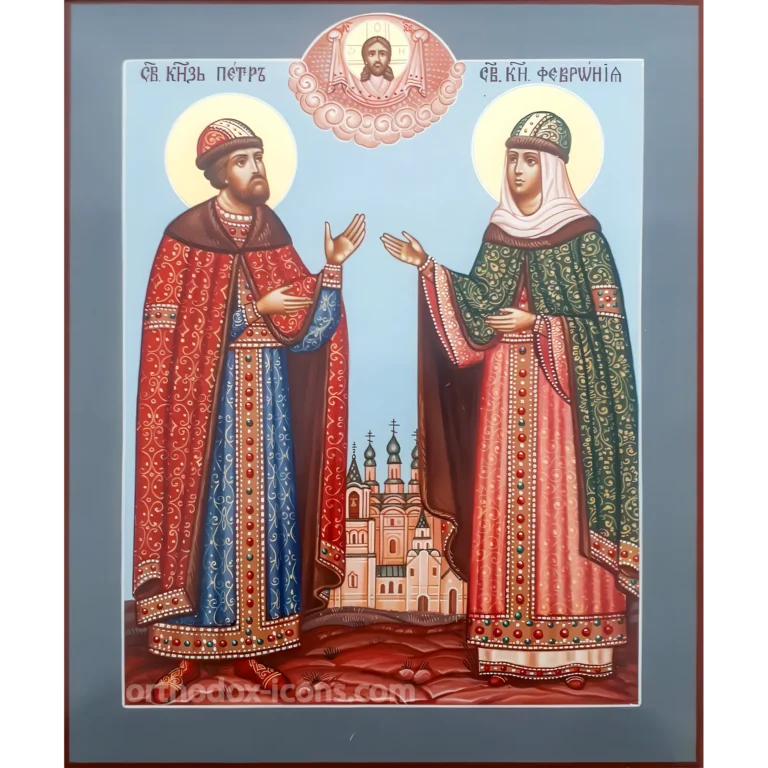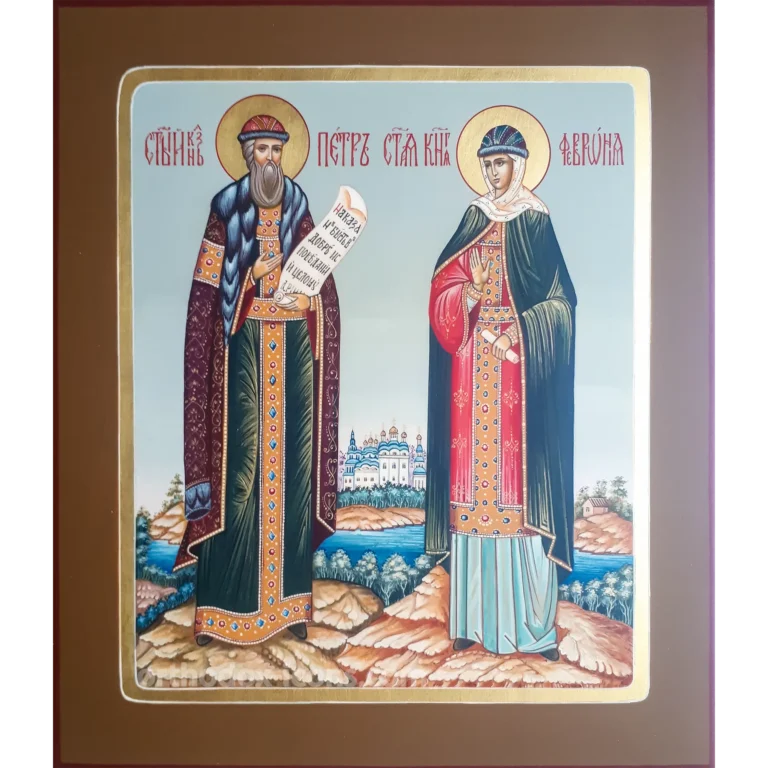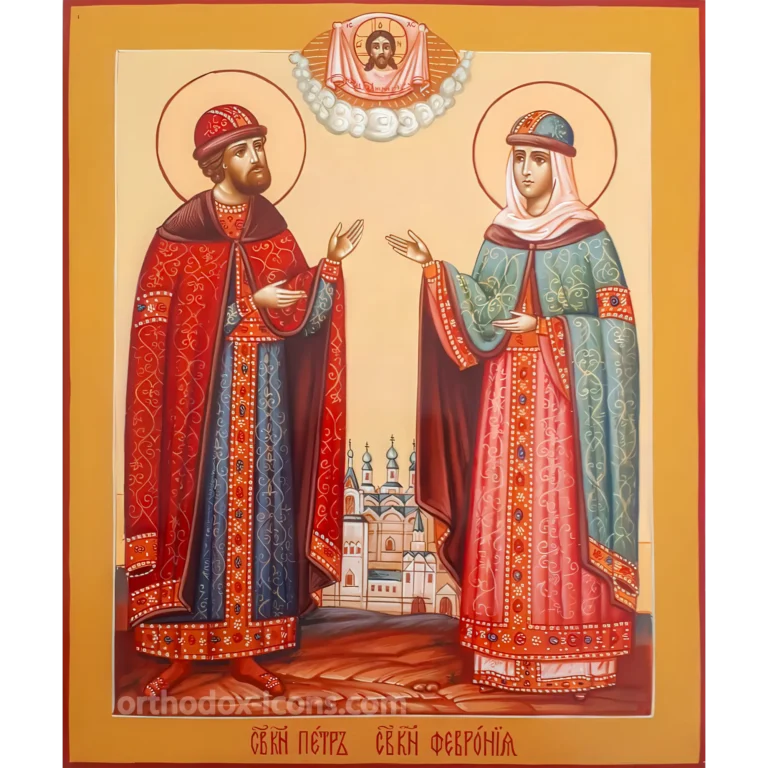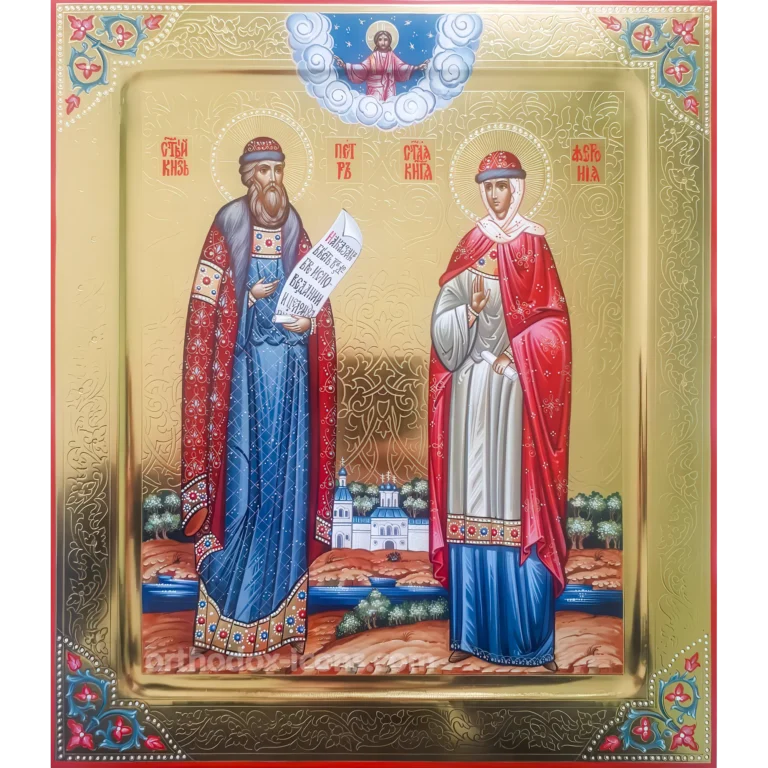
St. Peter and Fevronia Orthodox Icon
$850
Available size: 18×31 cm (7.1×12.2 in) and larger iconostasis sizes by request.
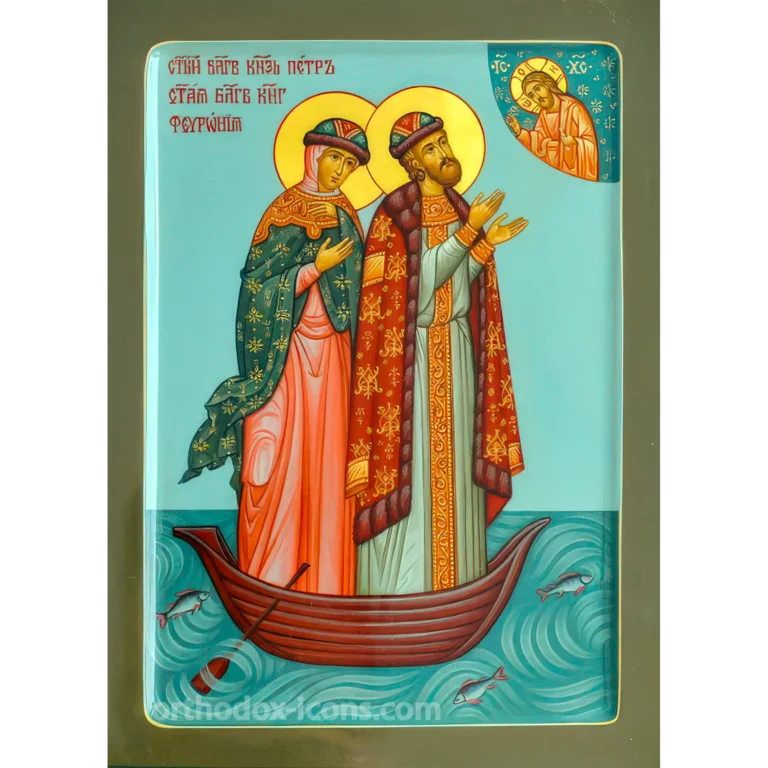
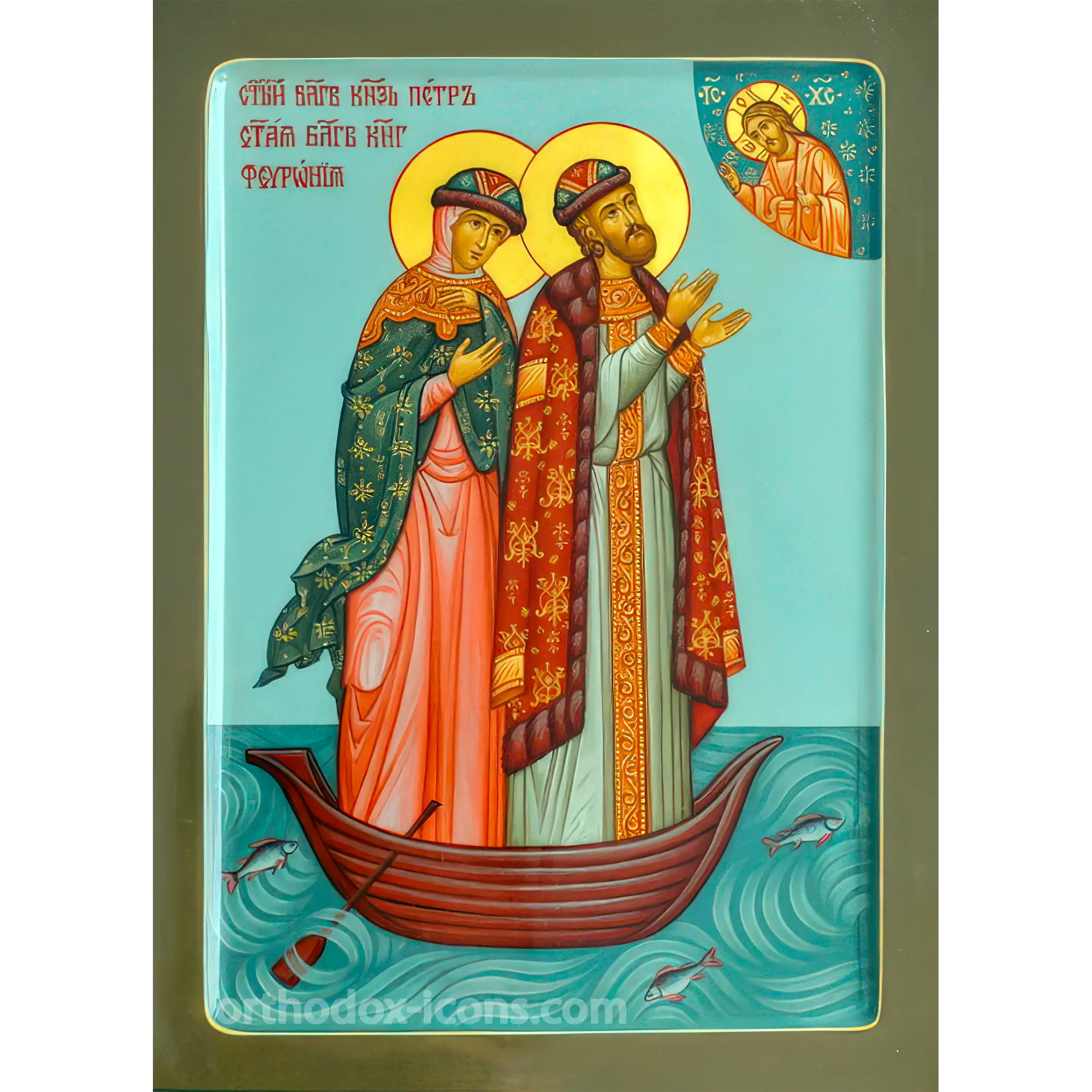
This hand-painted icon of Saints Peter and Fevronia of Murom presents the Orthodox patrons of family life, marital fidelity, patient love, and Christian marriage. The saints are shown standing together in a boat, a reference to the moment in their life when Prince Peter chose faithfulness to his wife over power and left Murom with Fevronia.
Their hands are raised in prayer toward Christ, who is shown in the heavenly segment above them. The boat, water, fish, princely garments, gold halos, and vertical composition make this icon especially meaningful for a family icon corner, wedding gift, anniversary, or prayer for peace in the home.
Materials: linden wood panel, oak support battens, gesso ground, egg tempera, gold leaf, and protective finish.
Free international shipping is included. Payment is made after you receive and approve the icon.
It is possible to paint an image in any size to order
Free shipping worldwide
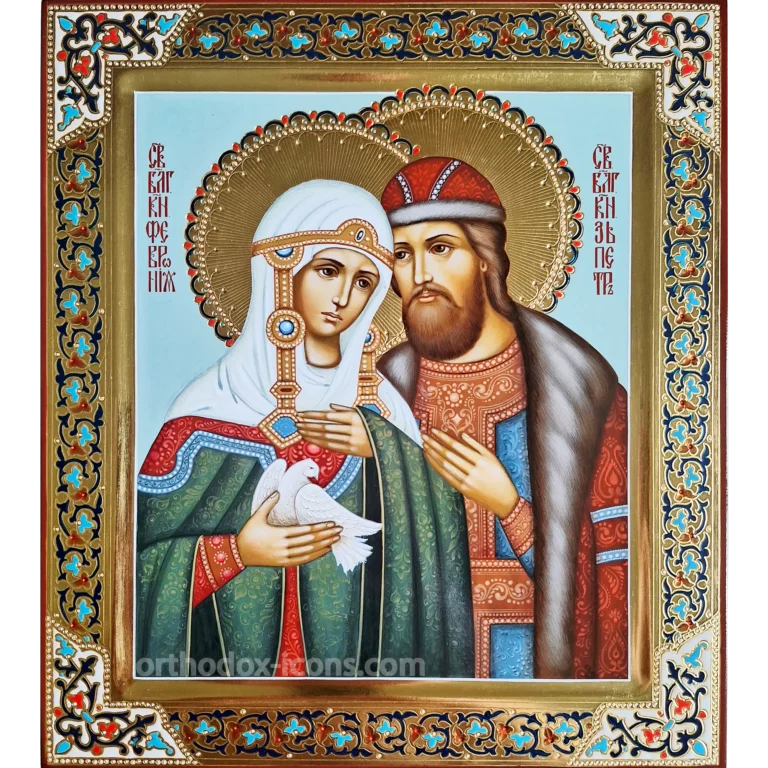
This hand-painted icon of the holy right-believing Prince Peter and Princess Fevronia of Murom is a deeply meaningful family image. In the Orthodox Church, Saints Peter and Fevronia are venerated as patrons of marital fidelity, patient love, mutual support, and Christian marriage. Their life shows a family path in which love is joined to faithfulness to God, humility, sacrifice, and the willingness to pass through trials together.
This icon is especially suitable for the home of a married couple, a family icon corner, a wedding or church marriage gift, an anniversary, a new home, or another important family occasion. It is not simply a decorative image of a husband and wife, but a prayerful icon of saints who lived marriage as a path before God.
In this composition, Saints Peter and Fevronia are shown in a boat on the water. This is not only a general symbol of a shared family journey. It refers to a specific episode from their life: when the boyars of Murom refused to accept Fevronia as princess and demanded that Prince Peter leave her, he would not betray his wife. He chose to lose power rather than break marital fidelity, and Peter and Fevronia departed from Murom together by boat.
This narrative detail gives the icon unusual depth. The boat speaks of the shared path of husband and wife, but also of a choice: power or fidelity, social pressure or love, earthly status or Christian truth. The saints stand side by side, their halos close to one another, and their hands are raised in prayer toward Christ, who is shown in the heavenly segment above. The main meaning of the image is clear: a Christian family is preserved not only by human effort, but by turning together toward God.
The size 18×31 cm (7.1×12.2 in) is well suited to the vertical composition with two figures, the boat, the water, inscriptions, and the image of Christ above. In this format the faces, princely garments, gold halos, prayerful gestures, waves, fish, and boat details remain readable. Larger iconostasis sizes can be discussed for a church, chapel, family prayer space, or individual icon case.
Features of This Peter and Fevronia Icon
The main feature of this icon is its narrative composition with the boat. Saints Peter and Fevronia are not shown merely standing beside one another. They are shown at a moment that recalls faithfulness, trial, and a shared spiritual decision. When the nobility of Murom demanded that Peter reject Fevronia, he refused to separate from his wife. For this reason, the boat is understood as an image of exile, fidelity, and spiritual victory over human pride.
Prince Peter is shown on the right in light princely garments and a red cloak with ornamental details. His hands are lifted in prayer. Princess Fevronia stands beside him in a light garment and green mantle enriched with fine decorative elements. Her hand is also raised in a prayerful gesture. Together they stand before Christ, which makes the composition not a domestic scene, but a theologically meaningful icon of Christian marriage.
The upper right segment of the icon contains the image of Christ the Savior. Christ is shown in glory, blessing from the heavenly space. This detail is essential: Peter and Fevronia do not merely leave the city, but preserve faithfulness before God. Their departure is not shown as defeat, because they choose not princely authority, but the truth of marriage and the blessing of God.
The water in the lower part of the icon is painted decoratively and expressively. Waves, fish, the oar, and the shape of the boat help the viewer recognize the particular event from the saints’ life, while also preserving a symbolic meaning. Water recalls the changing circumstances of life; the boat suggests the shared path of spouses; and the prayerful turning toward Christ points to the spiritual support without which family life can lose direction.
Iconography: Boat, Water, and Prayer to Christ
The iconography of Saints Peter and Fevronia can take several forms. They may be shown full-length in princely garments, sometimes with crosses, scrolls, or the city of Murom. In this icon, the chosen subject is their departure from the city. This makes the image especially appropriate for family prayer, because it reminds the faithful that loyalty to one’s spouse and to God’s commandment may be higher than external success, rank, or human approval.
The saints are in one boat. This is important not only compositionally, but spiritually. Peter does not abandon Fevronia, and Fevronia remains with him in trial. There is no panic or confusion in their poses. They are not shown running away or hiding. Rather, they stand in prayer, preserving dignity and inner calm. For this reason, it is more accurate to say that they left Murom after pressure and exile, while keeping faithfulness to one another.
The touching halos emphasize the spiritual unity of the saints. In the Orthodox understanding, their marriage is not only human affection, but a path of salvation in which husband and wife help one another keep faith, patience, forgiveness, and fidelity. This is why Peter and Fevronia have become beloved patrons of Orthodox families.
The image of Christ in the upper part points to the source of family strength. The spouses are not closed in on themselves; they turn toward Christ. This is an important thought for a wedding and family icon: Christian marriage is built not only on feeling, but on common prayer, responsibility, forgiveness, and the desire to live before God.
Prayer Before the Icon of Saints Peter and Fevronia
Before the icon of Saints Peter and Fevronia, Orthodox Christians pray for family, marriage, love, fidelity, and peace between spouses. This image is especially close to those who want to build family life not only on emotions, but also on trust, patience, responsibility, and spiritual support.
People ask Saints Peter and Fevronia for the preservation of love and fidelity in marriage; peace between husband and wife; help in overcoming quarrels, resentment, and mistrust; strength to form a stable Christian family; blessing for church marriage and married life; mutual understanding between spouses; patience, humility, and the ability to forgive; help in raising children; protection of the family from division; and support during difficult periods of life together.
Prayer before this icon does not replace the personal work of spouses: honest conversation, responsibility, keeping one’s word, faithfulness, willingness to yield, and readiness to forgive. But the image of Peter and Fevronia helps a family see marriage as a path traveled not by one person alone, but by two people together and before God.
Who This Icon Is Suitable For
An icon of Saints Peter and Fevronia is especially appropriate for a family icon corner. It is often chosen by married couples, newlyweds, parents for their children, godparents, and couples preparing for church marriage. It can become a meaningful gift for a wedding, church wedding, anniversary, new home, the birth of a child, or reconciliation after a difficult family period.
The icon is also suitable for men and women named Peter or Fevronia as a named icon of their heavenly patrons. Yet its meaning is broader than name patronage. Saints Peter and Fevronia have become a symbol of fidelity, shared service, and Christian love for Orthodox families, so the icon may be given even to those who do not bear these names but especially venerate the saints.
For newlyweds, this icon is a prayerful reminder that marriage begins not only with celebration, but with a promise to remain faithful in joy and in hardship. For spouses with many years of family life, the image of Peter and Fevronia can become a sign of gratitude to God for years lived together, children, home, shared memory, and mutual support.
In a church, the icon is appropriate in places where people pray for families, marriage, and the upbringing of children. Iconostasis sizes are selected individually, taking into account the height, lighting, neighboring icons, and how clearly the figures, boat, water, inscriptions, and image of Christ need to be seen.
Brief Life of Saints Peter and Fevronia of Murom
The holy right-believing Prince Peter and Princess Fevronia of Murom lived in ancient Rus and entered church memory as an example of Christian marriage. The tradition tells that Prince Peter was healed by the wise maiden Fevronia, who was known for piety, spiritual discernment, and humility. After his healing, their union passed through trials, misunderstanding, and resistance from others.
Fevronia was not of noble birth, and this caused resentment among the boyars. They did not want to see her as princess and demanded that Peter abandon his wife. But the prince would not destroy his marriage for the sake of power. He chose to leave Murom together with Fevronia. The spouses departed by boat, preserving faithfulness to one another. This is the very episode shown in the icon.
After Peter and Fevronia left, disorder and conflict began in Murom. The people then asked the prince and princess to return. The saints came back and ruled the city, striving to live as Christians, with wisdom, mercy, and care for the people. Their life shows that fidelity, humility, and love are stronger than pride, class prejudice, and the struggle for power.
At the end of their lives, Peter and Fevronia entered monastic life with the names David and Euphrosyne. According to tradition, they departed to the Lord on the same day, a sign of their spiritual unity. The Church glorified them as holy right-believing spouses, and their memory became especially dear to those who pray for family and marriage.
The memory of Saints Peter and Fevronia of Murom is celebrated on July 8 in the civil calendar. The translation of their relics is also commemorated on September 19. These dates are often remembered when choosing a family icon, a wedding gift, an anniversary gift, or a named icon.
Materials, Gold Leaf, and Execution
The icon of Saints Peter and Fevronia is painted on a linden wood panel prepared with a traditional icon ground. Oak support battens may be used for stability. Gesso is applied to create an even surface for egg tempera painting. The faces, hands, princely garments, boat, water, fish, inscriptions, image of Christ, and decorative details are painted by hand.
Color plays an important role in this image. The turquoise background and water create a sense of purity, air, and movement. Red, green, pink, and golden tones in the garments make the figures expressive, while the gold halos emphasize the holiness of Peter and Fevronia. The ornamental details on the garments require careful handwork, especially in the 18×31 cm format and larger, where the details should remain clear.
Gold leaf is used in the halos and selected decorative elements. It helps distinguish the saints and the image of Christ without overloading the composition. In this icon, gold works with restraint: it highlights the spiritual center while preserving the gentle character of the water theme and the narrative scene.
For an individual order, the size, level of detail, border design, icon case, home or church format, and iconostasis version may be discussed in advance. For a larger image, it is important to determine the place of installation beforehand so that the composition with the boat, water, figures of the saints, and heavenly image of Christ can be perceived as a whole.
Choosing the Size of the Icon
The size 18×31 cm (7.1×12.2 in) is well suited to the vertical image of Saints Peter and Fevronia. In this format the icon remains slender and intimate, while the figures of the spouses, boat, waves, fish, and image of Christ remain readable. It is a good choice for a home icon corner, a married couple’s bedroom, a family prayer shelf, or a wedding gift.
A larger size is worth choosing if the icon will be placed in a spacious home, chapel, church, or separate icon case. In a larger format, the ornaments on the clothing, the expressions of the faces, the prayerful gestures, inscriptions, movement of the water, and upper decorative details can be seen more fully.
Iconostasis sizes are discussed separately. In that case, the proportions of the row, height, lighting, neighboring icons, and overall artistic design of the space should be considered. For an icon of Peter and Fevronia, it is important to preserve both the narrative event and the prayerful turning toward Christ, so the composition must be large enough not to lose its meaningful details.
Placement, Blessing, and Care
The icon of Saints Peter and Fevronia can be placed in a home icon corner near the icons of Christ, the Mother of God, Saint Nicholas, the Guardian Angel, and the patron saints of the family. It may also be placed in a married couple’s room or in a family prayer area, provided that the place is chosen reverently and the icon is not treated as ordinary interior decoration.
After receiving the icon, it may be blessed in an Orthodox church. A blessed icon is intended for prayer, thanksgiving to God, and turning to Saints Peter and Fevronia as heavenly patrons of family life.
A hand-painted icon should be protected from direct sunlight, moisture, overheating, soot, and sudden temperature changes. The surface should not be wiped with wet cloths, alcohol, household cleaners, or rough fabric. Special care is needed around the faces, gilded halos, fine ornaments, inscriptions, and water details.
Dust should be removed with a dry soft brush, without pressure. To protect the painting and gilding, a wooden glazed icon case is recommended. It is especially helpful if the icon is placed in a home where candles or lamps are often used, or if the image is made in a larger format with many fine details.
Icon Characteristics
| Name | St. Peter and Fevronia Orthodox Icon |
| Saints | Holy right-believing Prince Peter and Princess Fevronia of Murom |
| Icon type | Family and wedding icon with a narrative scene in a boat |
| Visible details | Boat, water, fish, princely garments, gold halos, prayerful gestures, Christ in the heavenly segment |
| Available size | 18×31 cm (7.1×12.2 in); larger iconostasis sizes by request |
| Technique | Hand-painted egg tempera on a prepared linden wood panel |
| Decoration | Gold leaf, painted ornament, protective finish |
| Purpose | Family icon corner, wedding gift, church marriage gift, anniversary, prayer for peace in the home |
| Shipping | Free international shipping; payment after receiving and approving the icon |
Questions and Answers
Who is depicted on this icon of Saints Peter and Fevronia?
The icon depicts the holy right-believing Prince Peter and Princess Fevronia of Murom, Orthodox patrons of family life, marital fidelity, and Christian marriage.
Why are Peter and Fevronia shown in a boat?
The boat refers to the episode when Prince Peter refused to abandon Fevronia and left Murom with her, choosing faithfulness to marriage over earthly power.
Did Peter and Fevronia flee from Murom?
It is more accurate to say that they left Murom after pressure from the boyars. Peter did not renounce his wife for the sake of power, but remained faithful and departed with her.
What does Christ in the upper part of the icon mean?
The image of Christ shows that the family path of the saints is lived before God and under His blessing, which is central to the Christian understanding of marriage.
What do Orthodox Christians pray for before this icon?
People pray for peace in the family, preservation of marriage, fidelity, mutual understanding, blessing for married life, help in forming a family, and guidance in raising children.
Is this icon suitable as a wedding gift?
Yes. An icon of Saints Peter and Fevronia is one of the most meaningful Orthodox gifts for a wedding, church marriage, or wedding anniversary.
Can this icon be given to newlyweds?
Yes. It is a prayerful reminder of fidelity, patience, mutual support, forgiveness, and God’s blessing on family life.
What size is this icon?
The listed size is 18×31 cm (7.1×12.2 in). Larger and iconostasis sizes can also be discussed for a custom order.
When are Saints Peter and Fevronia commemorated?
Their main feast is celebrated on July 8 in the civil calendar, and the translation of their relics is commemorated on September 19.
How should a hand-painted family icon be cared for?
Keep the icon away from direct sunlight, moisture, heat, soot, and harsh cleaners. Dust it gently with a dry soft brush, and use an icon case when possible.
| Dimensions | 18x31cm (7.1×12.2 in) |
|---|---|
| Name | Fevronia, Peter |
Related products
Hand-Painted Icon of Saints Peter and Fevronia of Murom
Available on backorder
Price range: $550 through $1600