Presentation in the Temple of Our Most Holy Queen
Price range: $1000 through $2250
Available sizes: 20×24 cm (7.9×9.4 in), 27×31 cm (10.6×12.2 in), 30×40 cm (11.8×15.7 in).
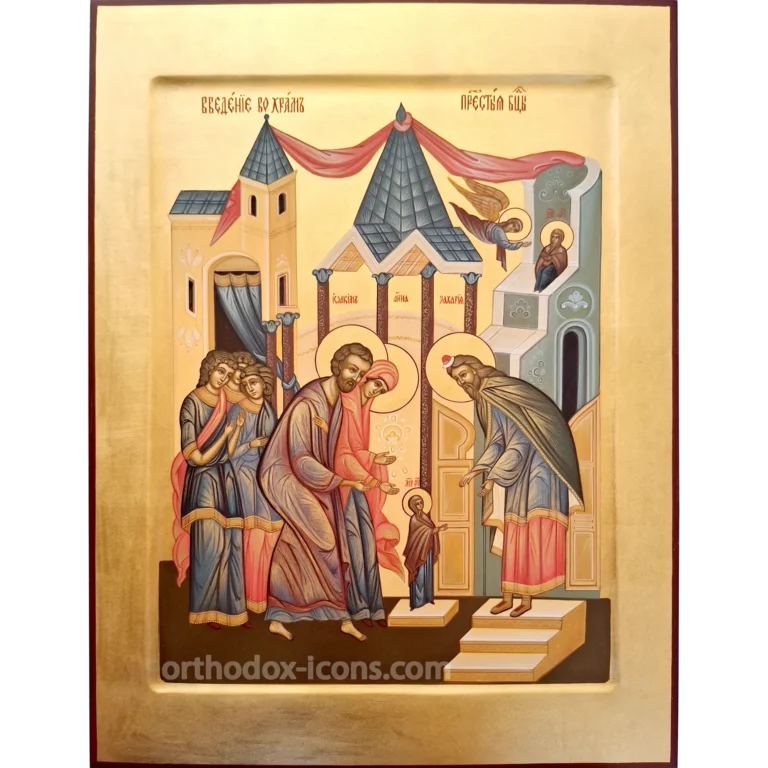
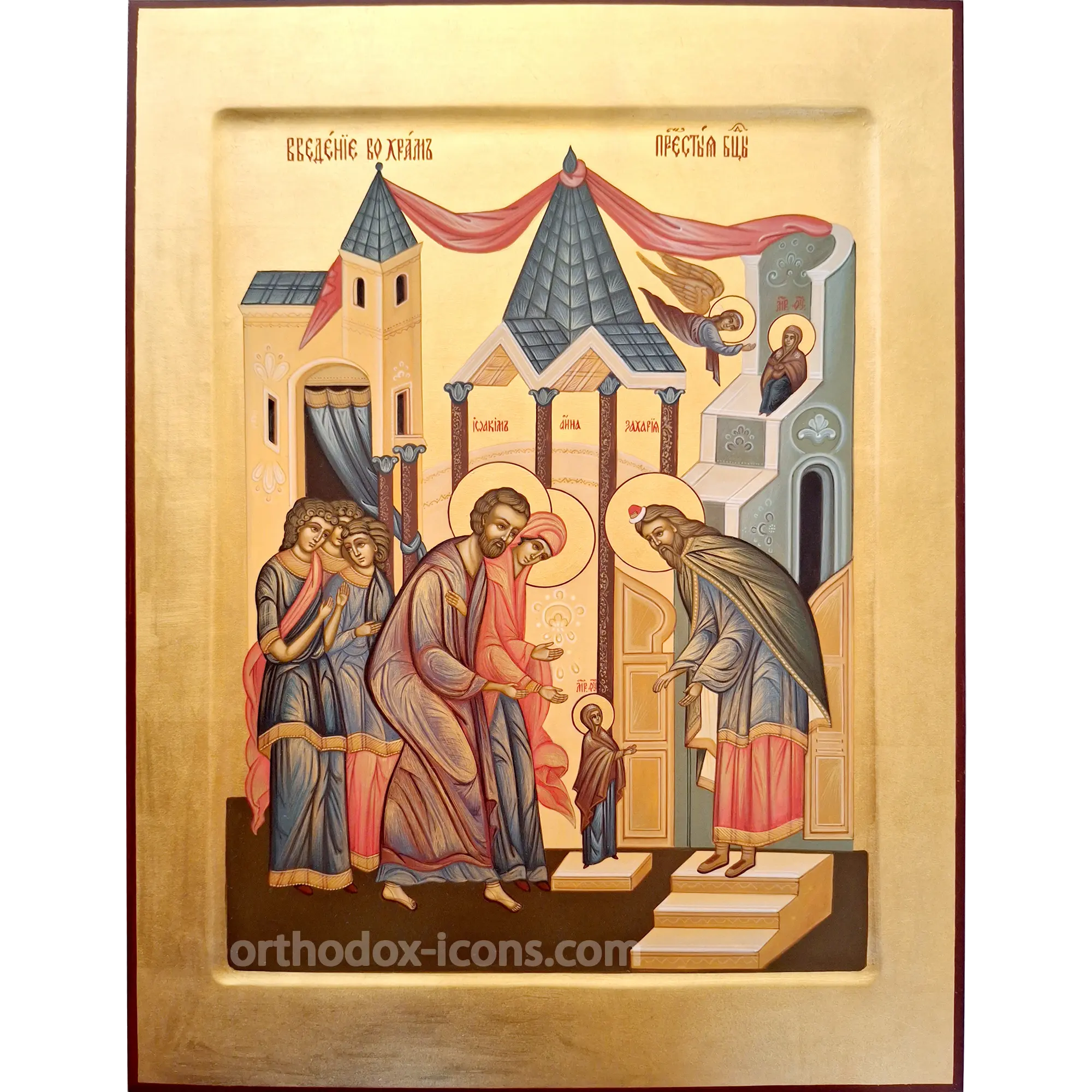
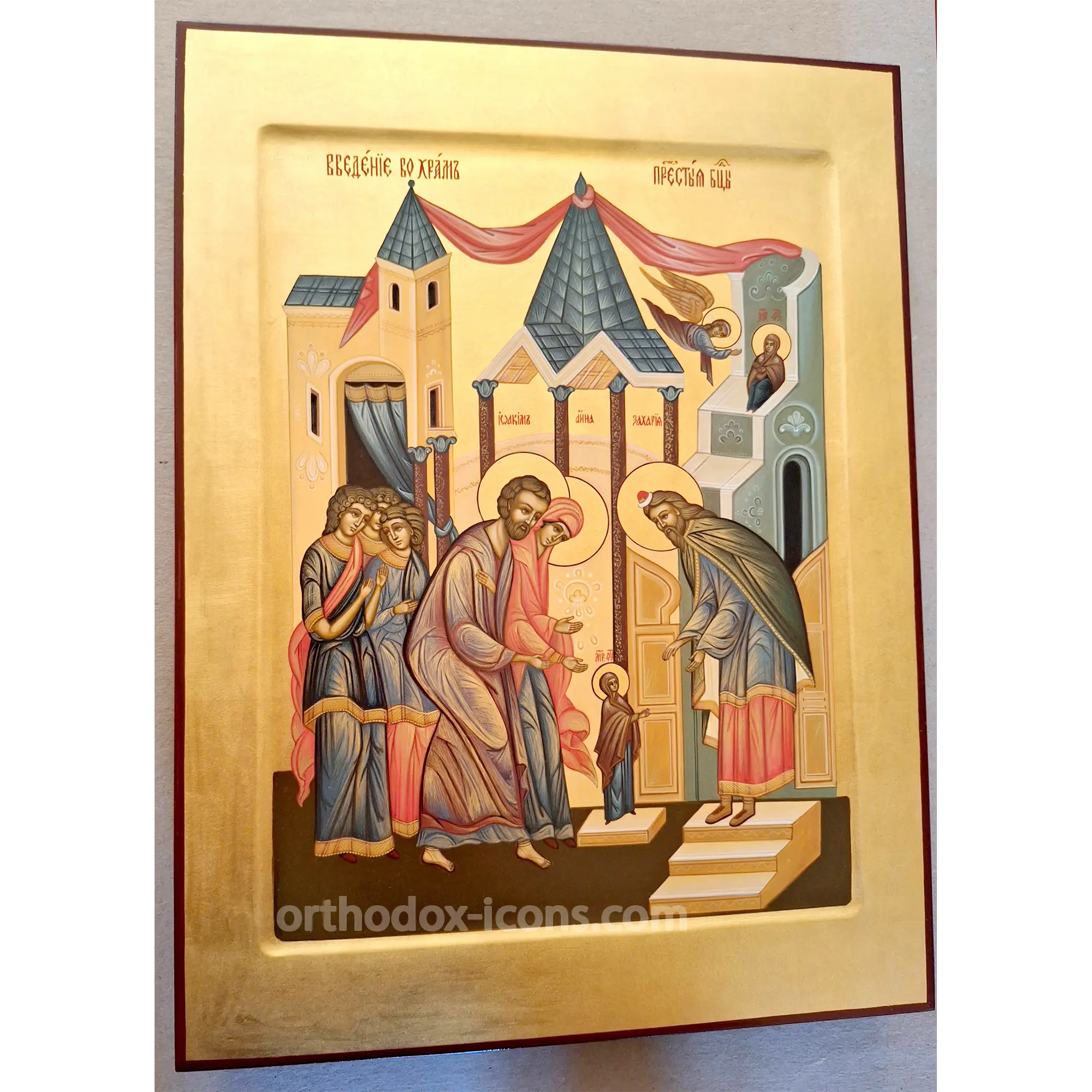
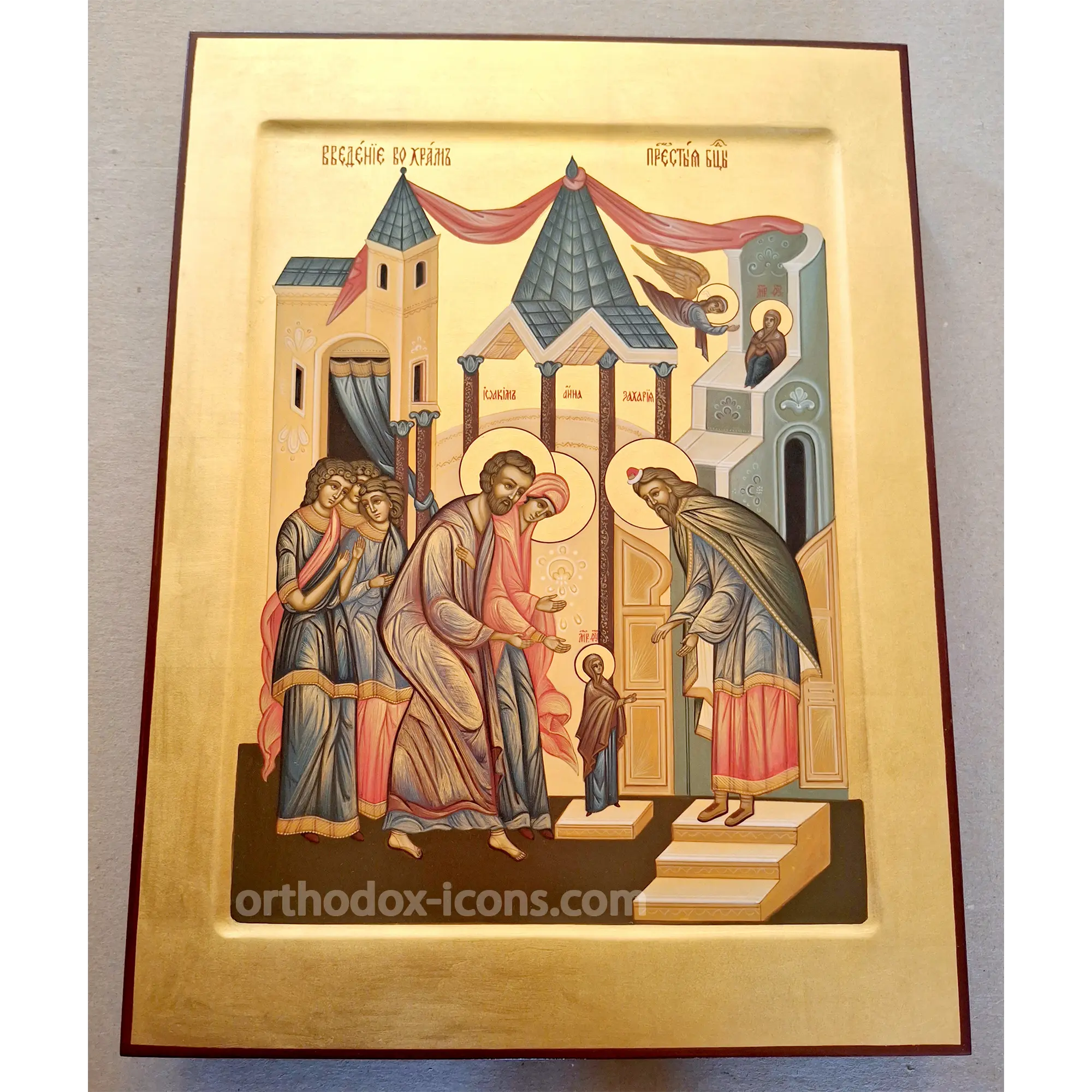
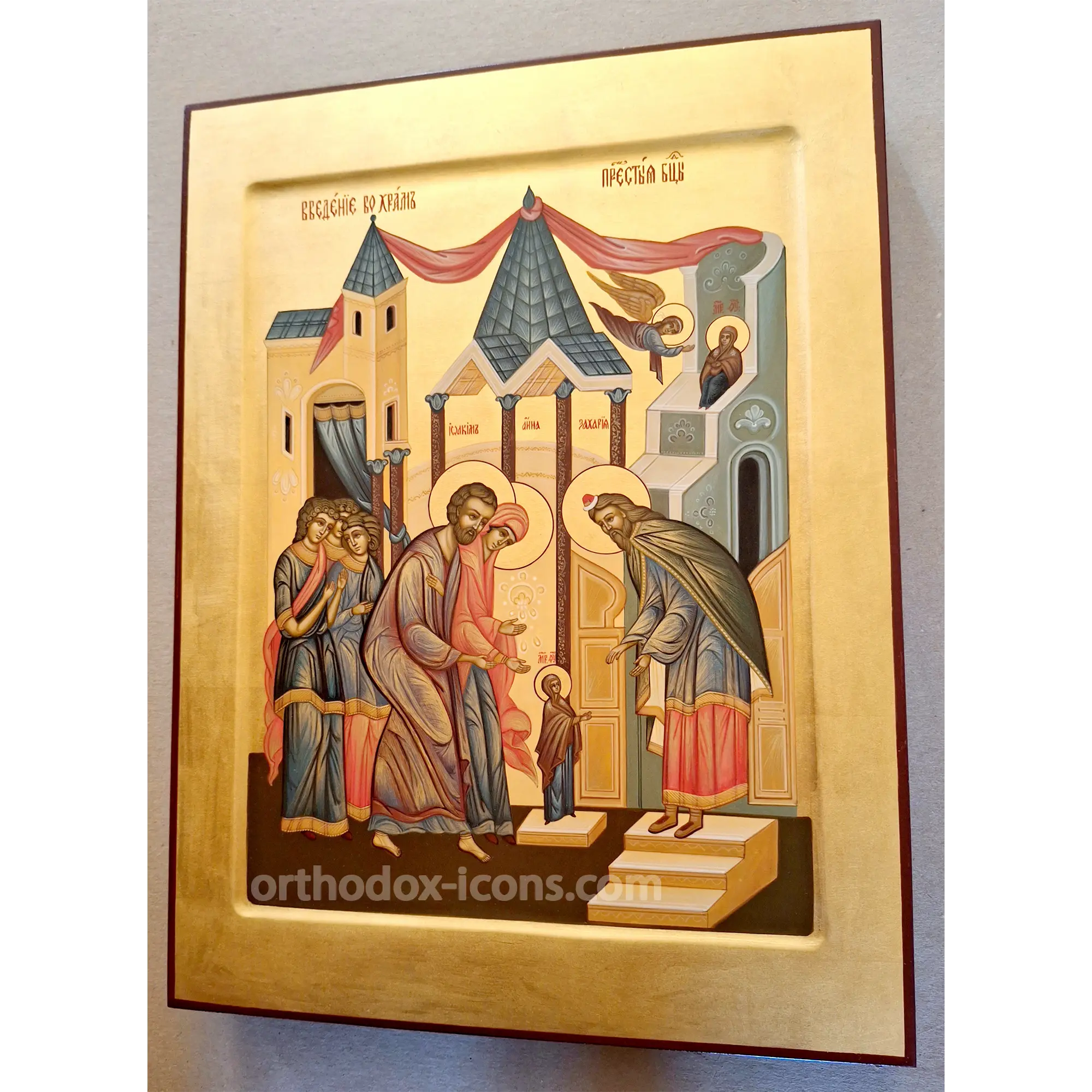
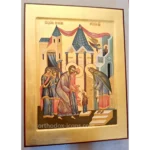
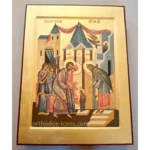
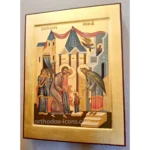
The Presentation in the Temple of Our Most Holy Queen icon depicts one of the Twelve Great Feasts of the Orthodox Church. According to ancient Church tradition, righteous Joachim and Anna brought their three-year-old daughter Mary to the Jerusalem Temple, where the high priest Zachariah received her and, by divine inspiration, led her into the Holy of Holies. This hand-painted Mstyora icon shows the young Theotokos ascending the temple steps, her parents and the procession of virgins behind her, architectural forms with a red velum, and Archangel Gabriel feeding Mary in the upper right scene. Painted with mineral egg tempera and 23K gold leaf. Free international shipping is included; payment is due upon delivery.
It is possible to paint an image in any size to order
Free shipping worldwide
The Presentation in the Temple of Our Most Holy Queen icon depicts one of the Twelve Great Feasts of the Orthodox Church: the Entry, or Presentation, of the Most Holy Theotokos into the Temple. The feast is celebrated on December 4 according to the new calendar, November 21 according to the old calendar. Although the event is not described in the canonical Gospels, it is preserved in ancient Church tradition, especially in the Protoevangelium of James and related early Christian texts.
The feast marks a decisive spiritual threshold. The Old Covenant is nearing its fulfillment, and the New Covenant is drawing near. The little Virgin Mary is brought into the Jerusalem Temple, but in the deepest sense she herself becomes the living Temple, the dwelling place of the uncontainable God. The icon therefore is not only a historical scene. It is a theological image of purity, obedience, vocation, and the preparation of the world for the Incarnation of Christ.
This hand-painted Mstyora icon is a complex multi-figure composition. It preserves the traditional Byzantine and Old Russian structure of the feast: the young Mary ascending the steps, righteous Joachim and Anna behind her, the procession of virgins, the high priest Zachariah receiving her, architectural forms with a red velum, and the upper scene of Archangel Gabriel feeding Mary in the Holy of Holies.
Presentation in the Temple of Our Most Holy Queen – The Fulfillment of a Vow
According to Church tradition, righteous Joachim and Anna of Nazareth remained childless into old age. In the world of Old Testament Israel, this was a heavy sorrow and was often seen as a sign of divine displeasure. In tears and prayer, they made a vow: if the Lord gave them a child, they would dedicate that child to the service of God.
The Lord heard their prayer, and a daughter was born to them. They named her Mary. When she reached the age of three, Joachim and Anna resolved to fulfill their promise. They gathered relatives and invited young virgins from Nazareth. With lamps and candles, the solemn procession set out for Jerusalem. The journey lasted three days.
When they came to the great Jerusalem Temple, the procession stopped before the high steps. The tradition speaks of fifteen steps, corresponding to the Psalms of Ascent sung by pilgrims. Joachim and Anna placed the three-year-old Mary on the first step. Then a miracle occurred: the little girl climbed the steps firmly and quickly by herself, without turning back and without needing adult support.
At the top, the high priest Zachariah, the future father of John the Baptist, received her. By a special inspiration of the Holy Spirit, he did not merely welcome Mary at the entrance. He led her into the Holy of Holies, the most sacred place of the Temple, where only the high priest was permitted to enter, and only once a year.
The Theological Meaning of the Feast
This action was extraordinary from the standpoint of the Old Testament Law, but its prophetic meaning is central to the feast. The Virgin Mary was being prepared to become the true Holy of Holies, the living Ark, and the dwelling place in which the Savior of the world would take flesh.
Mary remained at the Temple until her youth, according to different traditions until the age of twelve or fourteen. There she lived in prayer, reading of Scripture, handiwork, and purity. Church tradition also says that Archangel Gabriel brought her food while she dwelt in the Holy of Holies. This is why the icon includes a second small scene in the upper right corner.
The feast therefore speaks strongly to families, children, spiritual upbringing, and the dedication of life to God. It is a reminder that holiness begins with obedience, prayer, and trust, and that the soul can become a temple when it is offered to God.
Iconography of the Presentation in the Temple
The composition of this icon follows the canonical tradition that took shape in Byzantium and became firmly established in Old Russian icon painting. The scene unfolds before rich architectural forms: towers, columns with capitals, patterned porticoes, steps, and temple structures. These forms indicate the Jerusalem Temple, but they also represent the ordered, sacred space in which divine providence is revealed.
A red cloth, or velum, is stretched between the buildings in the upper part of the icon. In Byzantine and Old Russian iconography, the velum indicates that the event takes place indoors, even when the buildings are shown as if seen from outside. Here it shows that the mystery occurs within the Temple.
The young Virgin Mary stands at the center of the composition. Although she is three years old, she is shown as a small figure with mature spiritual dignity. She wears the maphorion, the traditional covering associated with the Mother of God. This does not describe ordinary childhood clothing; it points to her future vocation as the Theotokos.
Behind Mary stand her righteous parents, Joachim and Anna. Their faces express reverence and quiet joy because they are fulfilling their vow to the Lord. They release their daughter from the earthly family into the service of God, entrusting her to the heavenly purpose prepared for her.
The Procession and the High Priest Zachariah
Behind Joachim and Anna is a procession of young virgins from Nazareth. They are shown with uncovered heads, a sign of their virginity, and in varied garments that bring movement and solemnity to the scene. Their presence also emphasizes the purity and virginal dedication of the Theotokos herself.
At the doors of the Temple stands the high priest Zachariah, richly vested and bending toward the great mystery before him. His hands are extended toward Mary in a gesture of welcome and reverent reception. He is not merely receiving a child; he is standing before the one who will become the living Temple of God.
In the upper right part of the icon, a second small figure of Mary appears in a tower-like space symbolizing the Holy of Holies. Archangel Gabriel descends from heaven to feed her. This detail expresses her separation from worldly distraction and her constant life in divine grace.
Prayer Before This Icon
The feast of the Presentation is closely connected with family life, children, education, purity, and the dedication of one’s path to God. For this reason, Orthodox Christians often pray before this icon for the blessing of children and for help in raising them in faith.
Couples who have long desired a child may pray before this icon, remembering the long sorrow and answered prayer of Joachim and Anna. Parents pray for sons and daughters, asking the Mother of God to guide them away from destructive influences, strengthen them in chastity, give them love of learning, and lead them toward a Christian life.
Young women may pray before the Theotokos for purity, wisdom, and a blessed marriage. Others pray for help in choosing a life path, whether in family life, profession, service to the Church, or monastic vocation. As with every icon of the Mother of God, the faithful may also ask for healing of physical and spiritual illnesses.
Materials and Mstyora Technique
This icon is painted entirely by hand, from the preparation of the board to the final protective finish. The base is a seasoned linden board strengthened with inserted oak braces to help protect the wood from warping. Linen is glued to the board, and a natural chalk gesso ground is applied and polished until it becomes smooth and stable.
The background is gilded with 23K gold leaf. In Orthodox iconography, gold signifies divine, uncreated light, the Kingdom of Heaven, and eternity. It gives the feast icon a solemn radiance appropriate to its place among the Twelve Great Feasts.
The painting is made with mineral egg tempera, prepared from natural pigments on an egg emulsion. This traditional technique gives the colors depth, clarity, and durability. The architectural details, garments, faces, and the small scene with Archangel Gabriel require careful miniature work, especially in the smaller formats.
Available Sizes
The available sizes are 20×24 cm (7.9×9.4 in), 27×31 cm (10.6×12.2 in), and 30×40 cm (11.8×15.7 in). Because the icon is highly detailed and includes many figures and architectural elements, medium and larger sizes allow the composition to be read more clearly.
The 20×24 cm size is suitable for a compact home icon corner. The 27×31 cm size is the classic balanced format, giving enough room for the figures, gold ornament, architecture, and the scene with Archangel Gabriel. The 30×40 cm size is more ceremonial and may be chosen for a spacious home, chapel, or parish use. Larger church and iconostasis formats can be discussed individually.
Free international shipping is included; payment is due upon delivery.
Icon Characteristics
| Feature | Description |
|---|---|
| Feast | Presentation of the Most Holy Theotokos in the Temple, one of the Twelve Great Feasts |
| Main figures | The young Virgin Mary, righteous Joachim and Anna, high priest Zachariah, procession of virgins, Archangel Gabriel |
| Composition | Temple architecture, steps, red velum, and upper scene of Gabriel feeding Mary |
| Board | Linden wood with kovcheg, linen, natural gesso, and inserted oak braces |
| Painting | Mineral egg tempera in the Mstyora tradition |
| Gold | 23K gold leaf on the background, halos, and architectural details |
| Available sizes | 20×24 cm, 27×31 cm, 30×40 cm |
| Prayer use | Prayer for children, family life, infertility, blessed marriage, guidance, and strengthening in faith |
The Presentation in the Temple of Our Most Holy Queen icon is a luminous feast image about dedication, purity, and spiritual growth. It is a fitting Orthodox icon for family prayer, for parents and children, and for anyone seeking to offer their life more fully to God.
Questions and Answers
What event does this icon depict?
It depicts the Presentation of the Most Holy Theotokos in the Temple, when righteous Joachim and Anna brought the three-year-old Mary to the Jerusalem Temple in fulfillment of their vow.
Is this one of the Twelve Great Feasts?
Yes. The Presentation of the Theotokos is one of the Twelve Great Feasts of the Orthodox Church and is celebrated on December 4 according to the new calendar.
Why is the child Mary shown like a small adult?
Orthodox iconography often shows spiritual maturity rather than ordinary age. Mary is shown in a maphorion to point toward her future calling as the Mother of God.
Who receives Mary at the Temple?
The high priest Zachariah receives her at the entrance and, according to tradition, leads her into the Holy of Holies by inspiration of the Holy Spirit.
What does the red cloth between the buildings mean?
The red cloth is a velum. In Byzantine and Old Russian iconography it indicates that the event is taking place inside, even when the architecture is shown outwardly.
Who is shown in the upper right part of the icon?
Archangel Gabriel is shown bringing heavenly food to the Virgin Mary while she lives in the Holy of Holies.
What are people accustomed to pray for before this icon?
People pray before this icon for children, infertility, family life, the upbringing of teenagers, purity, guidance in life choices, and strengthening in faith.
What materials are used?
The icon is painted on a prepared linden board with linen, natural gesso, mineral egg tempera, and 23K gold leaf.
What sizes are available?
The available sizes are 20×24 cm (7.9×9.4 in), 27×31 cm (10.6×12.2 in), and 30×40 cm (11.8×15.7 in).
Do you ship internationally?
Yes. Free international shipping is included, and payment is due upon delivery.
| Dimensions | 20x24cm (7.9×9.4 in), 27x31cm (10.6×12.2 in), 30x40cm (11.8×15.7 in) |
|---|---|
| Name | Mary |