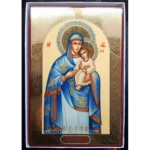
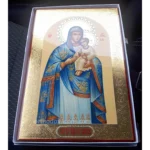
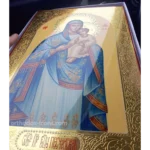
Peschan Icon of the Mother of God
Price range: $750 through $2000
Available sizes: 13×25 cm (5.1×9.8 in), 18×31 cm (7.1×12.2 in), 30×50 cm (11.8×19.7 in).
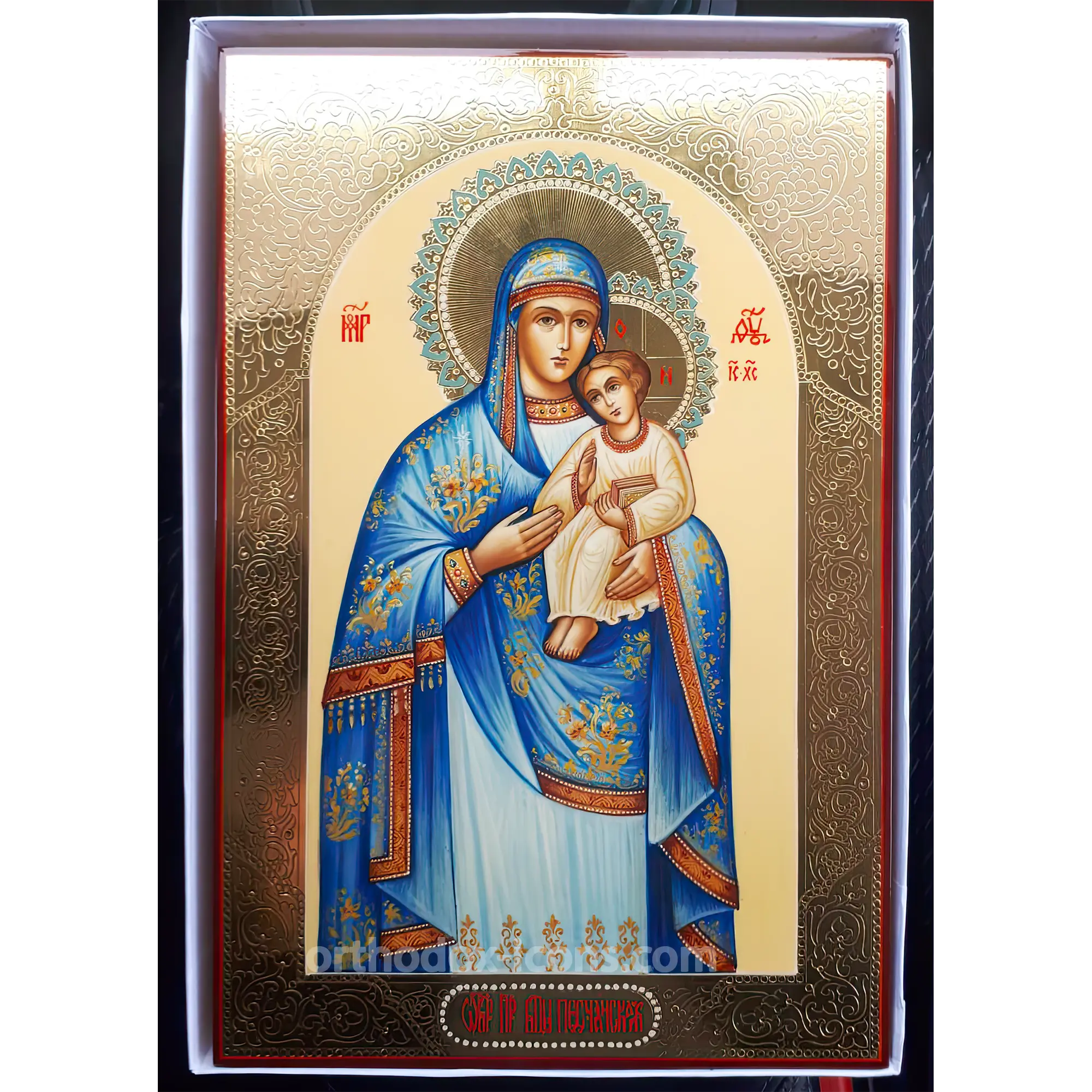
Peschan Icon of the Mother of God is a hand-painted Orthodox icon connected with Saint Joasaph of Belgorod and the miraculous discovery of the image in the Peski suburb of Izyum. It is venerated as a protective icon in times of war, danger, illness, and national trial.
The icon is painted in mineral egg tempera on a linden board. The background and fields are fully gilded with 23K gold leaf (960 purity), with relief floral ornament worked in gesso and rich gold assist on the blue maphorion of the Mother of God. Free international shipping is included, with payment due upon delivery.
It is possible to paint an image in any size to order
Free shipping worldwide
Peschan Icon of the Mother of God is a hand-painted Orthodox icon connected with Saint Joasaph of Belgorod and the miraculous discovery of the image in the eighteenth century. In Russian Orthodox devotion, the Peschan icon is remembered as a protective image in times of war, danger, epidemic, and national hardship, as well as a source of prayerful help for families and the sick.
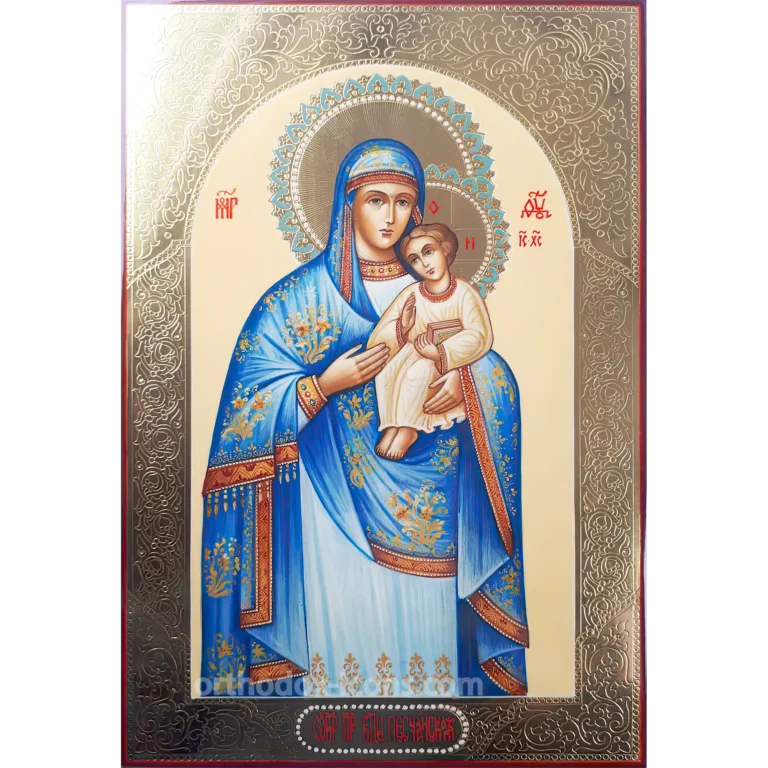
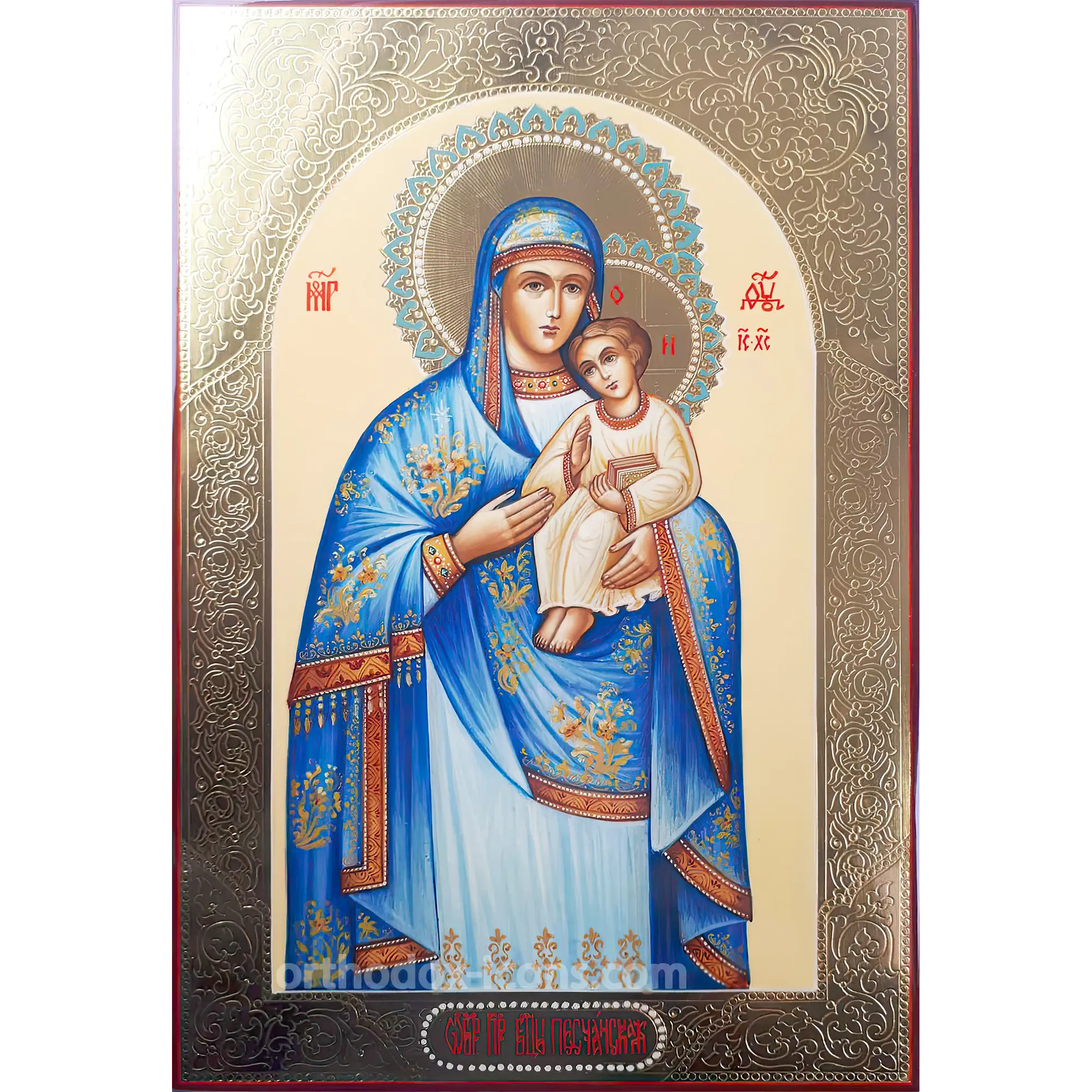
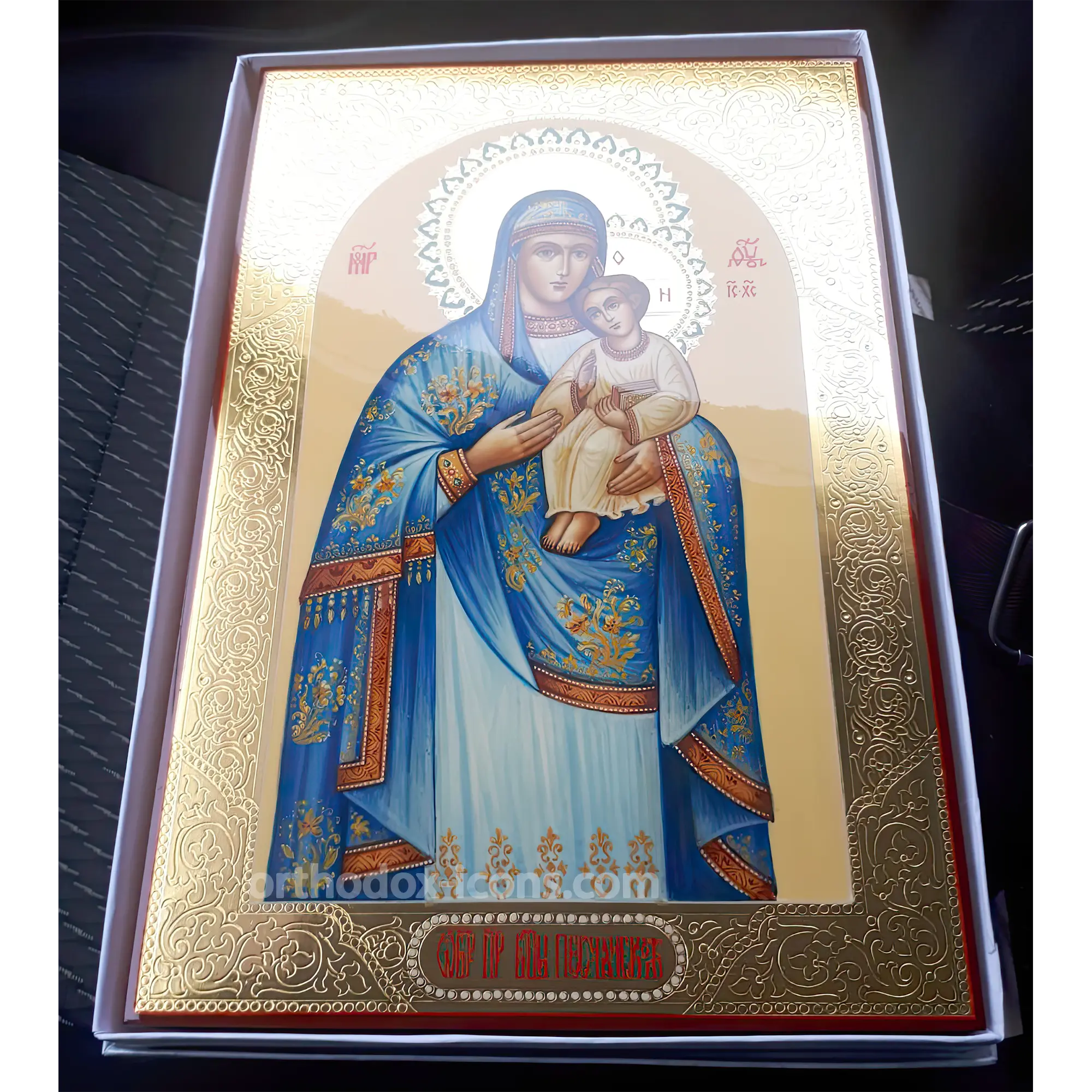
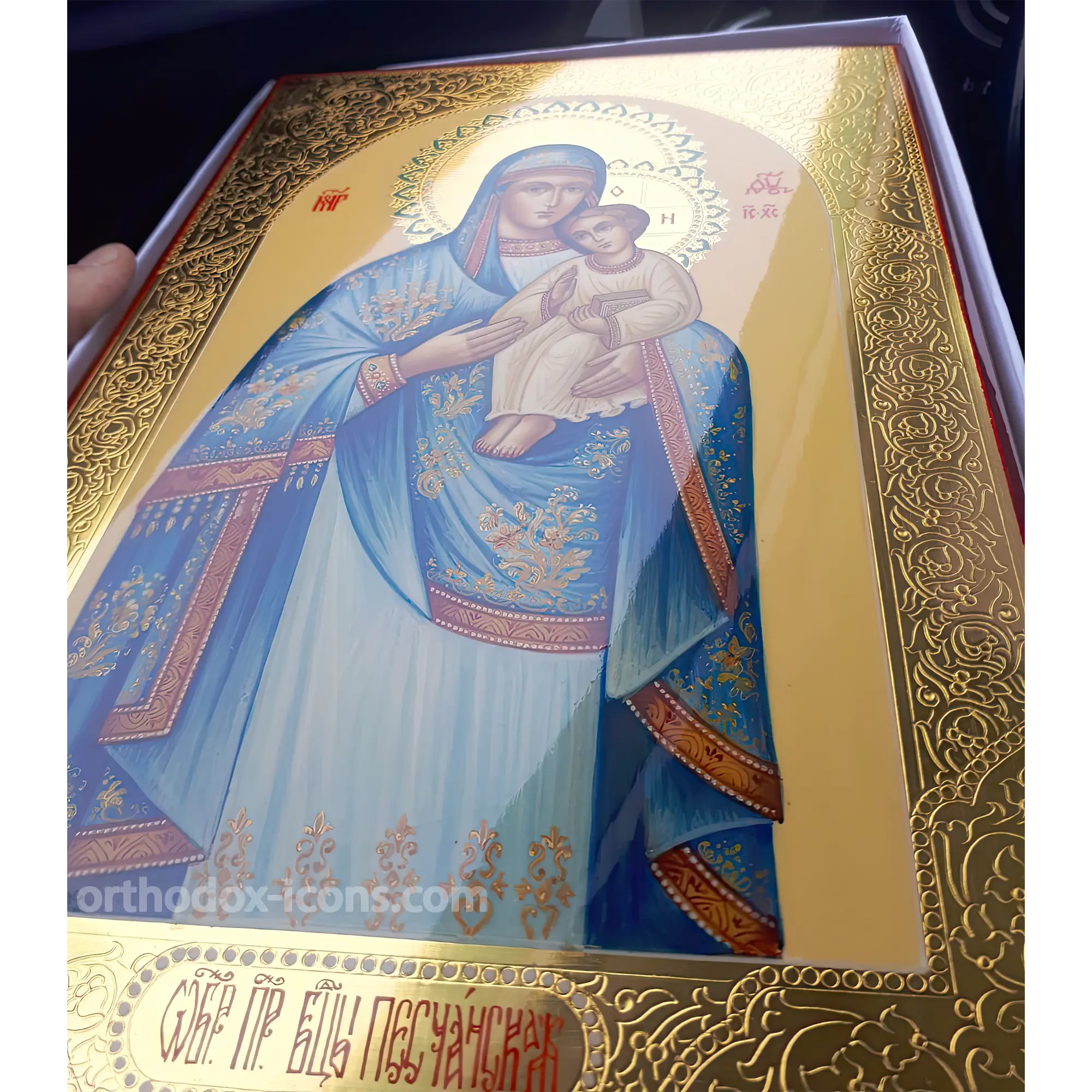
This icon is painted in an elongated format, with a richly gilded background and fields. The Mother of God is shown in a blue maphorion covered with gold ornament, while the Christ Child blesses and holds the closed Gospel. The icon combines the strict clarity of the Hodegetria type with the solemn beauty of full gilding and relief ornament.
Peschan Icon of the Mother of God – History
The history of the Peschan icon is closely connected with Saint Joasaph of Belgorod. In 1754, while traveling through his diocese, the saint saw a prophetic dream. He stood in the narthex of an unknown church and saw an icon of the Mother of God shining with light, yet lying in a heap of rubbish. A voice from the icon said that the image was appointed as a source of grace for that land, but had been cast aside.
When Saint Joasaph came to the town of Izyum in the Kharkov province, he entered the Ascension church in the suburb called Peski. There he recognized the church from his dream. In a corner he found the icon of the Mother of God serving as a partition for a pile of coal. The saint fell to his knees, wept, and asked forgiveness from the Queen of Heaven for the negligence shown to her image. He ordered the icon to be cleaned and placed in a place of honor.
After this discovery, the Peschan icon became known for many healings and acts of help. During the First World War, the icon was also connected with prayers for the protection of the country and soldiers, strengthening its reputation as a protective icon for times of war and danger.
Iconography and Relation to the Kazan Icon
The Peschan icon belongs to the Hodegetria type, the Mother of God as Guide. It is close in general composition to the Kazan icon, yet it has its own features. The Peschan image is more elongated, and the Mother of God is shown almost to the knees rather than only to the chest.
The Theotokos is shown frontally, her head slightly inclined toward the Christ Child. She holds Him on her left arm and indicates Him with her right hand as the only way to salvation. Christ turns slightly toward His Mother, blesses with His right hand, and holds the closed Gospel in His left hand. The Gospel is the Word of Life and a sign of His divine teaching.
Blue Maphorion, Gold, and Relief Ornament
A distinctive feature of this hand-painted icon is the blue maphorion of the Mother of God. While many icons show her in a dark red or cherry maphorion, the deep blue color here emphasizes heavenly purity, divine wisdom, and the ever-virginity of Mary. The surface of the maphorion is richly decorated with gold floral ornament, and the edges are finished with a multi-layered gold border, red accents, and fine gold fringe.
The Christ Child wears a light garment with ocher shadows. The white and light tones point to His divine light and sinlessness, while the ornate collar adds solemnity to the image.
The background and broad fields are fully gilded with 23K gold leaf (960 purity). Before the gold is applied, the iconographer works a complex floral pattern into the gesso by hand. The relief ornament appears on the fields and in the arched gold background above the Mother of God. Light catches the raised gold surface, giving the icon a vivid, ceremonial radiance.
The halo of the Mother of God includes additional lace-like ornament with blue and red accents, visually setting her face apart from the gold arch. The halo of Christ is marked with graphic rays and the traditional Greek letters.
Prayer Before the Peschan Icon
The Peschan icon is especially associated with prayer for protection in times of war, danger, and national trial. Families pray before it for soldiers, for the preservation of life, for peace, and for protection from enemies.
The icon is also connected with prayers for healing. From the time of its discovery, people have turned to the Mother of God before this image in serious illness, including conditions that seemed beyond human help. It is also associated with prayer during epidemics and public calamities.
On a personal level, people pray before the Peschan icon for strengthening of faith, protection from despair, help in difficult circumstances, and guidance when life seems closed or dangerous. It may serve as a family shrine and as a prayerful sign of the protection of the Mother of God over a home.
Materials and Technique
This icon is painted by hand on a seasoned linden board strengthened with oak braces. Linen cloth is applied to the front surface, followed by layers of natural chalk gesso. The gesso is polished smooth and then worked by hand to create the relief ornament for gilding.
The painting is made with mineral egg tempera. Natural pigments are ground into fine powder and mixed with an egg-based emulsion, producing deep, stable colors. The blue maphorion, gold assist, light garment of Christ, and gilded relief surface are all made to remain clear and luminous with proper care.
Available Sizes
Available sizes: 13×25 cm (5.1×9.8 in), 18×31 cm (7.1×12.2 in), and 30×50 cm (11.8×19.7 in). Larger church and iconostasis formats may be discussed individually before the icon is made. Free international shipping is included, with payment due upon delivery.
Icon Characteristics
| Name | Peschan Icon of the Mother of God |
| Icon type | Hodegetria type, close to the Kazan icon but with elongated proportions |
| History | Discovered by Saint Joasaph of Belgorod in the Peski suburb of Izyum in 1754 |
| Composition | The Mother of God points to Christ; Christ blesses and holds a closed Gospel |
| Board | Linden wood, linen cloth, natural gesso, oak braces |
| Painting | Mineral egg tempera |
| Gold and decoration | 23K gold leaf (960 purity), full gilding of background and fields, relief floral ornament in gesso, gold assist |
| Available sizes | 13×25, 18×31, and 30×50 cm |
| Main prayer themes | Protection in war, safety of soldiers, peace, healing, protection from epidemics, help in severe trials |
Questions and Answers
Why is this icon called Peschan?
The name comes from Peski, the suburb of Izyum where Saint Joasaph of Belgorod discovered the neglected icon in the Ascension church.
Who found the Peschan icon?
The icon was discovered in 1754 by Saint Joasaph of Belgorod after he saw a prophetic dream about an image of the Mother of God lying neglected among coal and rubbish.
How is the Peschan icon related to the Kazan icon?
Both belong to the Hodegetria type, but the Peschan icon usually has more elongated proportions and shows the Mother of God almost to the knees rather than only to the chest.
What does the Christ Child hold?
The Christ Child holds a closed Gospel in His left hand and blesses with His right hand, pointing to His divine teaching and His role as the Word of Life.
Why is the maphorion blue?
The blue maphorion emphasizes heavenly purity, divine wisdom, and the ever-virginity of the Mother of God. The gold ornament gives the icon a solemn and royal character.
What is special about the gold ornament?
The background and fields are fully gilded with 23K gold leaf, and the floral ornament is worked in relief in the gesso before gilding, creating a rich, light-catching surface.
What do people pray for before the Peschan icon?
People pray for protection in times of war, safety of soldiers, peace, healing of serious illnesses, protection from epidemics, and help in difficult circumstances.
Is this icon suitable for a home icon corner?
Yes. The elongated formats make it suitable for a home icon corner, and the larger 30×50 cm size can become a central family shrine.
What materials are used for this icon?
The icon is painted on a linden board prepared with linen cloth and gesso. It uses mineral egg tempera and 23K gold leaf (960 purity) over relief ornament.
What sizes are available?
The icon is available in 13×25, 18×31, and 30×50 cm. Larger church and iconostasis sizes may be discussed individually before the icon is made.
| Dimensions | 13x25cm (5.1×9.8 in), 18x31cm (7.1×12.2 in), 30x50cm (11.8×19.7 in) |
|---|---|
| Name | Mary |