St. Lazarus Orthodox Icon
Price range: $700 through $2250
Available sizes: 17×21 cm (6.7×8.3 in), 20×24 cm (7.9×9.4 in), 27×31 cm (10.6×12.2 in), 30×40 cm (11.8×15.7 in). Larger iconostasis sizes can be made by agreement.
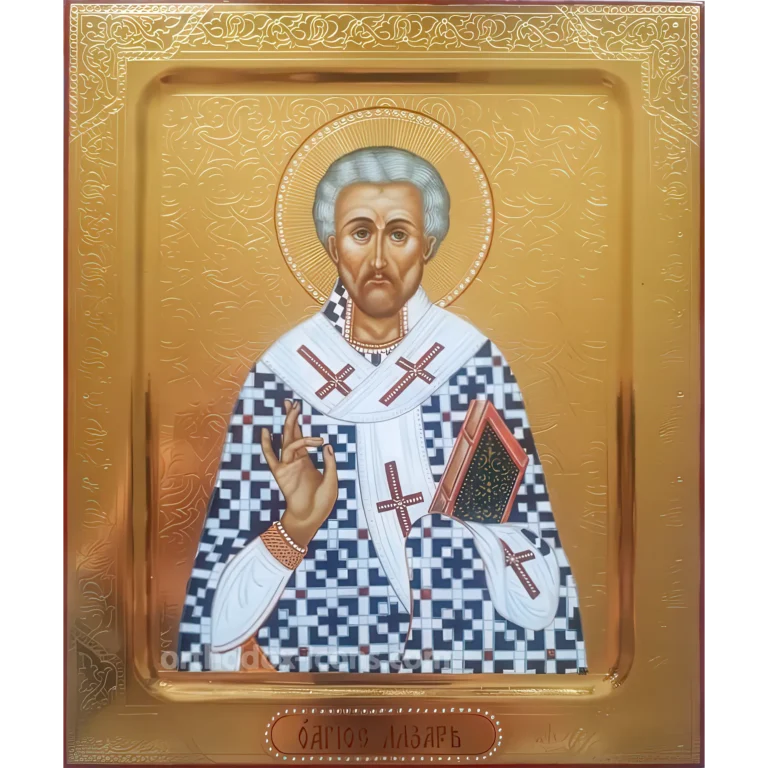
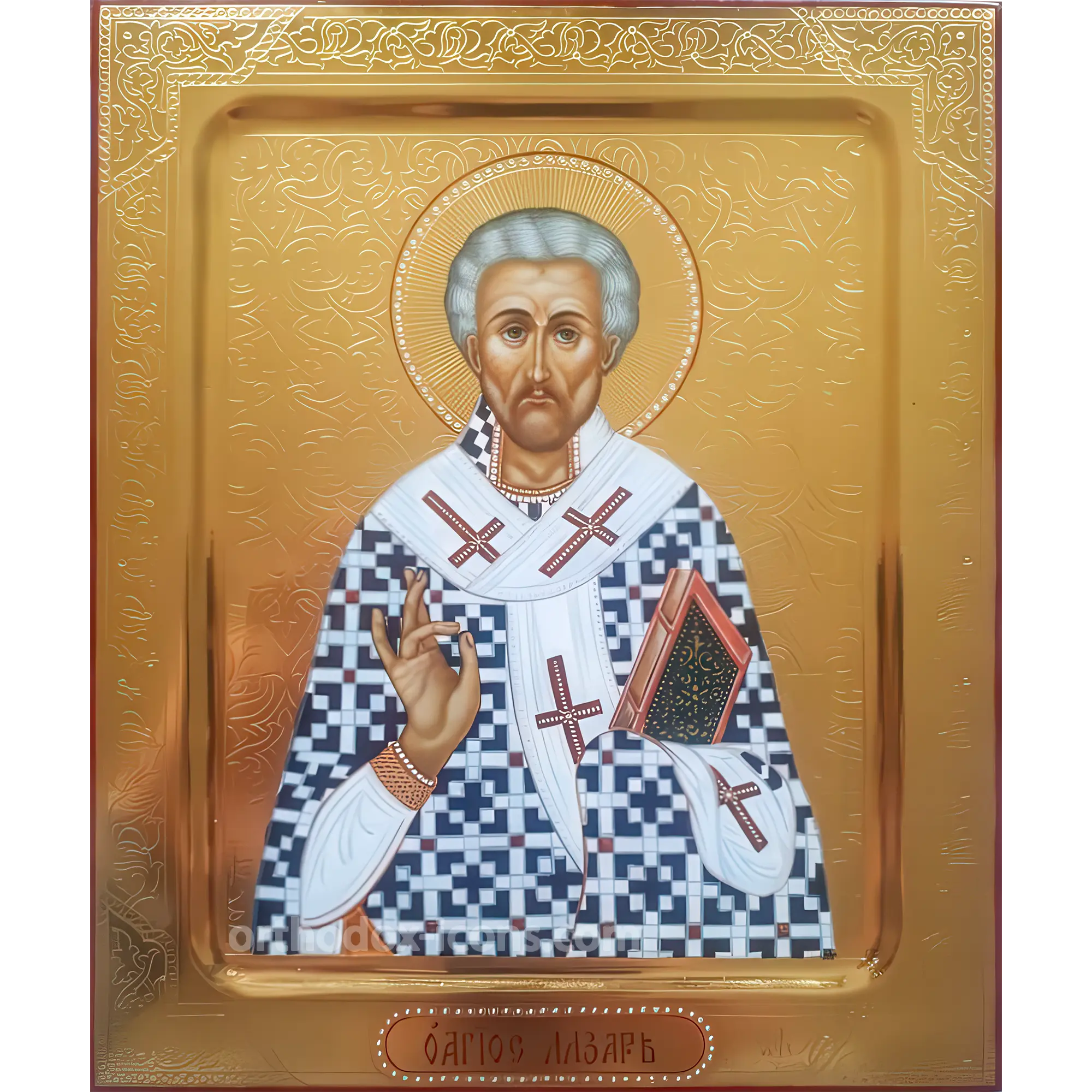
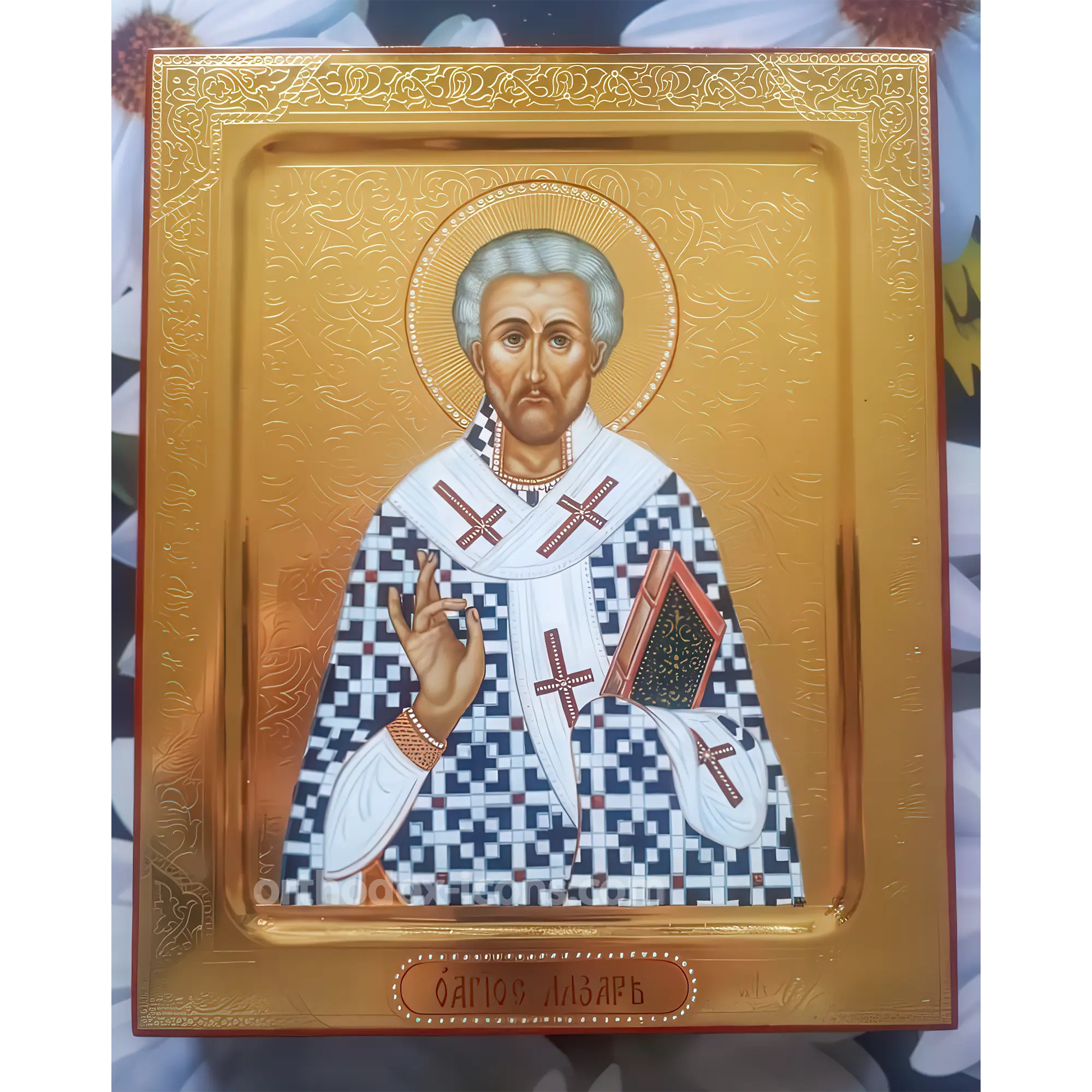
This hand-painted St. Lazarus Orthodox Icon shows Righteous Lazarus the Four-Days-Dead, friend of Christ and brother of Martha and Mary, whom the Lord raised on the fourth day after burial. Saint Lazarus is shown in episcopal vestments, with his right hand raised in blessing and the Gospel in his left hand, recalling the Church tradition that he later served as Bishop of Kition on Cyprus.
The icon is painted on a linden wood board with oak braces, gesso, egg tempera, mineral pigments, 23K gold leaf (960 purity), hand-tooled gold ornament, and a protective finish. It is suitable for a home iconostasis, patron saint gift, church, chapel, church office, or iconostasis row. Free international shipping is included. Payment is made after you receive and approve the icon.
It is possible to paint an image in any size to order
Free shipping worldwide
This hand-painted St. Lazarus Orthodox Icon is a prayerful image of Righteous Lazarus the Four-Days-Dead, Bishop of Kition, one of the most recognizable saints of the Gospel. Lazarus was the brother of Martha and Mary, lived in Bethany near Jerusalem, and is called in the Gospel the friend of Christ. His raising on the fourth day after burial became a great witness to the divine authority of the Savior over death.
For this reason, an icon of Righteous Lazarus is especially close to those who seek strengthening of faith, hope in difficult circumstances, help in illness, consolation in sorrow, and spiritual renewal. The image reminds the faithful that even where human hope seems exhausted, Christ remains the Lord of life.
In this icon Saint Lazarus is shown in episcopal vestments, with his right hand raised in blessing and the Gospel in his left hand. This iconographic form reveals not only the Gospel event of the raising of Lazarus, but also the later Church tradition of his service as Bishop of Kition on Cyprus. This is not a narrative scene of the Raising of Lazarus, but an image of the righteous saint and hierarch who became a living witness to the power of Christ.
Available sizes are 17×21 cm (6.7×8.3 in), 20×24 cm (7.9×9.4 in), 27×31 cm (10.6×12.2 in), and 30×40 cm (11.8×15.7 in). Larger iconostasis sizes can be made by agreement. Smaller formats are convenient for a home iconostasis, personal prayer shelf, or patron saint gift. The 27×31 cm and 30×40 cm sizes reveal the episcopal vestments, white omophorion with crosses, Gospel, blessing hand, gilded background, and hand-tooled ornament more fully.
Features of This Icon
The main feature of this image is the episcopal depiction of Righteous Lazarus. The saint is shown half-length, frontally, in a light omophorion with crosses and richly painted vestments. His right hand is raised in blessing, while his left hand holds the Gospel. The composition unites two important themes: the miracle of Lazarus being raised by Christ and the saint’s later service as Bishop of Kition.
The face of Lazarus is calm and attentive. Gray hair, a short beard, deep gaze, and gentle concentration make the image prayerful rather than outwardly dramatic. There is no excessive tension here. The saint appears as one who passed through the mystery of death, was returned to life by Christ, and then dedicated the remaining years of his earthly life to the service of the Church.
The golden halo around the saint’s head is outlined with a fine red line and radiant light. It emphasizes the glorification of Lazarus in the Church and reminds the viewer that holiness is not only the memory of a miraculous event, but also the fruit of faithfulness to God. The halo reads clearly against the gilded background, and the red outline gives the face clarity and completion.
The background and wide borders of the icon are covered with 23K gold leaf (960 purity) and enriched with hand-tooled plant ornament. The gilding is not accidental decoration; it creates an atmosphere of church solemnity and helps focus attention on the spiritual meaning of the image. The tooled ornament makes the icon festive without overloading the composition. The face, blessing hand, and Gospel remain central.
The lower inscription identifies the saint and helps distinguish Righteous Lazarus the Four-Days-Dead from other saints named Lazarus. For a patron saint icon, this is especially important: the image should be beautiful, but also canonically clear, precise in its inscription, and suited to prayer.
Iconography of Righteous Lazarus
Righteous Lazarus can be shown in several iconographic contexts. The most famous is the Raising of Lazarus, where Christ stands at the tomb and Lazarus comes forth wrapped in burial cloths. In this icon, however, another form is chosen: Lazarus is shown as a hierarch, Bishop of Kition. This type is especially suitable for personal prayer and a patron saint icon.
The Gospel in the hand of the saint points to his ministry in the Church and his witness to Christ. Lazarus was not merely an eyewitness of a miracle. After he was raised, his life itself became preaching: a man whom the Lord had called out of the tomb bore witness by his very existence to the power of the Savior. For this reason, the book in his hands is a sign of faith, teaching, and episcopal service.
The white omophorion with crosses speaks of his episcopal dignity. In Church tradition Lazarus is venerated as Bishop of Kition, serving on Cyprus. His vestments help the viewer see the continuation of the Gospel history: after Bethany, the tears of Martha and Mary, the tomb, and the miracle of resurrection, the saint continued his earthly path as a pastor of the Church.
The blessing hand reveals Lazarus as a holy intercessor. Before his icon, the faithful do not turn to an abstract symbol, but to a living saint who experienced human weakness, death, restoration to life, and a long path of service. This makes the image of Righteous Lazarus especially close to those who pass through illness, loss, inner crisis, or a time when hope seems nearly impossible.
Prayer Before the Icon of Saint Lazarus
Before an icon of Righteous Lazarus the Four-Days-Dead, Orthodox Christians pray for strengthening of faith, patience, and hope. His image reminds the believer that for God there is no final hopelessness. The raising of Lazarus is one of the strongest Gospel witnesses to Christ as the source of life. Therefore people turn to Saint Lazarus when it is important not to become hardened, not to fall into despair, and not to lose trust in God under heavy circumstances.
People may pray to Righteous Lazarus for strengthening of faith and hope; help in illness and long treatment; patience in sorrow, loss, and difficult waiting; spiritual renewal and return to church life; support for someone struggling with despondency or despair; peaceful ordering of family and loved ones; help for those caring for sick relatives; guidance in difficult circumstances; firmness before the fear of death; and heavenly protection for people named Lazarus.
Orthodox prayer before an icon is not a request for the mechanical fulfillment of a wish. It is an appeal to God through the prayerful intercession of the saint. The image of Lazarus helps a person remember that even where human strength fails, Christ remains the Lord of life. Such an icon is especially appropriate in a home where people pray for health, spiritual strengthening, family peace, and support during trials.
Brief Life of Saint Lazarus
Righteous Lazarus lived in the village of Bethany near Jerusalem with his sisters Martha and Mary. The Gospel testifies that the Lord Jesus Christ loved this family and visited their home. When Lazarus became ill and died, his sisters grieved, and the Lord came to the tomb on the fourth day after burial.
The raising of Lazarus became one of the most important Gospel events before the Passion of Christ. The Lord commanded that the stone be taken away from the tomb and cried out, “Lazarus, come forth.” Lazarus came out, still bound in burial cloths. This miracle strengthened the faith of many, but also provoked hatred among the chief priests, because many who saw Lazarus alive believed in Christ.
According to Church tradition, Lazarus lived for about thirty more years after this event. He went to Cyprus and became Bishop of Kition, a city associated with modern Larnaca. There he continued to serve the Church, bearing witness to Christ not only as an eyewitness of a miracle, but also as a pastor who strengthened people in faith.
Lazarus is called the Four-Days-Dead because Christ raised him on the fourth day after death. This name is not merely a chronological detail. It reveals the depth of the miracle: the Lord showed His authority over death when human hope had already been exhausted.
Commemoration and Patron Saint Meaning
The memory of Righteous Lazarus the Four-Days-Dead is connected above all with Lazarus Saturday, the Saturday of the sixth week of Great Lent, on the eve of Palm Sunday. This date changes each year according to the date of Pascha. On this day the Church remembers the raising of Lazarus as a foreshadowing of the Resurrection of Christ.
On October 30 according to the civil calendar, the Church also remembers the translation of the relics of Righteous Lazarus from Cyprus to Constantinople. For a person named Lazarus, this may be a name day if Righteous Lazarus the Four-Days-Dead, Bishop of Kition, was chosen as his heavenly patron.
This icon is especially suitable as a patron saint icon for a man or boy named Lazarus. It may be given for baptism, name day, birthday, entrance into studies, the beginning of independent life, housewarming, or an important family event. The image carries not only a personal name meaning, but also a deep spiritual message of hope, renewal, and faith in Christ the Lord of life.
Materials and Technique
The icon is hand-painted on a linden wood board strengthened with oak braces. The surface is prepared with gesso, and the image is painted in egg tempera with mineral pigments. 23K gold leaf (960 purity) is used for the background, halo, and sacred accents. The gilded field and borders include hand-tooled ornament, and a protective finish is applied after painting.
Because this is a hand-painted icon, small differences in gold tone, tooling, inscriptions, vestment details, facial painting, and color accents are natural. They do not change the iconographic meaning of the image. They show that the icon is a painted devotional work rather than a printed reproduction.
Choosing the Size
The 17×21 cm size is compact and suitable for a small home icon corner or personal patron saint icon. The 20×24 cm size remains easy to place while giving the image more presence. The 27×31 cm and 30×40 cm sizes reveal the episcopal vestments, omophorion, Gospel, blessing hand, gilded background, and hand-tooled ornament more fully. Larger iconostasis sizes can be discussed for a church, chapel, office, prayer room, or iconostasis row.
Placement and Care
The icon should be placed in a clean and dignified area, away from moisture, direct sunlight, overheating, soot, and mechanical damage. Dust should be removed only with a soft dry brush, without pressure. For additional protection of the painting and gilding, an icon case is recommended.
Free international shipping is included. Payment is made after you receive and approve the icon.
Questions and Answers
Who is shown in the St. Lazarus Orthodox Icon?
The icon shows Righteous Lazarus the Four-Days-Dead, friend of Christ and brother of Martha and Mary, whom the Lord raised on the fourth day after burial.
Why is Lazarus called the Four-Days-Dead?
This name refers to the Gospel event: Lazarus had been in the tomb for four days before Christ raised him from the dead.
Why is Saint Lazarus shown in episcopal vestments?
According to Church tradition, after his resurrection Lazarus lived on Cyprus and served as Bishop of Kition, so he is shown in hierarchal vestments.
What does the Gospel in Saint Lazarus’s hand mean?
The Gospel points to his service in the Church, his witness to Christ, and his episcopal dignity.
What do people pray for before an icon of Righteous Lazarus?
People may pray for strengthening of faith, hope in difficult circumstances, help in illness, patience, spiritual renewal, and protection from despair.
Who is this icon suitable for as a gift?
It is suitable for someone named Lazarus, and also for anyone who needs prayerful support, strengthening of hope, consolation in sorrow, or spiritual renewal.
What sizes are available for this icon?
The available sizes are 17×21 cm, 20×24 cm, 27×31 cm, and 30×40 cm. Larger iconostasis sizes can also be discussed before painting.
When is Righteous Lazarus commemorated?
Righteous Lazarus is commemorated on Lazarus Saturday, and the translation of his relics is remembered on October 30 according to the civil calendar.
Is this icon suitable for a home iconostasis?
Yes. The icon of Righteous Lazarus is suitable for a home iconostasis, personal prayer place, study, chapel, or church.
How should a hand-painted icon with gilding be cared for?
Keep the icon away from moisture, direct sunlight, overheating, soot, and mechanical damage. Dust it only with a soft dry brush; an icon case is recommended to protect the painting and gilding.
| Dimensions | 17x21cm (6.7×8.3 in), 20x24cm (7.9×9.4 in), 27x31cm (10.6×12.2 in), 30x40cm (11.8×15.7 in) |
|---|---|
| Name | Lazarus |