Coronation of the Virgin Orthodox Icon
$3000
Available size: 30×40 cm (11.8×15.7 in).
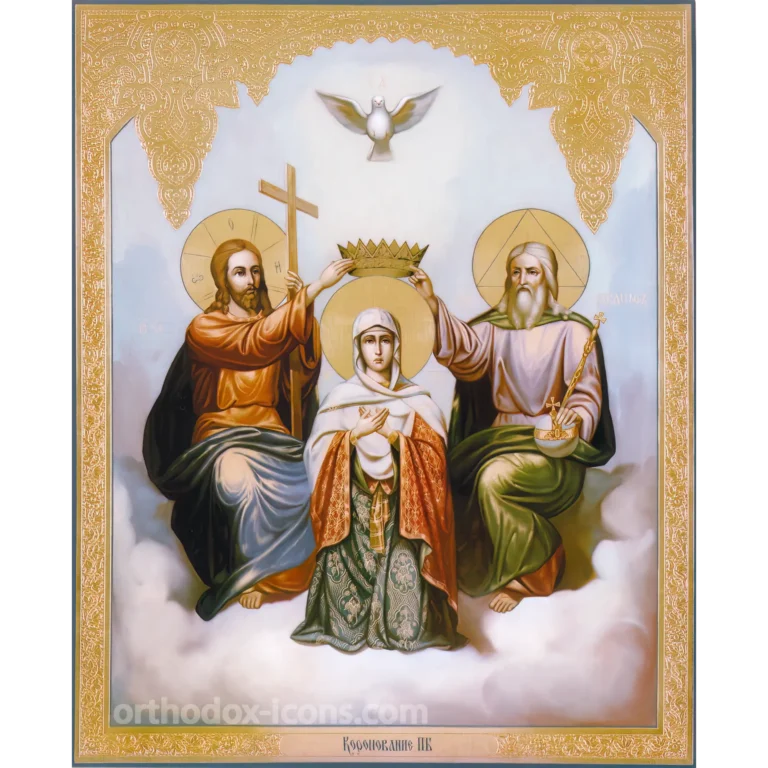
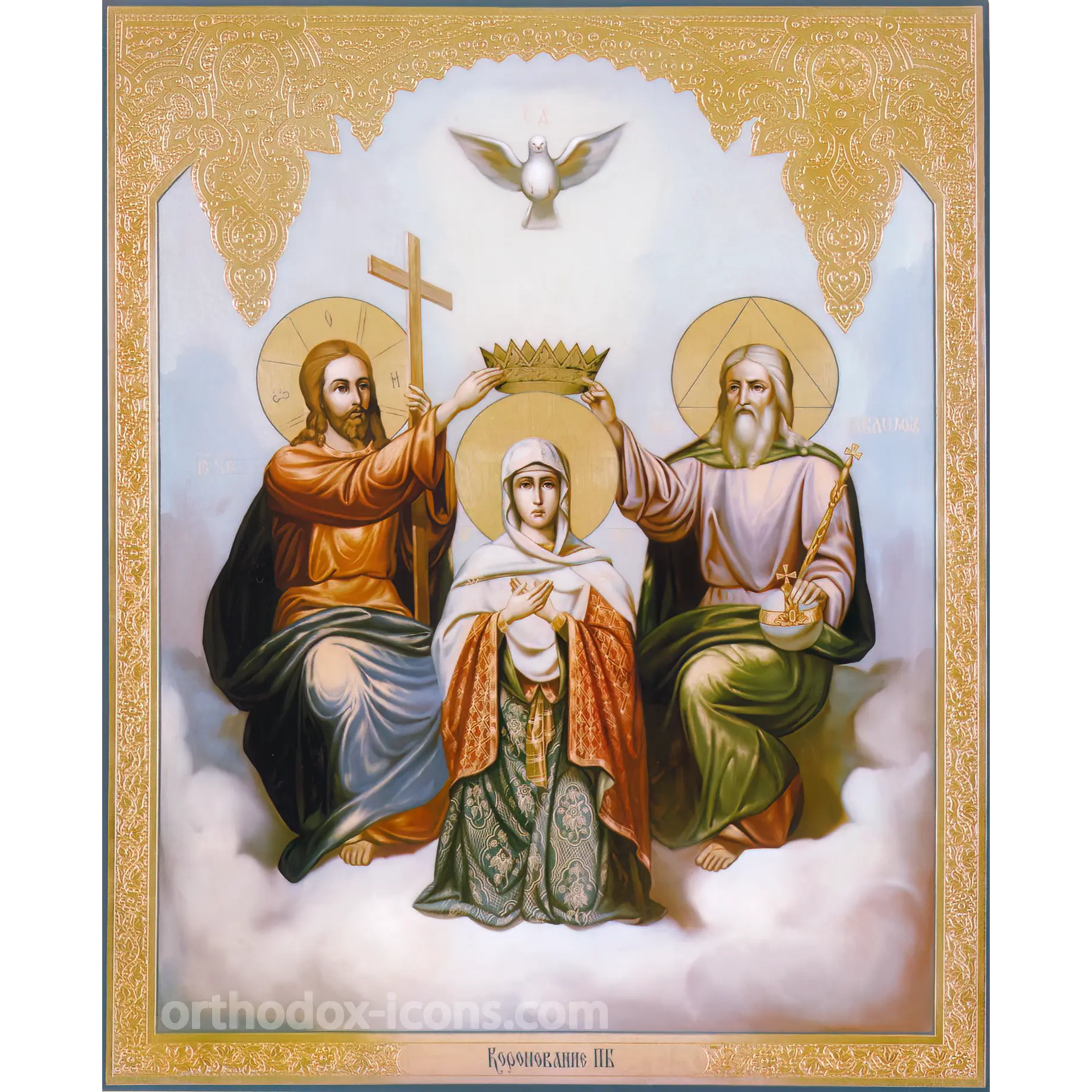
The Coronation of the Virgin Orthodox Icon is a solemn academic-style icon of the heavenly glorification of the Mother of God after her Dormition. The Theotokos kneels on white clouds with her hands folded on her breast, while Jesus Christ, holding the Cross, and God the Father, shown as the Ancient of Days, place a golden crown upon her head. Above them the Holy Spirit appears as a white dove, completing the Trinitarian composition. This hand-painted icon is made in the Russian synodal academic tradition with soft painterly modeling, 23K gold leaf, and finely tooled floral gold ornament forming an architectural arch. Free international shipping is included; payment is due upon delivery.
It is possible to paint an image in any size to order
Free shipping worldwide
The Coronation of the Virgin Orthodox Icon is one of the most solemn and visually majestic Marian images found in the Russian church art of the later period. It is not a direct illustration of a Gospel passage, because Holy Scripture does not describe events after the Dormition and heavenly glorification of the Virgin Mary in this form. The icon is based on Church tradition and theological reflection on the honor given to the Mother of God in the Kingdom of Heaven.
The image proclaims that she who served the mystery of the Incarnation was exalted above the angelic and human worlds, becoming Queen of Heaven and the merciful intercessor of Christians. The icon is therefore not simply a ceremonial scene. It is an image of divine justice, humility crowned by glory, and the triumph of grace over earthly sorrow.
This hand-painted icon is made in an academic, painterly style associated with the Russian synodal period. It combines soft modeling of faces and garments, cloud-filled heavenly space, strict symbolic structure, and a richly gilded ornamental frame. The background and broad fields are covered with 23K gold leaf and decorated by hand with fine floral tooling.
Coronation of the Virgin Orthodox Icon – Origin of the Subject
The iconography of the Coronation of the Virgin has a distinctive history. Unlike ancient Byzantine Marian types such as Hodegetria or Eleusa, this subject first developed in Western Christian art around the twelfth and thirteenth centuries. It was often shown as the final triumphant scene in larger cycles of the Dormition and Assumption of Mary, and it appeared in stained glass, sculpture, and painted decoration in Gothic churches.
The subject entered Russian and broader Orthodox visual culture much later, especially in the second half of the seventeenth century. Its spread was connected with cultural contacts with Europe and with engravings in Ukrainian and Belarusian printed liturgical and theological books. One important channel was the world of early printed books and devotional engravings, which influenced church art of the period.
By the eighteenth and nineteenth centuries, during the synodal period, the subject became popular in Russian church painting. It was often treated as an independent composition expressing the triumph of the Church and the heavenly glorification of the Mother of God. Although the subject has Western roots, Russian Orthodox church art gave it its own theological reading centered on the Most Holy Trinity and the royal dignity of the Theotokos.
Composition and Academic Style
The composition is symmetrical, monumental, and filled with light. The Most Holy Theotokos kneels in the center on soft white clouds. Her posture expresses complete humility and obedience to the will of God, even at the moment of her highest glorification. Her hands are folded crosswise on her breast in a gesture of deep prayer.
The Mother of God is shown in light garments and a white veil over her head, symbolizing purity, holiness, and spiritual radiance. A rich mantle with gold ornament is placed over her. The painterly treatment of the garments, clouds, and faces belongs to the academic style rather than to the strict flatness of earlier Byzantine iconography.
To one side of the Theotokos sits Jesus Christ, clothed in red and blue garments. The red recalls His Passion and the blood shed for the salvation of the world; the blue points toward His divine nature. He holds the large wooden Cross of Golgotha, the instrument of human redemption, and with His other hand places the crown upon the head of His Mother.
God the Father, the Holy Spirit, and the Crown
On the other side is God the Father, shown as Sabaoth or the Ancient of Days, an elder with white hair and beard. This way of depicting God the Father belongs especially to the academic and synodal style of Russian church painting. It differs from stricter Byzantine canonical practice, but it was common in the period and style represented by this icon.
God the Father rests upon a sphere, or orb, surmounted by a cross. The orb symbolizes divine authority over the whole universe, visible and invisible. Together with Christ, He places the golden crown upon the head of the Virgin Mary.
At the upper center of the composition, in a radiant light, the Holy Spirit appears in the form of a white dove. Thus all three Persons of the Most Holy Trinity are represented in the act of glorifying the Mother of God: the Father crowns her as beloved daughter, the Son as His most pure Mother, and the Holy Spirit as the one upon whom divine grace rested in the mystery of the Incarnation.
The golden crown is the central visible sign of the scene. It is not a symbol of earthly political power. It is the crown of holiness, spiritual perfection, heavenly dignity, and the royal honor of the Queen of Heaven.
Gold Ornament and Decorative Frame
The icon is richly decorated. The main heavenly scene is enclosed within an architectural arch. Around this arch, the background and broad fields are covered with 23K gold leaf. Into the gilded surface, the master works a delicate relief floral ornament by hand. This tooling gives the icon a precious and ceremonial appearance.
The gold does not function only as decoration. In Orthodox iconography, gold points to divine light, eternity, and heavenly glory. Here it also supports the meaning of the subject: the glorification of the Mother of God in the Kingdom of Heaven.
Prayer Before the Coronation of the Virgin Icon
As an image of heavenly triumph, the Coronation of the Virgin gives spiritual support to the faithful in earthly struggle. Before this icon, people pray for strengthening of faith and for deliverance from despondency, despair, and heavy thoughts. The image reminds the faithful that humility, suffering, and fidelity to God are not forgotten by the Lord.
Families may pray before this icon for peace in the home. The Mother of God, honored as Queen of Heaven, is asked to calm conflicts, restore mutual understanding, and protect family life from division, slander, envy, and hostility.
Mothers also pray before the crowned Theotokos for their children: for protection from danger, harmful influences, and spiritual confusion; for wisdom, diligence in study, and guidance on a righteous path. People also ask for healing from serious physical and spiritual illnesses, especially when human help seems insufficient.
Materials and Painting Technique
Painting this icon in the academic style requires strong command of drawing, proportion, perspective, light, shadow, and layered color. The base is a solid linden board strengthened on the back with inserted oak braces to help protect the wood from warping. The front surface is covered with linen and natural chalk gesso.
After the gesso is polished, the gilded fields and upper background are covered with 23K gold leaf. Fine floral relief ornament is then tooled into the gold with special hand tools. The faces, figures, garments, and clouds are painted in a soft academic manner with layered translucent painting, creating gentle transitions and a luminous heavenly atmosphere.
The completed icon is protected with a high-quality varnish or oil finish, preserving the paint layer from dust, humidity, and fading.
Available Size
The available size is 30×40 cm (11.8×15.7 in). This is the minimum and most suitable home size for this complex subject. The composition includes the Theotokos, Christ, God the Father, the Holy Spirit, the Cross, the orb, clouds, garments, and rich gold tooling, all of which require enough space to be painted clearly.
Larger formats can be discussed individually for spacious interiors, church settings, large kiots, or iconostasis placement.
Free international shipping is included; payment is due upon delivery.
Icon Characteristics
| Feature | Description |
|---|---|
| Subject | Coronation, or Glorification, of the Mother of God by the Most Holy Trinity |
| Style | Academic Russian church painting of the synodal period |
| Main figures | The Theotokos, Jesus Christ with the Cross, God the Father, and the Holy Spirit as a dove |
| Board | Linden wood with linen, natural gesso, and inserted oak braces |
| Painting | Layered painterly work in an academic manner |
| Gold and decoration | 23K gold leaf with fine hand-tooled floral ornament |
| Available size | 30×40 cm (11.8×15.7 in), with larger formats by agreement |
| Prayer use | Strengthening of faith, family peace, protection of children, consolation, and healing prayers |
The Coronation of the Virgin Orthodox Icon is a solemn image of heavenly glory, humility, and divine love. It is a fitting icon for prayer in the home, for family protection, and for anyone seeking hope in the mercy and intercession of the Queen of Heaven.
Questions and Answers
Is the Coronation of the Virgin described in the Gospels?
No. The scene is not described directly in the canonical Gospels. It is based on Church tradition and theological reflection on the heavenly glorification of the Mother of God after her Dormition.
Where did this iconographic subject come from?
The Coronation of the Virgin first developed in Western Christian art in the twelfth and thirteenth centuries and entered Russian icon painting in the seventeenth century.
Who places the crown on the head of the Virgin Mary?
In this composition, Jesus Christ and God the Father place the crown on the head of the Mother of God, while the Holy Spirit appears above them as a dove.
Why is God the Father shown as an elder?
This belongs to the academic Russian synodal style, where God the Father, or Sabaoth, was often shown as the Ancient of Days. It differs from stricter Byzantine practice.
What does the crown symbolize?
The crown is not a sign of earthly political power. It symbolizes the heavenly glory, holiness, and royal dignity of the Mother of God as Queen of Heaven.
Why is the Mother of God shown in white?
The white veil and light garments symbolize her purity, holiness, and spiritual radiance. Academic icon painting often varied garment colors for theological and artistic expression.
What are people accustomed to pray for before this icon?
People pray before this icon for strengthening of faith, family peace, protection of children, healing, consolation in despondency, and hope in the mercy of God.
What materials are used?
The icon is painted on a prepared linden board with natural gesso, painterly layers of paint, 23K gold leaf, and hand-tooled gold ornament.
What size is available?
The available size is 30×40 cm (11.8×15.7 in). Larger church and iconostasis formats can be discussed individually.
Do you ship internationally?
Yes. Free international shipping is included, and payment is due upon delivery.
| Dimensions | 30x40cm (11.8×15.7 in) |
|---|---|
| Name | Mary |