Filigree Icon of Peter and Fevronia
$950
Available size: 17×21 cm (6.7×8.3 in). Production time for a filigree icon is about 2 months.
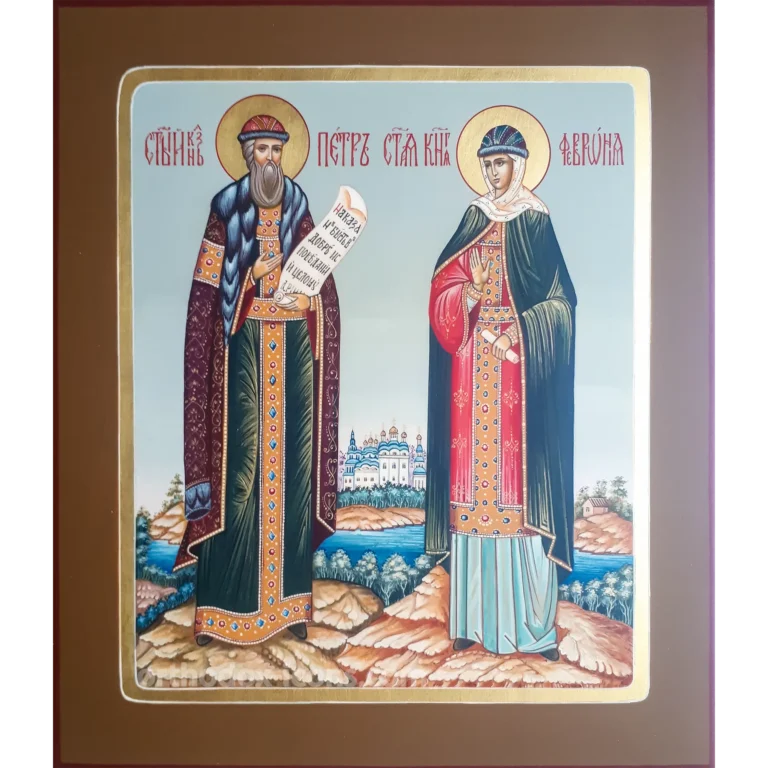
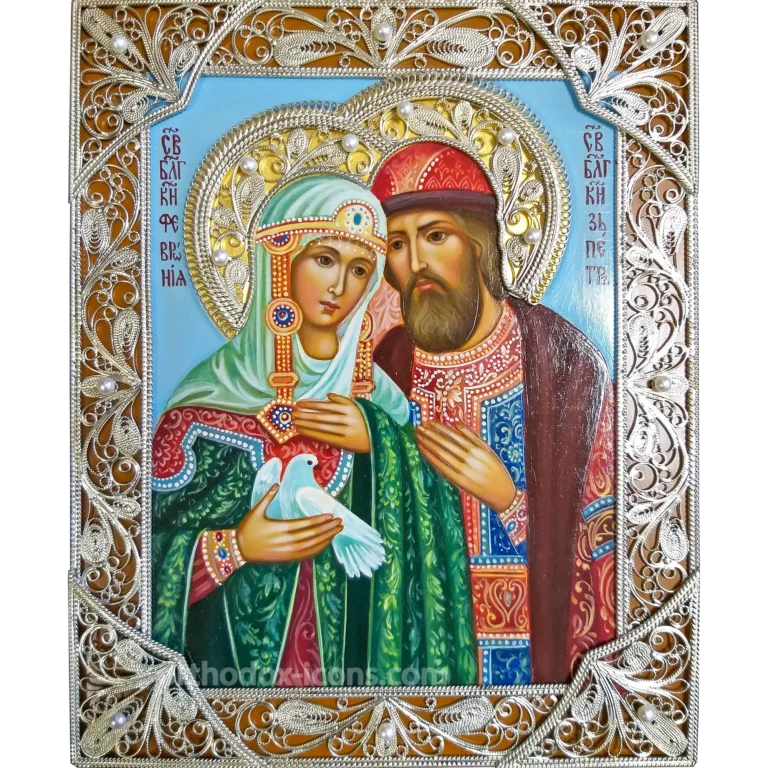
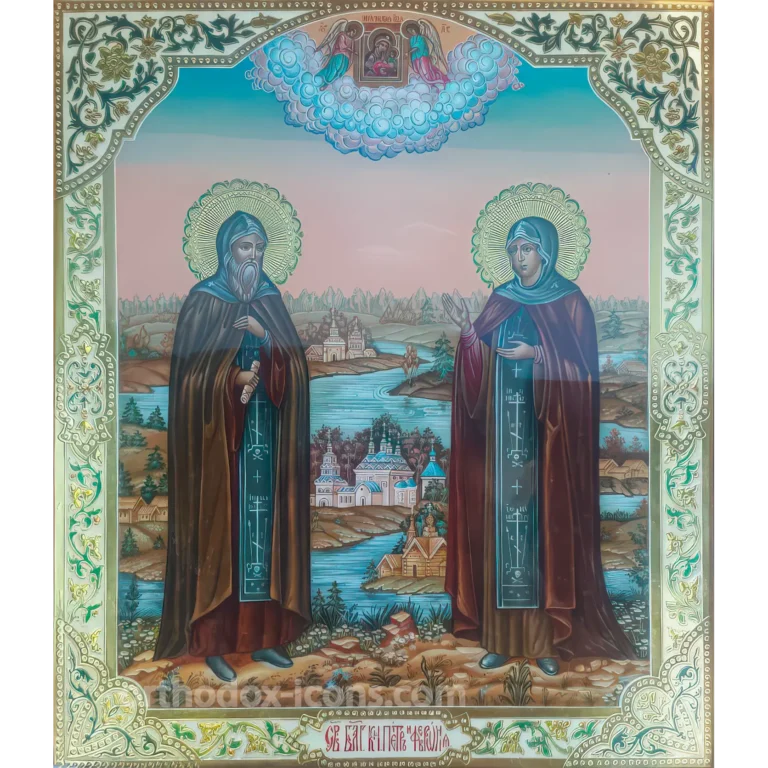
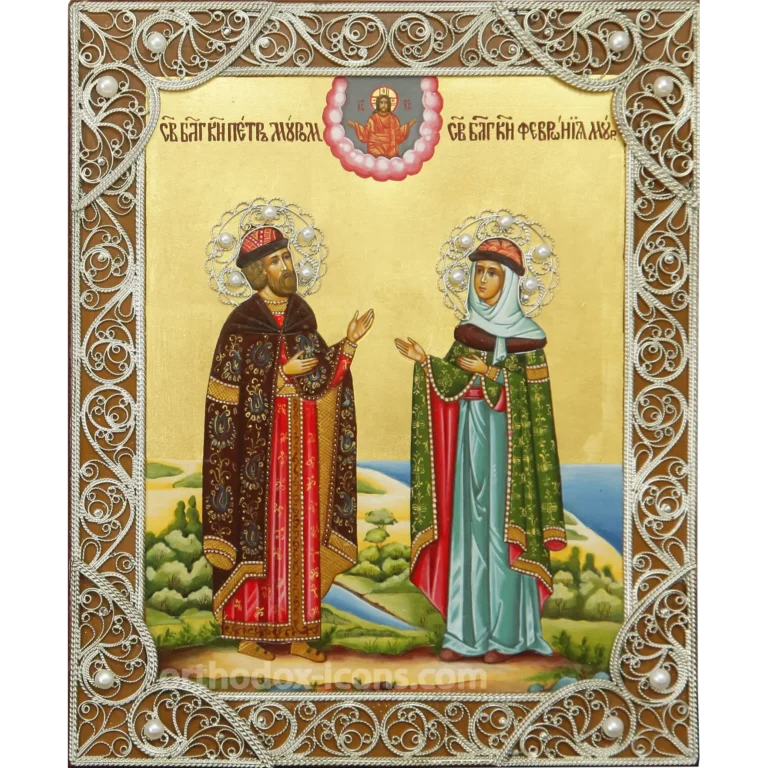
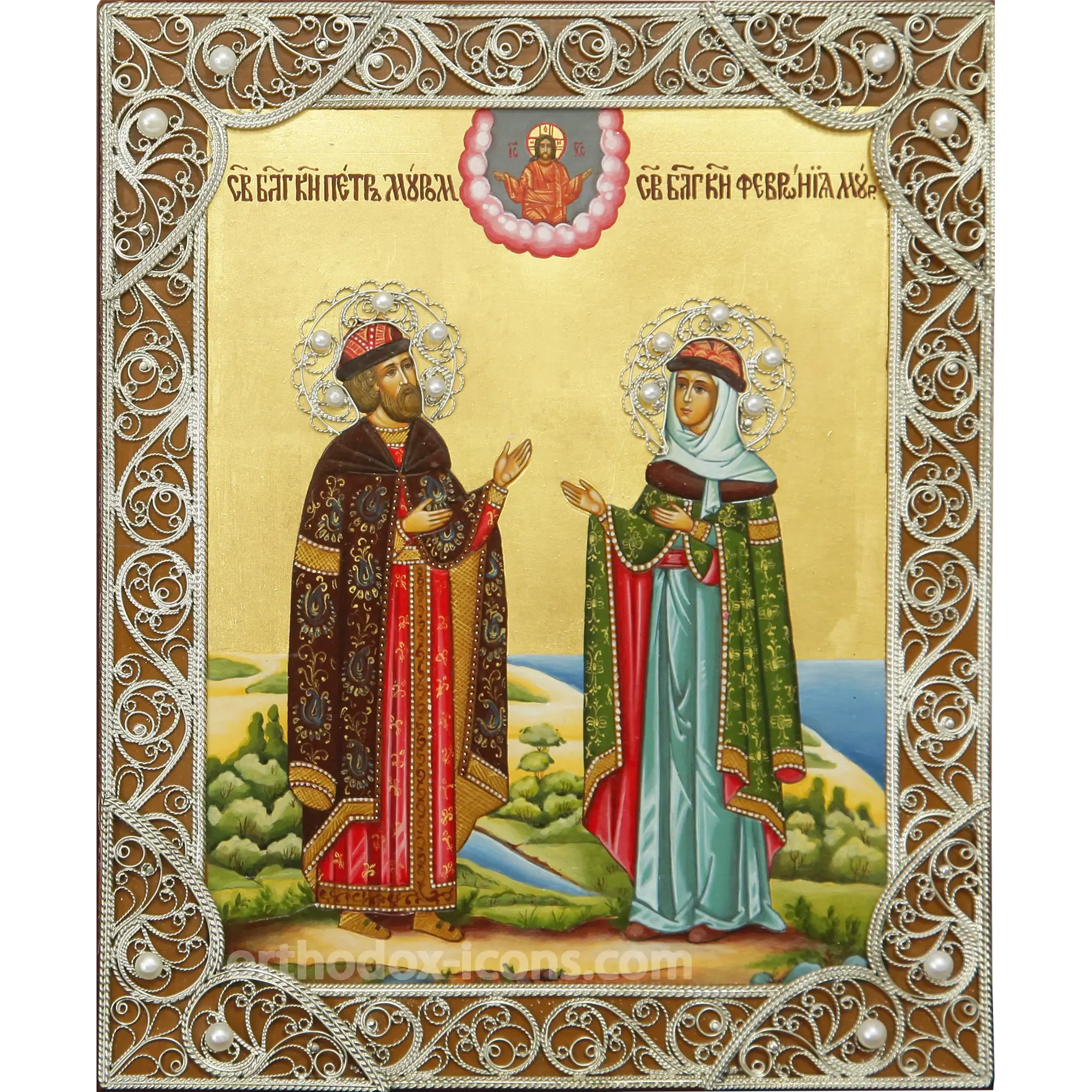
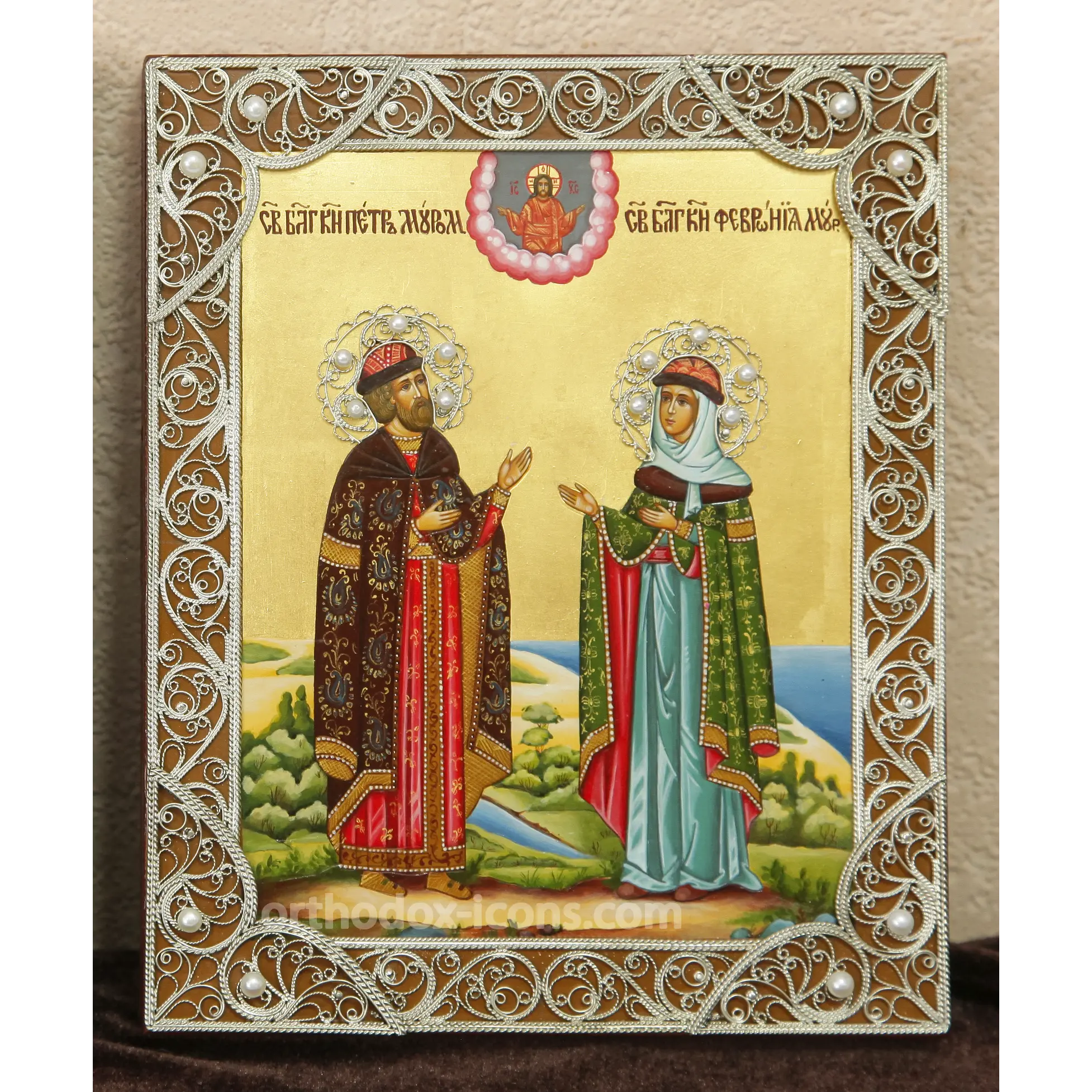
Filigree Icon of Peter and Fevronia is a premium hand-painted Orthodox wedding and family icon in a richly decorated filigree setting. The holy spouses are shown full-length in princely garments, standing before the landscape of Murom and the Oka River, while Christ blesses them from above.
- For whom it is suitable: a memorable Orthodox gift for a wedding, church marriage, anniversary, silver wedding, pearl wedding, or a family heirloom.
- Prayer focus: Saints Peter and Fevronia are asked for love, faithfulness, peace in marriage, protection of the family, children, healing, and the blessing of a future spouse.
- Materials: linden board, chalk gesso, mineral egg tempera, 23K gold leaf (960 purity), hand-made nickel-silver filigree, and artificial pearls.
- Iconographic features: full-length composition, Christ blessing from the clouds, Oka River landscape, filigree halos and border, pearl decoration, and richly ornamented princely clothing.
It is possible to paint an image in any size to order
Free shipping worldwide
Hand-painted Filigree Icon of Peter and Fevronia is a richly decorated Orthodox icon of the holy spouses of Murom, patrons of Christian marriage and family life. This is a premium work that unites traditional Mstyora icon painting with fine jewelry ornament: egg tempera painting, 23K gold leaf (960 purity), hand-made filigree, and pearl-like decoration.
The icon is intended as a serious prayer image and a family heirloom. It is especially suitable for a wedding, church marriage, anniversary, silver wedding, pearl wedding, or a gift to a family that wants a beautiful Orthodox icon connected with faithfulness, mutual sacrifice, and peace in the home.
Iconography: Love Against the Landscape of Murom
The composition is built around spiritual unity and mutual service. Saints Peter and Fevronia are shown full-length, turned toward one another in a quiet prayerful dialogue. Their hands and faces suggest agreement, tenderness, and a common turning of the heart toward God.
Prince Peter is dressed in a deep burgundy princely cloak richly ornamented with gold plant motifs. A bright red garment is visible beneath it. Princess Fevronia wears a soft blue dress, a heavy emerald-green mantle, a white head covering, and a princely cap. The garments emphasize not only their dignity as rulers of Murom, but also the inward nobility associated with their Christian life.
Above the spouses, in a rose-colored cloud of divine glory, Christ the Savior blesses them. This detail shows that their union is understood not simply as earthly affection, but as a marriage blessed before God. Behind the saints is a landscape with green hills, sandy banks, and the broad blue water of the Oka River, the river connected with Murom and with the story of their exile and return.
Filigree, Gold, and Pearl Decoration
The main visual value of this icon is its jewelry setting. The background is covered with polished 23K gold leaf (960 purity). Over this luminous field, the craftsman creates an openwork filigree ornament, also known in Russian tradition as skan.
Filigree is made from very fine twisted metal wire. In this icon the ornament is made from nickel silver, a bright metal alloy with a silver-like appearance. Each curl is shaped by hand, joined into a lace-like pattern, and fixed to the icon. This is slow, careful work, closer to jewelry making than ordinary decorative framing.
The halos around Saints Peter and Fevronia are woven from filigree. The wide outer border is also covered with a raised openwork filigree pattern. White artificial pearls are set into the halos and border, adding a solemn festive quality. The combination of silver-toned filigree, pearl-white accents, gold leaf, and painted garments gives the icon a rich and ceremonial appearance.
Prayer to Saints Peter and Fevronia
Saints Peter and Fevronia are honored in the Orthodox Church as examples of faithful Christian marriage. Their memory is especially associated with family love, patience, loyalty, forgiveness, and the ability to remain together through illness, poverty, social pressure, and sorrow.
Orthodox Christians pray before their icon for the strengthening of marriage, protection from betrayal and division, peace between spouses, patience during family conflict, the blessing of children, and the healing of relationships. People who are not yet married may also ask the saints for help in finding a faithful spouse and forming a Christian family.
The icon should not be treated as a charm or a guarantee of a particular outcome. In Orthodox life, prayer before an icon is a prayer to God through the intercession of His saints, joined with repentance, forgiveness, and a sincere desire to live according to the Gospel.
The Life of Peter and Fevronia
The story of Peter and Fevronia is one of the most beloved accounts of ancient Rus. Prince Peter became gravely ill, and it was revealed that he could be healed by Fevronia, a wise young woman of humble origin. She healed him and asked that he become her husband. At first Peter failed to keep his promise, and the illness returned. After repentance, he returned to Fevronia, was healed, and married her.
When Peter became ruler of Murom, the proud boyars did not want to accept a princess of peasant origin. They demanded that he either abandon his wife or leave the throne. Peter chose Fevronia over power and wealth. The spouses left the city by the Oka River, but soon Murom fell into disorder, and the boyars begged them to return. Peter and Fevronia forgave them and ruled with justice and mercy.
In old age, they received monastic tonsure and prayed to depart this life on the same day. According to tradition, they reposed on July 8, 1228. Though people first placed their bodies in separate churches, the saints were found together again in one coffin. Their story became a sign of faithful love that is stronger than worldly rank and even stronger than death.
How the Icon Is Made
This icon requires several stages of demanding handwork. The base is a solid linden board strengthened with oak splines. Chalk gesso is applied and polished until the surface becomes smooth enough for fine icon painting. The image is then painted in the Mstyora tradition with natural egg tempera and mineral pigments.
After the painting and gilding are completed, the filigree ornament and pearls are added. This requires the coordinated work of an icon painter, a gilder, and a filigree craftsman. The result is not simply a painted board with decoration attached, but an integrated hand-made icon in which iconography, gold, metal lace, and pearl ornament serve one spiritual image.
The size is 17×21 cm (6.7×8.3 in). Because the filigree is made by hand and the ornament is complex, the production time for this icon is about 2 months.
Care for a Filigree Icon
A filigree icon with metal ornament, pearls, and gold leaf requires careful handling. It should not be placed in direct sunlight, near radiators, under air conditioning, or in a place with sharp changes of humidity. Moisture can damage both the metal filigree and the gilded surface.
Do not clean the icon with water, damp cloths, alcohol, polish, or household chemicals. Dust should be removed only with a very soft, completely dry brush, taking care not to catch the delicate filigree lace. For long-term preservation, a glazed wooden kiot is strongly recommended.
The icon can be blessed in an Orthodox church before shipping. Free international shipping is included. Payment is made after you receive and approve the icon.
Questions and Answers
What is filigree on this icon?
Filigree is a jewelry technique in which fine twisted metal wire is shaped into openwork ornament. On this icon, the halos and wide border are decorated with hand-made nickel-silver filigree.
Are the pearls natural?
The icon is decorated with high-quality artificial pearls. They give the filigree ornament a festive pearl-like appearance while keeping the work more accessible than natural pearl decoration.
What river is shown behind Peter and Fevronia?
The landscape refers to the Oka River, connected with the city of Murom. In the traditional account, Peter and Fevronia left Murom by river when the boyars opposed their marriage.
Who is shown in the pink cloud above the saints?
Christ the Savior is shown above the spouses, blessing them. This detail points to the heavenly blessing of their marriage, love, and faithfulness.
Why is this icon often given for weddings?
Peter and Fevronia of Murom are honored in the Orthodox Church as patrons of Christian marriage and family life. Their story is associated with loyalty, patience, forgiveness, and love that endures trials.
Can people pray before this icon during family conflict?
Yes. Orthodox Christians pray before Saints Peter and Fevronia for reconciliation, patience, forgiveness, protection of marriage, and peace in the home.
Is this icon suitable for someone who is not married yet?
Yes. It can be given to a person praying for a faithful spouse and a blessed Christian family life.
Will the painted parts fade under the filigree decoration?
The painted faces and garments are made with mineral egg tempera, a traditional icon-painting medium known for depth and durability when the icon is cared for properly.
Does filigree require special care?
Yes. The metal ornament should be protected from moisture. Do not wipe the icon with wet cloths or cleaners; use only a very soft, dry brush.
Can the icon be blessed before shipping?
Yes. The icon can be blessed in an Orthodox church before shipping. Free international shipping is included, and payment is made after you receive and approve the icon.
| Dimensions | 17x21cm (6.7×8.3 in) |
|---|---|
| Name | Fevronia, Peter |
Related products
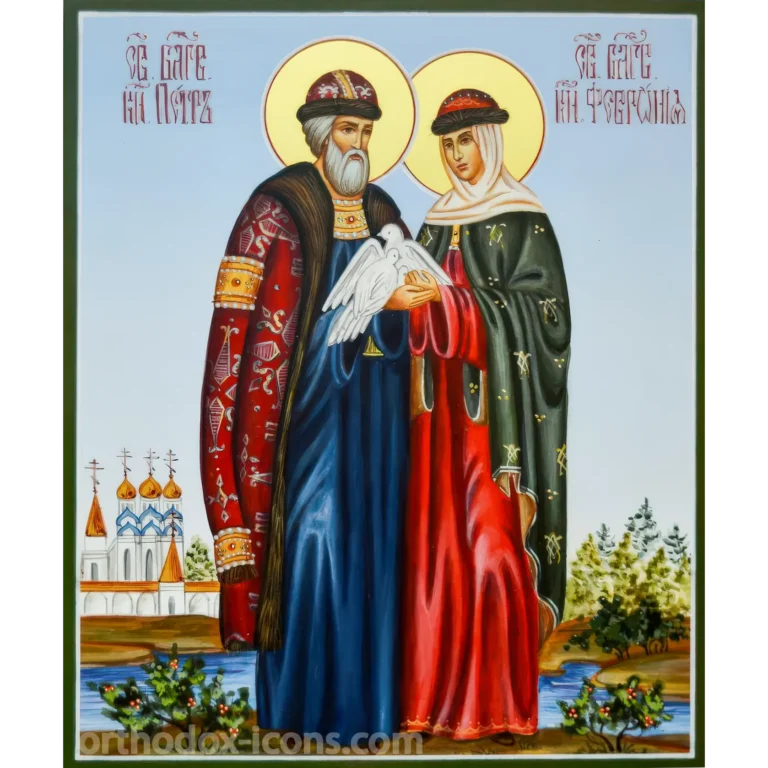
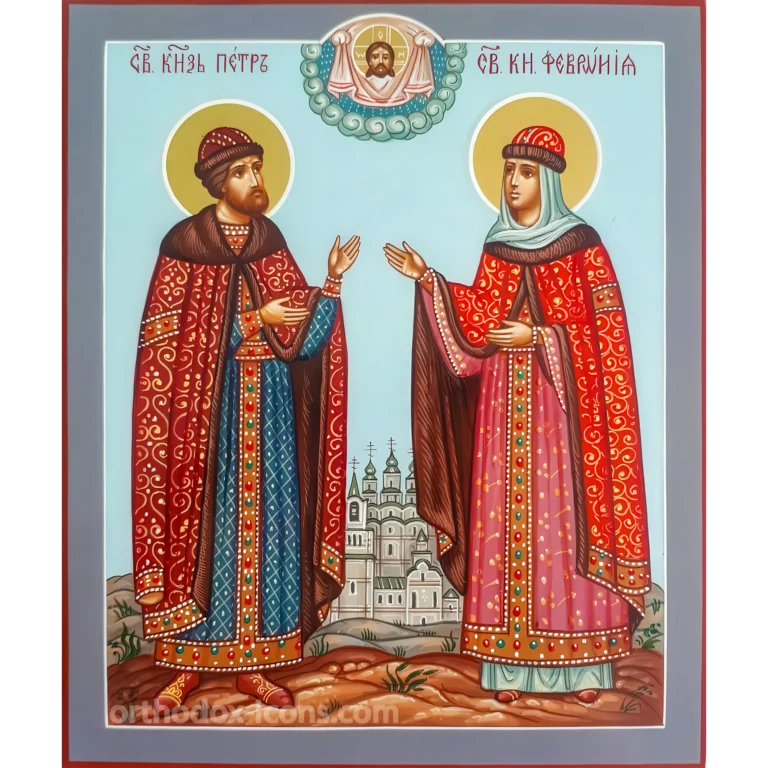
Hand-Painted Icon of Saints Peter and Fevronia of Murom
Available on backorder
Price range: $550 through $1600