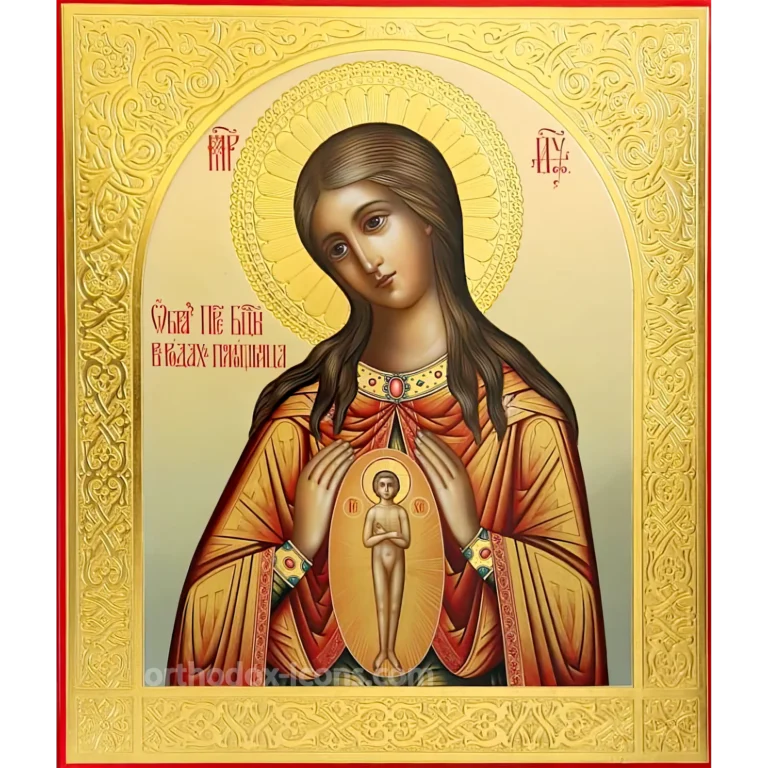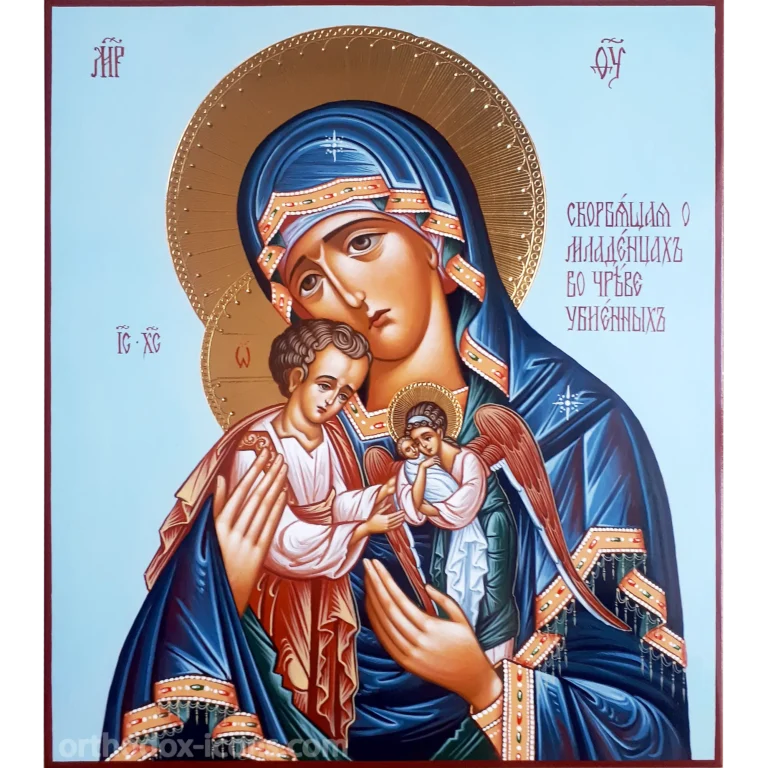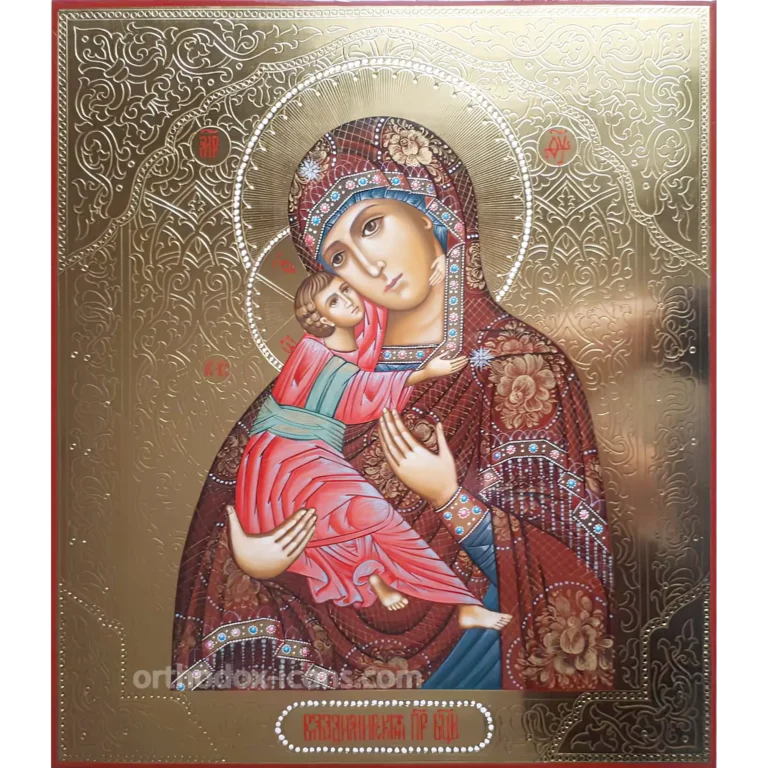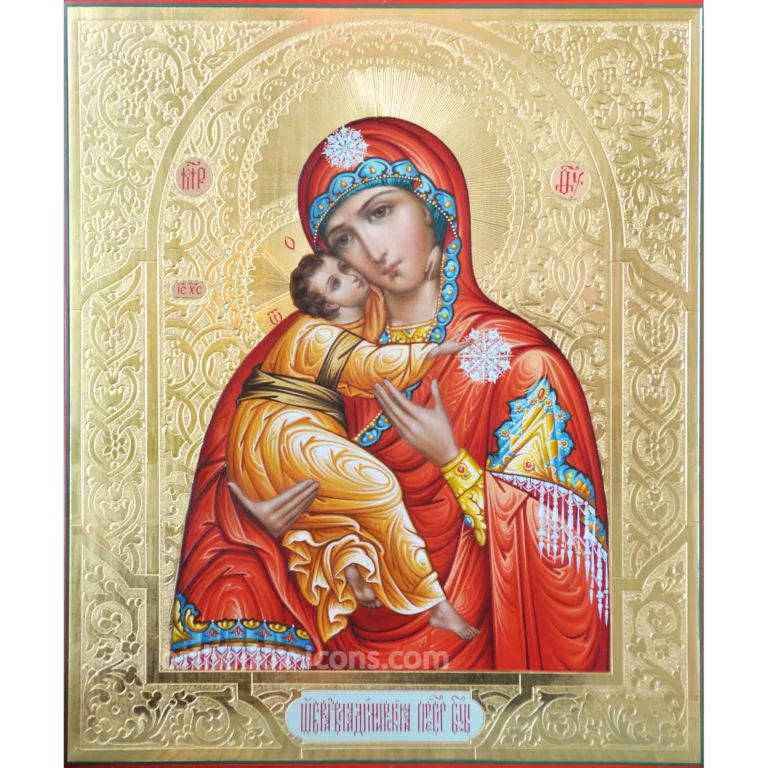
Seven Arrows Icon of Virgin Mary
Price range: $500 through $1600
Available sizes: 17×21 cm (6.7×8.3 in), 20×24 cm (7.9×9.4 in), 27×31 cm (10.6×12.2 in), 30×40 cm (11.8×15.7 in).
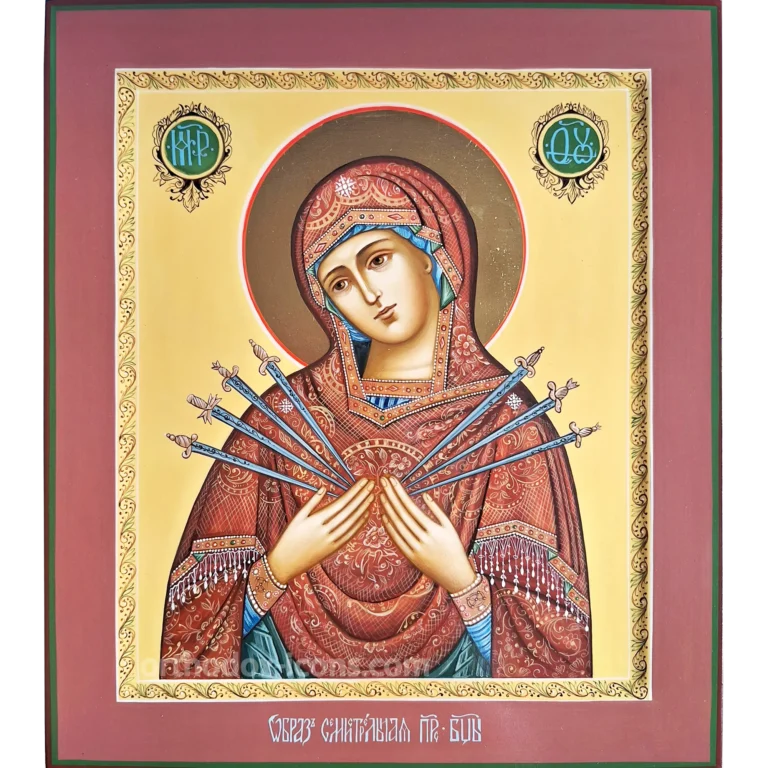
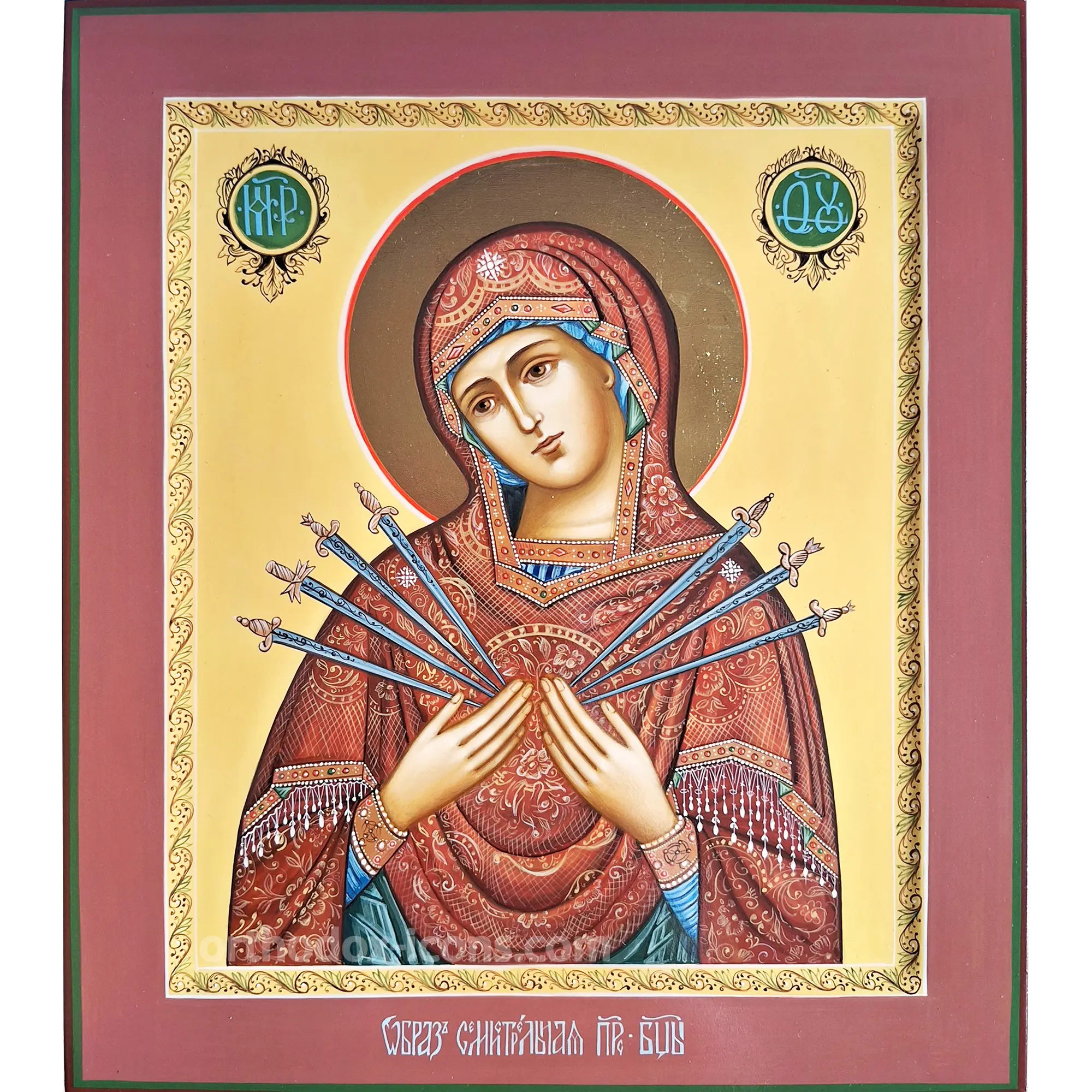
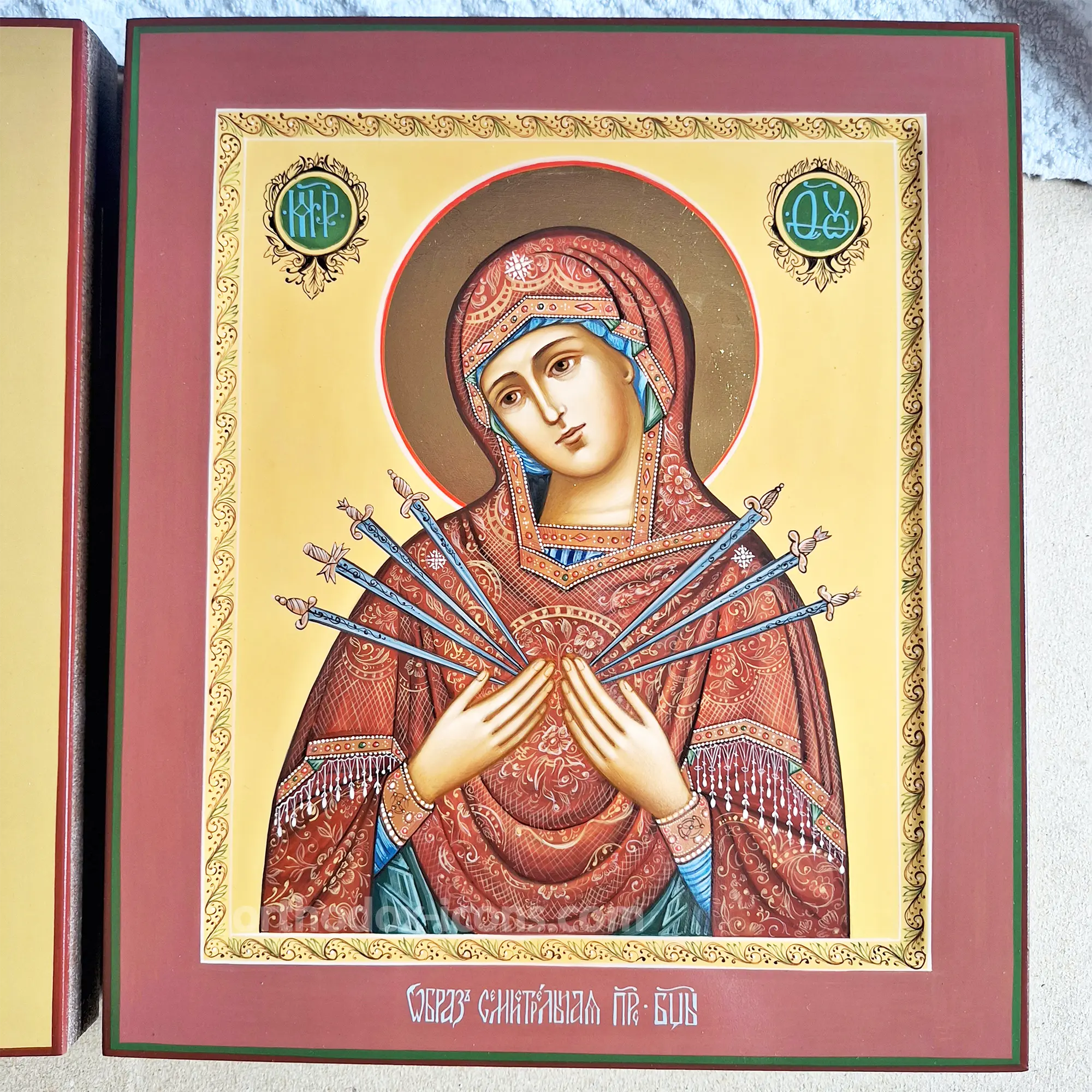
The Seven Arrows Icon of Virgin Mary is a deeply moving Orthodox image of the Mother of God without the Christ Child. Seven swords pierce her heart, three on one side and four on the other, symbolizing the fullness of her sorrow at the Passion of Christ and the sins that wound the human heart. This hand-painted icon is made in warm, luminous tones, with a red maphorion, blue head covering, steel-colored swords, ornamental borders, mineral egg tempera, and a 23K gold leaf background. Free international shipping is included; payment is due upon delivery.
It is possible to paint an image in any size to order
Free shipping worldwide
Among the many iconographic images of the Most Holy Theotokos, the Seven Arrows Icon of Virgin Mary has a particularly piercing and contemplative character. It does not show the joyful majesty of the Queen of Heaven with the Christ Child in her arms. Instead, it presents the Mother of God in deep sorrow, with seven swords piercing her heart. Yet this sorrow is not despair. It is filled with redemptive love, compassion, and mercy.
Before this icon, the faithful are invited to consider the words, actions, anger, envy, and passions that wound the heart. The grief of the Theotokos is shown not as distance from humanity, but as motherly compassion for the suffering of her Son and for the spiritual illness of people. For this reason, the Seven Arrows icon is especially connected with prayers for reconciliation, the softening of anger, protection of the home, and the healing of hardened hearts.
This hand-painted icon follows the Russian Mstyora tradition. The composition is solemn and warm: the Virgin Mary is shown with a red maphorion, a blue head covering, seven steel-colored swords, a 23K gold leaf background, and refined ornamental borders. It is a serious Orthodox icon for prayer, not a printed reproduction or decorative souvenir.
Seven Arrows Icon of Virgin Mary – History of the Image
The history of the Seven Arrows Icon is connected with the Russian North. According to tradition, the prototype of the image was painted more than five hundred years ago. For a long time, however, it remained forgotten in the Church of Saint John the Theologian on the Toshna River near Vologda.
The story of its rediscovery is traditionally placed in the eighteenth century. A peasant from the Kadnikov district had suffered for many years from a severe illness of the legs. He limped badly, endured constant pain, and had nearly lost hope of recovery. In a dream he heard a command to go to the church, climb the bell tower, and find an icon of the Most Holy Theotokos. If he prayed before it, he would receive healing.
When he came to the church, the clergy did not believe him at first and twice refused to let him climb the bell tower. Only on the third request, moved by his tears, did they allow him to search there. To everyone’s astonishment, the icon was found on a landing of the bell tower, lying face upward and covered with dust and dirt. For years the bell ringers had walked over it, mistaking it for an ordinary wooden step.
The image was lifted with reverence, cleaned, and a thanksgiving service was held before it. During that prayer, the sick man was healed of his lameness, just as the vision had promised. The Seven Arrows icon later became widely known in 1830, when a cholera epidemic struck the Vologda region. After processions with the wonder-working image around the city, the epidemic began to subside and then ceased.
Iconography and the Prophecy of Simeon
The iconography is rooted in the Gospel account of the Presentation of Christ in the Temple. When the Virgin Mary and righteous Joseph brought the Child Jesus to Jerusalem on the fortieth day after His birth, righteous Simeon spoke prophetic words to the Mother of God: ?and a sword will pierce through your own soul also, that the thoughts of many hearts may be revealed? (Luke 2:34-35).
This ?sword? passing through the soul of the Theotokos is shown visually as seven swords, or in earlier usage, arrows. The Mother of God is shown without the Christ Child, often half-length, her face inclined in meek sorrow and humility, and her hands folded upon her breast in prayer. In the Seven Arrows type, the swords are arranged asymmetrically: three on one side and four on the other.
The number seven has a sacred meaning in Scripture. It expresses fullness, completion, and abundance. Here it points first to the fullness of the Mother of God’s sorrow as she stood near the Cross and saw the suffering of her sinless Son. It also points to the fullness of human sin and passion, which repeatedly wounds the pure and loving heart of the Theotokos.
Seven Arrows and Softener of Evil Hearts
The Seven Arrows icon is often identified with, or closely associated with, the icon called Softener of Evil Hearts, also known as Simeon’s Prophecy. Their spiritual meaning and prayerful use are extremely close: both are connected with the softening of anger, reconciliation, and the transformation of cruel or hardened hearts.
The main distinction is compositional. In the Softener of Evil Hearts icon, the swords are usually placed symmetrically, three on one side, three on the other, and one from below. In the Seven Arrows icon, the swords are asymmetrical, three on one side and four on the other. For this product, the iconographic type is identified as the Seven Arrows icon, with the asymmetrical arrangement of the swords.
Artistic Features of This Hand-Painted Icon
The presented Seven Arrows icon is painted in a bright, peaceful manner despite the tragic theme. The icon painter has created a face filled with meek sorrow and compassion rather than fear or despair. The large, expressive eyes of the Theotokos draw the person praying into a quiet reflection on mercy, repentance, and forgiveness.
The red maphorion of the Virgin Mary symbolizes both suffering and royal dignity. It is richly ornamented with fine gold decoration that recalls precious embroidery and fringe. Beneath the maphorion, the blue head covering speaks of heavenly purity and ever-virginity. The cold steel color of the seven swords contrasts sharply with the warm tones of the garments, focusing the eye on the instruments of sorrow.
The background is covered with 23K gold leaf, traditionally used in Orthodox iconography to signify uncreated divine light. The fields of the icon are completed with a refined plant ornament, and the upper corners include stylized monograms of the Mother of God. These details make the icon solemn and complete while keeping the theological center clear.
Prayer Before the Seven Arrows Icon
The words of righteous Simeon, ?that the thoughts of many hearts may be revealed,? are a key to the prayerful meaning of this icon. Before the Seven Arrows icon, Orthodox Christians pray for the softening of hearts: their own hearts, the hearts of family members, and the hearts of those who are angry, envious, hostile, or unable to forgive.
This icon is especially associated with prayer for peace in the family. People turn to the Mother of God during conflicts between husband and wife, misunderstandings between parents and children, quarrels with relatives, and situations where patience and mutual respect have grown weak. The icon is also kept as a prayerful protection for the home against hostility, envy, slander, and destructive anger.
In times of social conflict or war, mothers, wives, and families may pray before this icon for the ending of bloodshed, for the softening of hatred, and for the protection of loved ones. The icon does not encourage fear or superstition; it calls the faithful to repentance, prayer, mercy, and peace.
Where to Place the Icon at Home
There is a widespread pious tradition of placing the Seven Arrows icon near the entrance of a home, opposite the door, or above the door. The meaning of this custom is prayerful: the Mother of God is asked to guard the household and to keep anger, envy, quarrels, and hostile intentions from entering.
This placement is not a strict church rule. The icon may also be placed in the family icon corner beside icons of Christ, the Theotokos, and the saints. It can be especially appropriate in a place where the family gathers for daily prayer, or in a room where reconciliation and peace are deeply needed.
Materials and Mstyora Technique
The icon is painted according to the traditional methods of the Mstyora school. The base is a seasoned linden board strengthened with inserted oak braces on the back. Linen is applied to the front, and a natural chalk gesso ground is built up in layers to create a smooth and stable surface for painting.
The painting is made with mineral egg tempera. These natural pigments, mixed with egg emulsion, allow the painter to build soft layered highlights, refined facial modeling, and rich color transitions. The gold background is applied by hand with 23K gold leaf. Unlike imitation metal leaf, true gold preserves its noble brightness when the icon is properly cared for.
Available Sizes
The available sizes are 17×21 cm (6.7×8.3 in), 20×24 cm (7.9×9.4 in), 27×31 cm (10.6×12.2 in), and 30×40 cm (11.8×15.7 in). The smaller sizes are suitable for placement near an entrance or in a compact home icon corner. The 27×31 cm size is a classic home format with enough space for the face, swords, garment ornament, and gold background to read clearly. The 30×40 cm size is more ceremonial and can be chosen for a spacious home, office, chapel, or parish setting.
Free international shipping is included; payment is due upon delivery.
Icon Characteristics
| Feature | Description |
|---|---|
| Iconographic type | Seven Arrows Mother of God, with seven swords arranged asymmetrically |
| Main meaning | Softening of hearts, reconciliation, protection of the home, repentance, and peace |
| Board | Linden wood with linen, natural gesso, and inserted oak braces |
| Painting | Mineral egg tempera in an academic Mstyora style |
| Gold | 23K gold leaf background |
| Decoration | Gold ornament on the maphorion and plant ornament on the icon fields |
| Available sizes | 17×21 cm, 20×24 cm, 27×31 cm, 30×40 cm |
| Use | Family prayer, reconciliation, protection of the home, and devotional gifts |
The Seven Arrows Icon of Virgin Mary is a solemn image of sorrow transformed by mercy. It is a fitting Orthodox icon for those praying for peace, forgiveness, protection of the home, and the healing of anger in the human heart.
Questions and Answers
What is the Seven Arrows Icon of Virgin Mary?
It is an Orthodox icon of the Mother of God shown without the Christ Child, with seven swords piercing her heart as a sign of her sorrow and compassionate intercession.
How is the Seven Arrows icon different from Softener of Evil Hearts?
The theological meaning is very close, but the arrangement of the swords differs. In the Seven Arrows icon the swords are asymmetrical, usually three on one side and four on the other.
What do the seven swords symbolize?
They symbolize the fullness of the sorrow of the Theotokos at the suffering of Christ, and also the sins and passions that wound the human heart.
What Gospel passage is connected with this icon?
The icon is connected with the prophecy of righteous Simeon in Luke 2:34-35: ?and a sword will pierce through your own soul also.?
Why is this icon associated with reconciliation?
The icon is traditionally connected with prayers for the softening of angry hearts, the ending of quarrels, and the restoration of peace in families and communities.
Can the icon be placed near the entrance of a home?
Yes. Many Orthodox families place this icon near or opposite the entrance as a prayerful reminder that envy, anger, and hostility should not enter the home.
Is the entrance placement a strict church rule?
No. It is a pious household tradition, not a strict rule. The icon can also be placed in a home icon corner beside other Orthodox icons.
What materials are used?
The icon is painted on a prepared linden board with natural gesso, mineral egg tempera, and a 23K gold leaf background.
What sizes are available?
The available sizes are 17×21 cm (6.7×8.3 in), 20×24 cm (7.9×9.4 in), 27×31 cm (10.6×12.2 in), and 30×40 cm (11.8×15.7 in).
Do you ship internationally?
Yes. Free international shipping is included, and payment is due upon delivery.
| Dimensions | 17x21cm (6.7×8.3 in), 20x24cm (7.9×9.4 in), 27x31cm (10.6×12.2 in), 30x40cm (11.8×15.7 in) |
|---|---|
| Name | Mary |