Warrantress of the Sinful Orthodox Icon
$1500
Available size: 27×31 cm (10.6×12.2 in).
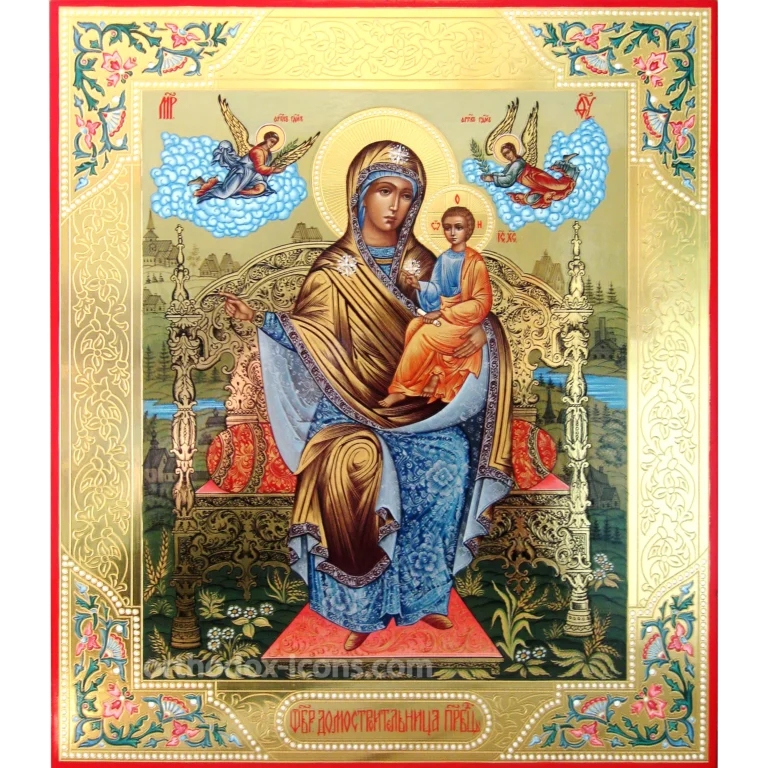
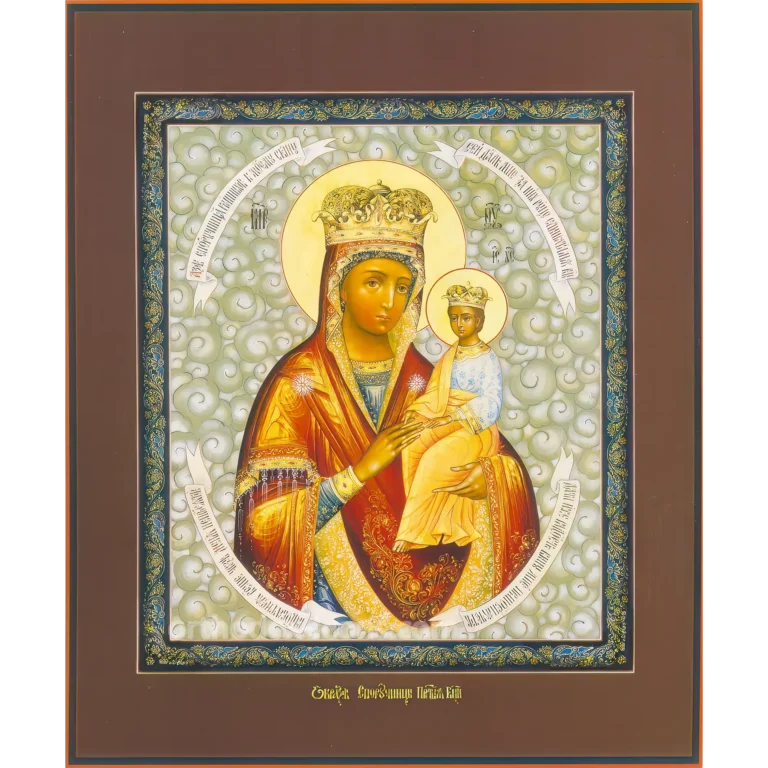
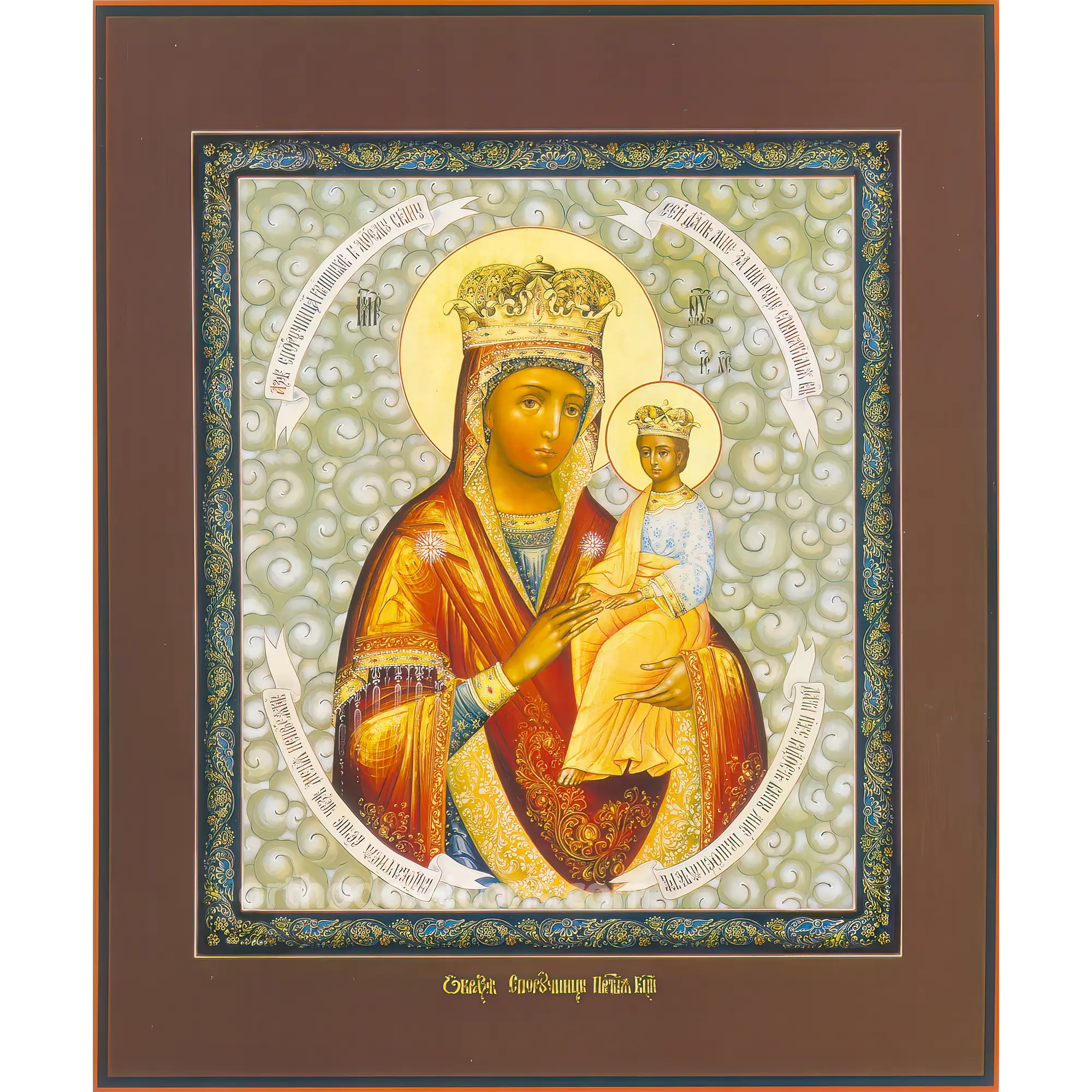
The Warrantress of the Sinful Orthodox Icon, also known as the Mother of God “Surety of Sinners,” is one of the most merciful and consoling icons of the Theotokos. The Christ Child holds the right hand of His Mother with both hands, a unique gesture understood as a pledge that He hears her intercession for repentant sinners. This hand-painted icon shows the Mother of God and Christ against a luminous cloud-filled background, with golden crowns, prayer scrolls, ornamental borders, mineral egg tempera, and 23K gold leaf details. Free international shipping is included; payment is due upon delivery.
It is possible to paint an image in any size to order
Free shipping worldwide
Among the many icons of the Most Holy Theotokos venerated in the Orthodox Church, the Warrantress of the Sinful Orthodox Icon stands out for its profound mercy and theological depth. The Russian title, “Sporuchnitsa greshnykh,” is difficult to translate with one smooth English phrase. It means “Surety of Sinners,” “Warrantress of Sinners,” or “the One who gives a pledge for sinners.” In spiritual terms, the Mother of God is shown as the intercessor who stands before Christ for those who are burdened by sin, weakness, fear, and despair.
The image is not sentimental in a shallow sense. It is an icon of hope for the person who has fallen, repented, and no longer knows how to approach God. The Theotokos does not replace Christ, but leads the faithful to Him. She asks her Son for mercy, forgiveness, healing, and salvation, and the icon expresses this intercession through one of the most touching gestures in Marian iconography.
This hand-painted version is made in the Mstyora tradition with a luminous academic manner of painting. The Mother of God and the Christ Child are set against a light, cloud-filled background. Golden crowns, fine ornament, prayer scrolls, and rich borders give the icon a solemn and consoling presence. It is intended for prayer, family devotion, and long-term use in a home icon corner, chapel, or church interior.
Warrantress of the Sinful Orthodox Icon – Meaning of the Title
The word “Warrantress” may sound unusual to modern English ears, just as the Russian word “Споручница” sounds somewhat archaic today. Its meaning is important. A surety is a person who takes responsibility for another, especially for someone in debt. In the spiritual sense, the Mother of God is shown as the one who intercedes before the righteous Judge, her Son Jesus Christ, for those who have sinned and seek mercy.
For Orthodox believers, this does not mean that sin is treated lightly. The icon speaks precisely to those who recognize their need for repentance. It offers not an excuse, but hope. The Theotokos is presented as a motherly intercessor who asks Christ to receive the repentant sinner, heal the wounded soul, and lead the person back into life with God.
History of the Icon
Unlike some ancient icons whose traditions reach back to the earliest Christian centuries, the well-known history of the Warrantress of the Sinful Icon begins in the middle of the nineteenth century. The first reliable accounts are connected with the Nikolaevsky Odrin Monastery, located in the Karachev district of the former Oryol province, in the area that is now connected with the Bryansk region.
According to the monastery records, an old and darkened icon of the Mother of God had long stood in neglect. It was so worn and dim from age that it was kept in an old wooden chapel near the holy gates of the monastery. Its origin was unknown, and for a time no one knew who had painted it or why it should be especially venerated.
In 1843, a remarkable change occurred. During the summer months, people from nearby villages began to receive dreams or inner visions that directed them to go to the Odrin Monastery and pray before the forgotten icon of the Mother of God called the Warrantress of the Sinful. The image was revealed as one filled with grace and wonder-working power.
Soon many pilgrims began to come to the monastery. The first officially recorded healing took place in 1844, when a paralyzed boy, the son of the merchant woman Pochepina, was healed after fervent prayer before the icon and washing with holy water. Not long afterward, a blind girl received her sight. News of the grace-filled image spread rapidly.
The monks reverently transferred the icon from the old chapel into the cathedral church and cleansed it from the dust of many years. As the darkened surface was cleaned, bright colors and the inscription connected with the title of the image became visible. The icon became especially famous during the cholera epidemic of 1848, when processions with the holy image were associated with the retreat of the deadly disease from whole towns. A large church with three altars was later built at the Odrin Monastery in honor of this icon.
Iconography and Central Gesture
The Warrantress of the Sinful belongs broadly to the Hodegetria type, the “She Who Shows the Way,” but it has several distinctive details that make it immediately recognizable. The Mother of God holds Christ, and the whole image points the faithful toward Him as the source of mercy and salvation.
The central detail is the gesture of the hands. The Christ Child sits on the left arm of the Virgin Mary, while with both of His small hands He firmly holds her right hand. In the ancient world, the clasping or taking of hands could symbolize a pledge, covenant, or solemn agreement. In this icon, the gesture is interpreted as Christ giving His Mother a divine pledge that He will hear her prayers for repentant sinners.
This gesture gives the icon its name and its spiritual force. The Theotokos intercedes, and Christ responds. The image therefore speaks with particular strength to those who feel unworthy, ashamed, spiritually exhausted, or afraid to approach God. It reminds them that repentance is not a closed door. The Mother of God prays, and Christ is merciful.
Visual Details of This Hand-Painted Icon
Another important feature of the icon is the golden crowns on the heads of the Theotokos and the Christ Child. These crowns point to their royal dignity: Christ as the heavenly King and the Mother of God as Queen of Heaven. In this hand-painted version, the crowns are rendered with fine golden assist, giving the impression of radiant jewels and carefully worked ornament.
The background is also distinctive. Instead of a plain gold field, the icon is painted with luminous white and blue clouds. This cloud-filled setting emphasizes the heavenly glory of Christ and the Mother of God. It gives the image a sense of air, light, and spiritual consolation, while remaining solemn and prayerful.
The maphorion of the Virgin Mary is painted in rich red and golden tones, with an ornamental border that recalls embroidered goldwork and fringe. The stars of her ever-virginity shine clearly on her shoulders. The garments of the Christ Child are painted in light blue and ocher tones with soft layered highlights. The icon fields are framed with refined blue and gold plant ornament that completes the composition without distracting from the holy figures.
Prayer Scrolls and Inscription
One of the most recognizable details of the Warrantress of the Sinful icon is the presence of scrolls floating in the background. They contain the words from which the title of the image comes. In Church Slavonic, the scrolls express the spiritual dialogue of the icon: the Mother of God is the surety of sinners before her Son, and Christ gives her the pledge that He will always hear her.
These scrolls are not decorative filler. They explain the theology of the image. The icon is a visible prayer about mercy, repentance, and intercession. The text, the hand gesture, the crowned figures, and the cloud-filled background all work together to show the same truth: the Mother of God does not abandon sinners who turn to God with repentance.
What People Pray For Before This Icon
Through this icon, Orthodox Christians ask the Theotokos for help in moments of deep spiritual need. The image is especially associated with prayers for forgiveness of sins, sincere repentance, and deliverance from destructive passions. People come before it when they feel trapped by old sins, addictions, despair, or spiritual darkness.
The icon is also connected with prayers for healing. Historically it became known through healings and through the retreat of epidemics. Today the faithful may pray before it for help in serious illnesses, infectious diseases, physical weakness, insomnia, loss of appetite, and difficult chronic conditions. As always in Orthodox prayer, the icon is not treated mechanically; healing is sought from God through faith, repentance, and the intercession of the Mother of God.
Many also pray before this image for deliverance from despondency and hopelessness. Its luminous cloud-filled composition and tender gesture between Christ and His Mother make it especially appropriate for those passing through grief, anxiety, depression, family sorrow, or a sense of spiritual abandonment.
Families may keep this icon as a prayer image for peace in the home, reconciliation between spouses, the return of those who have gone astray, the well-being of children, and the strengthening of love and patience within the household.
Materials and Mstyora Painting Technique
The icon is painted on a linden wood board prepared according to traditional methods. The board is strengthened from the back with inserted oak braces. This helps the wood remain stable as it responds naturally to changes in temperature and humidity.
Linen is applied to the front of the board, and up to fifteen layers of natural chalk gesso are laid over it. The ground is then carefully polished until it becomes smooth and firm. This prepared surface allows the painter to build fine layers of color and delicate transitions in the faces, garments, clouds, and ornament.
The painting is made with mineral egg tempera. The pigments are prepared from mineral colors, earths, and other traditional materials mixed with egg emulsion. The academic manner used for this icon requires layered translucent painting, allowing the faces to gain volume, the clouds to remain soft, and the garments to appear flowing and luminous.
Gold elements, including the crowns, assist, and ornamental details, are made with 23K gold leaf. In technical terms this corresponds to high-purity gold leaf of 960 purity, or 23K gold leaf. Unlike imitation metal leaf, real gold does not darken or oxidize in the same way, and it preserves its noble shine for many years when the icon is cared for properly.
Available Size
The available size is 27×31 cm (10.6×12.2 in). This is a classic size for a home icon corner. It allows the prayer scrolls, ornamental fields, crowns, and cloud-filled background to remain readable while still fitting comfortably in a domestic prayer space.
Larger formats, including 30×40 cm (11.8×15.7 in), may be discussed for a more ceremonial home placement or as a gift to a parish. Church and iconostasis sizes can also be considered individually, especially when the icon is intended for a chapel, shrine, or carved kiot.
Free international shipping is included; payment is due upon delivery.
Icon Characteristics
| Feature | Description |
|---|---|
| Iconographic type | Mother of God Warrantress of the Sinful, related to the Hodegetria type |
| Main meaning | Intercession for repentant sinners, mercy, forgiveness, and spiritual hope |
| Central gesture | The Christ Child holds the right hand of the Theotokos with both hands as a pledge of hearing her prayers |
| Board | Linden wood with linen, natural gesso, and inserted oak braces |
| Painting style | Academic Mstyora hand painting with layered highlights |
| Paints | Mineral egg tempera on a prepared gesso ground |
| Gold details | 23K gold leaf for crowns, assist, and ornamental accents |
| Background | Luminous white and blue cloud-filled painting |
| Available size | 27×31 cm (10.6×12.2 in) |
| Use | Home prayer, family devotion, healing prayers, repentance, spiritual consolation |
The Warrantress of the Sinful Orthodox Icon is a visible image of hope in the mercy of Christ and the intercession of His Mother. It is a fitting icon for anyone seeking forgiveness, healing, family peace, and a renewed trust that repentance is always possible before God.
Questions and Answers
What does the name Warrantress of the Sinful mean?
The title means that the Mother of God stands as a surety and intercessor for sinners before Christ, asking her Son for mercy, forgiveness, and salvation.
Is this icon also called Surety of Sinners?
Yes. In English this icon is often rendered as the Mother of God Surety of Sinners. The product title uses Warrantress of the Sinful, while the meaning is the same: the Theotokos intercedes for repentant sinners.
Why does the Christ Child hold the hand of the Theotokos?
This is the central symbolic detail of the icon. Christ holds the hand of His Mother with both hands, like a solemn pledge that He will hear her prayers for those who repent.
What is written on the scrolls in the icon?
The scrolls contain the Church Slavonic words connected with the title of the image: the Mother of God is named the surety of sinners before her Son, who grants her the pledge of always hearing her.
Where did the veneration of this icon become famous?
The history is especially connected with the Nikolaevsky Odrin Monastery in the Oryol region, where a neglected and darkened icon became known for miracles in the nineteenth century.
When is the feast of this icon celebrated?
The Orthodox Church commemorates this icon on March 20 and June 11 according to the new calendar, corresponding to March 7 and May 29 on the old calendar.
What are people accustomed to pray for before this icon?
People pray before this icon for forgiveness, repentance, healing from serious illness, help in despondency, deliverance from destructive passions, and peace within the family.
Why is the background painted with clouds?
The cloud-filled background belongs to the elevated academic manner of this image. It emphasizes the heavenly glory of Christ and the Mother of God and gives the icon a luminous, consoling character.
What size is available?
The available size is 27×31 cm (10.6×12.2 in). Larger formats, including 30×40 cm (11.8×15.7 in) and church sizes, can be discussed individually.
Is this icon hand-painted?
Yes. It is painted by hand on a prepared wooden board with mineral egg tempera and 23K gold leaf details, not printed or mechanically reproduced.
| Dimensions | 27x31cm (10.6×12.2 in) |
|---|---|
| Name | Mary |