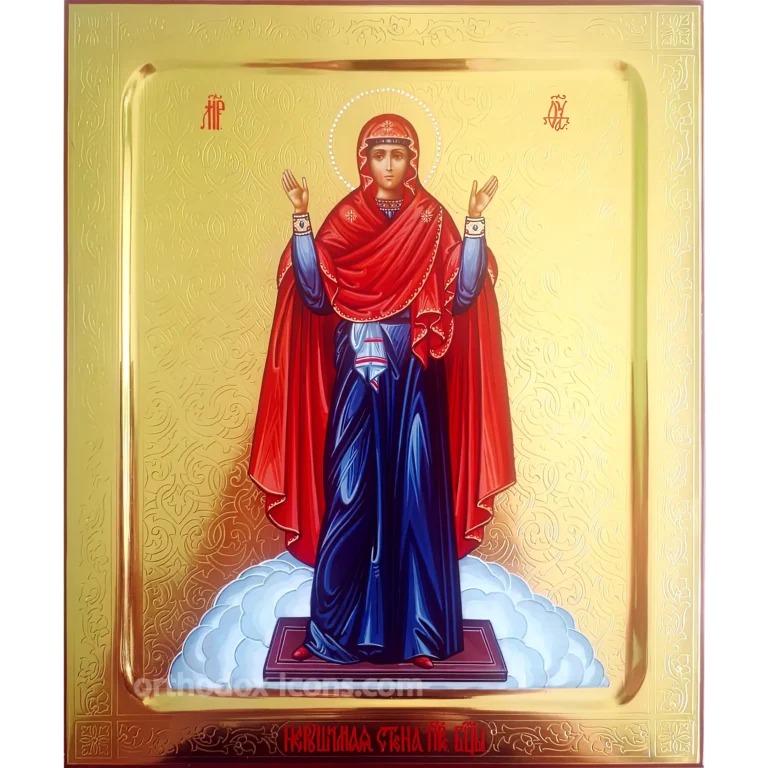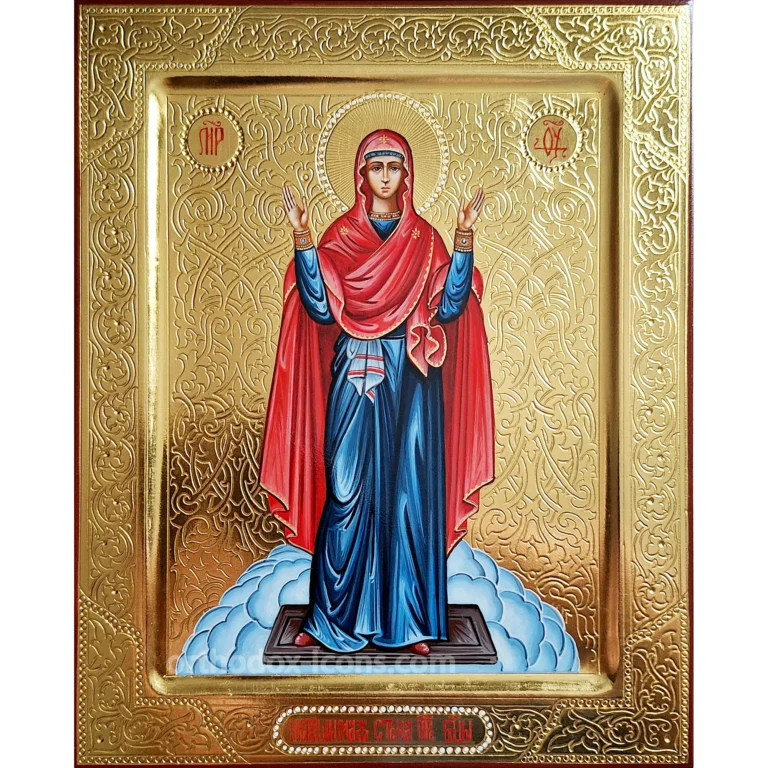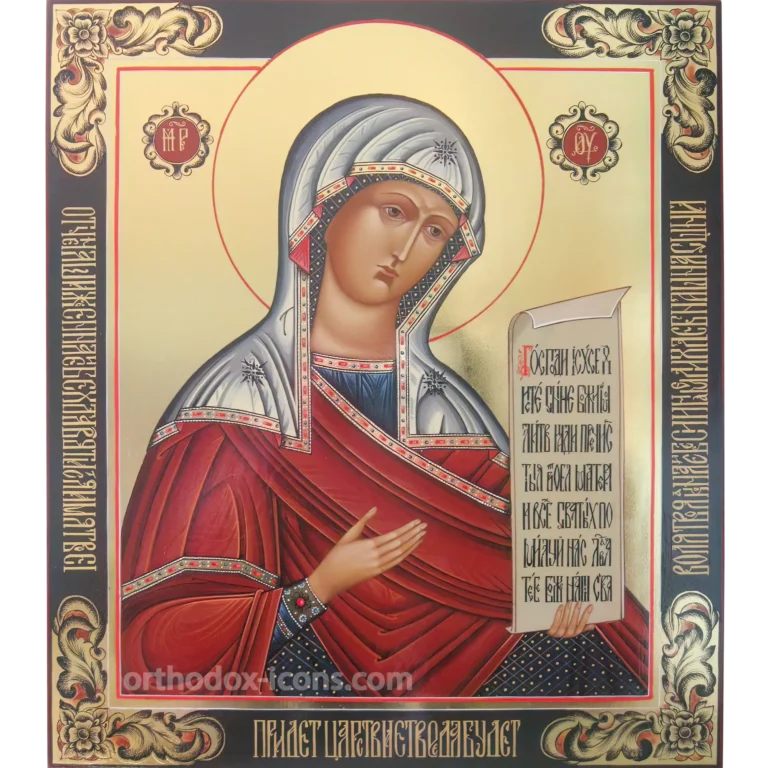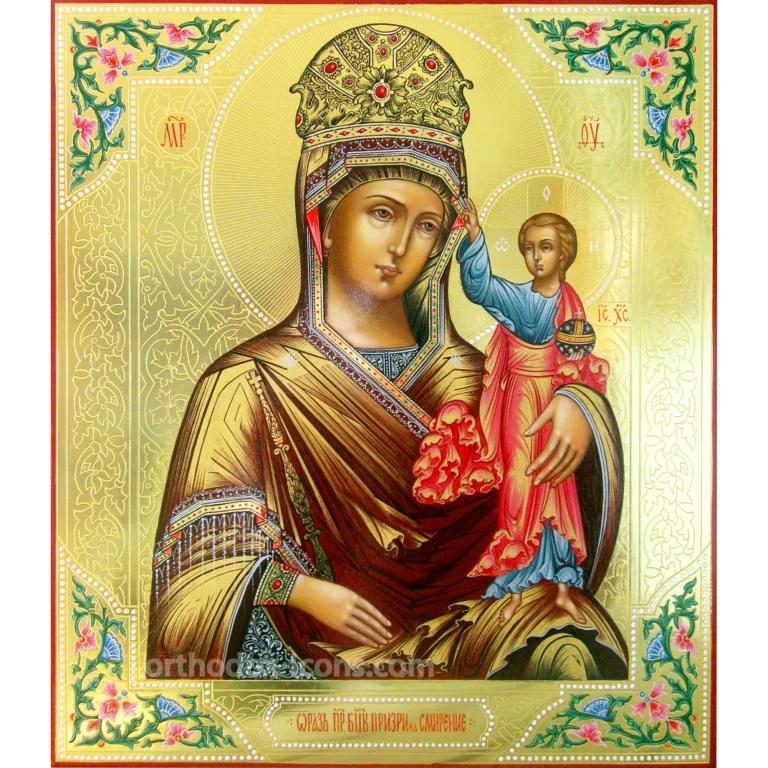
The Clouded Mount Orthodox Icon
$1600
Available size: 27×31 cm (10.6×12.2 in).
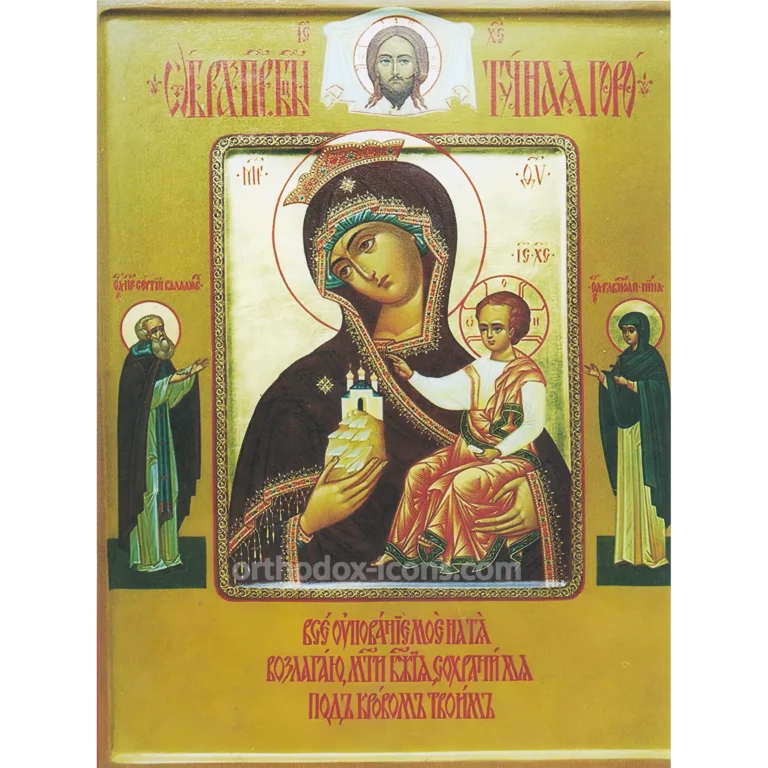
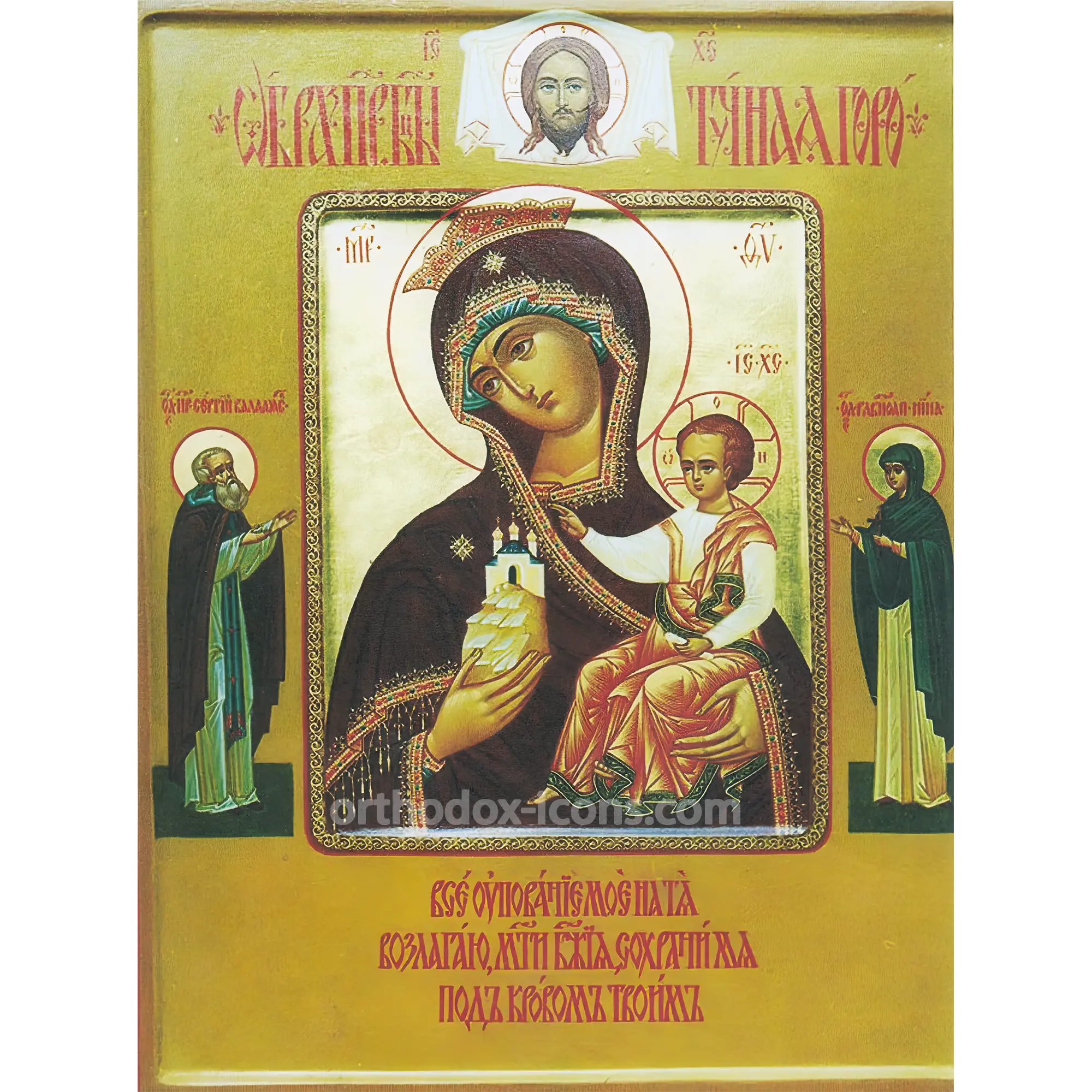
The The Clouded Mount Orthodox Icon is a rare and deeply symbolic Mother of God icon connected with Tver tradition. The Theotokos holds the Christ Child on her left arm and a rocky mountain crowned with a five-domed Orthodox church on her right hand. The composition refers to the prophecy of the ?mountain not cut by human hands,? understood in Orthodox tradition as a figure of the Virgin Mary and the Incarnation of Christ. This hand-painted icon includes Saint Sergius of Valaam and Holy Martyr Anastasia on the side fields, a dark cherry maphorion, the Holy Face of Christ above, 23K gold leaf background, gold assist, mineral egg tempera, and traditional Mstyora painting. Free international shipping is included; payment is due upon delivery.
It is possible to paint an image in any size to order
Free shipping worldwide
Among the many wonder-working images of the Mother of God, the The Clouded Mount Orthodox Icon occupies a rare and theologically rich place. It is not simply a portrait image of the Theotokos with the Christ Child. It is a complex iconographic confession, bringing together Old Testament prophecy, the mystery of the Incarnation, the image of the Church, and the merciful protection of the Mother of God.
The icon is known in Russian tradition as ?Tuchnaya Gora,? a phrase that may be understood as the ?Clouded,? ?Rich,? or ?Grace-filled Mountain.? The name points toward the biblical language of the holy mountain filled with divine grace. In Orthodox interpretation, this mountain is a figure of the Most Holy Theotokos, from whom Christ, the saving Stone, came into the world without human seed.
This hand-painted Mstyora icon preserves the distinctive details visible in the traditional composition. The Mother of God is shown with the Christ Child, while in her right hand she holds a rocky mountain crowned by a five-domed Orthodox church. The side fields show Saint Sergius of Valaam and Holy Martyr Anastasia standing in prayer. Above the central image is the Holy Face of Christ. The background is covered with 23K gold leaf, giving the icon a solemn liturgical brightness.
The Clouded Mount Orthodox Icon – History of the Image
The history of the Clouded Mount icon begins in seventeenth-century Tver. In one of the monasteries of Tver, an abbot undertook large repair works and hired a pious contractor named Kosma Volchaninov. Kosma worked honestly and skillfully, and when the repairs were completed, the abbot wished to thank him. He allowed Kosma to choose any icon from the monastery storeroom as a gift.
Among many old and dusty images, Kosma noticed an icon of the Mother of God lying face down. When he lifted it, he was struck by the unusual subject: the Mother of God held a mountain with an Orthodox church upon it. Kosma received the image with reverence and took it home. It became the chief family holy image of the Volchaninov household, passed from one generation to another as a treasured shrine.
Over time, however, reverence for the icon weakened in the family. One of Kosma’s descendants, careless toward holy things, removed the icon from the family prayer corner and put it away in a dusty attic. The first great miracle associated with the image is connected with this neglect. The wife of his son suffered harsh treatment from her husband and relatives. Driven to despair, she left the house with the intention of ending her life.
On the way, an unknown monk appeared to her. He asked where she was going, revealed her terrible intention, and commanded her to return home. He told her to take the Clouded Mount icon down from the attic, clean it, and pray before it, promising that the Mother of God would help her and that her life would become peaceful. The woman returned and told the family what had happened. The monk could not be found. The icon was brought down, cleaned, and a priest was invited to serve before it. From that day, according to tradition, peace gradually returned to the family.
Transfer to the Church and Veneration in Tver
For more than one hundred and fifty years, the Clouded Mount icon remained in the Volchaninov family. Later, the last heiress of the family, Ekaterina, married Georgy Konyaev and brought the icon with her. Georgy Konyaev lived to an advanced age and eventually decided to give the holy image to the Tver church of the Smolensk Icon of the Mother of God, where he was a parishioner.
He asked that a separate chapel be arranged for the icon. His request was connected with the location of the church on a height, a hill where people brought their belongings during floods. He desired that the Queen of Heaven, the Clouded Mount, would rest her grace upon that height and cover those buried and praying there with her mercy. On July 15, 1866, the icon was solemnly transferred to the new chapel.
From that time, the image became a focus of pilgrimage and prayer. Many miracles were attributed to the intercession of the Mother of God before this icon, especially healings of children from serious eye diseases. In gratitude, the faithful of Tver later made a massive gilded silver covering for the icon.
Biblical Meaning of the Holy Mountain
The theology of the Clouded Mount icon is rooted in the Old Testament, especially the prophecy of Daniel. The prophet interpreted the dream of King Nebuchadnezzar, who saw a great statue destroyed by a stone cut from a mountain without the help of human hands. The Fathers of the Church understood this as a prophecy of the Incarnation: the mountain is the Most Holy Theotokos, and the stone is Christ, born of her without an earthly father.
The title also recalls the words of Psalm 67: ?The mountain of God is a rich mountain.? In Russian tradition this is connected with the phrase ?Tuchnaya Gora.? In this sense, the Mother of God is the grace-filled mountain, filled with the presence of the Holy Spirit and chosen for the birth of the Savior.
On the icon, the Theotokos is shown half-length. Her royal crown and dark cherry maphorion emphasize her dignity as Queen of Heaven. Her gaze is directed both toward the person praying and toward the mountain in her hand. On the summit of that rocky mountain stands a five-domed Orthodox church. The church symbolizes the New Testament Church of Christ, founded upon Christ Himself.
The Christ Child is supported by the left hand of the Mother of God. His right hand is raised in blessing, directed toward the church on the mountain, as if showing the way of salvation. In His left hand He holds a rolled scroll, a sign of divine teaching.
Saints in the Side Fields
In this hand-painted version, the side fields contain praying saints who give the icon a deeply personal and intercessory character. On the left is Saint Sergius of Valaam, the wonderworker and one of the founders of the ancient Transfiguration Monastery on Valaam, shown in monastic vestments. On the right is Holy Martyr Anastasia, shown in dark green covering and light garments, standing in prayer before the Mother of God.
The presence of Saint Sergius of Valaam strengthens the prayerful theme of inner peace, ascetic struggle, and spiritual firmness. The image of Holy Martyr Anastasia recalls endurance in trials, patience, and faithfulness to Christ under suffering. Together, the saints stand before the Theotokos, turning the icon into a many-layered prayer for family life, faith, healing, and protection.
Artistic Details of This Hand-Painted Icon
The background of the icon is richly covered with 23K gold leaf, corresponding to the high-purity gold leaf traditionally used by the workshop. The gold signifies divine light and gives the image a solemn liturgical brightness.
The maphorion of the Theotokos is painted in a deep, dark cherry color and is richly decorated with gold assist and a precious-looking border. These details emphasize her royal dignity and the beauty of the heavenly realm. Above the head of the Mother of God, in a special cartouche, appears the Holy Face of Christ, also known as the Image Not Made by Hands. Beneath it, the title ?Clouded Mount? is traditionally written in large Slavonic lettering.
The faces of the Mother of God, the Christ Child, and the accompanying saints are painted in a strict canonical manner with fine layered highlights. The mountain, the church, the garments, the inscriptions, and the side saints all serve the theological meaning of the icon rather than functioning as mere decoration.
What People Pray For Before the Clouded Mount Icon
The history of the icon has shaped its prayerful meaning. Orthodox Christians turn to the Clouded Mount image in difficult and seemingly hopeless circumstances. It is especially connected with prayer for deliverance from despair, oppressive fear, and thoughts of self-harm. The story of the suffering young woman saved from a fatal decision gives this icon particular significance for those who feel that life has become unbearable.
The icon is also connected with prayers for the preservation of family life. People pray before it for help in situations of harshness, domestic cruelty, loss of love, and approaching divorce. The Mother of God is asked to soften hearts, restore respect, and bring peace where anger and humiliation have taken root.
Parents and spouses also pray before this icon for those who have wandered into destructive habits, harmful company, or addictions. In the Tver tradition, the icon became known for healings, especially of eye diseases in children, and it is also approached in prayer for healing from serious physical and spiritual illnesses.
Because Saint Sergius of Valaam and Holy Martyr Anastasia are shown on the side fields, the icon also carries a prayerful emphasis on spiritual steadfastness, endurance in trials, and faith that remains firm under pressure.
Materials and Mstyora Technique
The icon is made on a carefully prepared linden board. The back is strengthened with inserted oak braces to help protect the board from warping. Linen is applied to the front surface, and 10 to 15 layers of natural chalk gesso are built up and polished to form a smooth and stable ground.
The background and gold details are gilded by hand with 23K gold leaf. The painting is done with mineral egg tempera, prepared from ground mineral pigments on an egg emulsion. These traditional paints are valued for their durability, depth, and noble aging. The faces are painted with fine layered highlights, while the gold ornament on the garments is made with assist.
Available Size
The available size is 27×31 cm (10.6×12.2 in). This classic home size gives the icon painter enough space to show the church on the mountain, the faces of Saint Sergius of Valaam and Holy Martyr Anastasia, the inscriptions, and the gold details clearly. Larger 30×40 cm (11.8×15.7 in) and church formats can be discussed individually for a chapel, kiot, or iconostasis setting.
Free international shipping is included; payment is due upon delivery.
Icon Characteristics
| Feature | Description |
|---|---|
| Iconographic type | Hodegetria-related Mother of God icon known as the Clouded Mount |
| Main symbol | Rocky mountain with a five-domed church held by the Theotokos |
| Side saints | Saint Sergius of Valaam and Holy Martyr Anastasia |
| Board | Linden wood with linen, natural gesso, and inserted oak braces |
| Painting | Mineral egg tempera in the Mstyora tradition |
| Gold | 23K gold leaf background, halos, and gold assist on garments |
| Available size | 27×31 cm (10.6×12.2 in) |
| Prayer use | Consolation in despair, family peace, strengthening of faith, endurance in trials, and healing prayers |
The The Clouded Mount Orthodox Icon is a rare and powerful image of the Mother of God as the grace-filled mountain from whom Christ came into the world. It is a fitting icon for prayer in family trials, spiritual heaviness, illness, and the search for firm hope in God.
Questions and Answers
Why is this icon called The Clouded Mount?
The name refers to biblical images of the holy mountain filled with grace, especially Psalm 67 and the prophecy of Daniel about the stone cut from the mountain without human hands.
What does the mountain in the hand of the Theotokos mean?
The mountain is a symbol of the Mother of God and of the New Testament Church. The church on the mountain points to Christ as the foundation and place of salvation.
Who are the saints shown beside the Mother of God?
In this hand-painted version the side fields show Saint Sergius of Valaam and Holy Martyr Anastasia standing in prayer before the Theotokos.
What is shown above the head of the Theotokos?
Above the head of the Mother of God, the Holy Face of Christ is shown in a special cartouche, adding another Christ-centered layer to the composition.
What is the historical origin of this icon?
The history is connected with Tver in the seventeenth century, the contractor Kosma Volchaninov, and a family icon that later became known for miraculous help.
What are people accustomed to pray for before this icon?
People pray before this icon for help in despair, preservation of family peace, healing of illnesses, strengthening of faith, and protection in difficult circumstances.
When is this icon commemorated?
The Russian tradition gives three commemorations: April 6, July 29, and November 20 according to the new calendar.
What materials are used?
The icon is painted on a linden board prepared with linen and natural gesso, using mineral egg tempera and 23K gold leaf.
What size is available?
The available size is 27×31 cm (10.6×12.2 in). Larger 30×40 cm (11.8×15.7 in) and church formats can be discussed individually.
Do you ship internationally?
Yes. Free international shipping is included, and payment is due upon delivery.
| Dimensions | 27x31cm (10.6×12.2 in) |
|---|---|
| Name | Mary |