Icon of the Despairing
$3750
Icon of the Despairing, also known as the Mother of God “Of the Despairing, One Hope,” is a hand-painted Orthodox icon in an academic, painterly style.
Available size: 30×50 cm (11.8×19.7 in). Larger church and iconostasis sizes may be discussed before painting.
Materials: solid linden board with inset oak braces, linen pavoloka, polished chalk levkas, layered painting, 23K gold leaf, and protective finish.
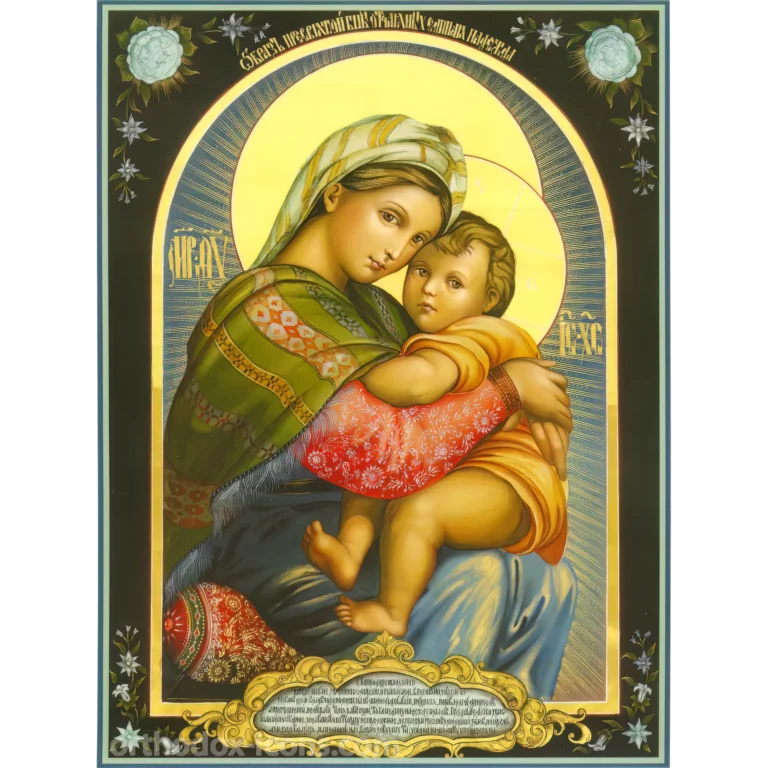
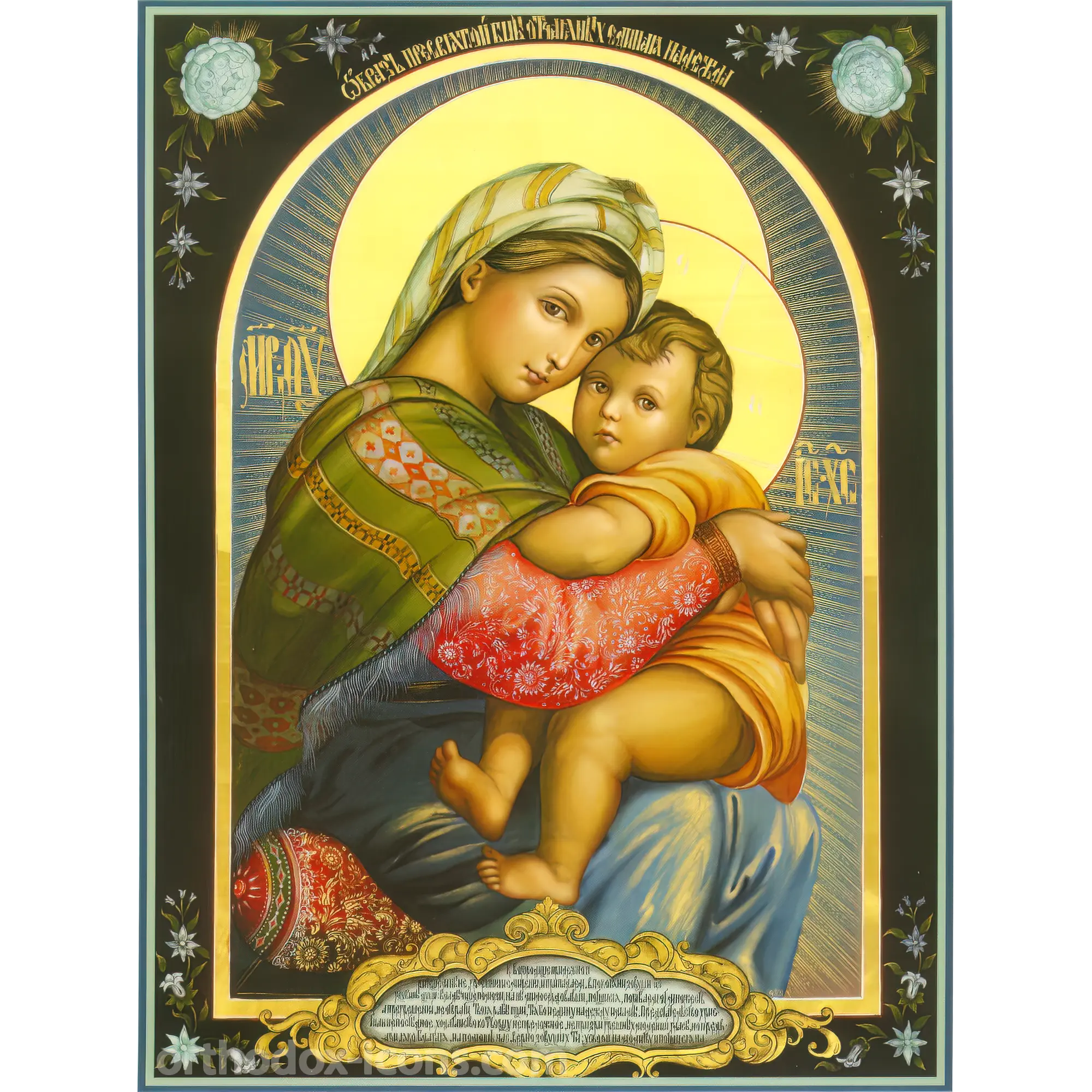
Image: the Virgin Mary tenderly embraces Christ, surrounded by a radiant golden mandorla, white flowers, dark olive background, and a lower prayer cartouche.
It is possible to paint an image in any size to order
Free shipping worldwide
Icon of the Despairing is the English page title for the deeply moving icon of the Mother of God known in Russian as “Of the Despairing, One Hope.” Among the many venerated images of the Queen of Heaven, this icon stands out for its direct name and unusual, memorable iconography.
The name itself expresses the heart of the image. The Mother of God is shown as the last and faithful hope for those who feel that every earthly door has closed, whose strength is exhausted, and whose soul longs for mercy, consolation, and help from above.
The presented hand-painted icon is made in an academic, painterly church style on a solid linden board with inset oak braces. It is prepared with linen pavoloka and polished chalk levkas, painted in a layered manner, decorated with 23K gold leaf, and finished with a protective coating. The listed size is 30×50 cm (11.8×19.7 in).
Brief Description of the Icon
- Name: Icon of the Despairing
- Traditional title: Mother of God “Of the Despairing, One Hope”
- Iconographic type: Eleusa, or Tenderness, in an academic painterly style
- Main meaning: hope, consolation, mercy, maternal intercession, and spiritual refuge
- Available size: 30×50 cm (11.8×19.7 in), with larger formats by agreement
- Suitable for: home prayer, family shrine, chapel, church, and a meaningful Orthodox gift
On the icon, the Virgin Mary tenderly embraces the Christ Child. Her bright face, framed by a light patterned veil, is filled with love and compassion. Around the figures is a dazzling golden mandorla with rays, cutting through the surrounding dark olive background and turning the whole composition into an image of light in darkness.
The color palette is rich and expressive. Emerald tones in the garments of the Mother of God contrast with the fiery yellow chiton of Christ. White flowers in the corners, the golden prayer cartouche in the lower part, and the luminous gilded field give the image a solemn yet warm character.
History: The Cell Icon of St. Amphilochius
The history of the Mother of God “Of the Despairing, One Hope” is unusual because it does not reach back into remote Byzantine or ancient Russian antiquity. The image appeared comparatively recently, in the twentieth century, most likely on the territory of Ukraine. The name of the first painter has not been preserved.
The later history of the icon is closely connected with St. Amphilochius of Pochaev, known in the world as Yakov Holovatyuk. He endured severe persecutions, imprisonment, and suffering during the years of anti-religious rule, and was revered by many faithful people as a healer, comforter, and elder of spiritual insight.
Many people who were sick, wounded in soul, or deeply distressed came to him in the Pochaev Lavra and later in his native village of Mala Ilovytsia. In the cell of this holy elder stood the icon “Of the Despairing, One Hope.” It was painted on canvas and placed with care in a carved gilded kiot.
Photographs from the elder’s lifetime show him praying fervently before this very image. Understanding the limits of human strength, he entrusted the gravely ill and despairing to the care of the Queen of Heaven, praying before her icon as before the One Hope of those whom no earthly help could reach.
After the elder’s repose, the icon continued to be widely venerated. The faithful associated sincere prayer before this image with consolation, peace of soul, and help in grave trials. On September 25, 2018, the Holy Synod of the Ukrainian Orthodox Church glorified the icon among locally venerated holy images and appointed its feast for November 18, or November 5 according to the old calendar.
Iconography: Light in Darkness
The presented hand-painted version of the Icon of the Despairing is a striking example of academic, painterly church art. This style was shaped under the influence of Western European painting, but in Russian church art it acquired a deeply Orthodox and devotional tone.
Iconographically, the image belongs to the Eleusa, or Tenderness, type. Its central theological idea is the boundless love and unity between the Mother and the Christ Child. The composition is unusual and highly symbolic.
The Virgin Mary is not shown in a traditional strict dark maphorion that fully covers the figure. Instead, a light patterned veil with golden ornament lies over her curling hair. This detail gives the image a special nearness to the person praying before it, emphasizing maternal openness, tenderness, and compassion.
The Christ Child, dressed in a bright yellow chiton with red sleeves and fine white ornament, presses trustingly to His Mother and embraces her around the neck with His left arm. This gesture gives the image its emotional warmth and expresses trust, protection, and the sheltering love of the Theotokos.
The background is especially important. The Mother of God and Christ are placed at the center of a radiant golden mandorla from which thin straight rays extend outward. This strong divine light cuts through the dark olive, almost black surrounding field. The contrast carries the main theological message of the image: Christ and His Mother are shown as saving light able to pierce the darkness of despair, sin, and spiritual loneliness.
White Flowers and Prayer Cartouche
In the corners of the dark background, the painter placed graceful white flowers, understood as roses or lilies. They symbolize purity, paradisal beauty, spiritual fragrance, and the unfading grace of the Queen of Heaven.
In the lower part of the icon, directly beneath the figures, is a shaped golden cartouche. Inside it, a prayer or hymn to the Mother of God “Of the Despairing, One Hope” is written in ornate Slavonic lettering. This makes the icon not only an image for veneration, but also a visible call to prayer and repentance.
The saturated palette of emerald green, deep blue, fiery red, and gold creates an impression of royal richness, while the tenderness of the figures gives the icon a warm, deeply personal character.
Spiritual Meaning and Prayer
In Orthodox ascetic teaching, despair and despondency are among the most dangerous states of the soul, because they obscure faith in God’s providence and mercy. In such moments, a person may need not only words of encouragement, but a living reminder of divine compassion and maternal intercession.
The Icon of the Despairing becomes such a reminder. Its painterly style has a consoling quality: the soft, living, compassionate features of the Mother of God are perceived not as distant severity, but as the face of a merciful Mother who understands human pain.
Before this icon, the faithful pray in situations of extreme need, grief, illness, family conflict, dependency, fear, spiritual confusion, and loss of hope. The icon does not replace necessary human care, medical help, or pastoral guidance, but it gives the praying person a sacred focus for turning the heart toward God and the intercession of the Theotokos.
- For consolation: peace of soul in sorrow, anxiety, loneliness, and heavy trials.
- For healing and strength: help for the sick and for those preparing for difficult treatment or surgery.
- For freedom from destructive habits: prayer for loved ones struggling with alcohol, drugs, gambling, or other dependencies.
- For reconciliation: softening of hearts in family conflicts, disputes, and long-standing hostility.
- For faith: strengthening of those whose faith has weakened or who are searching for the right spiritual path.
Mstyora Painting Tradition and Materials
Creating such a complex, multicolored, and emotionally rich image requires a high level of artistic skill and knowledge of traditional techniques. The icon is painted by hand, with careful attention to the faces, the folds of the garments, the golden ornaments on the veil, the white flowers, and the fine text in the lower cartouche.
The process begins with a solid linden wood board. Linden is valued for icon painting because it has an even structure and receives the ground and paint layers well. Inset oak braces are placed into the back of the board to help protect it from bending as temperature and humidity change.
The front surface is covered with linen pavoloka and many layers of natural chalk levkas. Each layer is dried and polished by hand until the surface becomes smooth and stable. This traditional ground supports the durability of the painting and gives the colors clarity.
The painting is executed in a layered technique suitable for an academic church image, with soft transitions of light and shadow, careful modeling of the faces, and detailed ornamental work. The luminous mandorla and decorative elements are made with genuine 23K gold leaf, which does not oxidize like imitation metal leaf and preserves its warm brightness with proper care.
A protective finish is applied at the end to help preserve the paint layer from dust, moisture, and light exposure. For long-term protection, a wooden kiot with glass is especially appropriate for an icon of this size and level of detail.
Icon Characteristics
| Name | Icon of the Despairing |
|---|---|
| Traditional title | Mother of God “Of the Despairing, One Hope” |
| Iconographic type | Eleusa, or Tenderness, in academic painterly style |
| Main meaning | Hope, consolation, maternal intercession, and spiritual refuge in severe trials |
| Historical connection | Associated with St. Amphilochius of Pochaev |
| Board | Solid linden wood board with inset oak braces |
| Preparation | Linen pavoloka and multi-layer polished chalk levkas |
| Painting | Layered academic church painting; tempera/oil technique according to the chosen execution |
| Gold and decoration | 23K gold leaf (960 purity), radiant mandorla, white flowers, and lower prayer cartouche |
| Available size | 30×50 cm (11.8×19.7 in) |
| Larger formats | Church and iconostasis sizes may be discussed before painting |
| Purpose | Home prayer, family shrine, chapel, church, memorial or consolation gift |
| Shipping | Free international shipping is included; payment is due upon delivery. |
Questions and Answers
What does the name Icon of the Despairing mean?
The name means that the Mother of God is venerated as the one hope and faithful refuge for people who feel they have exhausted their own strength and earthly help.
What is the fuller title of this icon?
The fuller traditional title is Mother of God “Of the Despairing, One Hope.” On the English page it is presented as Icon of the Despairing, following the product H1.
What style is this icon painted in?
This icon is painted in an academic, painterly church style. It uses softer modeling, light and shadow, emotional warmth, and rich color while keeping a devotional Orthodox purpose.
Who is connected with the history of this icon?
The history of the icon is closely connected with St. Amphilochius of Pochaev, whose cell contained this image and who prayed before it for the sick, suffering, and despairing.
Why is the Mother of God shown with a light patterned veil?
In this academic version, the Mother of God is not shown in a strict dark maphorion. The light patterned veil and visible hair give the image a warmer, more intimate, and compassionate character.
What does the golden mandorla symbolize?
The radiant golden mandorla around the Mother of God and Christ symbolizes divine light breaking through the dark background, a visual sign of hope, mercy, and consolation.
What do the white flowers in the corners mean?
The white flowers, often understood as roses or lilies, symbolize purity, paradisal beauty, spiritual fragrance, and the unfading grace of the Queen of Heaven.
What is written in the lower cartouche?
The lower golden cartouche usually contains a prayer or hymn addressed to the Mother of God “Of the Despairing, One Hope,” making the icon itself a visible call to prayer.
What size is listed for this icon?
The listed size is 30×50 cm (11.8×19.7 in). Larger formats may be discussed, especially for a church, chapel, or iconostasis setting.
Is free international shipping included?
Yes. Free international shipping is included; payment is due upon delivery. The icon is painted to order and packed carefully after completion.
| Dimensions | 30x50cm (11.8×19.7 in) |
|---|---|
| Name | Mary |