Kupyatich Icon of the Mother of God
$1100
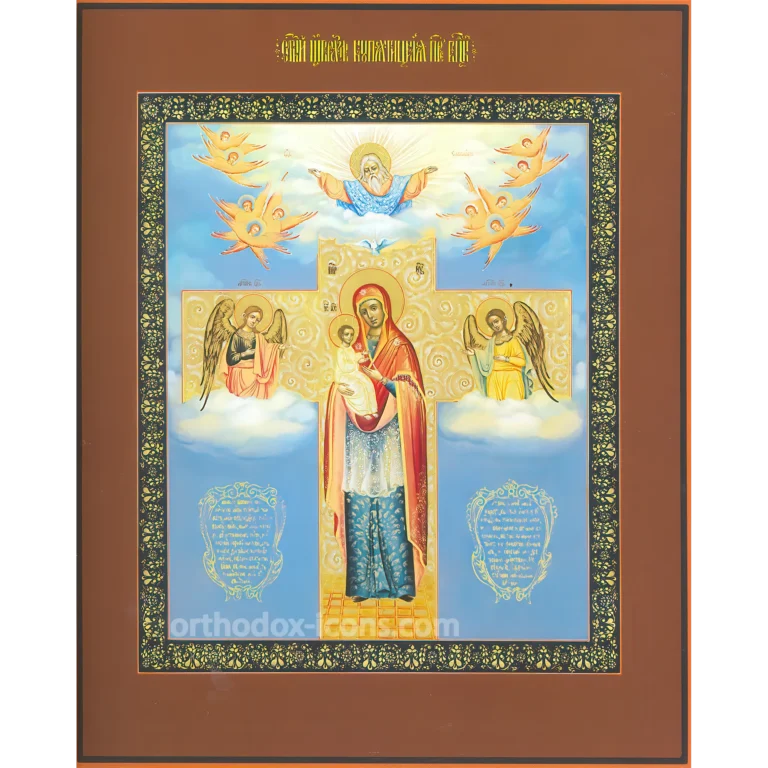
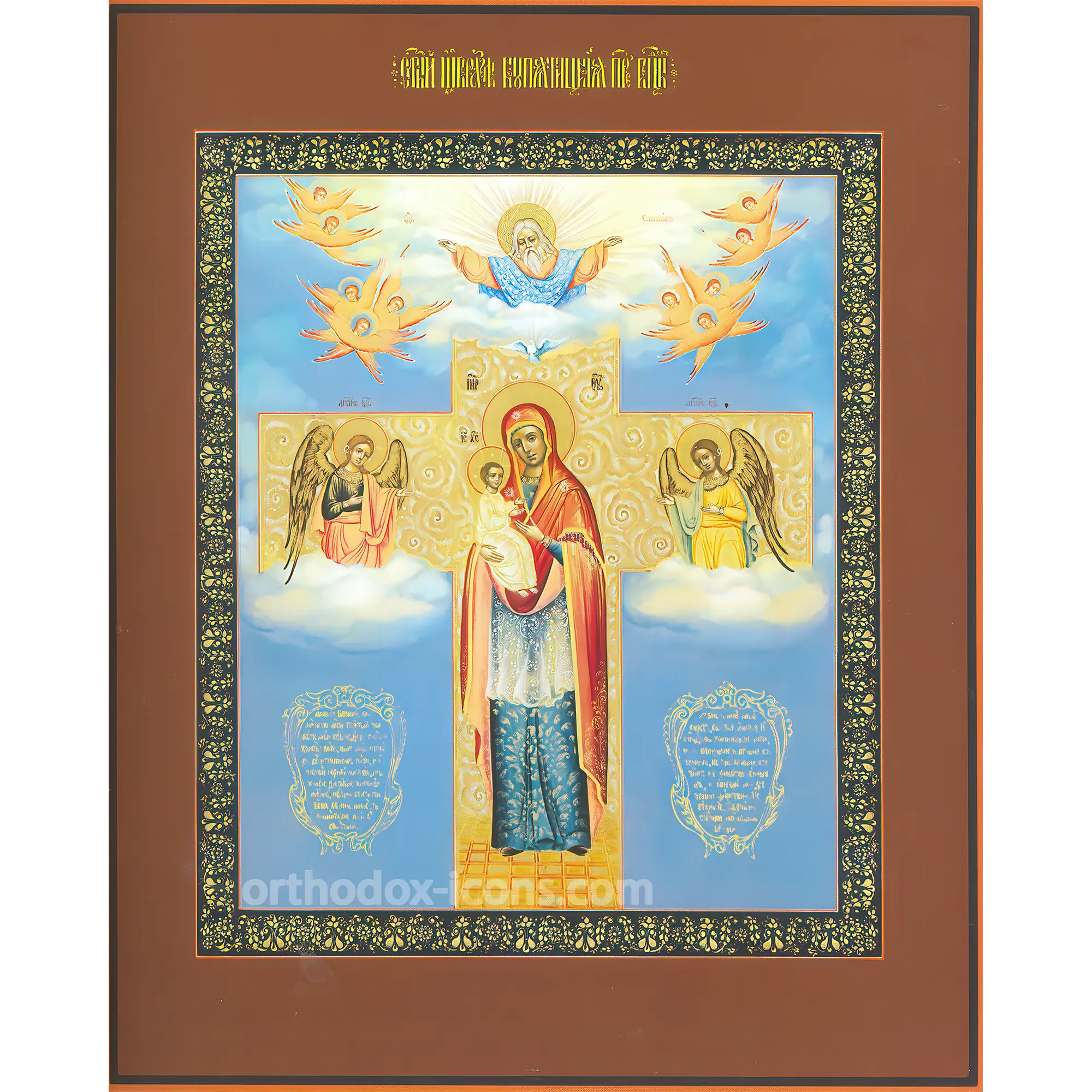
Kupyatich Icon of the Mother of God is a rare hand-painted Orthodox icon in which the Theotokos and Christ are shown within a radiant golden cross.
Available size: 27×31 cm (10.6×12.2 in). Larger church and iconostasis sizes may be discussed before painting.
Materials: linden wood board with inset oak braces, linen pavoloka, polished chalk levkas, mineral egg tempera, 23K gold leaf, and protective finish.
Composition: Hodegetria within a cross-enkolpion form, blue sky, clouds, kneeling angels, God the Father above, the Holy Spirit as a dove, and golden prayer cartouches.
It is possible to paint an image in any size to order
Free shipping worldwide
Kupyatich Icon of the Mother of God occupies a very special place among Orthodox holy images. It is not a usual painted image of the Queen of Heaven, but a rare cross-shaped iconography in which the maternal intercession of the Theotokos and the saving power of the Cross are joined in one composition.
The icon unites two central Christian symbols: the sacrifice of Christ on the Cross and the prayerful protection of the Most Holy Mother of God. Its bright blue background, radiant golden cross, clouds, angels, and sacred figures create an atmosphere of solemn prayer and quiet reverence.
The presented hand-painted icon is made on a linden wood board with inset oak braces, prepared with linen pavoloka and polished chalk levkas, painted with natural mineral egg tempera, and decorated with 23K gold leaf. The listed size is 27×31 cm (10.6×12.2 in), with larger and iconostasis formats available by agreement.
Brief Description of the Kupyatich Icon
- Name: Kupyatich Icon of the Mother of God
- Iconographic type: Hodegetria, She Who Shows the Way, placed within a cross-enkolpion form
- Main meaning: the Cross of Christ, the intercession of the Mother of God, protection, healing, and strengthening in faith
- Historical origin: the miraculous finding of a small copper cross-icon in Polesia in the twelfth century
- Available size: 27×31 cm (10.6×12.2 in), with larger formats by agreement
- Suitable for: home prayer, family shrine, chapel, church, or iconostasis
The central element of the composition is a massive golden cross floating in a bright blue sky among white, rolling clouds. The surface of the cross is covered with delicate shadow ornament that resembles precious metalwork, tooled gold, or an ornate church covering.
In the center of the cross, the Most Holy Theotokos is shown full-length in the Hodegetria type. She wears a scarlet maphorion and a dark blue chiton decorated with golden stars, and holds the Christ Child on her left arm.
History: The Miracle in the Polesia Forests
The history of the Kupyatich icon is a story of divine providence. According to ancient traditions and the account recorded by the monk Athanasius Kalnofoysky in the Teraturgima of 1638, the image was revealed in 1182, or according to another account in 1180, in the forests of Pinsk Polesia near the village of Kupyatichi on the Yaselda River, in the territory of present-day Belarus.
The first person to find the shrine was a simple six-year-old peasant girl named Anna. While tending her father’s herd, she noticed an unusual, unearthly light in the thick branches of a tree. Coming closer, she found the source of the radiance: a small cast copper cross-enkolpion, about twelve centimeters long.
On one side of the cross was a relief image of the Mother of God with the Christ Child, and on the reverse side was the Crucifixion. Anna took the cross reverently and hurried home to show it to her father, but when she arrived, the cross had disappeared. Returning to the pasture, she again saw the light in the same tree and found the shrine once more.
When the cross disappeared a second time after being brought home, Anna and her father went together to the tree. Seeing the miracle with their own eyes, the villagers reported it to the local priest. A wooden church dedicated to the Entrance of the Mother of God into the Temple was built at the place of the finding, and the Kupyatich cross-icon was placed there.
Centuries later, at the end of the fifteenth century, the church was burned during Tatar raids. The shrine, however, was not destroyed by fire. It was found again by a pilgrim named Joachim, returning from Jerusalem, who saw light on the ashes and discovered the copper cross unharmed. The church was rebuilt, and later the Kupyatich monastery arose there.
Unique Iconography: The Mother of God in the Cross
This hand-painted version of the Kupyatich icon shows how the ancient three-dimensional form of a reliquary cross could be reinterpreted on a wooden icon board. The result is a complex and theologically rich composition.
The Mother of God is shown within the cross itself. This is not a decorative invention, but a direct reference to the original cross-enkolpion. The Hodegetria gesture points to Christ as the true way, while the cross surrounding the image proclaims the saving sacrifice of the Lord.
On the side arms of the cross, kneeling angels stand in the clouds with hands folded in prayer. Above the cross the heavens open, and God the Father is shown blessing the world, surrounded by fiery seraphim. From Him the Holy Spirit descends as a white dove toward the head of the Theotokos.
The lower part of the icon is also full of meaning. To the left and right of the base of the cross are two shaped golden cartouches, usually inscribed in Slavonic lettering with prayers, troparia, or kondakia dedicated to the Kupyatich Mother of God.
The whole heavenly scene is enclosed in a strict dark-brown frame with a wide inner border richly painted with golden floral ornament. This creates the impression of a precious church covering or ornate filigree frame.
Prayer and Spiritual Meaning
The Kupyatich icon has long been venerated as the Protectress of the Polesia land, but the memory of its help extends beyond one region. The faithful pray before this image for the intercession of the Mother of God in illness, danger, travel, family trials, and moments when faith needs strengthening.
- For healing: prayer for those suffering in soul or body, with trust in the mercy of God and the intercession of the Theotokos.
- For protection: help in danger, protection from visible and invisible enemies, and prayer for those traveling by land or sea.
- For motherhood: prayer for safe childbirth, children’s health, and the gift of children.
- For faith: strengthening in Orthodox faith, softening of hardened hearts, and help in doubt or despondency.
Because the image is an icon-cross, it brings together the sign of the Life-giving Cross and the maternal protection of the Mother of God. This gives the composition a serious and strongly devotional character.
Mstyora Materials and Painting Technique
A detailed image such as the Kupyatich icon requires careful handwork and traditional icon-painting technique. The base is a well-dried solid linden board. Inset oak braces are placed into the back of the board to help prevent deformation as humidity and temperature change.
Linen pavoloka is applied to the front surface, followed by many layers of natural chalk levkas. After careful hand polishing, the levkas becomes a smooth, bright ground suitable for fine painting and gilding.
The shining cross, ornamental borders, cartouches, and halos are made with genuine 23K gold leaf. Unlike imitation metal leaf, high-purity gold does not oxidize or darken in normal conditions and keeps its warm internal glow with proper care.
The painting is executed with natural mineral egg tempera in the Mstyora tradition. This technique allows a clear sky-blue background, rich but restrained color, delicate modeling of the faces, and fine detail in the clouds, angels, ornaments, and sacred inscriptions.
Icon Characteristics
| Name | Kupyatich Icon of the Mother of God |
|---|---|
| Iconographic type | Hodegetria, She Who Shows the Way, within a cross-enkolpion form |
| Main meaning | The Cross of Christ, intercession of the Mother of God, protection, healing, and strengthening in faith |
| Historical origin | Miraculously found near Kupyatichi in Pinsk Polesia in the twelfth century |
| Board | Solid linden wood board with inset oak braces |
| Preparation | Linen pavoloka and multi-layer natural chalk levkas |
| Painting | Natural mineral egg tempera, layered Mstyora painting |
| Gold and decoration | 23K gold leaf (960 purity) on the cross, ornaments, cartouches, and halos |
| Composition details | God the Father, the Holy Spirit as a dove, angels, seraphim, clouds, and golden cartouches |
| Available size | 27×31 cm (10.6×12.2 in) |
| Larger formats | Church and iconostasis sizes may be discussed before painting |
| Purpose | Home prayer, family shrine, chapel, church, and iconostasis |
| Shipping | Free international shipping is included; payment is due upon delivery. |
Questions and Answers
Why is the Mother of God shown inside a cross?
This rare iconography comes from the history of the original Kupyatich shrine, which was a small cast copper cross-enkolpion with a relief image of the Mother of God and Christ on one side and the Crucifixion on the other.
Where and when was the Kupyatich icon found?
According to tradition, the icon was revealed in 1182, or according to another account in 1180, near the village of Kupyatichi in the Pinsk Polesia region, now in Belarus.
Who first found the Kupyatich cross-icon?
The shrine was found by a six-year-old peasant girl named Anna, who saw an unearthly light in the branches of a tree while tending her father’s herd.
What iconographic type is the Mother of God in this image?
The Mother of God is shown as Hodegetria, She Who Shows the Way. She holds Christ on her left arm within the form of the radiant cross.
Who is shown above the cross?
At the top of the icon, heaven opens and God the Father is shown blessing the world, surrounded by fiery seraphim. The Holy Spirit descends as a white dove toward the Mother of God.
What are the golden cartouches at the bottom?
The golden shaped cartouches usually contain prayers, troparia, or kondakia written in Slavonic lettering and dedicated to the Kupyatich Mother of God.
What prayers are offered before the Kupyatich icon?
The faithful pray before this icon for strengthening in the Orthodox faith, protection in danger, help in travel, healing, peace of soul, and the intercession of the Mother of God.
What materials and gilding are used?
The icon is painted with mineral egg tempera on polished chalk levkas over linen pavoloka. The cross, ornaments, cartouches, and halos are gilded with 23K gold leaf.
What size is listed for this icon?
The listed size is 27×31 cm (10.6×12.2 in). Larger formats may be discussed, including church and iconostasis sizes.
Is free international shipping included?
Yes. Free international shipping is included; payment is due upon delivery. The icon is painted to order and packed carefully after completion.
| Dimensions | 27x31cm (10.6×12.2 in) |
|---|---|
| Name | Mary |