The Great M. Anastasia Icon
Price range: $500 through $1350
Available sizes: 13×25 cm (5.1×9.8 in), 18×31 cm (7.1×12.2 in), 30×50 cm (11.8×19.7 in)
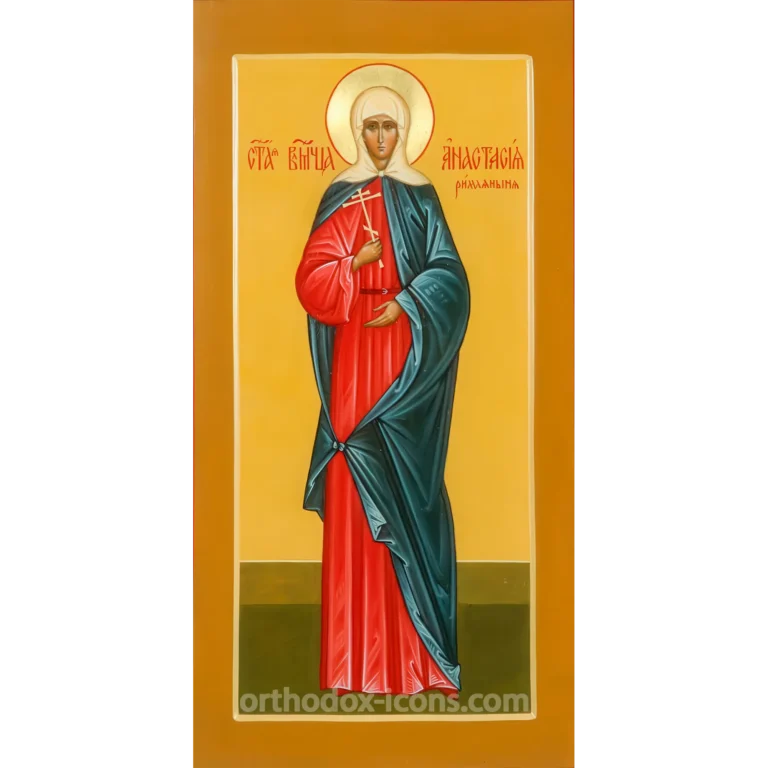
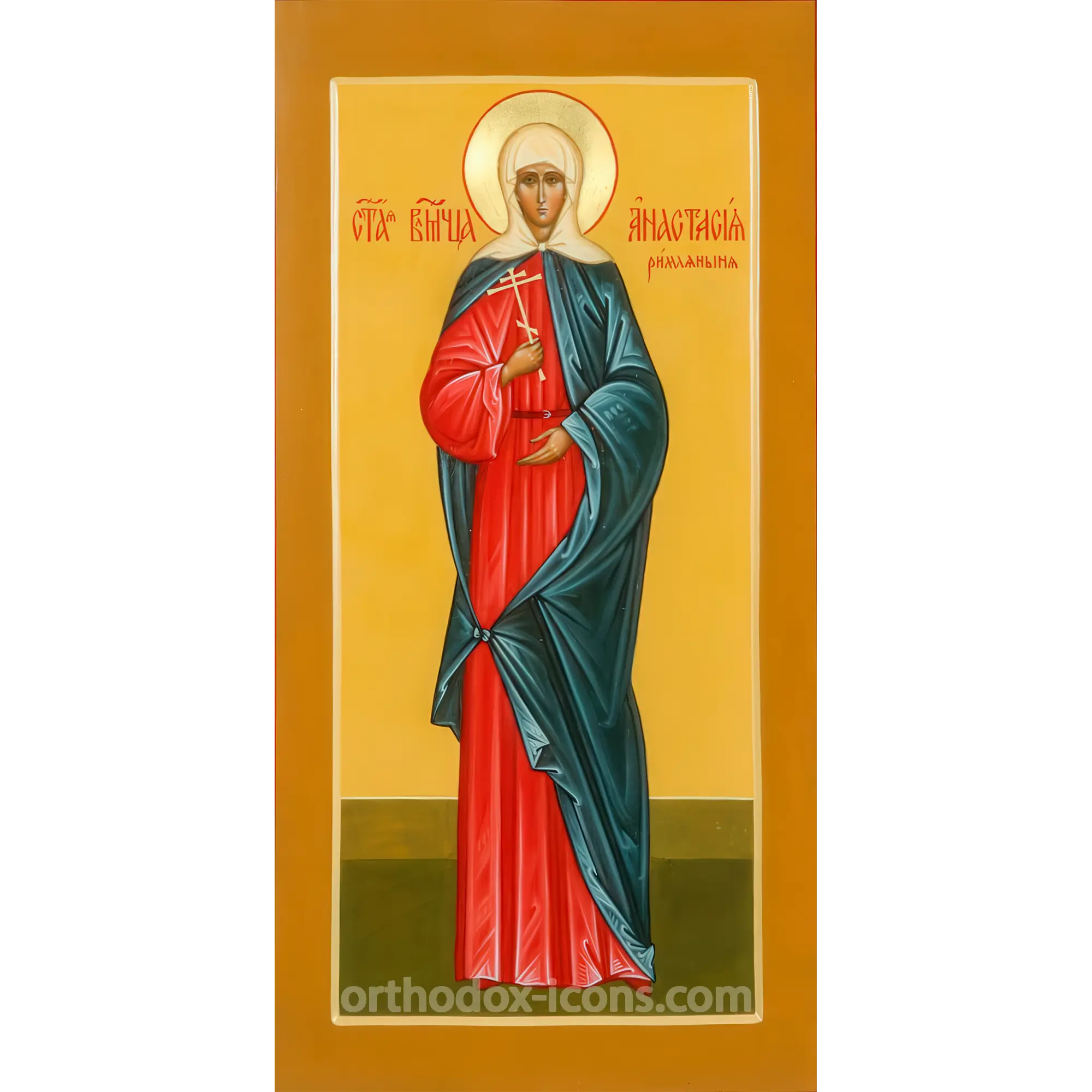
The Great M. Anastasia Icon is a hand-painted Orthodox icon of the Holy Great Martyr Anastasia, known in the Slavic tradition as Anastasia the Deliverer from Bonds. She is shown full-length in a red tunic, blue-green mantle, and white head covering, holding the martyr’s cross in her right hand.
The icon follows a strict and prayerful type: there is no medicine vessel in this version; the focus is on Saint Anastasia’s martyrdom, compassion, and steadfast confession of Christ. The golden halo stands against a warm ocher background, and the saint’s calm face expresses mercy, purity, and quiet spiritual strength.
This icon is suitable as a patron saint icon for women and girls named Anastasia, and as a meaningful Orthodox gift for expectant mothers, medical workers, caregivers, and families praying for loved ones in captivity, confinement, addiction, or difficult trials. Free international shipping is included. Payment is made after you receive and approve the icon.
It is possible to paint an image in any size to order
Free shipping worldwide
The Great M. Anastasia Icon is a hand-painted Orthodox icon of the Holy Great Martyr Anastasia, venerated in the Slavic tradition as Anastasia the Deliverer from Bonds. Saint Anastasia lived in Rome at the turn of the third and fourth centuries and devoted her life to serving Christians imprisoned for their faith in Christ. This full-length icon presents her with calm dignity, mercy, and quiet spiritual strength.
The icon is painted in the Mstyora tradition, following a strict and prayerful type. Saint Anastasia stands in a red tunic, a blue-green mantle, and a white head covering. In her right hand she holds the martyr’s cross. The golden halo shines against a warm ocher background, and the face is painted with special delicacy: the large compassionate eyes give the image a sense of attentive prayer and readiness to help.
The available sizes are 13×25 cm (5.1×9.8 in), 18×31 cm (7.1×12.2 in), and 30×50 cm (11.8×19.7 in). These tall formats suit the full-length image of Saint Anastasia. They preserve the figure, white head covering, red garment, blue-green mantle, martyr’s cross, halo, kovcheg, and inscription.
Iconography and Spiritual Symbolism
In Orthodox art, the image of Saint Anastasia the Deliverer from Bonds has a clear and recognizable form. On this icon she is shown full-length, in classical Byzantine-inspired garments. The composition is restrained and centered, so the viewer’s attention remains on the saint’s face, the martyr’s cross, and her prayerful presence.
The face of Saint Anastasia is painted with fine detail. Her large, expressive eyes look toward the person praying with compassion and seriousness. The white head covering closely frames the face and falls over the shoulders. White in icon painting is connected with purity, chastity, divine light, and freedom from worldly vanity.
The red tunic reaches to the feet and is painted in a rich cinnabar tone. For a martyr, red points directly to the blood shed for Christ, but it also suggests fervent love for God and neighbor. The blue-green mantle is arranged in soft folds and tied around the figure. Green and blue tones may be associated with healing, earthly life, hope, and spiritual renewal.
In her right hand, Saint Anastasia firmly holds a small golden cross. This is the main attribute of the holy martyrs: it shows that the saint accepted the way of the cross for the sake of Christ. Her left hand supports the folds of the mantle. The halo is gilded with 23K gold leaf (960 purity), and its brightness contrasts with the warm ocher background.
The inscription identifies the saint as Anastasia of Rome. The icon does not include a medicine vessel in this version. This is important: some icons of Saint Anastasia show a vessel of healing oil, but this stricter type focuses on her martyrdom, compassion for prisoners, and prayerful standing before God.
Who This Icon Is For
The icon of Saint Anastasia is especially appropriate as a patron saint icon for women and girls named Anastasia. The name is traditionally connected with resurrection, and the image of the saint reminds the person of spiritual renewal, mercy, and fidelity to Christ. It may be given for baptism, nameday, birthday, the beginning of adult life, or another important spiritual occasion.
In Orthodox tradition, Saint Anastasia is also remembered by expectant mothers. The title Deliverer from Bonds was understood in a broad spiritual sense, and in the Slavic tradition it became connected with prayers during pregnancy and childbirth. The icon may therefore be a meaningful gift for a pregnant woman, offered with prayer and love, without replacing medical care or practical responsibility.
Because Saint Anastasia cared for prisoners and the suffering, her icon is also meaningful for doctors, nurses, caregivers, volunteers, prison chaplains, and families praying for loved ones in captivity, legal trouble, confinement, addiction, or deep inner struggle. The icon speaks of mercy, endurance, and the hope that no person is forgotten before God.
Prayers Before Anastasia the Deliverer from Bonds
The title Deliverer from Bonds means one who helps loosen bonds or chains. Saint Anastasia received this name because she dedicated herself to relieving the suffering of imprisoned Christians. Before her icon, Orthodox Christians pray for those in prison, for those unjustly accused, for those burdened by addictions, passions, fear, despair, and difficult circumstances.
People also ask her intercession for expectant mothers, for a peaceful pregnancy and safe childbirth, for those suffering from bodily or emotional illness, and for families who need patience, mercy, and hope. Such prayer should not be treated as a guarantee of a specific outcome. In Orthodox life, prayer is joined to repentance, wise action, medical help when needed, and trust in God’s mercy.
Saint Anastasia’s image reminds the believer that the deepest bondage is not always visible. A person may be outwardly free and inwardly bound by fear, sin, resentment, or despair. Her icon calls the heart toward Christ, who alone gives true freedom.
Brief Life of the Great Martyr
Saint Anastasia was born in Rome at the end of the third century, in the family of a wealthy pagan senator and a secret Christian mother. Her mother entrusted her education to the learned Christian teacher and martyr Chrysogonus, who instructed her not only in knowledge, but also in the truth of the Christian faith.
When the persecutions of Christians under Diocletian filled the prisons with believers, Anastasia secretly visited them. Disguised in humble clothing and carrying money, she entered prisons, gave food to the prisoners, washed and bandaged their wounds, and comforted them before death. Because of this compassionate ministry, she became known as the Deliverer from Bonds.
When the authorities learned of her activity, Anastasia was arrested and pressured to renounce Christ. According to the traditional life, she endured suffering and remained faithful. Her martyrdom took place in the early fourth century, and the Church has honored her ever since as a great martyr, helper of the suffering, and intercessor for those held in visible or invisible bonds.
The memory of Saint Anastasia the Deliverer from Bonds is celebrated in the Orthodox Church on January 4 according to the modern calendar, corresponding to December 22 in the old calendar.
Mstyora Tradition and Materials
This icon is the result of careful hand work based on traditional icon-painting methods. The board is made from dried solid linden wood. A kovcheg is carved on the front, creating a recessed sacred field for the image. Oak splines are inserted into the back of the panel to help protect the board from warping over time.
The surface is covered with linen cloth and multi-layer chalk gesso. The image is painted in egg tempera with natural mineral pigments and earth colors, including cinnabar, blue tones, and ochers. This technique allows the iconographer to achieve depth, clarity, and a living softness in the face, garments, and folds.
The halo is gilded with 23K gold leaf (960 purity). The completed icon receives a protective finish. Such an icon is not a printed picture or decorative souvenir, but a hand-painted Orthodox image intended for prayer, veneration, and long-term use in a home, chapel, or church.
Choosing the Size and Iconostasis Formats
The 13×25 cm (5.1×9.8 in) size is an elegant small icon, suitable for a personal patron saint gift, baptism, birthday, or a child’s prayer corner. The 18×31 cm (7.1×12.2 in) size gives more room for the expressive face of the great martyr and the beautiful folds of the blue-green mantle.
The 30×50 cm (11.8×19.7 in) size is a larger and more solemn format, appropriate for the center of a home icon corner, a family holy image, a chapel, or a church gift. In a larger icon, the face, cross, garments, inscription, kovcheg, and gilded halo can be rendered with greater detail.
Individual iconostasis sizes may also be discussed. For a custom order, the background may be made fully gilded, and family patron saints may be painted on the borders if desired. Size, proportions, inscriptions, kiot, and decorative details should be agreed before the icon is made.
Blessing and Care
The icon may be blessed in an Orthodox church after it is received. Once blessed, it is used for prayer and veneration in a home, chapel, or church.
To preserve egg tempera and gold leaf, keep the icon away from direct sunlight, heaters, moisture, soot, and sudden changes of temperature. Do not wipe the painted surface with wet tissues, water, alcohol, polish, or household chemicals.
Dust should be removed only with a dry soft brush, without pressure. For the best long-term protection, a wooden glazed kiot is recommended. It helps protect the icon from dust, accidental touch, and environmental changes.
Questions and Answers
What does the title Deliverer from Bonds mean?
The title refers to Saint Anastasia’s ministry to imprisoned Christians. She visited them, cared for them, and helped relieve their suffering, so she became known as a saint who intercedes for those bound by captivity or hardship.
Why is Saint Anastasia associated with childbirth?
In the Slavic tradition, the idea of being released from bonds was also connected with childbirth. Women have long asked Saint Anastasia’s intercession during pregnancy and delivery.
Why does Saint Anastasia hold a cross?
The cross is the main sign of her martyrdom. It shows that she confessed Christ and accepted suffering rather than abandon the faith.
What does the red garment symbolize?
The red tunic points to martyrdom, sacrificial love, and fervent faith. In icon painting, red may also suggest life, resurrection, and spiritual fire.
Why does this icon not show a medicine vessel?
A vessel of healing oil is a common but not required attribute of Saint Anastasia. This icon follows a stricter type, emphasizing her martyr’s cross and prayerful standing before God.
Who is this icon especially suitable for?
It is especially suitable for women and girls named Anastasia. It may also be given to expectant mothers, medical workers, caregivers, and families praying for loved ones in captivity or difficult dependence.
What is the kovcheg on the icon board?
The kovcheg is a recessed area on the front of the icon board. It creates a visual boundary between the central image and the raised borders, giving the icon a traditional sacred depth.
Are egg tempera and mineral pigments durable?
Traditional egg tempera with mineral pigments is valued for depth and durability. With proper care, a hand-painted icon can preserve its color and clarity for many years.
Why is the background ocher rather than fully gilded?
The warm ocher background is a traditional painted background that creates a calm, prayerful atmosphere. In this icon, gold is used primarily for the halo.
How should the icon be cleaned from dust?
Do not use water, polish, wet wipes, or household chemicals. Dust should be removed gently with a dry soft brush or dry soft cloth, without pressure.
| Dimensions | 13x25cm (5.1×9.8 in), 18x31cm (7.1×12.2 in), 30x50cm (11.8×19.7 in) |
|---|---|
| Name | Anastasia |