Icon of Peter and Fevronia
$3750
Available size: 30×50 cm (11.8×19.7 in) and larger. Custom iconostasis sizes can be discussed before painting.
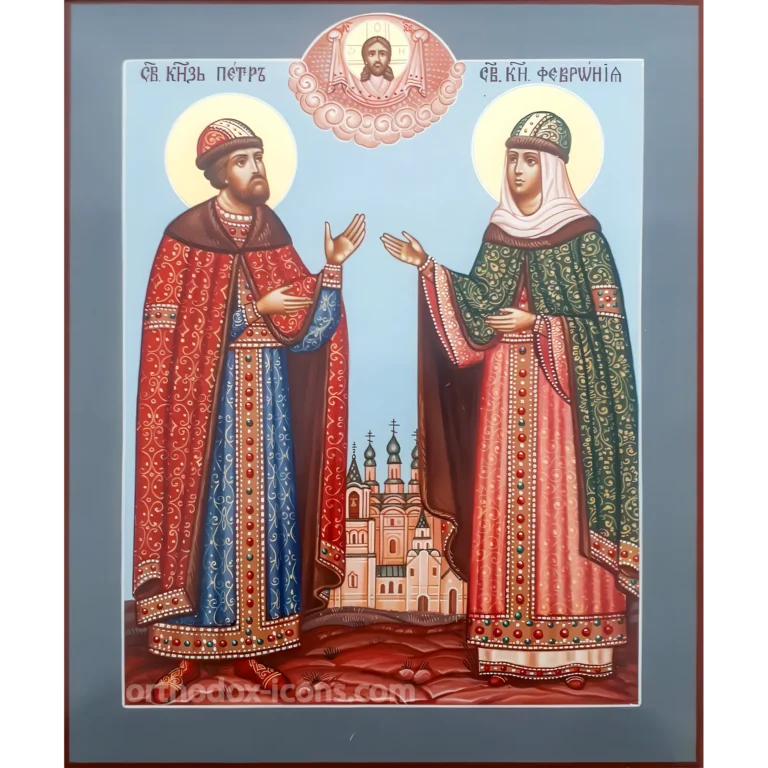
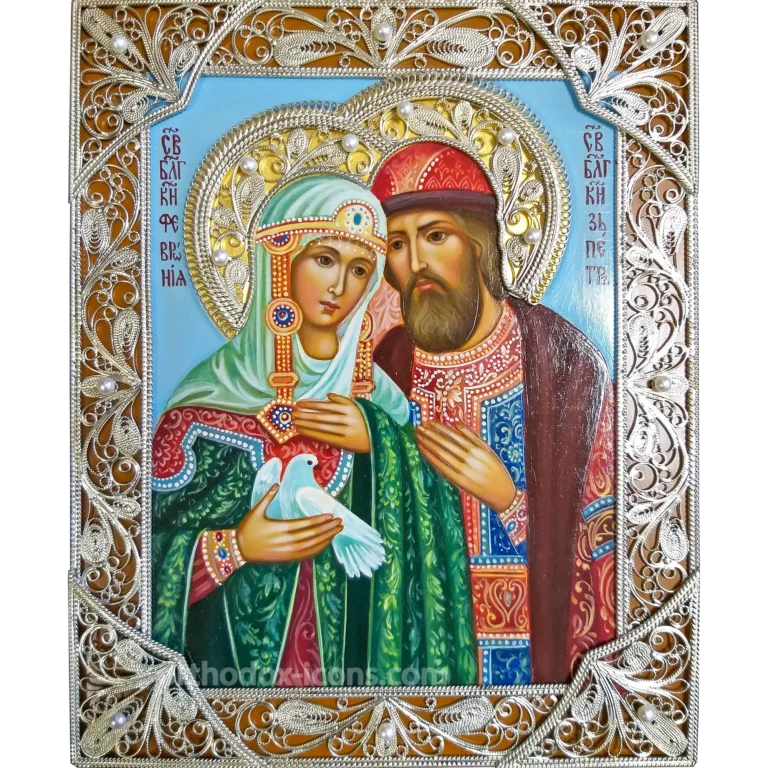
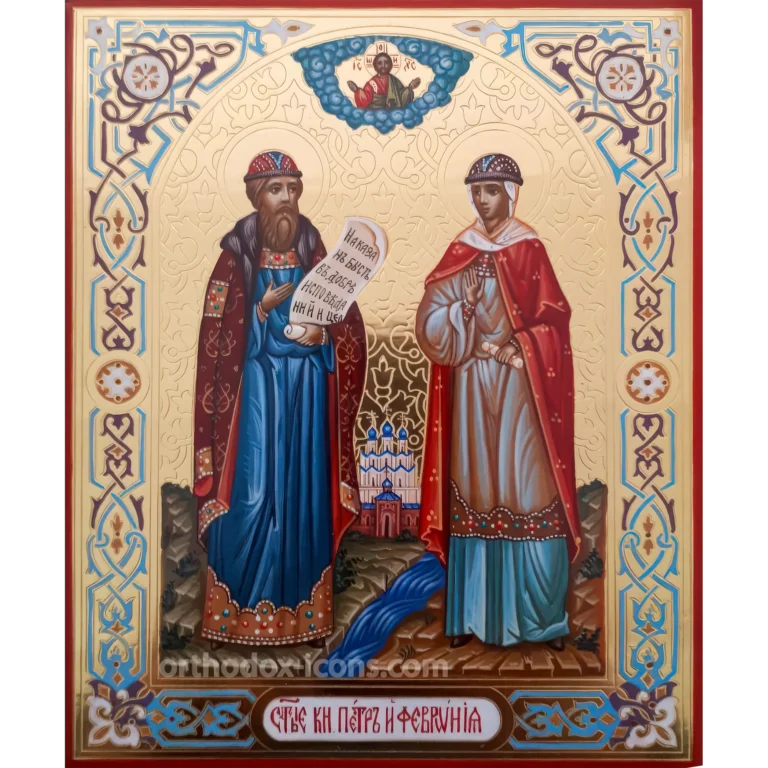
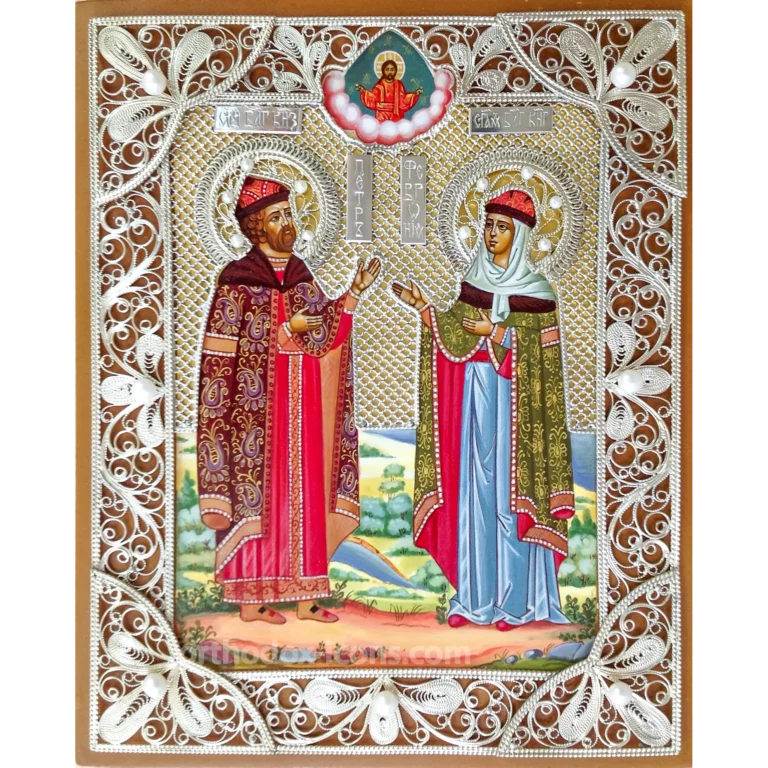
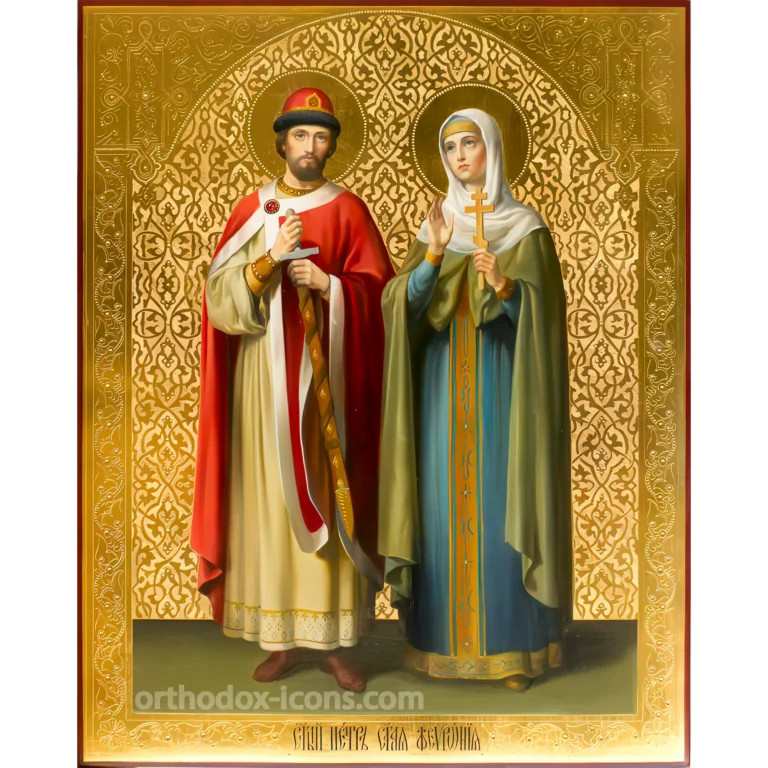
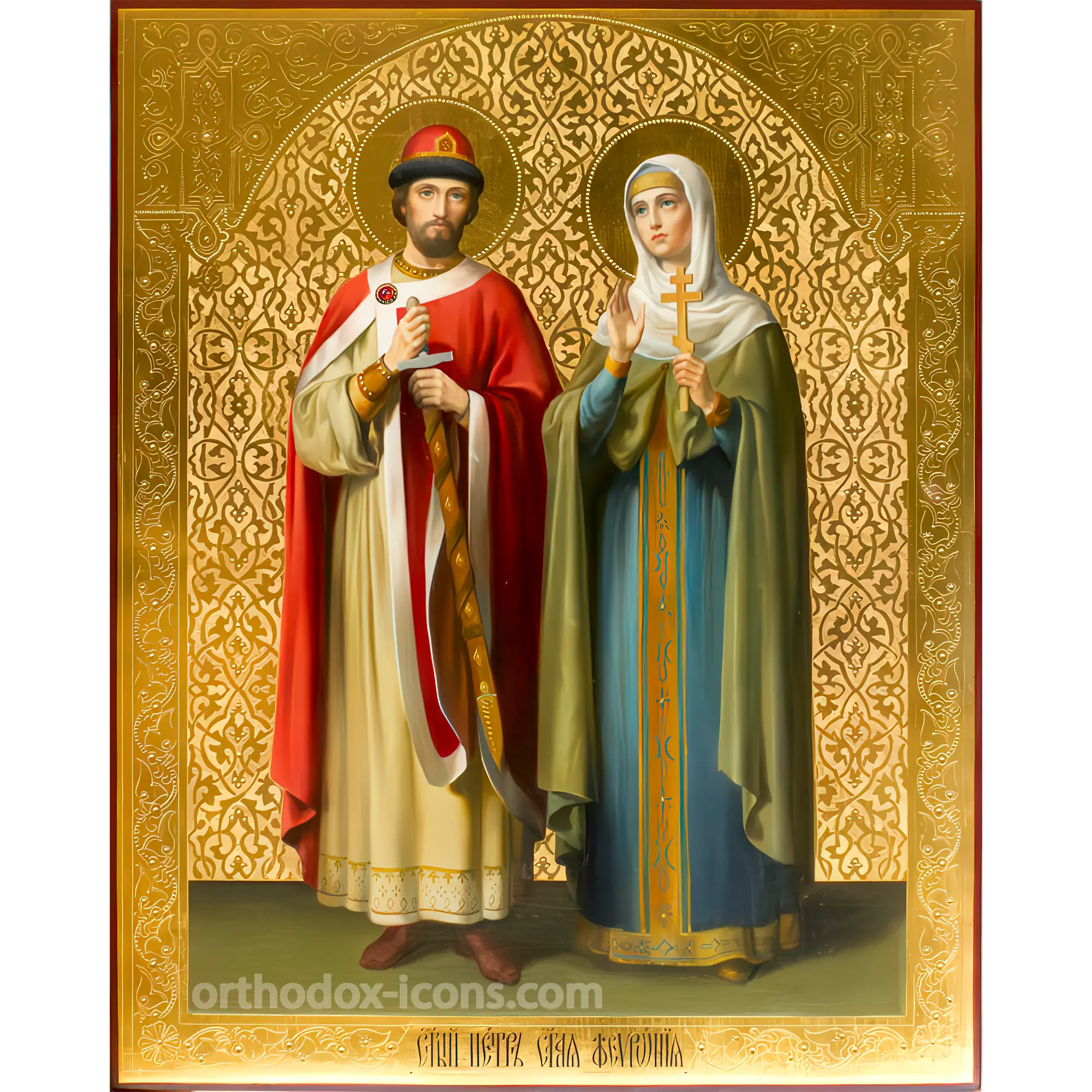
Icon of Peter and Fevronia is a hand-painted Orthodox family icon of the holy faithful Prince Peter and Princess Fevronia of Murom, patrons of Christian marriage, love, faithfulness, and peace between spouses. The saints are shown full-length in princely garments, holding crosses, against a solemn gilded arched background.
- Prayer focus: marriage, family peace, faithfulness, reconciliation, mutual understanding, blessing for a church wedding, and the strengthening of a Christian family.
- Materials: linden board, oak splines, chalk gesso, egg tempera, mineral pigments, gold leaf, and protective finish.
- For whom it is suitable: spouses, newlyweds, couples preparing for a church wedding, Orthodox families, people named Peter or Fevronia, and parish or chapel use.
- Iconographic features: full-length pair, princely garments, crosses in the hands, large halos, gilded ornamental background, and solemn arched composition.
It is possible to paint an image in any size to order
Free shipping worldwide
Hand-painted Icon of Peter and Fevronia is a solemn family icon of the holy faithful Prince Peter and Princess Fevronia of Murom, Orthodox patrons of marriage, love, faithfulness, and peace between spouses. Their veneration is deeply connected with the Christian understanding of family life: love joined with patience, wisdom, humility, and the willingness to preserve the marriage bond even during difficult circumstances.
In this icon the saints are shown full-length in princely garments, standing against a gilded arched composition. Saint Peter stands on the left, wearing a red princely cloak over light clothing and holding a cross. Saint Fevronia stands on the right, with a white head covering, a blue-green dress, and a soft green mantle; she also holds a cross, while her other hand is raised in prayer. The image is not a scene of one moment from their life, but a solemn devotional portrait of a blessed married couple who became an example for Orthodox families.
The icon is made in a large vertical format: 30×50 cm (11.8×19.7 in) and larger. This size is especially suitable for a full-length paired composition, because it allows the viewer to see the faces, gestures, crosses, princely garments, large halos, gilded ornament, and decorative arched background with clarity.
Features of This Icon
The main feature of this icon is the solemn full-length image of the holy spouses on a gilded ornamental background. The composition is calm and balanced: Peter and Fevronia stand together, each with personal dignity, yet both are united by a common prayerful spirit. Their large halos stand out on the gold and emphasize not only their personal holiness, but also the spiritual meaning of their shared family witness.
Saint Peter is painted in light princely clothing and a red mantle. In icon painting, red may suggest dignity, love, sacrifice, and the readiness to pass through trials in faithfulness to God and to one’s neighbor. The cross in his hands points to Christian confession, spiritual responsibility, and the call to follow Christ.
Saint Fevronia is shown with a white head covering, green mantle, and blue-green dress. The white veil suggests purity, wisdom, and piety; the green tones can be read as a sign of life, peace, and spiritual fruitfulness. Her cross recalls the Christian path, while the raised hand expresses prayerful standing before God. In this image she appears not only as the prince’s wife, but as a wise and spiritually strong Christian woman.
The gilded background with an arched ornament gives the icon a church-like solemnity. The decorative arch behind the saints and the fine gold ornament around the borders do not distract from the faces; they create a liturgical frame around the central meaning of the icon: family faithfulness blessed by God.
Iconography of Saints Peter and Fevronia
Saints Peter and Fevronia of Murom can be shown in several iconographic forms: in princely garments, in monastic clothing, in scenes from their life, against the city of Murom, in a boat, or standing together in prayer. This icon uses a solemn full-length version with princely clothing and crosses. It emphasizes not one narrative episode, but the spiritual meaning of their marriage: loyalty, piety, concord, patience, and the refusal to betray one another when trials came.
The princely clothing recalls their earthly dignity, their service to Murom, and their responsibility before the people. Yet in an Orthodox icon, outward dignity is always subordinate to spiritual meaning. Peter and Fevronia are honored not simply as rulers, but as holy spouses whose life became an example for Christian families.
The crosses in their hands are an important detail. They show that Christian marriage is not only joy and affection, but also a path of mutual responsibility. Husband and wife are called to help one another move toward God, to forgive, to endure, to overcome pride, and to preserve the union entrusted to them.
Prayer Before the Icon of Peter and Fevronia
Before the icon of the holy faithful Peter and Fevronia, Orthodox Christians pray for family, marriage, love, faithfulness, and peace between spouses. Their veneration is closely tied to real family life: not an idealized life without difficulties, but a life that requires patience, trust, humility, prayer, and the decision to guard one another.
People pray before this icon for the preservation of love and faithfulness in marriage, peace between husband and wife, reconciliation after quarrels, help in overcoming distrust and coldness, blessing for a church wedding, the creation of a strong Christian family, mutual understanding, patience, humility, forgiveness, the upbringing of children, and protection of the family from division and harmful interference.
The icon reminds the family that married life is also spiritual work. The life of Peter and Fevronia does not show an easy fate without sorrow. It shows that love becomes mature through faithfulness, when a person refuses to trade a spouse for worldly advantage or temporary comfort.
Who This Icon Is For
The Icon of Peter and Fevronia is suitable for a home icon corner, a family prayer place, the home of a married couple, a parish church, or a chapel. It is often chosen as a gift for a wedding, church marriage, anniversary, house blessing, the birth of a child, or an important family date.
For newlyweds and couples preparing for marriage, this icon can become one of the main family icons. It reminds them that marriage begins not only with celebration, but with a promise to remain faithful in joy and in difficulty. For spouses who have lived together for many years, it can become a sign of gratitude to God for family, children, shared labor, and trials overcome together.
The icon is also appropriate for men and women named Peter or Fevronia as a patron saint icon. At the same time, its meaning is wider than name-day devotion: these saints have become an Orthodox image of family love, marital fidelity, and peace in the home.
Short Life of Saints Peter and Fevronia
Saints Peter and Fevronia entered the memory of the Church as an example of Christian marriage. According to tradition, Prince Peter was healed by the wise maiden Fevronia, who was known for piety, humility, and discernment. Their union later passed through misunderstanding, social resistance, and serious trials.
Fevronia was not of noble birth, and the boyars did not want to accept her as princess. They demanded that Peter leave his wife. He refused to destroy his marriage for power and position, choosing instead to leave Murom together with Fevronia. This episode is central to the meaning of their life: Peter chooses faithfulness and truth before God rather than outward advantage.
After Peter and Fevronia left, discord arose in Murom. The people understood that without their wise and pious rule, the city had lost peace, and they asked the spouses to return. Peter and Fevronia forgave those who had wronged them and ruled Murom with meekness, justice, and care for the people.
At the end of their lives, they received monastic tonsure with the names David and Euphrosyne. Tradition says that they departed to the Lord on the same day, a sign of their spiritual unity. Their memory is celebrated on July 8 according to the civil calendar, and the translation of their relics is commemorated on September 19.
Materials, Gilding, and Ornament
The icon is painted on a linden board prepared with traditional icon gesso. Oak splines may be used to help stabilize the wooden base. The faces, hands, crosses, princely clothing, halos, inscriptions, and ornament are painted in egg tempera with mineral pigments.
Gilding plays an important role in this image. The gold background and arched ornament create a sense of solemn church space. The halos are set apart on gold, while the decorative borders complete the large vertical composition. In Orthodox icon painting, gold is not only decorative; it points to divine light, heavenly glory, and the transfigured world.
For an individual order, the size, degree of gilding, ornament, border treatment, kiot, and iconostasis format can be discussed before painting. For a large icon, it is especially important to consider where it will be placed, so that the saints, crosses, halos, gilded background, and arched ornament are perceived as one harmonious image.
Choosing the Size
The indicated size for this icon is 30×50 cm (11.8×19.7 in) and larger. This format is well suited to the composition because it contains two full-length figures, large halos, crosses, princely garments, and a rich gilded background. It can become a central family icon in a spacious home icon corner, family prayer room, chapel, or separate kiot.
For iconostasis use, the size should be discussed individually. The proportions of the row, height of placement, lighting, neighboring icons, and viewing distance all affect how the final icon should be painted.
Placement, Blessing, and Care
The Icon of Peter and Fevronia can be placed in a home icon corner near icons of Christ, the Mother of God, Saint Nicholas, the Guardian Angel, and the patron saints of the family. It is also fitting for a family prayer room or the room of a married couple, provided the place is chosen reverently and the icon is treated as a holy image rather than ordinary interior decoration.
The icon can be blessed in an Orthodox church before shipping. Free international shipping is included. Payment is made after you receive and approve the icon.
A hand-painted icon should be protected from direct sunlight, dampness, overheating, soot, and sudden changes of temperature. Do not wipe the surface with wet cloths, alcohol, household chemicals, or rough fabric. Dust should be removed gently with a soft dry brush. A glazed wooden kiot is recommended, especially for a large icon with gilding and fine decorative details.
Questions and Answers
Who is shown on the Icon of Peter and Fevronia?
The icon shows the holy faithful Prince Peter and Princess Fevronia of Murom, Orthodox patrons of family life, marriage, and conjugal faithfulness.
Why are Peter and Fevronia considered patrons of family life?
Their life shows faithfulness, love, humility, and the willingness to preserve marriage through trials rather than abandon one another for status or comfort.
What do Orthodox Christians pray for before this icon?
They pray for peace in the family, preservation of marriage, faithfulness between spouses, reconciliation, blessing for a church wedding, mutual understanding, and the upbringing of children.
Is this icon suitable as a wedding gift?
Yes. It is one of the most appropriate Orthodox icons for a wedding, church marriage, anniversary, or family celebration.
What do the crosses in the saints hands mean?
The crosses remind us that Christian marriage is also a path of responsibility, patience, sacrifice, and faithfulness to God.
Does this icon include the boat scene from their life?
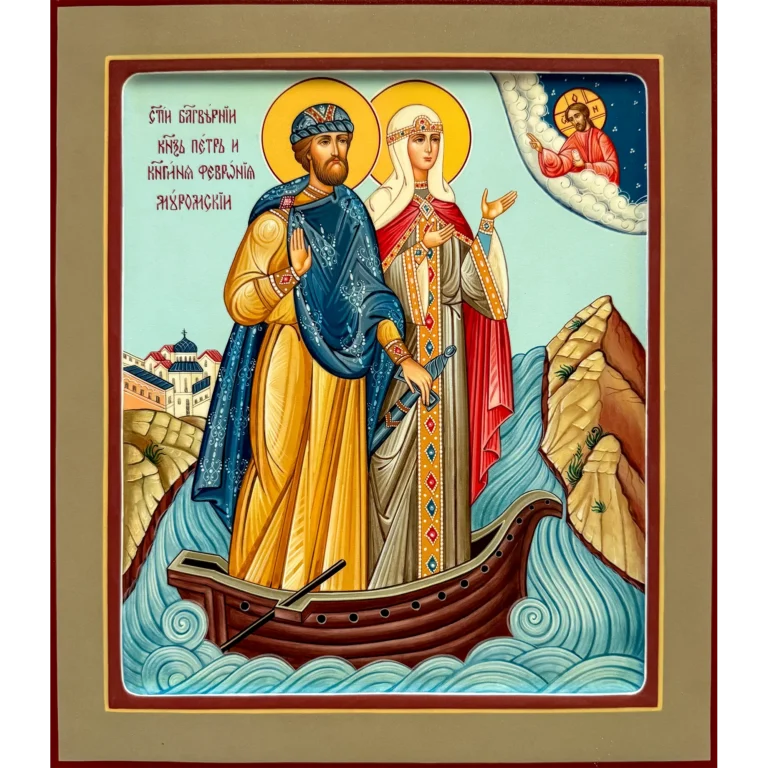
No. This icon shows the saints in a solemn full-length standing composition. The boat belongs to another narrative iconographic version connected with their departure from Murom.
What size is indicated for this icon?
The indicated size is 30×50 cm (11.8×19.7 in) and larger. Custom iconostasis sizes can also be discussed before painting.
When is the feast day of Saints Peter and Fevronia?
Their memory is celebrated on July 8 according to the civil calendar. The translation of their relics is also commemorated on September 19.
Can this icon be placed in a family icon corner?
Yes. The icon is especially fitting for a family icon corner, near icons of Christ, the Mother of God, patron saints, and other family devotional images.
How should a hand-painted icon be cared for?
Keep the icon away from moisture, direct sunlight, overheating, and mechanical damage. Remove dust only with a soft dry brush; a glazed kiot is recommended for protection.
| Name | Fevronia, Peter |
|---|---|
| Dimensions | 30x50cm (11.8×19.7 in) |
Related products
Hand-Painted Icon of Saints Peter and Fevronia of Murom
Available on backorder
Price range: $550 through $1600