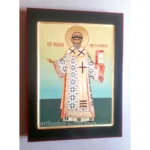
Orthodox Icon Philip Metropolitan of Moscow
Price range: $500 through $1600
Available sizes: 17×21 cm (6.7×8.3 in), 20×24 cm (7.9×9.4 in), 27×31 cm (10.6×12.2 in), 30×40 cm (11.8×15.7 in). Larger iconostasis sizes can be made by agreement.
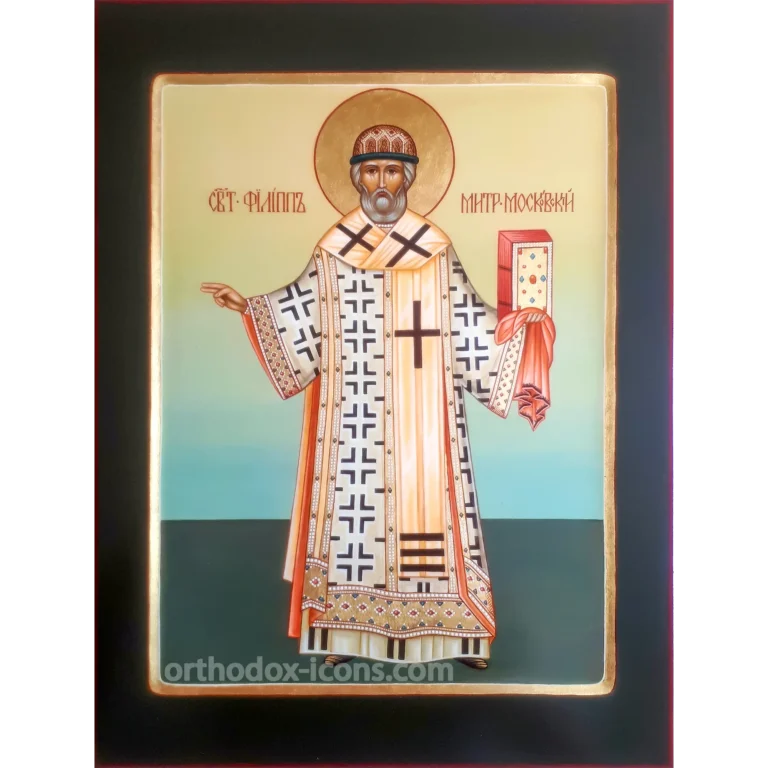
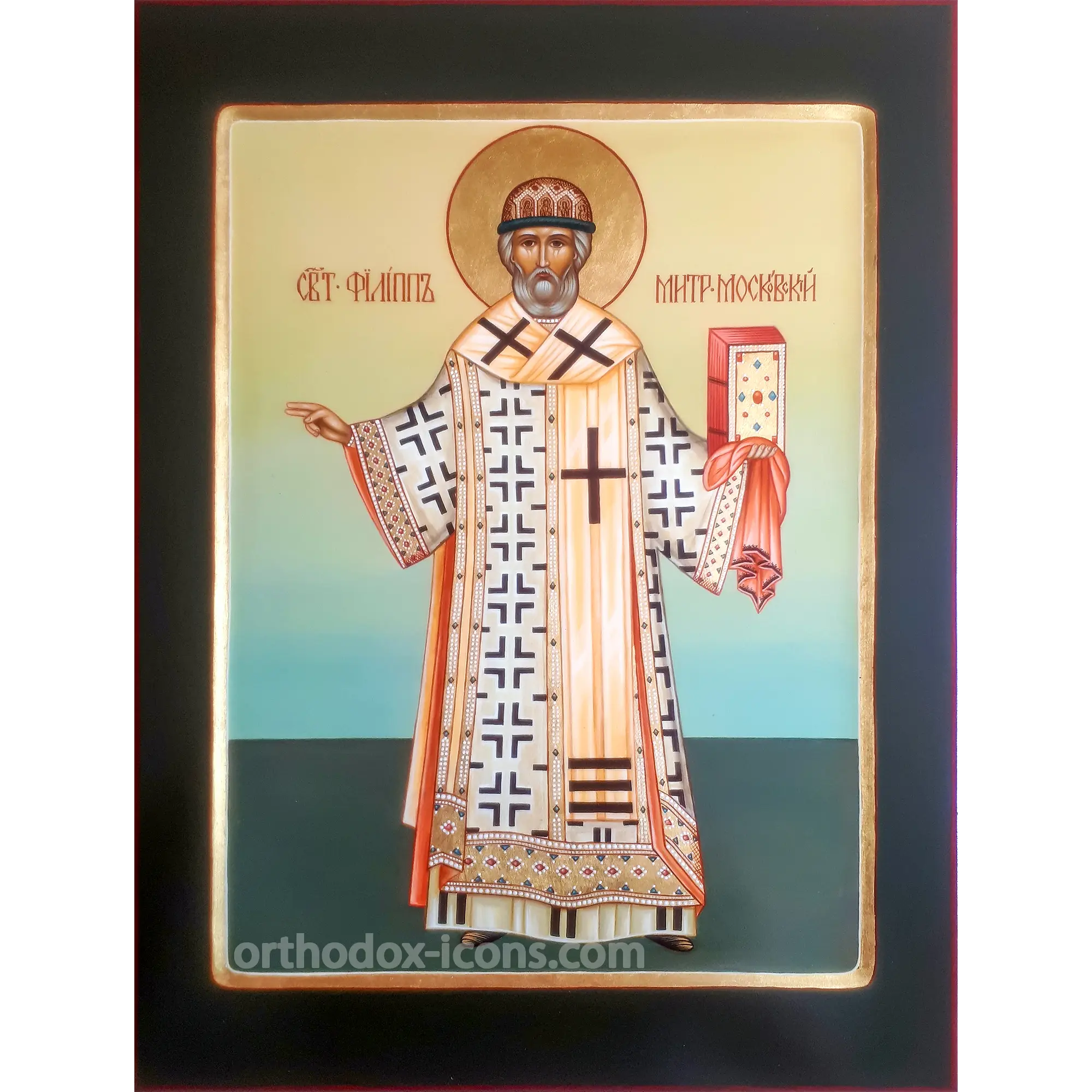
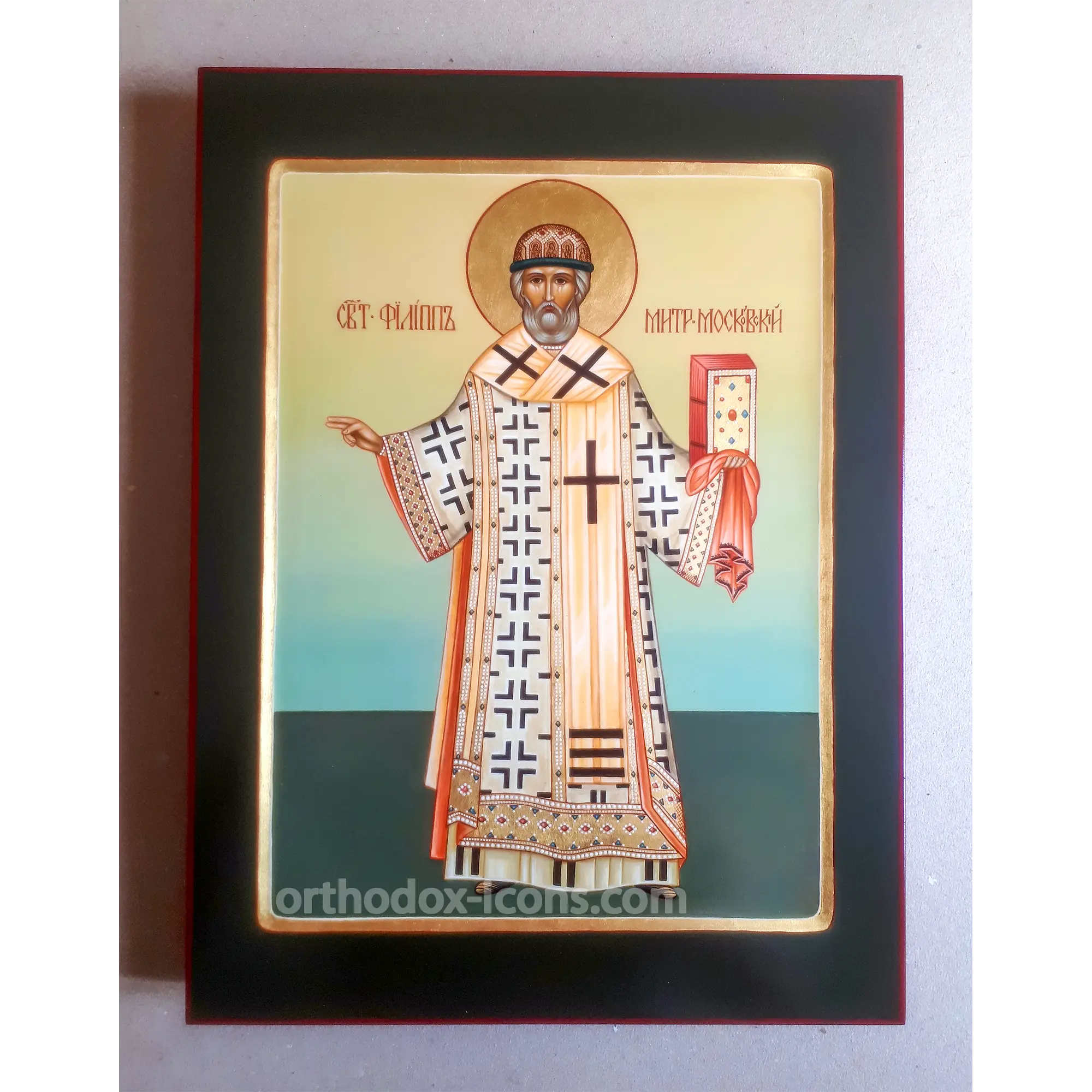
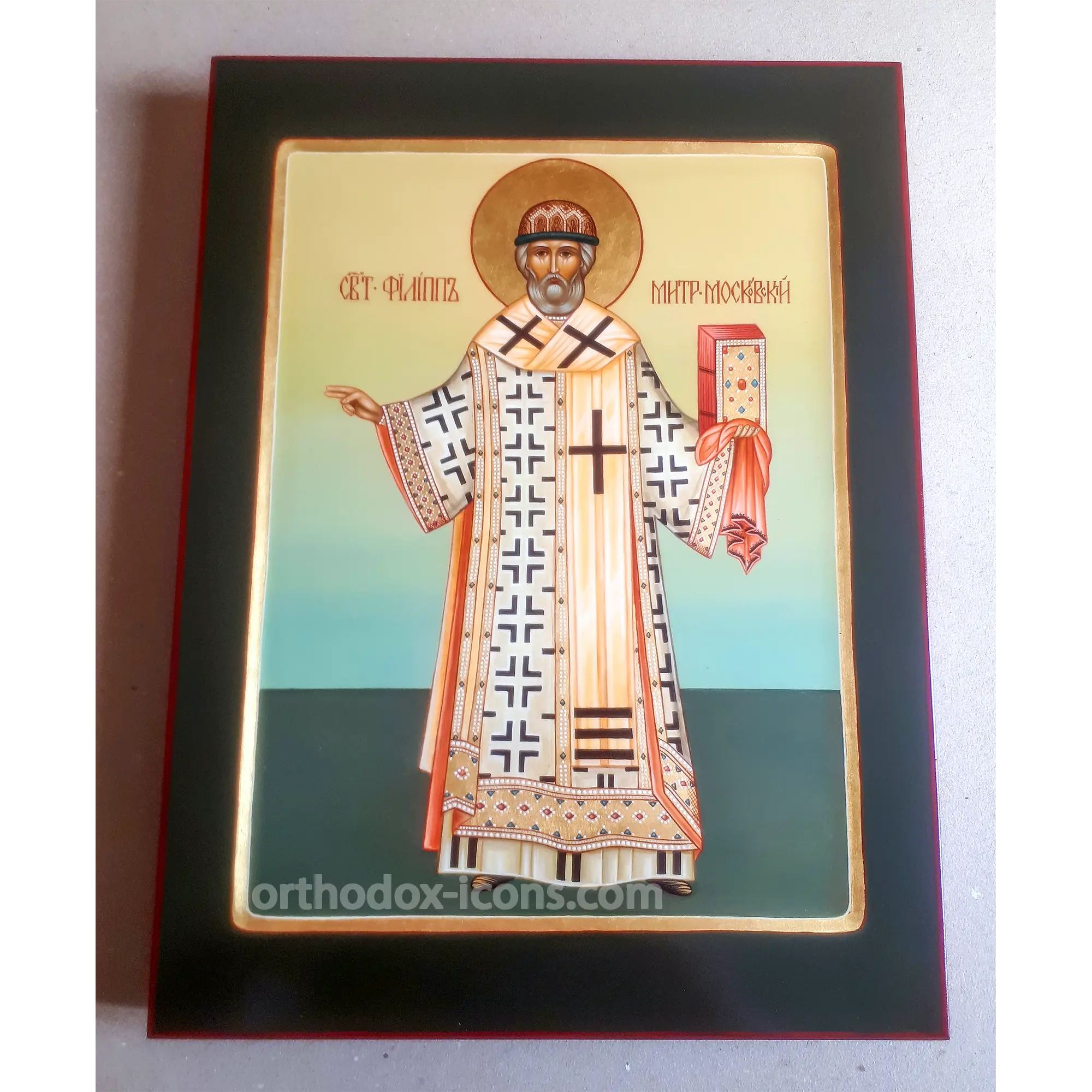
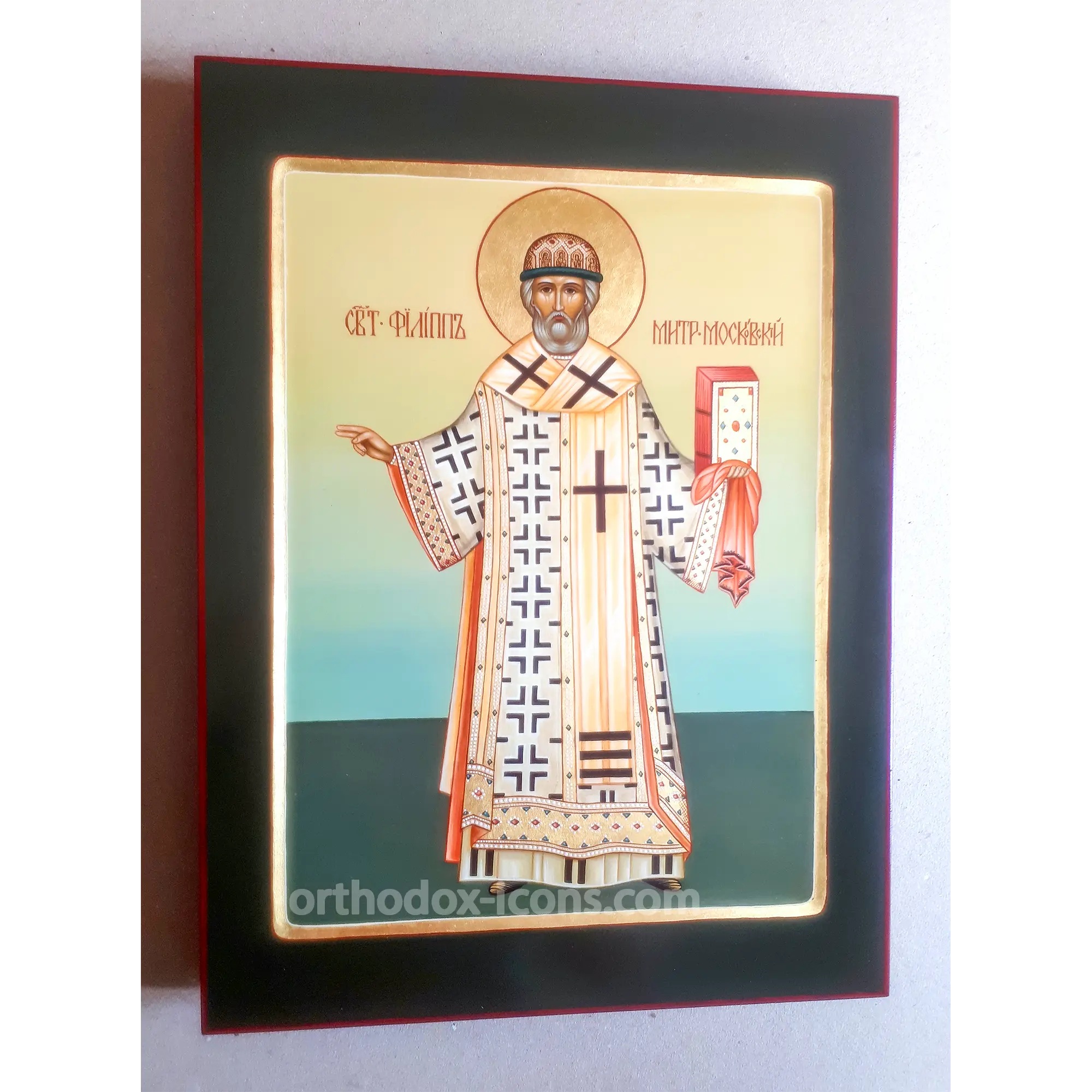
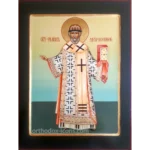
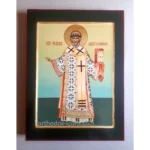
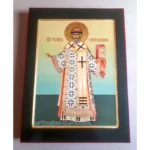
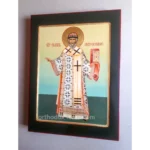
This hand-painted Orthodox Icon Philip Metropolitan of Moscow depicts Saint Philip, Metropolitan of Moscow and All Russia, a Solovki abbot, archpastor, confessor of truth, and martyr of the sixteenth century. He is shown full-length in episcopal vestments, blessing with his right hand and holding the Gospel in his left hand; the white vestment with crosses, gold halo, calm background, dark borders, and kovcheg create a strict and solemn image.
Prayer before this icon is often connected with strengthening of faith, courage to speak truth, spiritual firmness, help during unjust accusations, wisdom for leaders, protection from fear, and patron saint protection for people named Philip. The icon is painted on a linden wood board with braces, kovcheg, pavoloka, chalk gesso, egg tempera, 23K gold leaf (960 purity), and a protective finish. Free international shipping is included. Payment is made after you receive and approve the icon.
It is possible to paint an image in any size to order
Free shipping worldwide
This hand-painted Orthodox Icon Philip Metropolitan of Moscow is a prayerful image of one of the strongest and most honest archpastors in Russian Church history. Saint Philip is known not only as Metropolitan of Moscow, but also as a Solovki abbot, an organizer of monastic life, a man of strict faith, and a rare example of courage. His name is connected with a time when spiritual truth required not beautiful words, but readiness to suffer for it. He openly rebuked the cruelty of the oprichnina, refused to bless lawlessness, and accepted a martyr’s death while remaining faithful to Christ and to his archpastoral conscience.
In this icon Saint Philip is shown full-length in complete episcopal vestments. His right hand is extended in a pointing and blessing gesture, while his left hand holds a richly ornamented Gospel. The white vestment with large crosses, gold halo, restrained background, dark outer borders, and kovcheg create a strict, concentrated, and expressive image. There is no outward splendor for decoration’s sake: the whole composition serves the main meaning. The saint stands before us as a bishop, pastor, confessor of truth, and intercessor for the Church.
Available sizes: 17×21 cm (6.7×8.3 in), 20×24 cm (7.9×9.4 in), 27×31 cm (10.6×12.2 in), and 30×40 cm (11.8×15.7 in). Larger iconostasis sizes can be made by agreement. The 17×21 cm and 20×24 cm formats are convenient for a home icon corner, personal prayer shelf, study, or patron saint gift. The 27×31 cm size reveals the face of the saint, episcopal vestment, Gospel, gold halo, and kovcheg more clearly. The 30×40 cm format is suitable for more solemn placement in a home, church, chapel, parish office, or separate kiot.
This image is especially appropriate as a name saint icon for a man or boy named Philip. Yet its meaning is wider than name patronage alone. Saint Philip is close to those who face injustice, heavy choices, pressure, false accusations, fear before powerful people, or the temptation to compromise conscience. His image reminds us that Christian meekness is not weakness, and pastoral love does not mean silent agreement with falsehood. Sometimes faithfulness to Christ requires a firm word, calm courage, and readiness not to seek personal advantage.
Features of This Icon
The main feature of this icon is the strict episcopal image of Saint Philip. He is not shown in a narrative scene from his Life, but in prayerful presence: upright, collected, with the Gospel and a blessing hand. This composition is well suited for a home iconostasis and for church use, because it immediately reveals the saint as an archpastor, teacher, and confessor.
The face of the saint is painted calmly and attentively. Grey hair, a short beard, a clear gaze, and a restrained expression convey the spiritual maturity of a man who passed from noble birth and court service to monastic struggle, abbacy, metropolitan ministry, and martyrdom. There is no sharp severity in this face, but there is inner steadfastness. Saint Philip does not look threatening; he looks directly, as one who has long since made his choice.
The episcopal vestment occupies an important place in the composition. White and light ocher fabrics with large crosses speak of the saint’s hierarchal dignity, purity of service, and belonging to the living tradition of the Church. The vestment is richly patterned, but it does not overload the icon. Crosses, borders, ornamental inserts, and soft folds help convey the solemn character of the image.
The right hand of the saint is extended to the side. This gesture may be understood as a blessing and also as an indication of the truth of God. For the image of Saint Philip of Moscow, this detail is especially expressive. His life was connected with direct archpastoral speech and with refusal to remain silent before violence and lawlessness. The hand gesture makes the image living, almost personally addressed to the one who prays.
The Gospel in his left hand is the central sign of his ministry. Saint Philip did not oppose royal power because of personal offense or political calculation. His rebuke was rooted in the Gospel, in pastoral responsibility, and in the understanding that power without truth becomes tyranny. The book in his hand therefore reminds us that the measure of Christian life is not fear, advantage, or human force, but the word of God.
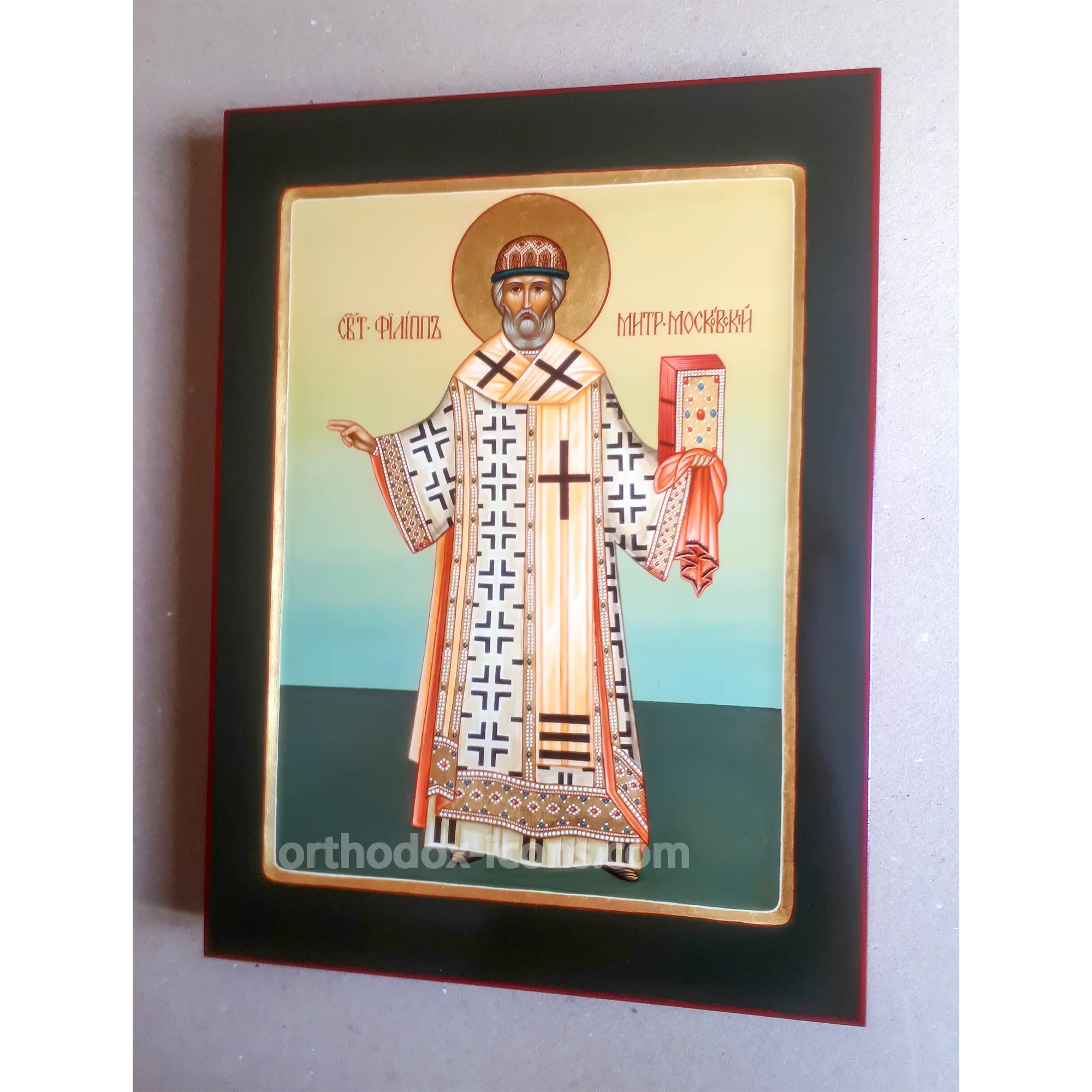
The icon is painted in a kovcheg: the central area is recessed and separated from the borders. This gives the icon traditional depth and helps focus attention on the figure of the saint. The gold halo and fine gilding around the inner field create a luminous space, while the dark outer borders make the composition gathered and noble. This contrast is especially fitting for Philip of Moscow: the light of holiness appears against the background of earthly heaviness, trial, and historical drama.
Iconography of Saint Philip of Moscow
In Orthodox iconography Saint Philip, Metropolitan of Moscow, is usually shown as a hierarch: in episcopal vestments, with an omophorion, the Gospel, and a blessing gesture. These details are not accidental. They emphasize that he is honored not simply as a historical figure, not as a statesman, and not merely as an opponent of Ivan the Terrible, but as an archpastor of the Church who bore responsibility before God for the flock entrusted to him.
The omophorion with crosses points to episcopal ministry. In the Church, the omophorion is connected with the image of the shepherd who bears care for the people. For Saint Philip this is especially important. As metropolitan, he did not limit himself to external performance of office, but stood up for the humiliated and rebuked cruelty. His episcopal dignity was not an ornament, but a cross.
The Gospel in the saint’s hand speaks of the spiritual foundation of his word. He was not a rebel for the sake of rebellion. His strength was faithfulness to Christ, Church conscience, and the understanding that a pastor cannot bless injustice. For this reason, an icon with the Gospel is especially meaningful for those who pray for wisdom, honesty, sober discernment, and strength not to betray conscience.
The gold halo around the head of Saint Philip reveals his glorification in the Church. The halo is not merely a decorative detail; it is a sign of grace-filled light and holiness. In this icon the halo is warm and restrained, not competing with the face. It gently sets the saint apart and helps the viewer see in him not only a historical confessor, but also a heavenly intercessor.
Prayer Before the Icon of Saint Philip
Before the icon of Saint Philip, Orthodox Christians may pray for strengthening of faith, courage, spiritual firmness, and help in difficult circumstances. His image is especially close to those who experience pressure, injustice, slander, conflict with authorities, a heavy moral choice, or fear of the consequences of truthful speech. Saint Philip shows that a Christian can be meek and firm at the same time.
- for strengthening of faith and faithfulness to Christ;
- for courage to speak truth without bitterness or pride;
- for help during unjust accusations, slander, and pressure;
- for wisdom for leaders, mentors, and people with responsible service;
- for protection from fear, faintheartedness, and inward compromise with falsehood;
- for peace in the Church and strengthening of pastors;
- for spiritual discernment in difficult decisions;
- for help for those who serve in a church, monastery, or parish community;
- for patience in sorrows, persecution, and trials;
- for heavenly patronage for people named Philip.
Prayer before the icon of Saint Philip is not a request for outward victory over other people. More deeply, it is an appeal to God for purity of conscience, strength of heart, and the ability to act in a Christian way. Saint Philip helps the faithful remember that truth without love can become hardness, while love without truth can become weakness. His image teaches firmness, humility, and responsibility together.
Brief Life of Saint Philip
Saint Philip, whose secular name was Feodor Kolychev, was born in 1507 into a noble boyar family. From youth he was prepared for state service, but court life did not become his true path. His inner longing for God led him north to the Solovki Monastery, where he accepted monasticism with the name Philip.
In the Solovki Monastery the saint passed through the path of novice, monk, and abbot. He labored greatly, strengthened monastic life, cared for the monastery’s practical order, building, prayer, and brotherhood. His abbacy was not only administrative, but deeply spiritual. Under him, Solovki became one of the important monastic centers of the Russian North.
In 1566, by the will of Tsar Ivan the Terrible, Philip was appointed Metropolitan of Moscow and All Russia. At first he tried to act peacefully, but soon saw that the oprichnina brought blood, fear, destruction, and falsehood to the country. The saint could not remain silent. He openly rebuked the tsar, called for an end to executions and violence, and refused to bless lawlessness.
For this, Saint Philip was slandered, condemned by an ecclesiastical court on false accusations, removed from his see, and exiled to the Otroch Monastery in Tver. There, in 1569, he accepted a martyr’s death. Later his relics were transferred first to the Solovki Monastery and then to Moscow. The Church honors Saint Philip as a confessor, martyr, and archpastor who did not betray truth for the sake of safety.
Commemoration and Patron Saint Meaning
The main commemoration of Saint Philip, Metropolitan of Moscow, is celebrated on January 22 according to the new calendar, corresponding to January 9 according to the old calendar. The Church also commemorates the translation of his relics on July 16. In addition, Saint Philip is remembered among the Moscow hierarchs, the Solovki saints, and other conciliar commemorations.
An icon of Saint Philip is especially suitable as a patron saint image for a man or boy named Philip. It may be given for baptism, name day, birthday, graduation, the beginning of responsible service, ordination, a new home, or an important family occasion. It is well suited for a person who values not only outward well-being, but also inner honesty, faithfulness to conscience, and the ability not to turn away from truth.
The name Philip is connected with several saints in the Orthodox calendar, so when choosing a patron saint icon it is important to know in honor of which saint the person was baptized. If the patron saint is Saint Philip of Moscow, this episcopal image is especially precise and personal. For a home iconostasis, it can become a reminder of spiritual courage, prayerful firmness, and responsibility before God.
Materials, Gold Leaf, and Custom Options
The icon of Saint Philip is painted on a linden wood board. Applied or mortise braces are used for stability. The central part of the board is made with a kovcheg: the holy image is placed in a recessed field, while the borders create a traditional iconographic frame. Pavoloka and chalk gesso are applied to the board, and then the image is painted in egg tempera.
In this version, 23K gold leaf (960 purity) has an important role. Gold is used in the halo, the inner frame, and selected details of the composition, creating a warm ecclesiastical radiance. The face, hands, Gospel, episcopal vestment, crosses, inscriptions, and decorative details are painted by hand. The final protective finish helps preserve the painting and gilding.
The color harmony is restrained and noble: the light vestment with large crosses, gold halo, soft background, dark borders, and fine red outline create a calm and strict impression. This image is suitable for a prayer place because it does not overload the eye and helps focus on the face of the saint.
For an individual commission, the size, border decoration, degree of gilding, background tone, inscription style, kiot, and format for a home, church, chapel, or iconostasis can be discussed. In a larger version it is especially important to preserve the expressiveness of the face, clarity of the blessing gesture, readability of the Gospel, and harmony between the kovcheg, borders, and central figure.
Choosing the Size
The 17×21 cm (6.7×8.3 in) size is suitable for a small home icon corner, personal prayer shelf, work study, or compact patron saint gift. In this format the main details remain readable: the face of the saint, halo, blessing hand, Gospel, and episcopal vestment.
The 20×24 cm (7.9×9.4 in) size remains convenient for home use, but gives more space for painting the face, hands, book, omophorion, and crosses on the vestment. This format is often chosen for a family iconostasis or as a gift for an adult named Philip.
The 27×31 cm (10.6×12.2 in) size reveals the painting and decorative details more fully: the kovcheg, gold halo, dark borders, folds of the vestment, inscriptions, Gospel, and blessing gesture become clearer. This is a good option for a spacious home icon corner, separate kiot, or parish office.
The 30×40 cm (11.8×15.7 in) size is chosen for more solemn placement in a large home, prayer room, church, chapel, or iconostasis row. Iconostasis sizes are selected individually with attention to placement height, lighting, neighboring icons, and the whole rhythm of the church space.
Placement, Blessing, and Care
The icon of Saint Philip may be placed in a home icon corner beside icons of Christ, the Mother of God, the Guardian Angel, Saint Nicholas the Wonderworker, the Solovki saints, the Moscow hierarchs, and other heavenly patrons of the family. For a person named Philip, this image can become a personal patron saint icon and a constant reminder of heavenly intercession.
After receiving the icon, it may be blessed in an Orthodox church. A blessed icon is intended for prayer, thanksgiving to God, and asking Saint Philip for faith, courage, truthfulness, steadfastness, help in service, protection from fear, and spiritual strengthening.
A hand-painted icon should be protected from direct sunlight, moisture, overheating, smoke, soot, and sudden temperature changes. Do not wipe the surface with wet cloths, alcohol, household cleaners, or rough fabric. The face of the saint, gilded halo, Gospel, blessing hand, inscriptions, kovcheg, and borders require especially careful handling.
Dust should be removed gently with a soft dry brush and without pressure. For long-term protection of the painting, gilding, and kovcheg, a wooden glazed kiot is recommended. It helps preserve the icon from dust, humidity, and accidental damage, especially when the icon is placed in an active home area, study, church, or intended for long-term use.
Questions and Answers
Who is depicted in the Orthodox Icon Philip Metropolitan of Moscow?
The icon depicts Saint Philip, Metropolitan of Moscow and All Russia, a Solovki abbot, archpastor, confessor, and martyr of the sixteenth century.
Why is Saint Philip shown in episcopal vestments?
He was Metropolitan of Moscow, so the icon presents him as a hierarch with an omophorion, crosses, the Gospel, and a blessing gesture.
What does the Gospel in Saint Philip’s hand mean?
The Gospel points to his archpastoral ministry, faithfulness to the word of God, Church teaching, and the spiritual foundation of his rebuke of injustice.
What does the blessing hand signify?
The blessing hand shows Saint Philip as a bishop and pastor, while also recalling his firm witness to divine truth before human power.
What do Orthodox Christians pray for before this icon?
Prayer before this icon is often connected with faith, courage, honesty, protection from fear, help during slander or unjust accusations, and strength in difficult moral choices.
Who may choose this icon as a patron saint icon?
This icon is especially suitable for a man or boy named Philip, and also for clergy, leaders, teachers, mentors, and those who value faithfulness to Christian conscience.
When is Saint Philip of Moscow commemorated?
The main commemoration of Saint Philip is on January 22 according to the new calendar, corresponding to January 9 according to the old calendar. The translation of his relics is celebrated on July 16.
Does this icon have a kovcheg?
Yes. The image is painted in a kovcheg: the central part of the board is recessed, and the borders give the icon traditional depth and focus.
Where can this icon be placed?
The icon may be placed in a home icon corner, private prayer place, study, church office, chapel, church, or iconostasis row.
How should a hand-painted icon with gold leaf be cared for?
Keep the icon away from moisture, direct sunlight, heat, smoke, and mechanical damage. Dust it gently with a soft dry brush, and consider a glazed kiot for long-term protection.
| Dimensions | 17x21cm (6.7×8.3 in), 20x24cm (7.9×9.4 in), 27x31cm (10.6×12.2 in), 30x40cm (11.8×15.7 in) |
|---|---|
| Name | Philip |