Leonid of Ustnedumsk Orthodox Icon
Price range: $500 through $1600
Available sizes: 17×21 cm (6.7×8.3 in), 20×24 cm (7.9×9.4 in), 27×31 cm (10.6×12.2 in), 30×40 cm (11.8×15.7 in). Larger iconostasis sizes can be made by agreement.
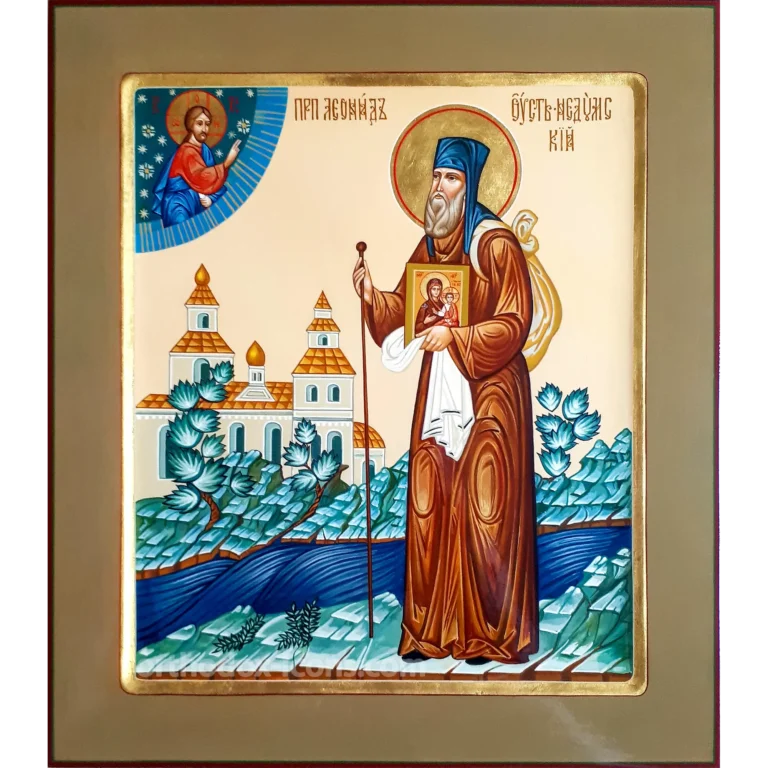
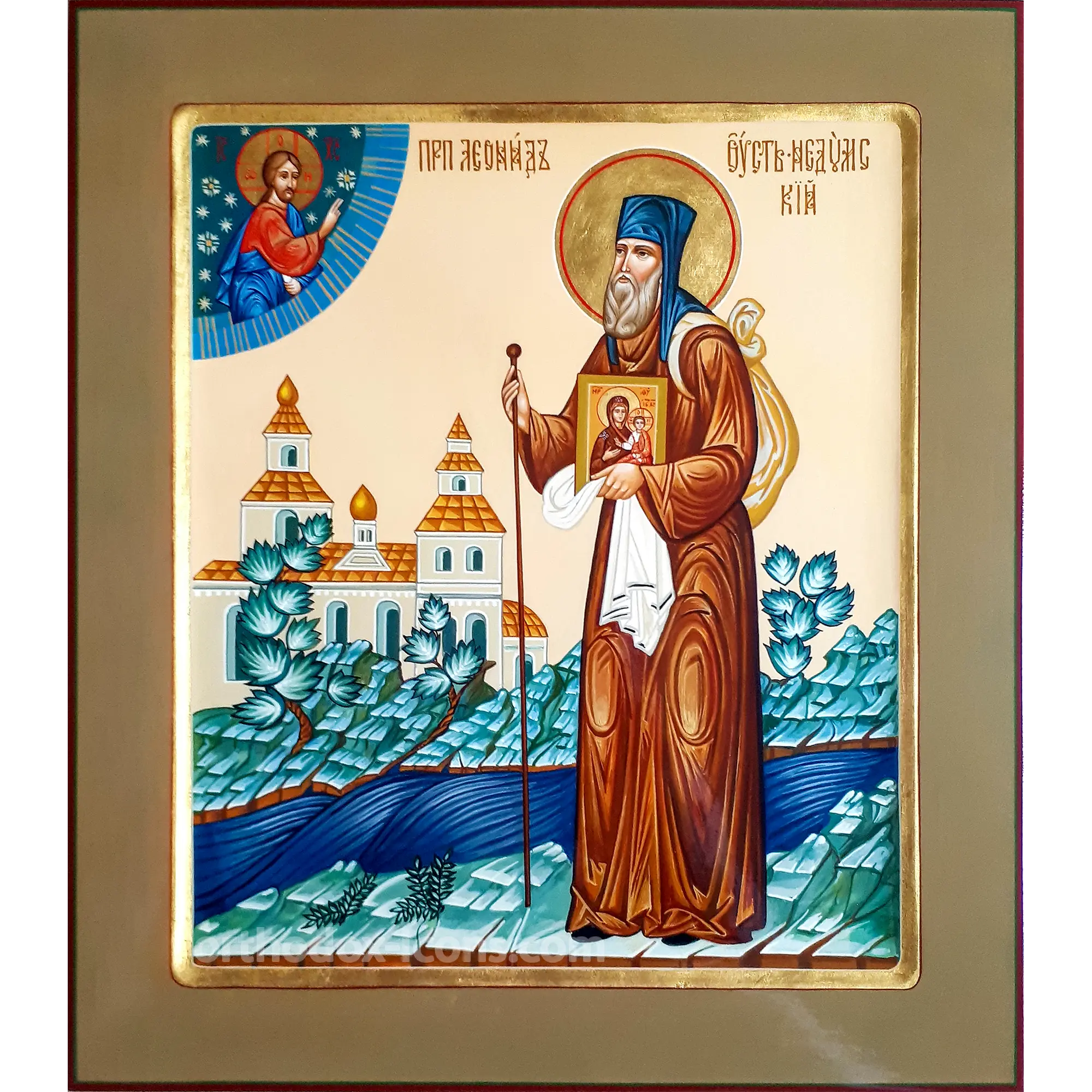
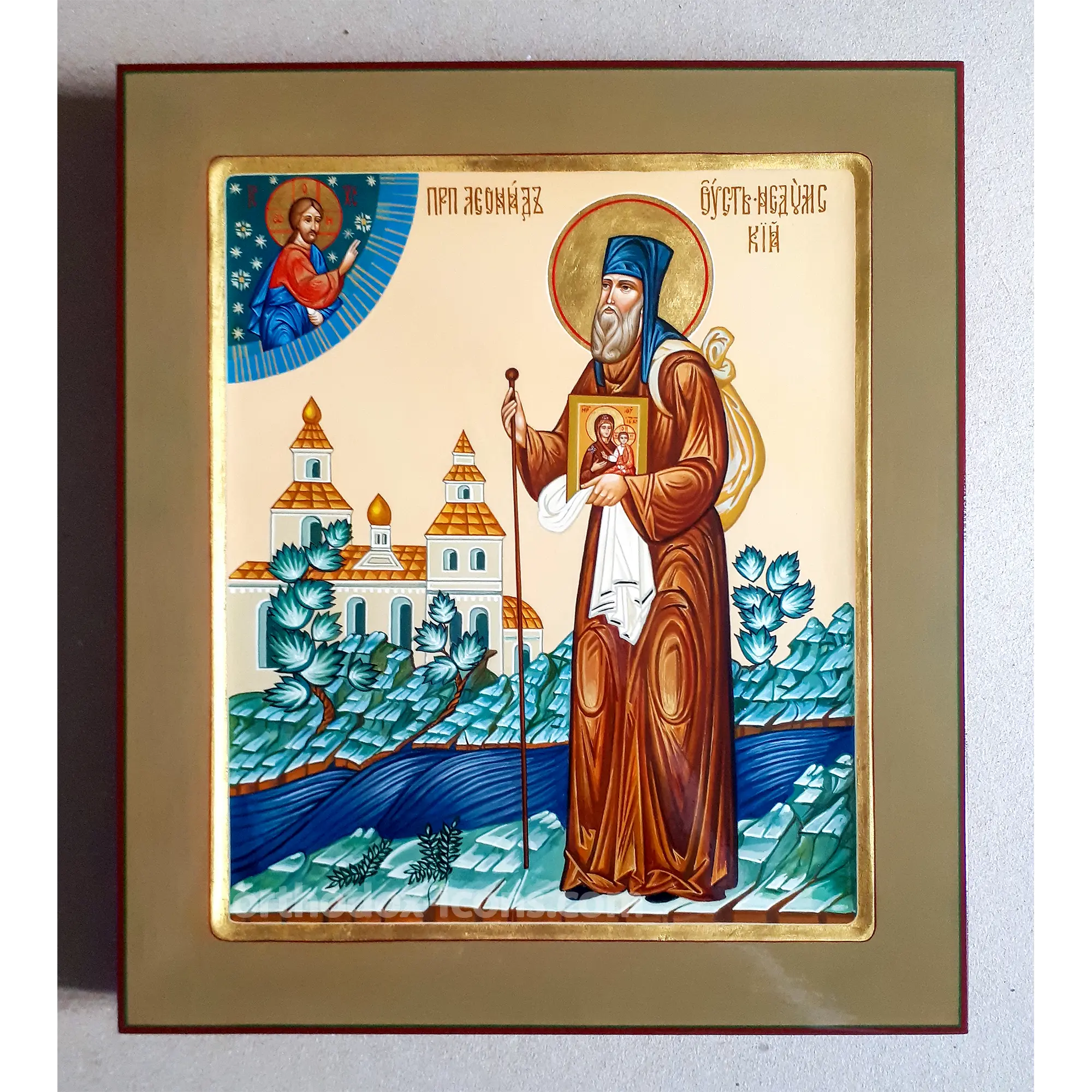
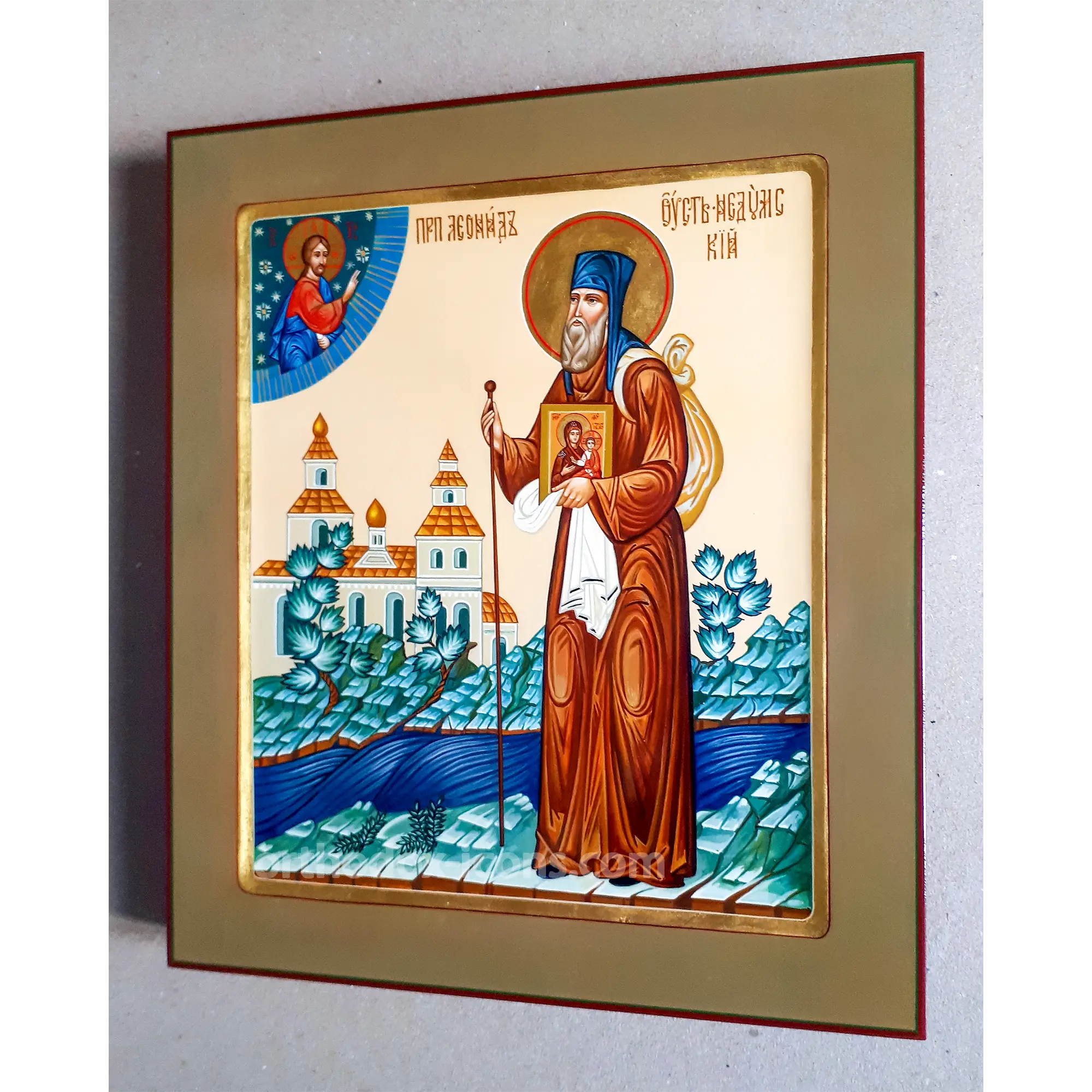
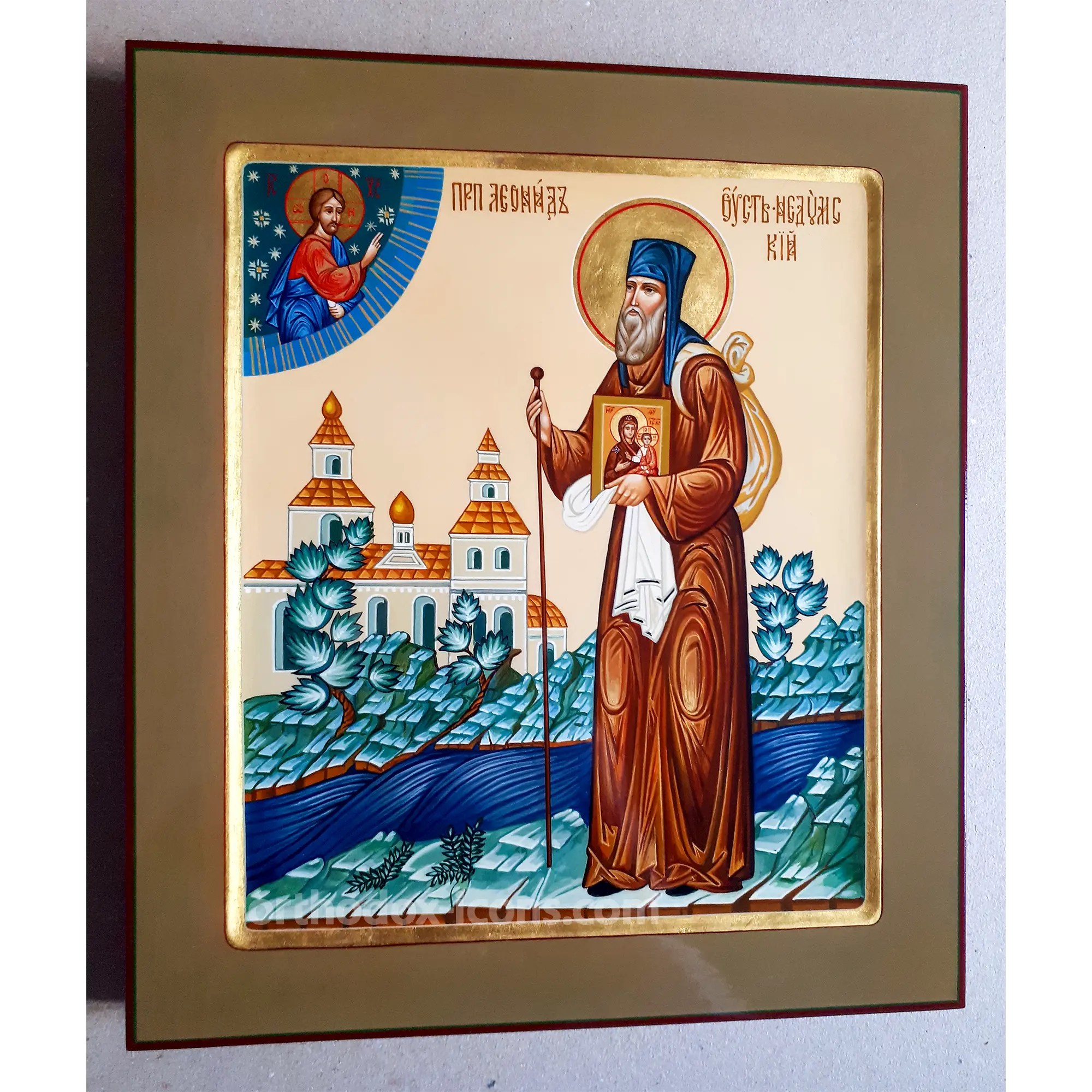
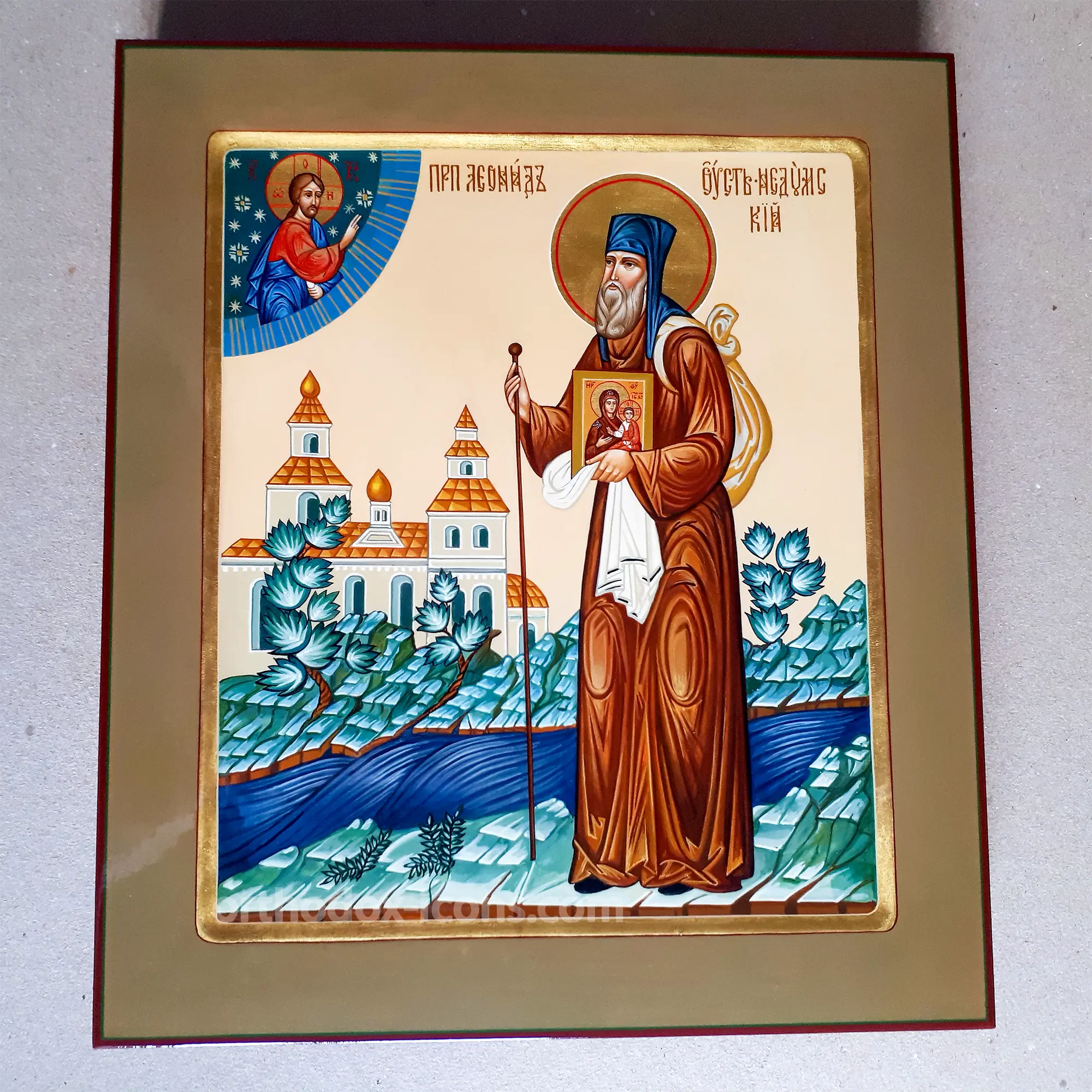
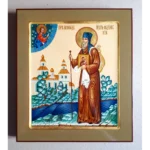
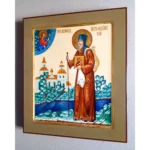
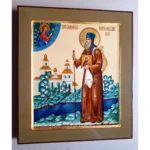
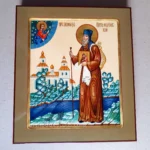
This hand-painted Leonid of Ustnedumsk Orthodox Icon depicts Saint Leonid, a seventeenth-century Russian venerable monk, hieromonk, desert-dweller, and founder of the Ustnedumsk Monastery. He is shown full-length in monastic clothing, holding a staff and an icon of the Mother of God Hodegetria; behind him are a northern landscape, river, monastery buildings, rocks, trees, and Christ blessing from a heavenly segment.
Prayer before this icon is often connected with strengthening of faith, patience, help in labor, spiritual endurance, protection on journeys, good ordering of monastic or family life, support in illness, and patron saint protection for people named Leonid. The icon is painted on a linden wood board with oak braces, gesso, egg tempera, mineral pigments, gold leaf, and a protective finish. Free international shipping is included. Payment is made after you receive and approve the icon.
It is possible to paint an image in any size to order
Free shipping worldwide
This hand-painted Leonid of Ustnedumsk Orthodox Icon is a prayerful image of a seventeenth-century Russian saint, hieromonk, desert-dweller, and founder of the Ustnedumsk Monastery. His life is connected with the northern Russian land, demanding monastic labor, the carrying of the Hodegetria icon of the Mother of God, and the building of a monastery on the Luza River. In the image of Saint Leonid, the theme of obedience to God’s will is especially clear: already in mature age he left his former agricultural life, accepted monasticism, and labored for many years to establish a monastery in a remote, marshy, and severe place.
In this icon Saint Leonid is shown full-length in monastic clothing, holding a staff and an icon of the Most Holy Theotokos. A travel bundle is shown behind his shoulders. Around him are a northern landscape, a river, rocks, trees, and monastery buildings with golden domes. In the upper left corner, Christ blesses from a heavenly segment. This composition does not simply show Saint Leonid as an ascetic; it connects his image with the main event of his life: obedience to the command of the Mother of God and the founding of the Ustnedumsk Monastery.
Available sizes: 17×21 cm (6.7×8.3 in), 20×24 cm (7.9×9.4 in), 27×31 cm (10.6×12.2 in), and 30×40 cm (11.8×15.7 in). Larger iconostasis sizes can be made by agreement. The 17×21 cm and 20×24 cm formats are convenient for a home icon corner, personal prayer shelf, and name saint gift. The 27×31 cm size allows the viewer to see more clearly the figure of Saint Leonid, the icon of the Mother of God in his hands, the staff, monastery landscape, and inscriptions. The 30×40 cm format is suitable for more solemn placement in a home, chapel, church, or separate kiot.
This icon is especially appropriate as a patron saint icon for a man or boy named Leonid. Its prayerful meaning, however, is wider than name patronage. It is an icon about patience, obedience, labor, and quiet faithfulness to God. Saint Leonid did not win loud outward victories, but for many years bore difficult work: living in wilderness places, draining marshes, building a church, gathering brethren, moving the monastery to a safer place, and remaining to the end of his life a man of prayer and labor.
Features of This Icon
The main feature of this icon is the union of the personal image of Saint Leonid with a landscape connected to his life. He is not shown against a plain gold background, but among northern nature: a river flows nearby, rocky banks rise, trees grow, and monastery buildings stand on the other side. This makes the icon vivid and recognizable. The viewer sees not simply a holy monk, but the founder of a particular monastery, connected with a particular land, labor, and prayer.
Saint Leonid holds an icon of the Mother of God with the Christ Child. This is the key detail for understanding the image. According to his Life, after a vision of the Theotokos, Saint Leonid was to take her Hodegetria icon from the Morzhevskaya Nikolaevskaya Hermitage and carry it to the place of the future monastery. Therefore the icon in his hands is not a decorative attribute, but a sign of his obedience to the Mother of God and the spiritual center of the Ustnedumsk Monastery.
The staff in the saint’s hand speaks of the road, pilgrimage, and monastic labor. Leonid of Ustnedumsk was not an urban teacher or a public hierarch, but an ascetic who walked through forests, rivers, and marshy places, endured hardship, and searched for the place where a church and monastery were to be built. The staff helps reveal him as a man of the road, both outwardly and spiritually.
Behind the saint’s shoulders is a travel bundle. This detail strengthens the theme of pilgrimage and renunciation of comfort. Saint Leonid left his former life and went where the Most Holy Theotokos directed him. In this image the monastic spirit of detachment is especially clear: the saint carries little of the earthly world, but preserves what matters most – faith, prayer, the icon, and obedience.
In the upper part of the composition, Christ is shown in a heavenly segment. Christ blesses the saint, which means that all his labor is shown not as a human initiative for personal glory, but as work done with God’s blessing. This is an important spiritual accent: the ascetic is not building something merely his own, but serving the work of God.
The borders and inner frame of the icon are kept in calm golden-olive tones. Fine gilding around the central composition separates the holy image from the outer field. The color harmony is soft and northern: ocher monastery buildings, blue-green water, cool stones, brown monastic clothing, a gold halo, and restrained borders create an atmosphere of quiet labor and prayerful concentration.
Iconography of Saint Leonid of Ustnedumsk
In Orthodox iconography Saint Leonid of Ustnedumsk is usually represented as a monk, ascetic, desert-dweller, and founder of a monastery. In this icon he is shown in monastic clothing, with a staff and the icon of the Mother of God. This form reveals his Life well: he did not merely withdraw from the world, but fulfilled a concrete obedience connected with the Hodegetria icon and the building of a monastery.
The saint’s clothing is painted in warm brown tones. Brown suggests earth, labor, simplicity, and monastic renunciation. Together with the blue klobuk and gold halo, the garments do not look dark; instead, the image keeps inner light and calm. The face of Saint Leonid is attentive and serious, but not harsh. It has the feeling of an elder who has walked a long road and knows the value of patience.
The icon of the Mother of God in the saint’s hands connects his image with the veneration of the Hodegetria, the Guide. For Saint Leonid, this icon became not only a holy object, but also the direction of his entire life. He followed the command of the Theotokos, carried her icon, and through it gathered the spiritual life of the future monastery.
The river and monastery buildings in the background recall the Ustnedumsk Monastery, named for the Neduma River. According to tradition, during difficult labor to drain the marshes, Saint Leonid was bitten by a poisonous snake, but he entrusted himself to God’s will and survived. In gratitude to God, the channel was called the Neduma River, and the monastery became known as Ustnedumsk. For this reason, the water motif in the icon has not only landscape value, but also a meaning connected with the saint’s Life.
Prayer Before the Icon of Saint Leonid
Before the icon of Saint Leonid of Ustnedumsk, Orthodox Christians may pray for strengthening of faith, patience, diligence, and help in difficult circumstances. His Life is especially close to people who work hard, carry responsibility for family, home, building, household tasks, monastic life, or Church work. Saint Leonid shows that the path to God may open not only through secluded prayer, but also through long, difficult, and sometimes almost unseen labor.
- for strengthening of faith and hope;
- for patience in long labors and trials;
- for help in building, moving, arranging a home, or founding a monastery;
- for protection on journeys and during long travel;
- for support in monastic life and spiritual choice;
- for help against despondency, weariness, and faintheartedness;
- for preservation of prayer amid everyday cares;
- for wise understanding in difficult decisions;
- for peace in the family and good ordering of life;
- for heavenly patronage for people named Leonid.
Prayer before the icon of Saint Leonid is not a request for an easy life without labor. Rather, his image helps the faithful ask God for strength to walk their path honestly, calmly, and with trust. Saint Leonid reminds us that the Lord sometimes leads a person not by the shortest road, yet that road can bear spiritual fruit. His icon is especially fitting where people pray for patience, family order, endurance, faithfulness, and help in a great work.
Brief Life of Saint Leonid
Saint Leonid of Ustnedumsk was born in the sixteenth century in the Poshekhonye region, in a pious peasant family. During the first part of his life he worked in agriculture. Already in mature age, around fifty years old, he saw the Mother of God in a dream. She commanded him to go to the Morzhevskaya Nikolaevskaya Hermitage, take her Hodegetria icon, and build a church on the Luza River near Turinskaya Mountain.
Leonid did not hurry to trust the dream and did not act according to his own will. He went to the Kozheozersky Monastery, accepted monasticism, and lived under spiritual guidance. When the miraculous vision was repeated, the monastery elders recognized it as true. Then Saint Leonid went to the Morzhevskaya Nikolaevskaya Hermitage, received a blessing, and took the Hodegetria icon of the Mother of God.
After reaching the Luza River, the saint first settled near Turinskaya Mountain. Later, because of oppression from local people, he moved to a more remote marshy place. There he built a cell and began the work of creating the future monastery. The place was difficult: marshes, river floods, wild nature, and lack of comfort. Yet the venerable father did not retreat.
To drain the marshes he dug channels connecting rivers and lakes. This work demanded enormous patience and physical strength. During the labor he was bitten by a poisonous snake, but he entrusted himself to God’s will and remained alive. In gratitude to the Lord he named the channel the Neduma River, and the monastery became known as Ustnedumsk.
In 1608 Saint Leonid was ordained a hieromonk. He became one of the first enlighteners of the local region, served in prayer, strengthened the brethren, and organized monastic life. Later, when floods of the Luza River threatened the monastery, he moved it to a higher place near Black Lake. The new church was consecrated in honor of the Entry of the Most Holy Theotokos into the Temple.
Saint Leonid reposed on July 17, 1654, after reaching deep old age. His memory has remained as the memory of a Russian northern ascetic, a man of prayer, labor, and obedience to the Mother of God. His Life shows how a modest earthly life can become a path of holiness when a person answers God’s call with the whole will and heart.
Commemoration and Patron Saint Meaning
Saint Leonid of Ustnedumsk is commemorated on July 30 according to the new calendar, corresponding to July 17 according to the old calendar. He is also honored among local saints connected with the northern and Vyatka lands. For a man or boy named Leonid, this date may be a name day if Saint Leonid of Ustnedumsk is the heavenly patron chosen at baptism.
A patron saint icon of Saint Leonid is an appropriate gift for baptism, name day, birthday, entry into school, the beginning of independent life, monastic tonsure, ordination, a new home, or an important family occasion. This image is especially suitable for a person of calm and hardworking character, to whom faithfulness, responsibility, inner collectedness, and trust in God’s providence are close.
The name Leonid is connected with several saints in the Orthodox calendar, so when choosing a patron saint icon it is important to know which heavenly patron was chosen at baptism. If the patron is Saint Leonid of Ustnedumsk, this icon is a precise personal prayer image. For a home iconostasis, it can become a reminder of patience, simplicity, labor, and prayerful steadfastness.
Materials, Gold Leaf, and Custom Options
The icon of Saint Leonid of Ustnedumsk is painted on a linden wood board with a prepared icon ground. Oak braces may be used for the stability of the board. Gesso is applied to the front surface to create an even base for painting. The face and hands of the saint, staff, icon of the Mother of God, monastic clothing, landscape, monastery buildings, inscriptions, and the image of Christ are painted in egg tempera with mineral pigments.
Gold leaf plays an important role in this image. Gold emphasizes the saint’s halo and the inner frame of the composition, gives the icon ecclesiastical solemnity, and helps separate the prayerful space of the image from the outer borders. Calm olive-brown fields keep the icon restrained, while the bright blue-green tones of the river and landscape add painterly depth.
For an individual commission, the size, background tone, degree of gilding, inscription, border design, kiot, and format for a home, church, chapel, or iconostasis row can be discussed. In a larger version it is especially important to preserve the clarity of the narrative composition: the figure of Saint Leonid, the icon of the Mother of God, the staff, monastery landscape, river, and Christ in the heavenly segment.
Choosing the Size
The 17×21 cm (6.7×8.3 in) size is suitable for a small home icon corner, bedside shelf, personal prayer place, or compact patron saint gift. In this format the main details remain readable: the saint’s figure, halo, staff, icon of the Mother of God, and the general landscape.
The 20×24 cm (7.9×9.4 in) size remains convenient for the home but gives more space for painting the face, monastic clothing, river, buildings, and heavenly segment with Christ. This format is often chosen for a family iconostasis or as a gift for an adult.
The 27×31 cm (10.6×12.2 in) size reveals the full composition better: the landscape details, golden church domes, staff, travel bundle, icon of the Mother of God in Saint Leonid’s hands, and inscriptions become more noticeable. This is a good option for a spacious home icon corner, office, or separate kiot.
The 30×40 cm (11.8×15.7 in) size is suitable for more solemn placement in a large home, prayer room, church, chapel, or parish space. Iconostasis sizes are selected individually with attention to placement height, lighting, neighboring icons, and the whole rhythm of the icon row.
Placement, Blessing, and Care
The icon of Saint Leonid of Ustnedumsk may be placed in a home icon corner beside icons of Christ, the Mother of God, the Guardian Angel, Saint Sergius of Radonezh, Saint Seraphim of Sarov, the Optina Elders, and other saints beloved by the family. For a person named Leonid, this image may become a personal patron saint icon and a constant reminder of heavenly intercession.
After receiving the icon, it may be blessed in an Orthodox church. A blessed icon is intended for prayer, thanksgiving to God, and asking Saint Leonid for patience, strengthening of faith, help in labor, good ordering of life, protection on the road, and spiritual endurance.
A hand-painted icon should be protected from direct sunlight, moisture, overheating, smoke, soot, and sudden temperature changes. Do not wipe the surface with wet cloths, alcohol, household cleaners, or rough fabric. The face of the saint, gilded halo, icon of the Mother of God in his hands, inscriptions, landscape, and fine lines of the clothing require especially careful handling.
Dust should be removed gently with a soft dry brush and without pressure. For protection of the painting and gilding, a wooden glazed kiot is recommended. It helps preserve the icon from dust, humidity, and accidental damage, especially when the image is placed in an active home area or intended for long-term church use.
Questions and Answers
Who is depicted in the Leonid of Ustnedumsk Orthodox Icon?
The icon depicts Saint Leonid of Ustnedumsk, a Russian venerable hieromonk of the seventeenth century, founder of the Ustnedumsk Monastery, and a devotee of the Hodegetria icon of the Mother of God.
Why does Saint Leonid hold an icon of the Mother of God?
The icon in his hands recalls his obedience after a vision of the Mother of God: he carried her Hodegetria icon and founded a monastery on the Luza River.
What does the staff in Saint Leonid’s hand mean?
The staff points to pilgrimage, monastic labor, spiritual endurance, and the long journey of Saint Leonid toward the place of the future Ustnedumsk Monastery.
Why is there a monastery landscape in this icon?
The monastery landscape refers to the main work of Saint Leonid’s life: the founding of the Ustnedumsk Monastery by the Luza River and the transfer of the icon of the Mother of God.
What does Christ in the heavenly segment signify?
Christ blessing from the heavenly segment shows that Saint Leonid’s labor was not for personal glory, but was undertaken with God’s blessing and in obedience to divine will.
What do Orthodox Christians pray for before this icon?
Prayer before this icon is often connected with faith, patience, help in labor, protection on journeys, spiritual endurance, good ordering of life, and support in difficult circumstances.
Who may choose this icon as a patron saint icon?
This icon is especially suitable for a man or boy named Leonid, and for anyone who values the themes of monastic labor, obedience, patience, prayer, and spiritual strengthening.
When is Saint Leonid of Ustnedumsk commemorated?
Saint Leonid of Ustnedumsk is commemorated on July 30 according to the new calendar, which corresponds to July 17 according to the old calendar.
Where can this icon be placed?
The icon may be placed in a home icon corner, personal prayer place, study, chapel, church, or iconostasis row.
How should a hand-painted icon be cared for?
Keep the icon away from moisture, direct sunlight, heat, smoke, and mechanical damage. Dust it gently with a soft dry brush, and consider a glazed kiot for long-term protection.
| Dimensions | 17x21cm (6.7×8.3 in), 20x24cm (7.9×9.4 in), 27x31cm (10.6×12.2 in), 30x40cm (11.8×15.7 in) |
|---|---|
| Name | Leonidas |