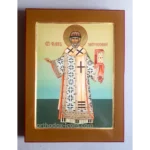
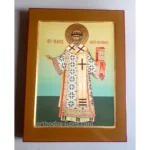
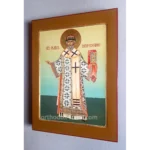
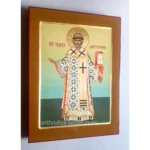
Philip Metropolitan of Moscow Orthodox Icon
Price range: $500 through $1600
Available sizes: 17×21 cm (6.7×8.3 in), 20×24 cm (7.9×9.4 in), 27×31 cm (10.6×12.2 in), 30×40 cm (11.8×15.7 in). Larger iconostasis sizes can be made by agreement.
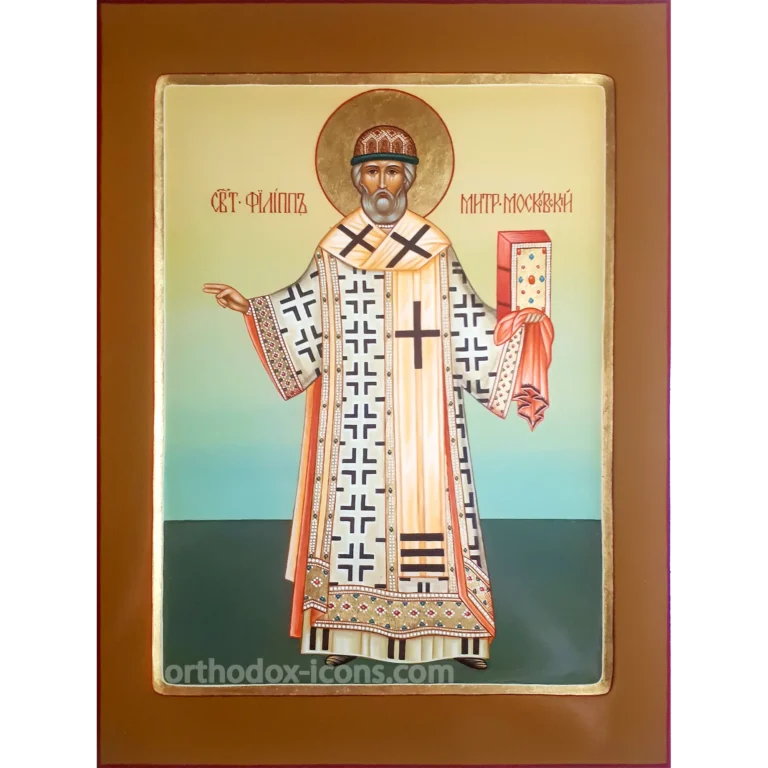
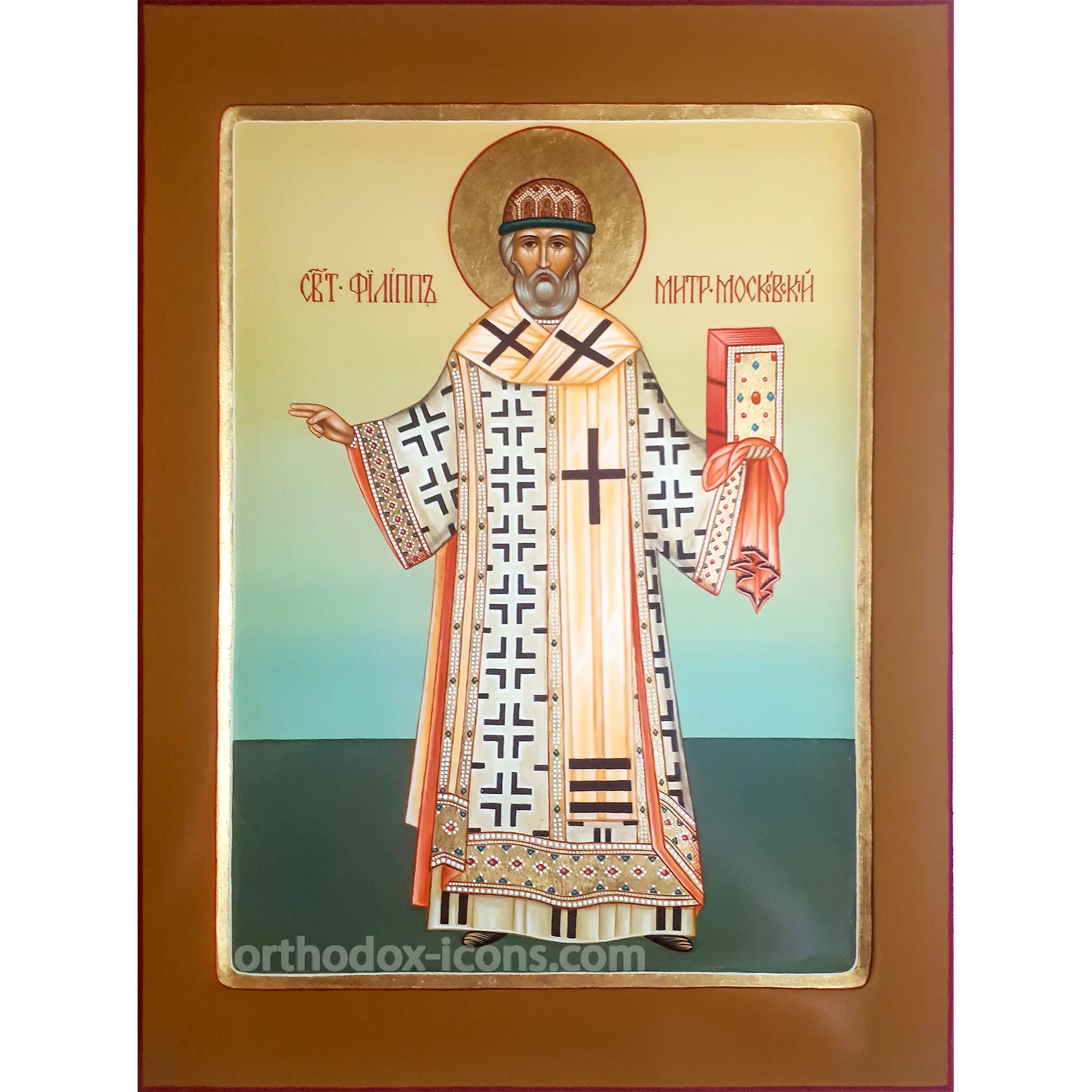
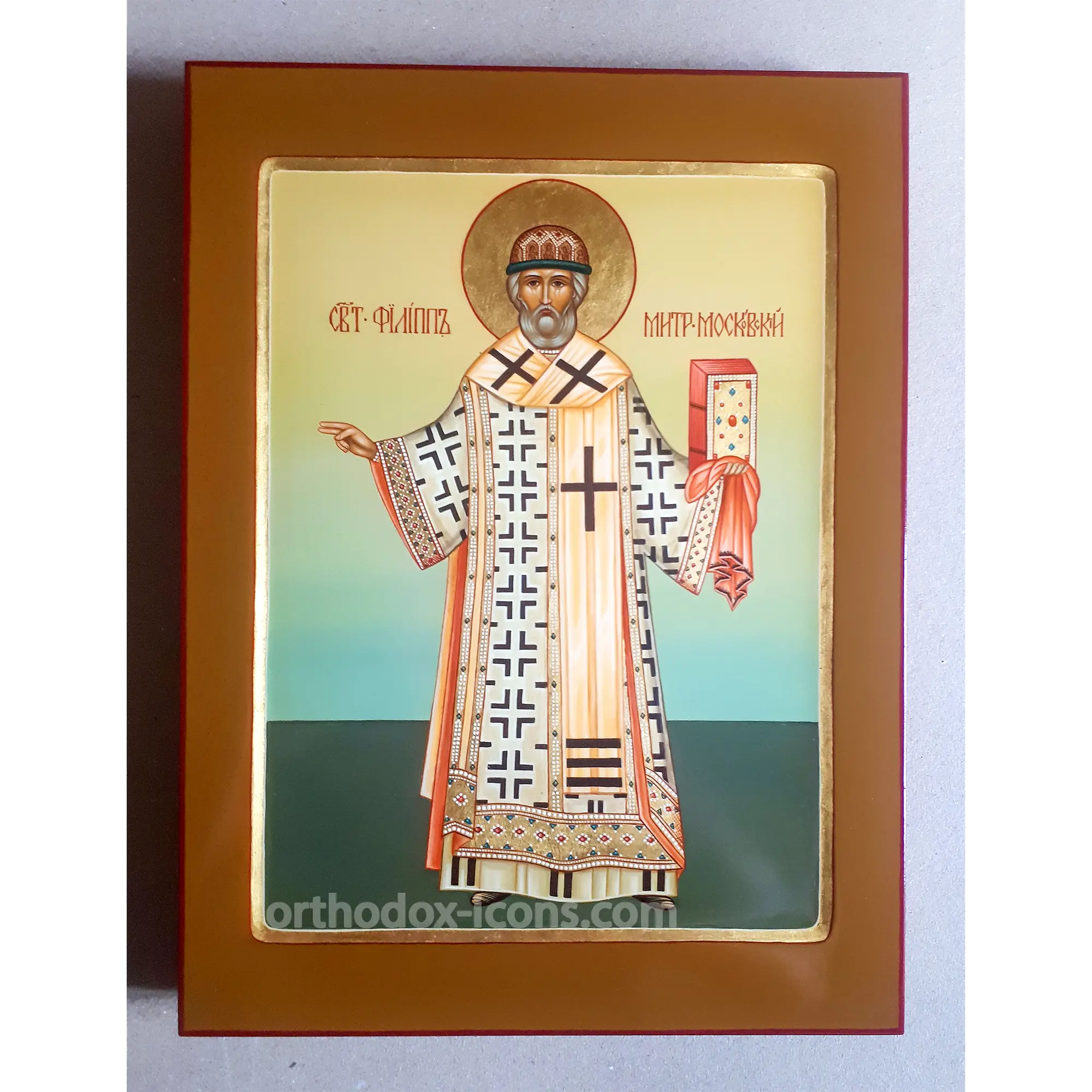
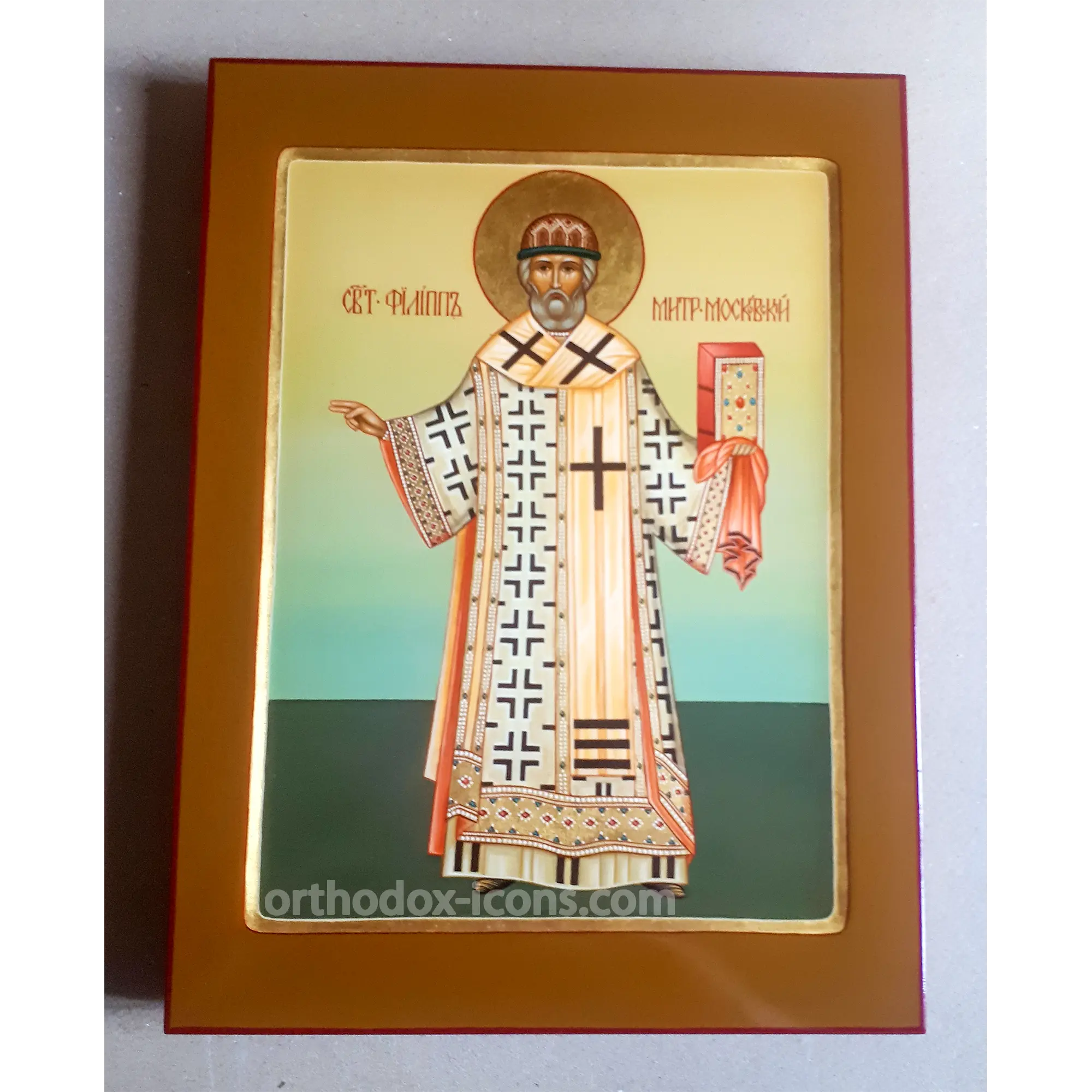
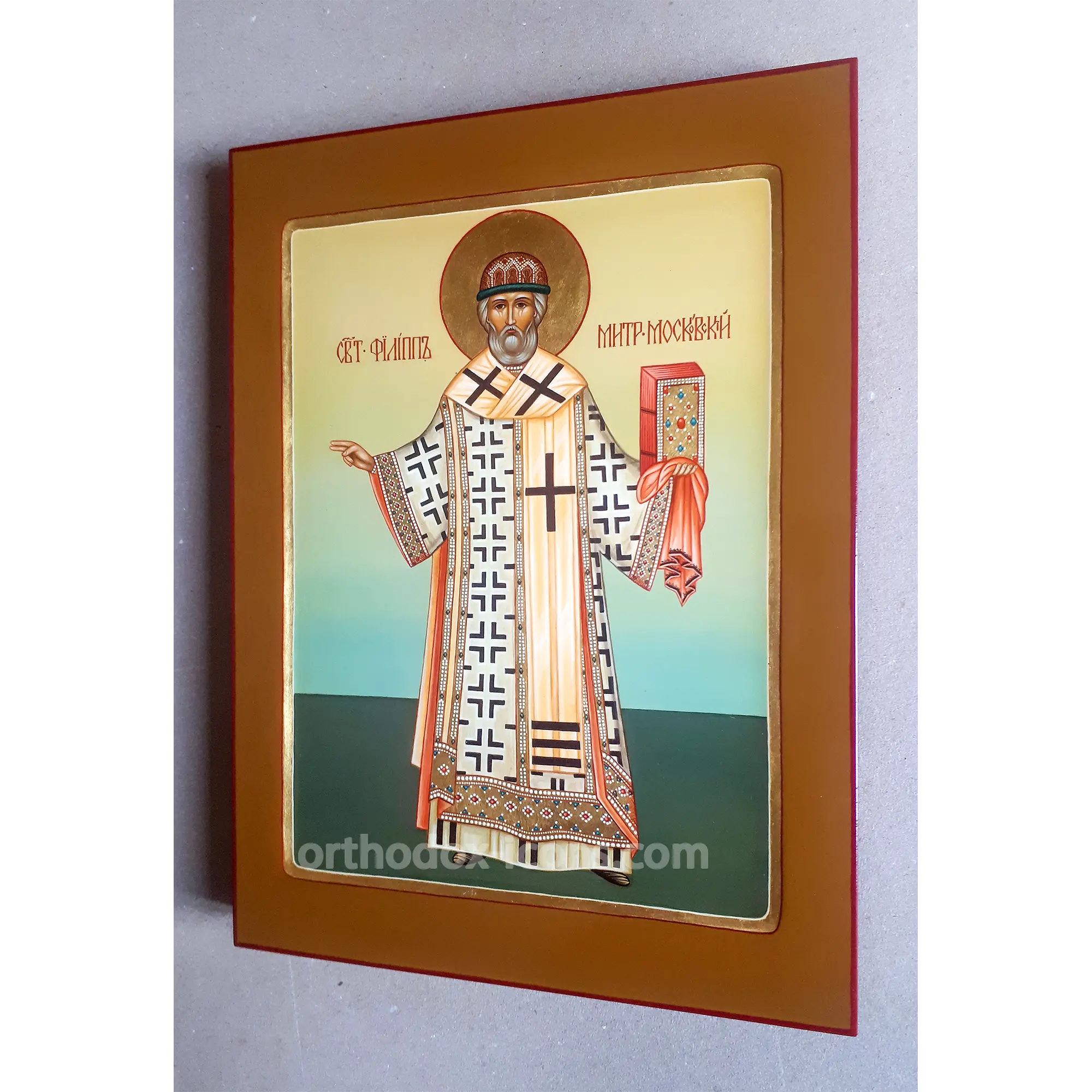
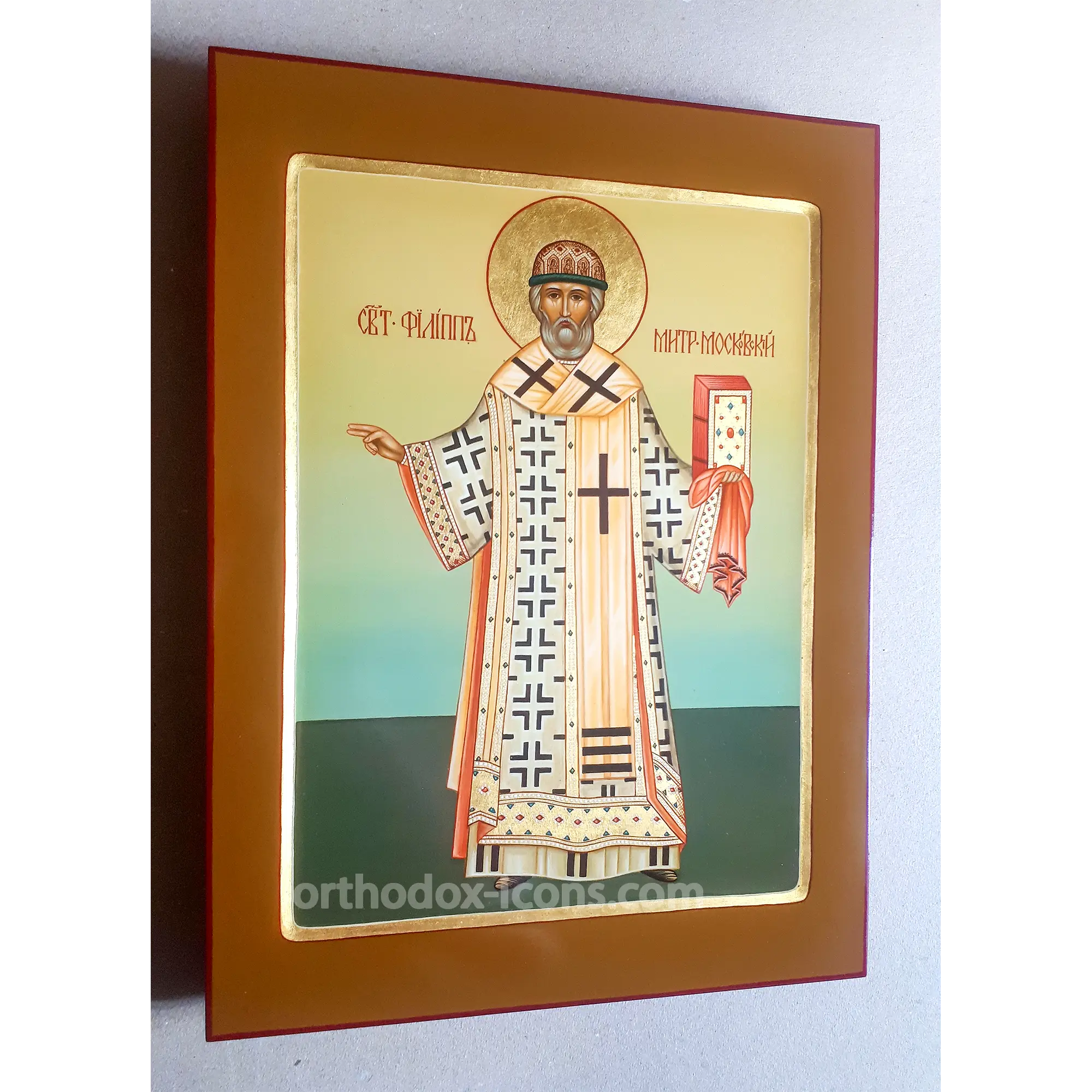
This hand-painted Philip Metropolitan of Moscow Orthodox Icon depicts Saint Philip, Metropolitan of Moscow and All Russia, a Solovki abbot, archpastor, confessor, and martyr who openly rebuked injustice in the time of Ivan the Terrible. He is shown full-length in episcopal vestments, holding the Gospel in his left hand and extending his right hand in a strong pointing and blessing gesture; the gold halo, kovcheg, light inner background, and dark borders give the icon a strict and noble character.
Prayer before this icon is often connected with strengthening of faith, courage to speak truth, spiritual steadiness, help under unjust accusations, wisdom for leaders, protection from fear, and patron saint protection for people named Philip. The icon is painted on a linden wood board with braces, kovcheg, pavoloka, chalk gesso, egg tempera, 23K gold leaf (960 purity), and a protective finish. Free international shipping is included. Payment is made after you receive and approve the icon.
It is possible to paint an image in any size to order
Free shipping worldwide
This hand-painted Philip Metropolitan of Moscow Orthodox Icon is a prayerful image of one of the strongest Russian archpastors of the sixteenth century. Saint Philip, known in the world as Feodor Kolychev, came from a noble boyar family, but left the path of courtly advancement for monastic life. He passed through the Solovki school of labor and prayer, became abbot, and later was called to the Moscow metropolitan see. His name is especially connected with Christian conscience: the saint did not agree to remain silent before cruelty, openly rebuked the lawlessness of the oprichnina, and accepted a martyr’s death while remaining faithful to Christ.
In this icon Metropolitan Philip is shown full-length in complete episcopal vestments. His left hand holds an ornamented Gospel, and his right hand is extended to the side in an expressive pointing and blessing gesture. The white hierarchal vestment with large crosses, gold halo, light background inside the kovcheg, and dark outer borders create a strict, gathered, and complete image. There is no unnecessary decoration here: the whole composition directs attention to the saint as pastor, confessor, and intercessor for those who seek truth, courage, and spiritual firmness.
Available sizes: 17×21 cm (6.7×8.3 in), 20×24 cm (7.9×9.4 in), 27×31 cm (10.6×12.2 in), and 30×40 cm (11.8×15.7 in). Larger iconostasis sizes can be made by agreement. The 17×21 cm and 20×24 cm formats are convenient for a home icon corner, personal prayer shelf, work study, or patron saint gift. The 27×31 cm size better reveals the face of the saint, gold halo, folds of the vestment, crosses on the omophorion, Gospel, and kovcheg. The 30×40 cm format is suitable for more solemn placement in a spacious home, chapel, church, parish office, or separate kiot.
This icon is especially appropriate as a name saint icon for a man or boy named Philip. Yet its meaning is wider than name patronage alone. Saint Philip is close to those who experience pressure, injustice, slander, a difficult choice, responsibility before others, or an inward struggle with fear. His image reminds the faithful that Christian meekness does not mean weakness, and love for peace does not require agreement with falsehood. Sometimes faithfulness to God is expressed in quiet endurance, an honest word, and readiness not to seek personal benefit.
Features of This Icon
The main feature of this icon is the strict hierarchal depiction of Saint Philip. He is not shown in a complicated narrative scene, but in prayerful presence: upright, calm, with the Gospel and a strong gesture of the right hand. This type of image is suitable both for home prayer and for church space, because it presents the saint first of all as an archpastor of the Church, a confessor of faith, and a guardian of Gospel truth.
The face of the saint is painted with restraint and attention. Grey hair, a short beard, direct gaze, and calm expression reveal the spiritual maturity of a man who passed from noble origin to monastic renunciation, from abbacy to metropolitan responsibility, and from Church governance to martyrdom. There is no sharp harshness in this face. Yet there is inner firmness, born not of pride, but of faithfulness to Christ.
The episcopal vestment has an important place in the composition. The light phelonion and omophorion with large crosses speak of hierarchal dignity, pastoral service, and the purity of episcopal responsibility. The crosses on the vestment are large and clear, so the image is immediately recognized as that of a bishop saint. Decorative borders, reddish accents, small ornamental elements, and measured geometric folds make the icon festive without making it overloaded.
The saint’s right hand is extended to the side. This gesture is especially important for the image of Metropolitan Philip. It can be read as a blessing and as a sign pointing toward the truth of God, before which both ordinary people and the powerful must humble themselves. Saint Philip did not seek conflict for its own sake, but he could not bless cruelty and lawlessness. The gesture makes the icon feel alive: the saint seems to address the one who prays and remind him that conscience cannot be postponed.
The Gospel in the left hand is the central sign of his archpastoral ministry. Saint Philip rebuked falsehood not from personal resentment and not for earthly influence. His word was rooted in the Gospel, in pastoral responsibility, and in the understanding that a Church archpastor cannot replace divine truth with human fear. The book in his hand reminds the faithful that the measure of Christian life is the word of God, not advantage, habit, pressure, or fear of power.
The icon is made with a kovcheg. The central part of the board is recessed, and the borders separate the holy image, giving the composition traditional iconographic depth. The light background inside the kovcheg makes the figure clear and calm, the gold halo gently emphasizes the face, and the dark outer borders gather the image and give it special strictness. This contrast is very fitting for Saint Philip: the light of spiritual truth appears against the background of historical heaviness, trial, and human fear.
Iconography of Saint Philip of Moscow
In Orthodox iconography Saint Philip, Metropolitan of Moscow, is usually depicted as a hierarch: in episcopal vestments, with an omophorion, the Gospel, and a blessing gesture. This is not only an external sign of rank. The whole iconography speaks of his service to the Church. He was not a political opponent of the tsar or a secular reformer, but an archpastor who answered before God for his flock and for the purity of Church witness.
The omophorion with crosses recalls the pastoral burden. Episcopal ministry is not honor and ornament, but responsibility for people, word, faith, and the peace of the Church. In the life of Saint Philip this burden became especially heavy. He did not limit himself to calm external service, but stood up for the humiliated, rebuked cruelty, and refused to bless lawlessness. On the icon, therefore, the episcopal vestment is seen as a visible sign of his cross.
The Gospel in the saint’s hand speaks of the spiritual foundation of his courage. Saint Philip had no earthly force that could protect him from the tsar’s anger. But he had faith, pastoral conscience, and the understanding that the word of God stands above human arbitrariness. For this reason his image is especially close to those who pray for honesty, sober discernment, the ability not to betray truth, and the strength not to become hardened while resisting falsehood.
The gold halo around the head of the saint reveals his glorification in the Church. The halo is not a decorative crown; it is a sign of grace-filled light in which the saint participates through communion with Christ. In this icon the halo is warm and restrained: it emphasizes the face without contradicting the strictness of the whole image. Because of this, the icon preserves prayerful simplicity and inner strength.
Prayer Before the Icon of Metropolitan Philip
Before the icon of Saint Philip, Orthodox Christians may pray for strengthening of faith, spiritual steadiness, courage, and help in difficult circumstances. His image is especially close to people who face injustice, slander, pressure, hard moral choices, or fear of speaking truth. Saint Philip helps us remember that a Christian can be peaceful and firm, humble and fearless at the same time.
- for strengthening of faith and faithfulness to Christ;
- for courage to speak truth without malice or pride;
- for help during unjust accusations, slander, and pressure;
- for wisdom for leaders, mentors, and people with responsible service;
- for protection from fear, faintheartedness, and inward compromise with falsehood;
- for spiritual discernment in difficult decisions;
- for peace in the Church and strengthening of pastors;
- for support for those who serve in a church, monastery, or parish community;
- for patience in sorrows, persecution, and life’s trials;
- for heavenly patronage for people named Philip.
Prayer before the icon of Metropolitan Philip is not a request for victory over other people at any cost. More deeply, it is an appeal to God for a clean conscience, strength of heart, humility, and the ability to act in a Christian way. Saint Philip teaches how to hold firmness and love together. Truth without love can become hardness, while love without truth can become weakness. In his image these two sides do not separate: the saint remains both a strict confessor and an intercessor for people.
Brief Life of Saint Philip
Saint Philip, whose secular name was Feodor Kolychev, was born in 1507 and came from a noble boyar family. From early years he was prepared for service at court, but his heart longed for another life. Leaving worldly prospects behind, he went north to the Solovki Monastery, where he accepted monasticism with the name Philip. This was not an escape from responsibility, but a search for true service to God.
In the Solovki Monastery the saint passed through the path of novice, monk, and abbot. He labored greatly, strengthened monastic life, cared for construction, practical order, the prayerful rhythm of the monastery, and the brethren. Under him, the Solovki Monastery grew stronger both spiritually and outwardly. Saint Philip was not only a contemplative; he took part in labor himself, helped build, organized the life of the monastery, and showed an example of active monastic responsibility.
In 1566, by the will of Tsar Ivan the Terrible, Philip was appointed Metropolitan of Moscow and All Russia. He did not wish to accept this difficult service quickly, understanding the danger and complexity of the time. Yet when he became first hierarch, he did not turn his see into a place of comfort. Very soon he saw that the oprichnina brought fear, blood, ruin, and falsehood to the country. He could not remain silent.
Saint Philip openly rebuked the tsar and called for an end to violence. His word was peaceful in spirit, but firm in content. He refused to bless lawlessness, for which he was slandered, removed from his see, and exiled to the Otroch Monastery in Tver. There, in 1569, he accepted a martyr’s death. Later his relics were transferred to the Solovki Monastery and then to Moscow. The Church honors him as a hierarch, confessor, and martyr who did not betray truth for the sake of safety.
Commemoration and Patron Saint Meaning
The main commemoration of Saint Philip, Metropolitan of Moscow, is celebrated on January 22 according to the new calendar, corresponding to January 9 according to the old calendar. The Church also celebrates the translation of his relics on July 16. In addition, Saint Philip is remembered among the Moscow hierarchs, the Solovki saints, and other conciliar commemorations.
An icon of Metropolitan Philip is especially suitable as a patron saint icon for a man or boy named Philip. It may be given for baptism, name day, birthday, graduation, the beginning of responsible service, ordination, a new home, or an important family occasion. It is not simply a name saint image, but a strong reminder of conscience, honesty, and spiritual responsibility.
The name Philip is connected with several saints in the Orthodox calendar, so when choosing a patron saint icon it is important to know in honor of which heavenly patron the person was baptized. If the patron is Saint Philip of Moscow, this hierarchal icon is especially accurate and personal. For a home iconostasis, it can become a daily reminder of courage, prayerful firmness, and faithfulness to Christ in difficult circumstances.
Materials, Gold Leaf, and Custom Options
The icon of Metropolitan Philip is painted on a linden wood board. Applied or mortise braces are used for stability. The central part of the board is made with a kovcheg: the holy image is placed in a recessed area, while the borders form the traditional iconographic frame. Pavoloka and chalk gesso are applied to the board, and then the image is painted in egg tempera.
In this version, 23K gold leaf (960 purity) has an important role. Gold is used in the halo, inner frame, and selected parts of the composition, creating a warm ecclesiastical radiance. The face, hands, Gospel, episcopal vestment, crosses, inscriptions, and decorative elements are painted by hand. The final protective finish helps preserve the painting and gilding.
The color harmony is restrained and noble: the light vestment with large crosses, gold halo, soft background, dark outer borders, and fine red outline create a calm and strict impression. This image does not overload the eye and is well suited for a prayer place. The viewer’s attention naturally rests on the face of the saint, the Gospel, and the gesture of the right hand.
For an individual commission, the size, border decoration, degree of gilding, background tone, inscription style, kiot, and format for a home, church, chapel, or iconostasis can be discussed. In a larger version it is especially important to preserve the expressiveness of the face, clarity of the gesture, readability of the Gospel, and harmony between the kovcheg, borders, and central figure.
Choosing the Size
The 17×21 cm (6.7×8.3 in) size is suitable for a small home icon corner, personal prayer shelf, work study, or compact patron saint gift. In this format the main details remain readable: the face of the saint, halo, right hand, Gospel, and general silhouette of the episcopal vestment.
The 20×24 cm (7.9×9.4 in) size remains convenient for home use, but gives more space for painting the face, hands, book, omophorion, and crosses on the vestment. This format is often chosen for a family iconostasis or as a gift for an adult named Philip.
The 27×31 cm (10.6×12.2 in) size reveals the painting and decorative details more fully: the kovcheg, gold halo, dark borders, folds of the vestment, inscriptions, Gospel, and expressive right-hand gesture become clearer. This is a good option for a spacious home icon corner, separate kiot, or church office.
The 30×40 cm (11.8×15.7 in) size is chosen for more solemn placement in a large home, prayer room, church, chapel, or iconostasis row. Iconostasis sizes are selected individually with attention to placement height, lighting, neighboring icons, and the whole rhythm of the church space.
Placement, Blessing, and Care
The icon of Metropolitan Philip may be placed in a home icon corner beside icons of Christ, the Mother of God, the Guardian Angel, Saint Nicholas the Wonderworker, the Solovki saints, the Moscow hierarchs, and other heavenly patrons of the family. For a person named Philip, this image can become a personal patron saint icon and a constant reminder of heavenly intercession.
After receiving the icon, it may be blessed in an Orthodox church. A blessed icon is intended for prayer, thanksgiving to God, and asking Saint Philip for faith, courage, truthfulness, steadfastness, help in service, protection from fear, and spiritual strengthening.
A hand-painted icon should be protected from direct sunlight, moisture, overheating, smoke, soot, and sudden temperature changes. Do not wipe the surface with wet cloths, alcohol, household cleaners, or rough fabric. The face of the saint, gilded halo, Gospel, hands, inscriptions, kovcheg, and borders require especially careful handling.
Dust should be removed gently with a soft dry brush and without pressure. For long-term protection of the painting, gilding, and kovcheg, a wooden glazed kiot is recommended. It helps preserve the icon from dust, humidity, and accidental damage, especially when the icon is placed in an active home area, study, church, or intended for long-term use.
Questions and Answers
Who is depicted in the Philip Metropolitan of Moscow Orthodox Icon?
The icon depicts Saint Philip, Metropolitan of Moscow and All Russia, a Solovki abbot, archpastor, confessor, and martyr of the sixteenth century.
Why is Saint Philip shown in episcopal vestments?
He was Metropolitan of Moscow, so the icon shows him as a hierarch in episcopal vestments, with an omophorion, crosses, the Gospel, and a blessing gesture.
What does the Gospel in Saint Philip’s hand mean?
The Gospel points to his archpastoral ministry, faithfulness to the word of God, Church teaching, and the spiritual foundation of his witness against injustice.
What does the gesture of the right hand signify?
The gesture may be read as both blessing and pointing toward divine truth, recalling Saint Philip’s refusal to bless cruelty and lawlessness.
What do Orthodox Christians pray for before this icon?
Prayer before this icon is often connected with faith, courage, honesty, help during slander or unjust accusations, protection from fear, and strength in difficult moral choices.
Who may choose this icon as a patron saint icon?
This icon is especially suitable for a man or boy named Philip, and also for clergy, leaders, teachers, mentors, and those who value faithfulness to Christian conscience.
When is Saint Philip of Moscow commemorated?
The main commemoration of Saint Philip is on January 22 according to the new calendar, corresponding to January 9 according to the old calendar. The translation of his relics is celebrated on July 16.
Does this icon have a kovcheg?
Yes. The icon is painted in a kovcheg, with the central part of the board recessed and the borders visually separating the holy image.
Where can this icon be placed?
The icon may be placed in a home icon corner, personal prayer place, study, church office, chapel, church, or iconostasis row.
How should a hand-painted icon with gold leaf be cared for?
Keep the icon away from moisture, direct sunlight, heat, smoke, and mechanical damage. Dust it gently with a soft dry brush, and consider a glazed kiot for long-term protection.
| Dimensions | 17x21cm (6.7×8.3 in), 20x24cm (7.9×9.4 in), 27x31cm (10.6×12.2 in), 30x40cm (11.8×15.7 in) |
|---|---|
| Name | Philip |