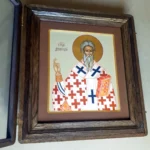
Dionysius the Areopagite Orthodox Icon
Price range: $500 through $1600
Available sizes: 17×21 cm (6.7×8.3 in), 20×24 cm (7.9×9.4 in), 27×31 cm (10.6×12.2 in), 30×40 cm (11.8×15.7 in). Larger iconostasis sizes can be made by agreement.
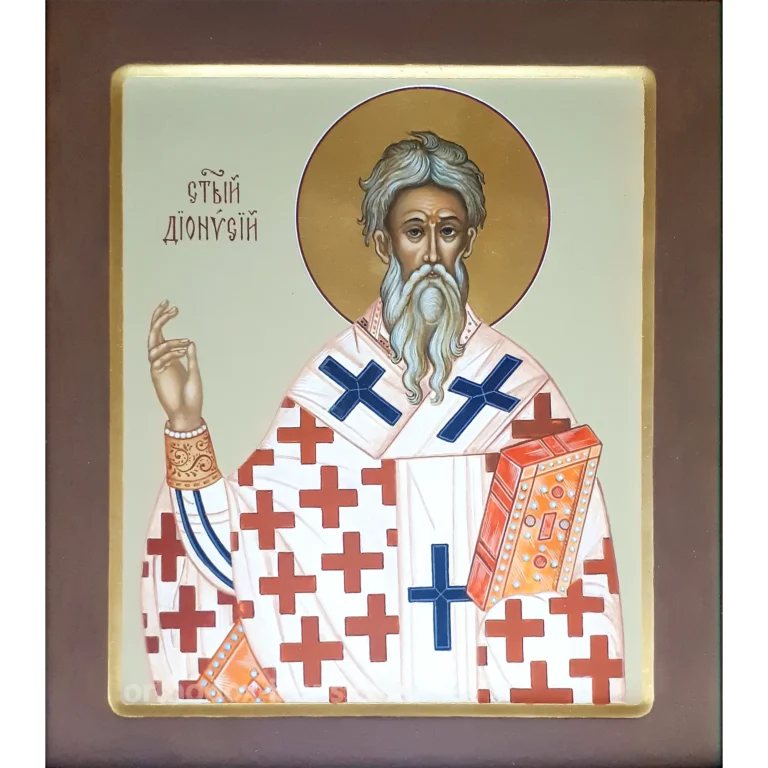
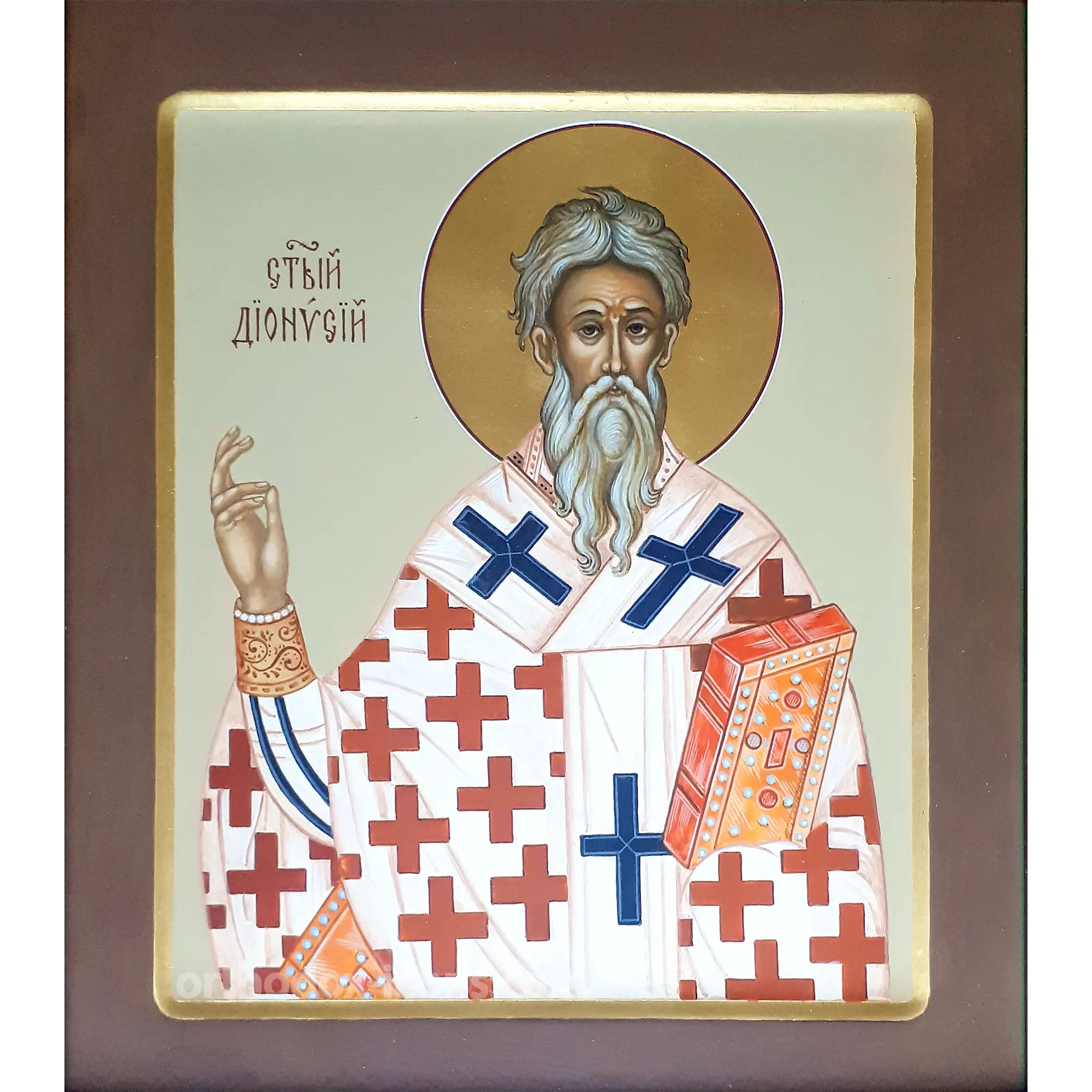
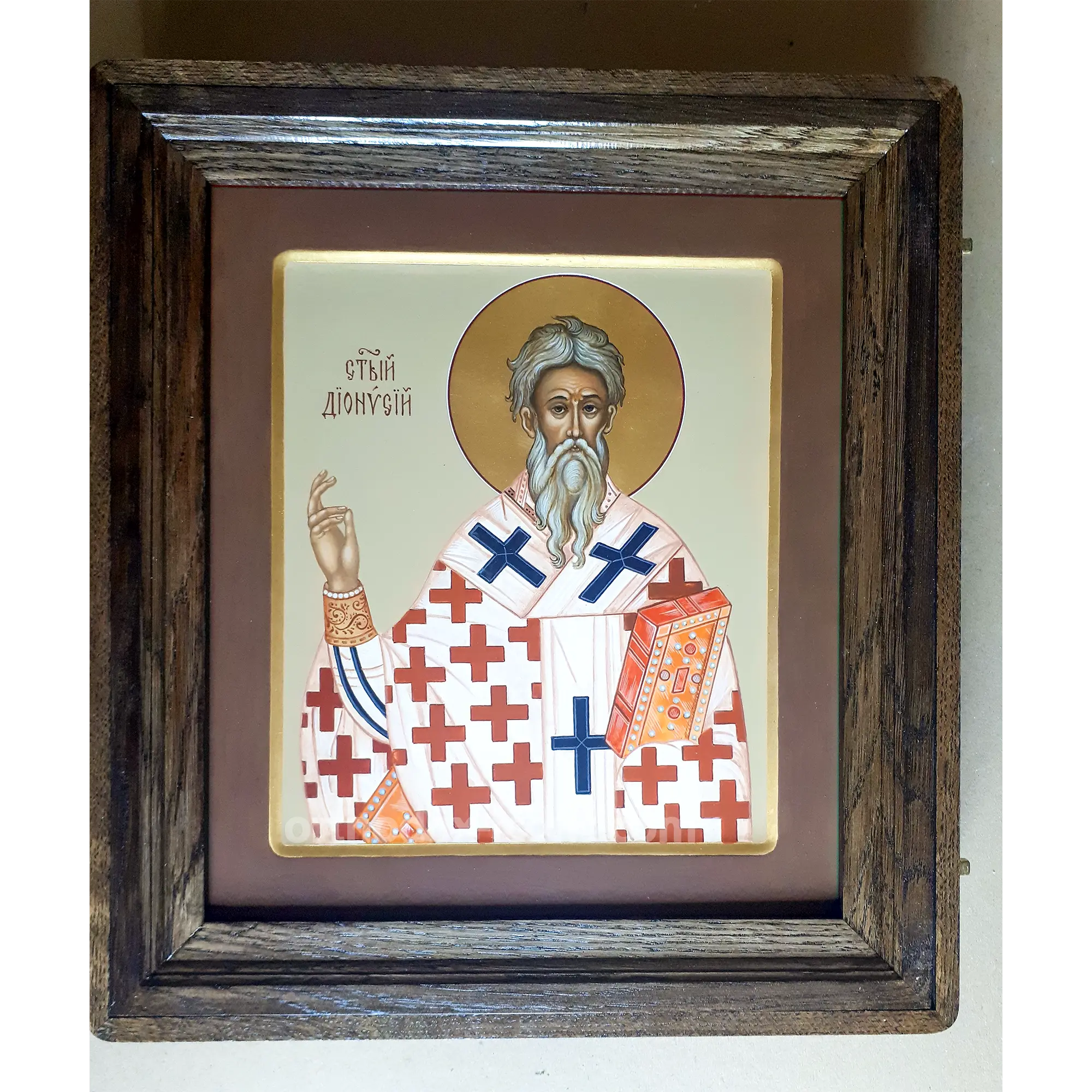
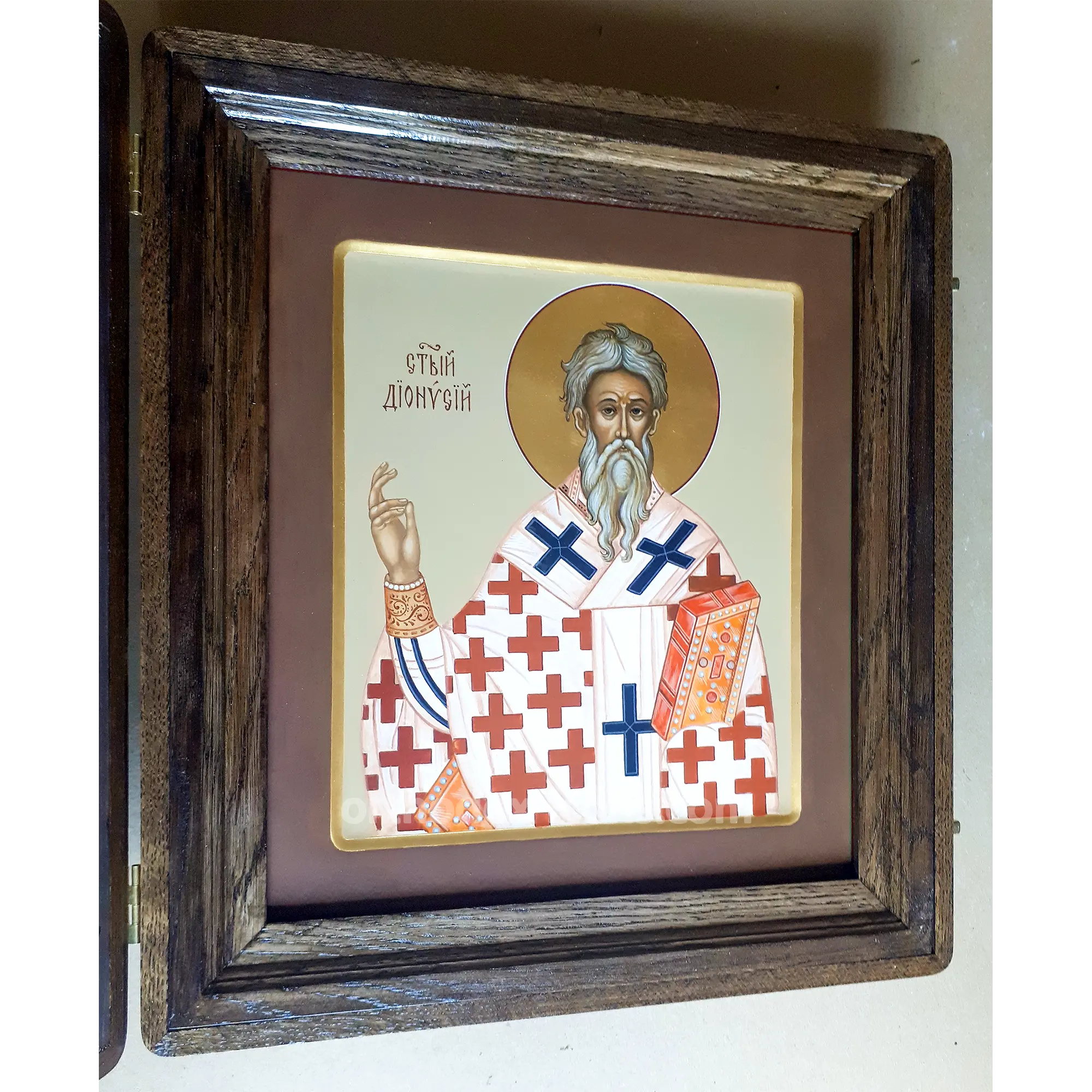
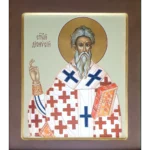
This hand-painted Dionysius the Areopagite Orthodox Icon depicts the holy hieromartyr Dionysius, Bishop of Athens, a disciple of the Apostle Paul and one of the revered saints of the early Church. He is shown in episcopal vestments, blessing with his right hand and holding the Gospel in his left hand; the white omophorion with crosses, gold halo, light background, kovcheg, and calm composition emphasize his ministry as bishop, theologian, and faithful witness to Christ.
Prayer before this icon is often connected with strengthening of faith, spiritual discernment, wisdom in study and decisions, help in theology and Church learning, purity of thought, steadfastness in trials, and patron saint protection for men named Dionysius or Denis. The icon is painted on a linden wood board with braces, kovcheg, pavoloka, chalk gesso, egg tempera, mineral pigments, 23K gold leaf (960 purity), and a protective finish. Free international shipping is included. Payment is made after you receive and approve the icon.
It is possible to paint an image in any size to order
Free shipping worldwide
This hand-painted Dionysius the Areopagite Orthodox Icon is a prayerful image of Saint Dionysius, Bishop of Athens, a disciple of the Apostle Paul, theologian, hierarch, and hieromartyr of the early Church.
Saint Dionysius came from Athens and belonged to the educated world of the Areopagus. His earthly dignity, learning, and public position were transformed by the apostolic preaching of Saint Paul. In Orthodox tradition he is honored not merely as a learned man, but as a bishop who received the Christian faith, served the Church, taught the Gospel, and remained faithful to Christ. For this reason his icon is especially meaningful for those who seek spiritual clarity, discernment, steadiness of faith, help in learning, theological work, teaching, pastoral service, or responsible leadership.
In this icon Saint Dionysius is shown in episcopal vestments. His right hand is raised in blessing, and in his left hand he holds the Gospel. The white omophorion with crosses, light vestment with geometric ornament, gold halo, calm frontal gaze, and restrained color harmony present him as a bishop and teacher of the Church. The image is solemn without being visually overloaded: attention remains on the face, the blessing hand, the Gospel book, and the hierarchal dignity of the saint.
Available sizes: 17×21 cm (6.7×8.3 in), 20×24 cm (7.9×9.4 in), 27×31 cm (10.6×12.2 in), and 30×40 cm (11.8×15.7 in). Larger iconostasis sizes can be made by agreement. The smaller formats are suitable for a home icon corner, personal prayer shelf, office, or patron saint gift. The 27×31 cm and 30×40 cm formats reveal more of the saint’s face, grey hair and beard, omophorion, Gospel, blessing hand, kovcheg, and fine lines of the episcopal vestment. A larger commission may be chosen for a church, chapel, theological school, parish office, or iconostasis row.
This icon is often chosen as a name saint icon for a man or boy named Dionysius. It may also be appropriate for Denis if Saint Dionysius the Areopagite is his baptismal patron saint. The meaning of the image is wider than name patronage alone. Saint Dionysius reminds the faithful of the meeting of faith and reason, education and humility, theological depth and obedience to the Church.
Features of This Icon
The main feature of this icon is the hierarchal depiction of Saint Dionysius. He is not presented as an abstract philosopher or secular wise man, but as a saintly bishop of the Church: vested for sacred ministry, holding the Gospel, and blessing the faithful. This is an important emphasis. Dionysius the Areopagite was brought to faith through apostolic preaching and, according to tradition, became Bishop of Athens; therefore the episcopal vestments reveal both his connection with Saint Paul and his pastoral responsibility for the Christian community.
The face of the saint is painted with softness and attention. The grey hair, long light beard, calm eyes, and slightly sorrowful expression form the image of a spiritually mature man. There is no outward harshness in the face, but there is inner sobriety: the seriousness that comes from prayer, experience, humility, and faithfulness to truth. This makes the icon suitable for quiet personal prayer, because it does not distract the viewer with excessive decoration.
The right hand is formed in a blessing gesture. For a bishop saint this detail is natural and expressive. Saint Dionysius stands before the faithful as one who teaches, blesses, supports, and guides. The Gospel in his left hand is the sign of Christ’s preaching, Church teaching, and spiritual responsibility. The book, with its darker field and reddish binding, stands out clearly against the light vestment.
The white omophorion with large crosses emphasizes the archpastoral dignity of the saint. The red and blue crosses, geometric vestment pattern, and neat decorative elements on the cuffs and book are not decorative for their own sake. They help reveal the image of a man of the Church, connected with worship, pastoral care, preaching, and the preservation of apostolic faith.
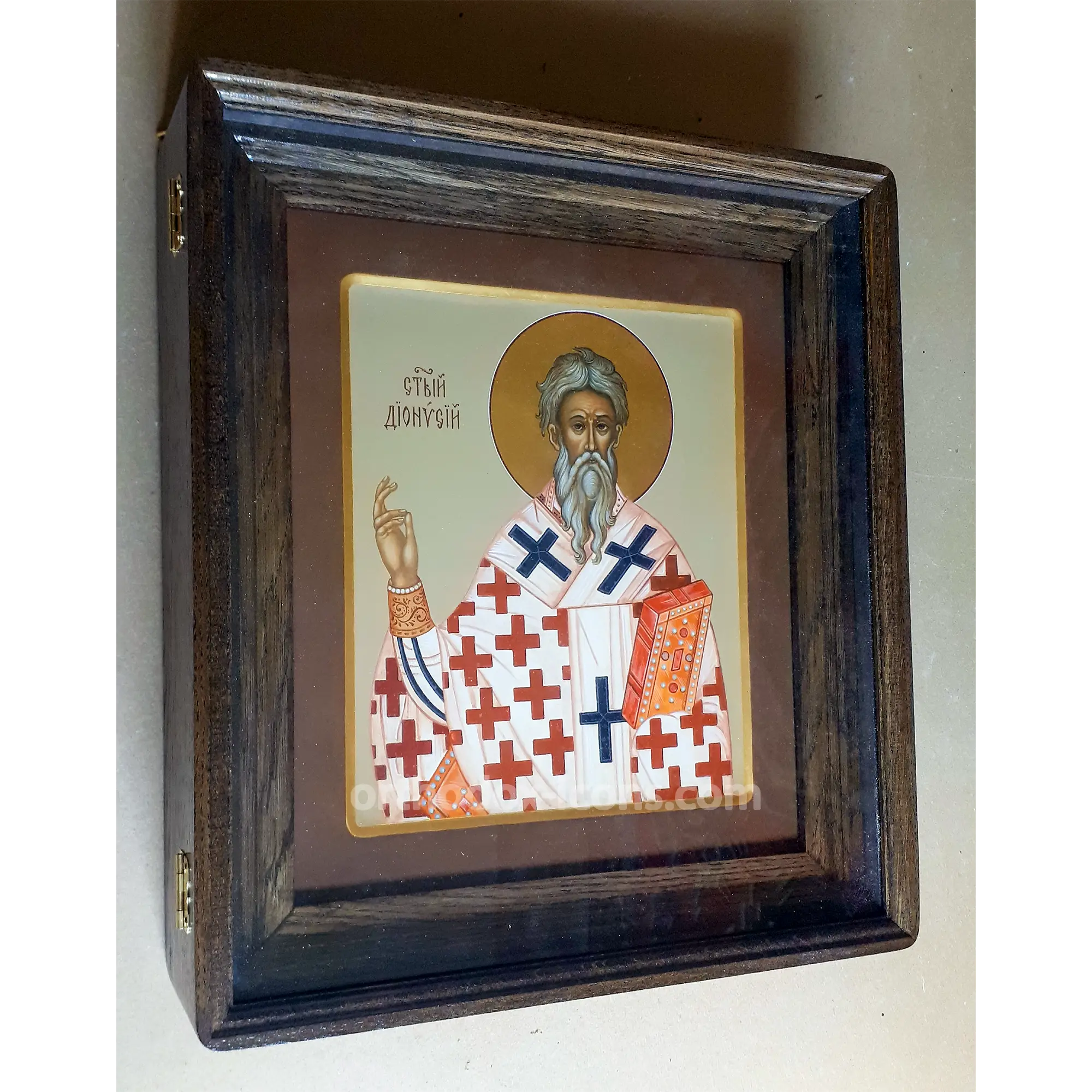
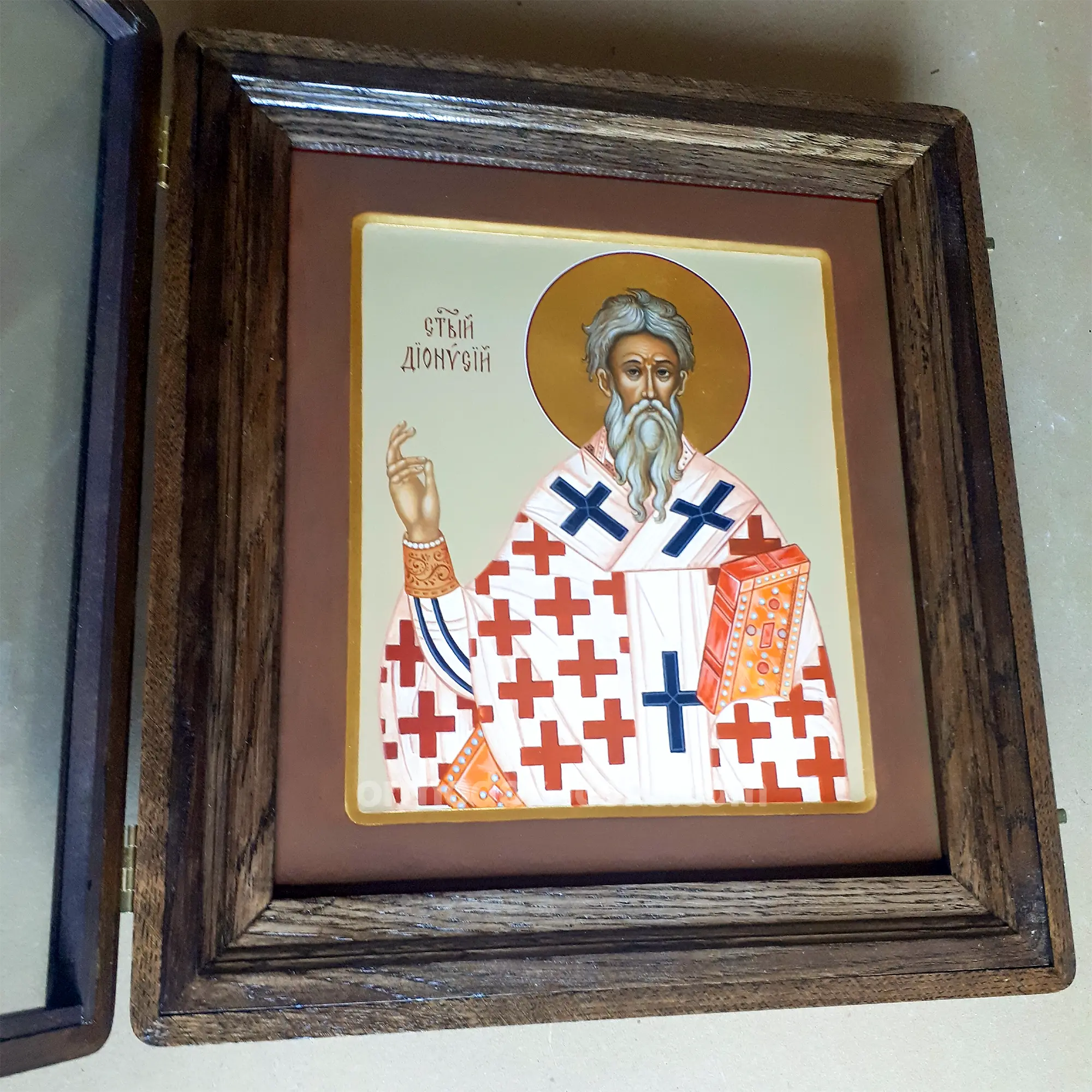
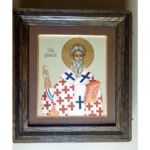
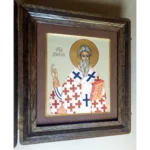
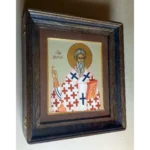
The icon is painted in a kovcheg. The recessed central area of the board sets apart the figure of the saint, while the wider borders give the icon a gathered and complete appearance. The warm gold halo and gilded interior bring light and ecclesiastical solemnity to the image. The outer borders are kept in a calm brown tone, so the icon looks noble, restrained, and not overloaded.
Iconography of Saint Dionysius the Areopagite
In Orthodox iconography Saint Dionysius the Areopagite is usually shown as a hierarch: in episcopal vestments, with the Gospel, a blessing hand, and a halo. This image brings together several meanings. It recalls his conversion through the preaching of the Apostle Paul, presents him as Bishop of Athens, and shows him as a theologian and teacher whose name is associated in Church tradition with deep reflection on the spiritual life, heavenly hierarchy, knowledge of God, and the ascent of the soul toward God.
The Gospel in the hand of Saint Dionysius is the central iconographic sign. It speaks not only about personal belief, but about service to the word of God. Saint Dionysius was educated, yet his wisdom became truly luminous after his meeting with Christian truth. The book therefore reminds the faithful that human reason becomes clear and fruitful when it is humbled before God and serves truth rather than pride.
The omophorion with crosses points to episcopal ministry. In the Church, a bishop is not simply a person of honor, but one who bears pastoral responsibility: guarding the faith, teaching, blessing, and caring for the spiritual life of the people. In this icon the theme is expressed calmly and clearly. Saint Dionysius is not shown in a complicated narrative scene, but stands before the praying person as a bishop, teacher, intercessor, and guide.
The gold halo around the head of the saint reveals his glorification in the Church. The halo is not a decorative crown; it is a sign of divine light in which the saint participates through communion with Christ. In this icon the halo is especially readable because of the warm gold tone and fine red outline. It frames the face while preserving the restrained character of the whole image.
Prayer Before the Icon of Saint Dionysius
Before the icon of Saint Dionysius the Areopagite, Orthodox Christians may pray for strengthening of faith, spiritual discernment, and help in understanding Christian life rightly. His image is especially close to people who need to join education, reason, professional responsibility, and faith. Saint Dionysius reminds us that true wisdom does not stand against God, but seeks the light of Christ and learns humility.
- for strengthening of faith and faithfulness to Christ;
- for spiritual discernment and sobriety of thought;
- for help in studying theology, philosophy, Church history, and Holy Scripture;
- for wisdom for teachers, scholars, students, and mentors;
- for right decisions in difficult circumstances;
- for humility in education, knowledge, and high responsibility;
- for firmness in confessing the Orthodox faith;
- for help in Church, priestly, teaching, and pastoral service;
- for protection from pride, spiritual distraction, and false teaching;
- for heavenly patronage for those named Dionysius or Denis.
Prayer before this icon is not a request for outward success at any cost. It is an appeal to God through the intercession of a saint who passed from human learning to Christian truth. His image helps the faithful ask not only for knowledge, but for purity of heart; not only for answers, but for the ability to accept God’s will; not only for strength to speak, but for wisdom to listen, be silent, and discern in a Christian way.
Brief Life of Saint Dionysius
Saint Dionysius the Areopagite lived in the first century in Athens. He was a member of the Areopagus, the high court and public assembly of the city, and was a noble and educated man familiar with the philosophical culture of the ancient world. The Acts of the Apostles records that after the preaching of the Apostle Paul in Athens, some believed, and among them was Dionysius the Areopagite. This meeting with apostolic preaching changed his life.
According to Church tradition, after his conversion Dionysius became a disciple of the Apostle Paul and was appointed Bishop of Athens. His ministry belonged to the time when Christianity was only beginning to spread among the peoples of the Roman Empire. Such service required not only education and eloquence, but above all courage, faithfulness, and readiness to endure misunderstanding and persecution.
Saint Dionysius is honored as a hieromartyr. His life shows how human wisdom is transformed when it meets the Gospel. He did not reject reason, but placed it in the service of Christ. He did not abandon responsibility, but filled it with Church meaning. He did not hide inside private learning, but became a shepherd and witness of the faith.
In Church tradition the name of Dionysius the Areopagite is associated with theological depth and the spiritual ascent of the human person toward God. For the one who prays before his icon, this is especially important: Christian faith is not a shallow feeling. It calls for attention, purification of the heart, discernment, humility, and willingness to live according to truth.
Commemoration and Patron Saint Meaning
Saint Dionysius the Areopagite, Bishop of Athens, is commemorated on October 16 according to the new calendar, corresponding to October 3 according to the old calendar. He is also remembered among the Seventy Apostles. For a person named Dionysius or Denis, October 16 may be a name day if Saint Dionysius the Areopagite is the heavenly patron chosen at baptism.
A name saint icon of Saint Dionysius can be an appropriate gift for baptism, name day, birthday, graduation, entry into a theological school, the beginning of teaching work, ordination, a new home, or an important family occasion. Unlike many more common patron saint images, the icon of Dionysius the Areopagite carries a particular emphasis on faith, reason, spiritual guidance, and responsibility for the word.
The name Dionysius is connected with several saints in the Orthodox calendar, so when choosing a patron saint icon it is important to know in honor of which saint the person was baptized. If the patron saint is Saint Dionysius the Areopagite, this episcopal icon is especially accurate. For Denis, the icon can also become a personal prayer image when the baptismal name is connected with Dionysius.
Materials, Gold Leaf, and Custom Options
The icon of Saint Dionysius is painted on a linden wood board. Applied or mortise braces are used for stability. The central area is made with a kovcheg, so the image is painted in a recessed field that gives traditional icon depth and separates the holy figure from the borders. Pavoloka and chalk gesso are applied to the front surface to create a strong and even ground for painting.
The face, hair, beard, hands, episcopal vestments, omophorion, Gospel, inscriptions, and decorative elements are painted in egg tempera. The gilding is made with 23K gold leaf (960 purity). In this icon the gold is especially important in the halo and the inner space of the image: it creates a warm radiance and underlines the spiritual meaning of the composition. A final protective finish helps preserve the painting.
The decoration of this icon is noble and restrained. There is no excessive brightness: the warm gilded central area, brown borders, white episcopal vestment, and red-blue crosses create a serious and balanced color harmony. This version is suitable for a patron saint icon, home iconostasis, study, prayer place, church, or iconostasis row.
For an individual commission, the size, border decoration, degree of gilding, inscription, background tone, kiot, and format for a home, church, chapel, or iconostasis can be discussed. In a larger version it is especially important to preserve the expressiveness of the face, clarity of the blessing hand, readability of the Gospel, and harmony between the kovcheg, borders, and central figure.
Choosing the Size
The 17×21 cm (6.7×8.3 in) size is suitable for a small home icon corner, personal prayer shelf, office, or compact name saint gift. In this format the main details remain readable: the saint’s face, halo, blessing hand, Gospel, and white omophorion with crosses.
The 20×24 cm (7.9×9.4 in) size looks slightly more expressive while remaining convenient for everyday home placement. It is often chosen for a family iconostasis, office, gift to a student, teacher, spiritual mentor, or a person named Dionysius or Denis.
The 27×31 cm (10.6×12.2 in) size reveals more of the painting: the features of the face, grey hair and beard, folds of the vestment, geometric ornament, book, kovcheg, and gilded halo become clearer. This format is suitable for a spacious home icon corner, individual kiot, or church office.
The 30×40 cm (11.8×15.7 in) size is chosen for a more solemn placement in a large home, prayer room, church, chapel, or theological study space. Iconostasis sizes are selected individually with attention to placement height, lighting, neighboring icons, and the whole rhythm of the icon row.
Placement, Blessing, and Care
The icon of Saint Dionysius may be placed in a home icon corner beside icons of Christ, the Mother of God, the Guardian Angel, the Apostle Paul, Saint Nicholas, family patron saints, and other beloved saints. For a person named Dionysius or Denis, it may become a personal patron saint icon and a constant reminder of heavenly intercession.
After receiving the icon, it may be blessed in an Orthodox church. A blessed icon is intended for prayer, thanksgiving to God, and asking Saint Dionysius for faith, wisdom, spiritual discernment, firmness in service, help in study, and protection from spiritual distraction.
A hand-painted icon should be protected from direct sunlight, moisture, overheating, smoke, soot, and sudden temperature changes. Do not wipe the surface with wet cloths, alcohol, household cleaners, or rough fabric. The face of the saint, gilded halo, Gospel, blessing hand, inscriptions, kovcheg, and borders require especially careful handling.
Dust should be removed gently with a soft dry brush and without pressure. For long-term protection of the painting, gilding, and kovcheg, a wooden glazed kiot is recommended. It helps protect the icon from dust, humidity, and accidental damage, especially when the icon is placed in an active home area, office, or intended for long-term church use.
Questions and Answers
Who is depicted in the Dionysius the Areopagite Orthodox Icon?
The icon depicts Saint Dionysius the Areopagite, Bishop of Athens, a disciple of the Apostle Paul, a hieromartyr, and a revered saint of the early Christian Church.
Why is Saint Dionysius shown in episcopal vestments?
According to Church tradition, after his conversion to Christ Saint Dionysius became Bishop of Athens, so he is shown as a hierarch in liturgical vestments with an omophorion.
What does the Gospel in his hand mean?
The Gospel points to the preaching of Christ, Church teaching, episcopal responsibility, and the spiritual guidance associated with Saint Dionysius.
What does the blessing hand signify?
The blessing hand presents Saint Dionysius as a bishop who teaches, blesses, guides, and intercedes for the faithful before God.
What is the kovcheg in this icon?
The kovcheg is the recessed central area of the icon board. It visually separates the holy image from the borders and gives the composition traditional iconographic depth.
What do Orthodox Christians pray for before this icon?
Prayer before this icon is often connected with strengthening of faith, spiritual discernment, wisdom in study and decisions, theological work, steadfastness in trials, and protection from false teaching.
Who may choose Saint Dionysius as a patron saint icon?
This icon is especially suitable for a man or boy named Dionysius, and also for Denis if Saint Dionysius the Areopagite is his baptismal patron saint.
When is Saint Dionysius the Areopagite commemorated?
Saint Dionysius the Areopagite is commemorated on October 16 according to the new calendar, which corresponds to October 3 according to the old calendar.
Where can this icon be placed?
The icon may be placed in a home icon corner, private prayer space, study, office, chapel, church, theological school, or iconostasis row.
How should a hand-painted icon with gold leaf be cared for?
Keep the icon away from direct sunlight, moisture, heat, smoke, and sudden temperature changes. Dust it gently with a soft dry brush, and consider a glazed kiot for long-term protection.
| Dimensions | 17x21cm (6.7×8.3 in), 20x24cm (7.9×9.4 in), 27x31cm (10.6×12.2 in), 30x40cm (11.8×15.7 in) |
|---|---|
| Name | Dionisius |