Hand-Painted Icon of Saint Tryphon of Apamea
Price range: $700 through $2100
Available sizes: 17×21 cm (6.7×8.3 in), 20×24 cm (7.9×9.4 in), 27×31 cm (10.6×12.2 in), 30×40 cm (11.8×15.7 in).
This hand-painted icon of Saint Tryphon of Apamea is made to order in the traditional Orthodox manner. Saint Tryphon is venerated as a young martyr of the third century, known for his firm confession of Christ, his purity of life, and his prayerful help to those who work with the land.
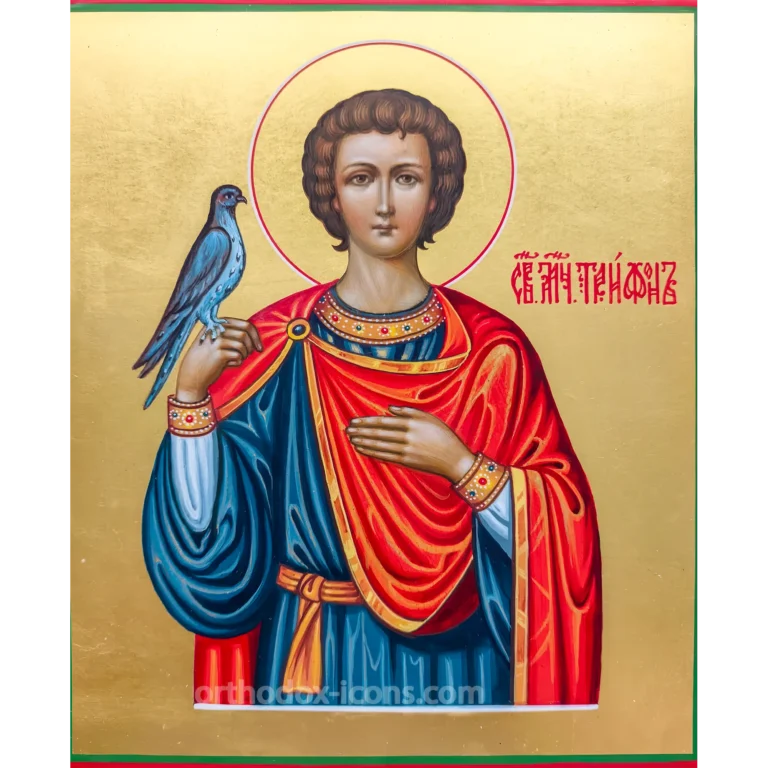
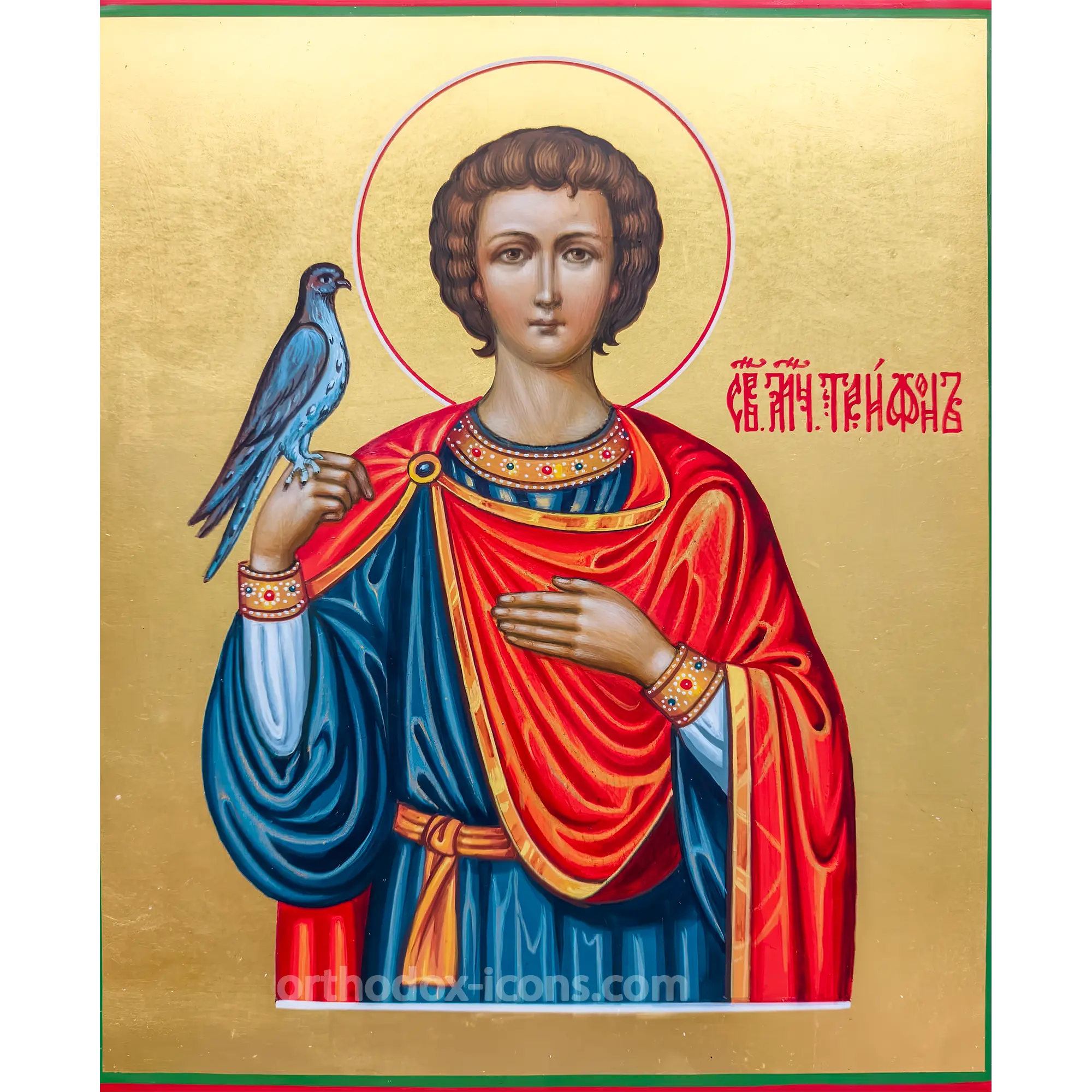
In this icon he is shown as a youthful saint, often with a bird on his hand, a traditional attribute connected with his patronage of gardeners, farmers, hunters, and those who ask God for protection of crops and honest labor.
Materials: linden wood panel with support battens, linen cloth, chalk gesso, 23K gold leaf (960 purity), egg tempera, and protective varnish.
Free international shipping is included. Payment is made after you receive and approve the icon.
It is possible to paint an image in any size to order
Free shipping worldwide
This hand-painted icon of Saint Tryphon of Apamea presents one of the beloved young martyrs of the early Church. In Orthodox tradition, Saint Tryphon is remembered for purity of heart, steadfast faith, and courageous confession of Christ. His image is especially meaningful for those who ask God’s blessing on work with the land, gardens, orchards, beekeeping, hunting, fishing, and all honest labor connected with nature.
The icon is painted to order on a prepared wooden panel in egg tempera, with 23K gold leaf (960 purity) and traditional hand-painted details. It is made with a linden wood panel, support battens, linen cloth, chalk gesso, egg tempera, gold leaf, and protective varnish, following the careful discipline of Orthodox icon painting.
Saint Tryphon is usually depicted as a young martyr. His youthful face, calm gaze, rich clothing, gold halo, and the bird held on his hand point to the main themes of his veneration: innocence, spiritual strength, closeness to God’s creation, and faithful service to Christ even in persecution.
Life of Saint Tryphon of Apamea
Saint Tryphon lived in the third century and is traditionally associated with the region of Phrygia in Asia Minor. From childhood he was known for piety, prayer, and deep devotion to Christ. Orthodox tradition remembers that even in youth he received spiritual gifts and became known for prayerful help to those suffering in body and soul.
One of the most familiar accounts in his life concerns the healing of the daughter of the Roman emperor Gordian. When physicians and pagan magicians were unable to help her, the young Tryphon was called. Through prayer and the name of Christ, he brought relief to the afflicted girl. This event made his name widely known, but it also brought hostility from pagan circles who saw Christian faith as a threat to their authority.
The life of Saint Tryphon shows that holiness is not limited by age. Though young, he was remembered as spiritually mature, firm in faith, and able to bear witness to Christ with wisdom and courage. For this reason, his icon is often chosen not only by gardeners and farmers, but also by parents who pray for their children and by young people seeking strength to remain faithful.
Martyrdom and Glorification
During the persecution of Christians under Emperor Decius, Saint Tryphon was arrested because he confessed Christ and refused to offer sacrifice to pagan gods. He was questioned, threatened, and tempted with promises of wealth or honor, but he did not renounce the Christian faith.
The traditional account tells of severe sufferings endured by the young martyr. He met torture with prayer, patience, and trust in God. The purpose of such stories is not to dwell on cruelty, but to show the victory of faith over fear and the spiritual freedom of a person who belongs to Christ.
Saint Tryphon accepted martyrdom at a young age, often described as about seventeen to nineteen years old. After his death, Christians honored his memory with reverence, and his veneration spread through the Orthodox world. His icon continues to remind the faithful that courage, purity, and love for Christ can shine even in youth.
Miracles and Patronage of Saint Tryphon
Saint Tryphon is widely venerated as a prayerful helper in matters connected with the land. Orthodox Christians have long asked his intercession for gardens, fields, orchards, vineyards, bees, livestock, and crops. In Russian Orthodox practice, he is especially remembered as a protector from insects, birds, and other pests that can damage harvests.
This patronage should be understood in a Christian way. Prayer to Saint Tryphon is not a magic formula. It is a request that God, through the prayers of His saint, bless honest labor, protect the fruits of the earth, and teach people to work with patience, gratitude, and reverence for creation.
Saint Tryphon is also honored by hunters and fishermen. The bird shown in his icon is connected with this part of his traditional veneration. Many Orthodox Christians ask his prayers before work outdoors, before a new gardening season, or when caring for plants, animals, and land entrusted to them.
Iconographic Features of the Saint Tryphon Icon
In this icon, Saint Tryphon is shown in rich garments, emphasizing both the dignity of the martyr and the beauty of sanctified youth. The red cloak with gold edging points to martyrdom and to the royal dignity given to the saints in the Kingdom of Heaven. Blue tones in the clothing speak of purity, spiritual depth, and heavenly aspiration.
A characteristic detail of Saint Tryphon’s iconography is the bird, often a falcon, shown on his hand. This attribute is connected with his patronage of hunters and with traditional stories about his special relationship to the created world. It also makes the image immediately recognizable among icons of young martyrs.
The face of the saint is painted with youthful beauty, restraint, and prayerful concentration. The large attentive eyes meet the viewer with quiet seriousness rather than sentimentality. The gold halo and gilded background point to holiness and glorification in the Kingdom of Heaven.
How the Hand-Painted Icon Is Made
The creation of a hand-painted icon of Saint Tryphon requires both technical skill and knowledge of Orthodox iconographic tradition. The process begins with a selected linden wood panel, strengthened with support battens. Linen cloth is applied to the surface, followed by layers of chalk gesso that prepare the ground for painting.
The composition is then drawn according to the iconographic model. The garments, ornamental details, face, hands, bird, inscriptions, and gold areas are developed step by step. Egg tempera allows the icon painter to build color in thin, luminous layers and to preserve the calm spiritual character of the image.
Gold leaf is used for the halo and decorative elements. In this icon the gold is described as 960 purity, which corresponds to approximately 23K gold leaf. After the painting and gilding are completed, the surface receives a protective finish to help preserve the icon under proper conditions.
Spiritual Meaning and Prayer
Saint Tryphon is honored as a courageous intercessor before God, especially in needs connected with farming, gardening, and work that depends on weather, soil, and the living world. People ask his prayers for the protection of gardens and crops, for favorable conditions for honest labor, and for patience when work becomes difficult.
His example also has a personal spiritual meaning. Saint Tryphon’s youth and martyrdom speak to those who seek purity, self-control, and faithfulness in a world filled with distractions and temptations. Parents may pray before his icon for their children, asking that they grow in courage, chastity, responsibility, and love for Christ.
In Orthodox churches, the memory of Saint Tryphon is kept on February 1/14. In some traditions, prayers are offered for gardens, fields, seeds, and the coming season of work. This does not replace practical care, but gives labor a prayerful foundation.
The Mstyora Icon-Painting Tradition
The Mstyora tradition is known for fine detail, restrained beauty, and careful work with color and line. These qualities are especially important in an icon of a young saint, where the painter must convey purity without softness becoming decorative or sentimental.
In an icon of Saint Tryphon, the painter pays close attention to the expression of the face, the rhythm of the garments, the gold ornament, and the bird that identifies the saint. The goal is not a theatrical portrait, but a prayerful image that helps the viewer turn toward the saint and, through him, toward Christ.
Fine ornament, balanced color, and delicate personal painting are all part of this tradition. The icon should remain clear from a distance and rich in detail when seen closely, especially in the larger 27×31 cm and 30×40 cm formats.
Feast Day and Folk Traditions
The feast of Saint Tryphon is celebrated on February 1 according to the old calendar and February 14 according to the new calendar. In Russian folk tradition, this day was connected with preparation for the coming agricultural season. People inspected gardens, thought about spring planting, and asked the saint’s prayers for the protection of orchards and fields.
There is also a pious custom of asking God’s blessing, through Saint Tryphon’s intercession, for seeds, saplings, tools, gardens, and agricultural work. Such traditions express gratitude for the earth and for the labor needed to care for it.
In some regions, people remembered the saint in connection with birds and wild creatures. This reflects a broader Christian attitude: creation is not merely a resource, but a gift entrusted to human care.
Who May Receive This Icon as a Gift
This icon is a fitting gift for people named Tryphon, especially for a name day, birthday, baptismal anniversary, or other personal occasion. It can also be meaningful for gardeners, farmers, beekeepers, hunters, fishermen, orchard owners, and anyone whose work is connected with land and nature.
The icon may be chosen for a garden house, family prayer corner, country home, chapel, or church. It can also be given to young people as an image of purity, courage, and fidelity to Christ. For parents, it can become a prayerful reminder to ask God’s help for the spiritual growth of their children.
A dedication on the reverse side may be discussed before the icon is painted. Decorative details can also be agreed upon within the limits of Orthodox iconographic tradition.
Sizes and Versions
The icon of Saint Tryphon is available in several sizes depending on where it will be placed. The 17×21 cm (6.7×8.3 in) and 20×24 cm (7.9×9.4 in) formats are convenient for a small home icon corner, garden house, or compact prayer space. The 27×31 cm (10.6×12.2 in) size gives the image more presence and allows the face, bird, garments, and gilded details to be seen more clearly.
The 30×40 cm (11.8×15.7 in) size is suitable for a larger home icon corner, chapel, rural parish, or a place where Saint Tryphon is especially venerated. The icon can be made in a stricter classical style or with more decorative plant ornament, if this is discussed before work begins and remains appropriate to the sacred image.
Modern Veneration and Relevance
In the modern world, many people are returning to gardening, small-scale farming, beekeeping, and a more attentive relationship with the natural world. For them, the veneration of Saint Tryphon can feel especially close. His icon reminds the faithful that work with soil, plants, animals, and weather should be done with humility, gratitude, and prayer.
At the same time, Saint Tryphon is not only a patron of rural life. He is a young martyr whose witness speaks to every Christian who must remain faithful under pressure. His image is relevant for families, young people, and anyone who seeks purity of heart and firmness in faith.
Prayer Texts and Akathist
Orthodox prayer books include prayers, a troparion, a kontakion, and in some traditions an akathist to Saint Tryphon. These texts praise his martyrdom and ask his intercession in different needs, especially those connected with land, gardens, crops, and protection from pests.
Many believers read a short prayer to Saint Tryphon before beginning garden work or when difficulties appear in the care of plants. Such prayer should be joined with responsible labor, patience, and thanksgiving to God for the fruits of the earth.
Questions and Answers
Who is Saint Tryphon of Apamea?
Saint Tryphon of Apamea is a young Christian martyr of the third century, remembered for his firm confession of Christ and for the spiritual gifts associated with his prayer.
When is Saint Tryphon commemorated?
Saint Tryphon is commemorated on February 1/14 in the Orthodox calendar.
Who is Saint Tryphon considered a patron of?
In Orthodox tradition he is especially venerated by gardeners, farmers, beekeepers, hunters, fishermen, and those whose work depends on the land and nature.
Why is Saint Tryphon shown with a bird?
The bird, often understood as a falcon, is a traditional iconographic attribute connected with his patronage of hunters and his association with the natural world.
What do Orthodox Christians ask Saint Tryphon for?
People ask for his prayers in agricultural work, protection of gardens and crops, help against pests, spiritual steadiness, and purity of life.
Which size is suitable for a small home or garden house?
The 17×21 cm and 20×24 cm sizes are convenient for smaller rooms, garden houses, and compact home prayer corners.
Can this icon be ordered with a personal dedication?
A dedication on the reverse side and certain decorative details may be discussed before the icon is painted, while keeping the image within Orthodox iconographic tradition.
How long does it take to paint this icon?
The usual time is about 14 to 30 days, depending on size, ornament, gilding, and the current workshop schedule.
How should this hand-painted icon be cared for?
Keep it away from direct sunlight, moisture, heat, and household cleaners. Dust it only with a dry soft cloth or brush, and consider an icon case for long-term protection.
Is this icon suitable as a gift for city dwellers?
Yes. It can be given not only to gardeners and farmers, but also to anyone who honors Saint Tryphon or seeks a named icon for someone called Tryphon.
| Dimensions | 13x16cm (5.1×6.3 in), 17x21cm (6.7×8.3 in), 20x24cm (7.9×9.4 in), 27x31cm (10.6×12.2 in), 30x40cm (11.8×15.7 in) |
|---|---|
| Name | Tryphon |