Hand-Painted Icon of Saint Fyodor Ushakov
Price range: $950 through $2250
Available sizes: 20×24 cm (7.9×9.4 in), 27×31 cm (10.6×12.2 in), 30×40 cm (11.8×15.7 in).
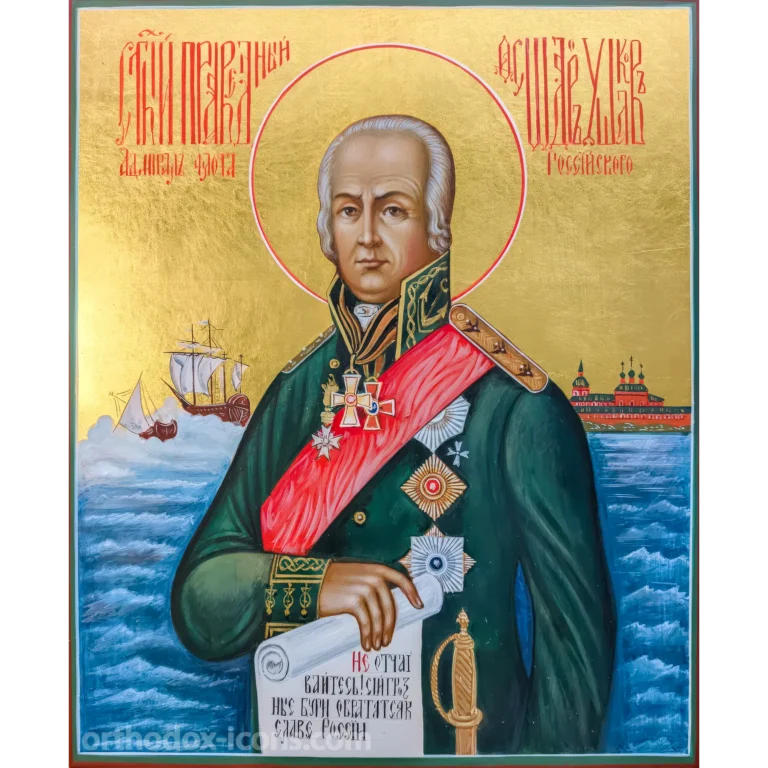
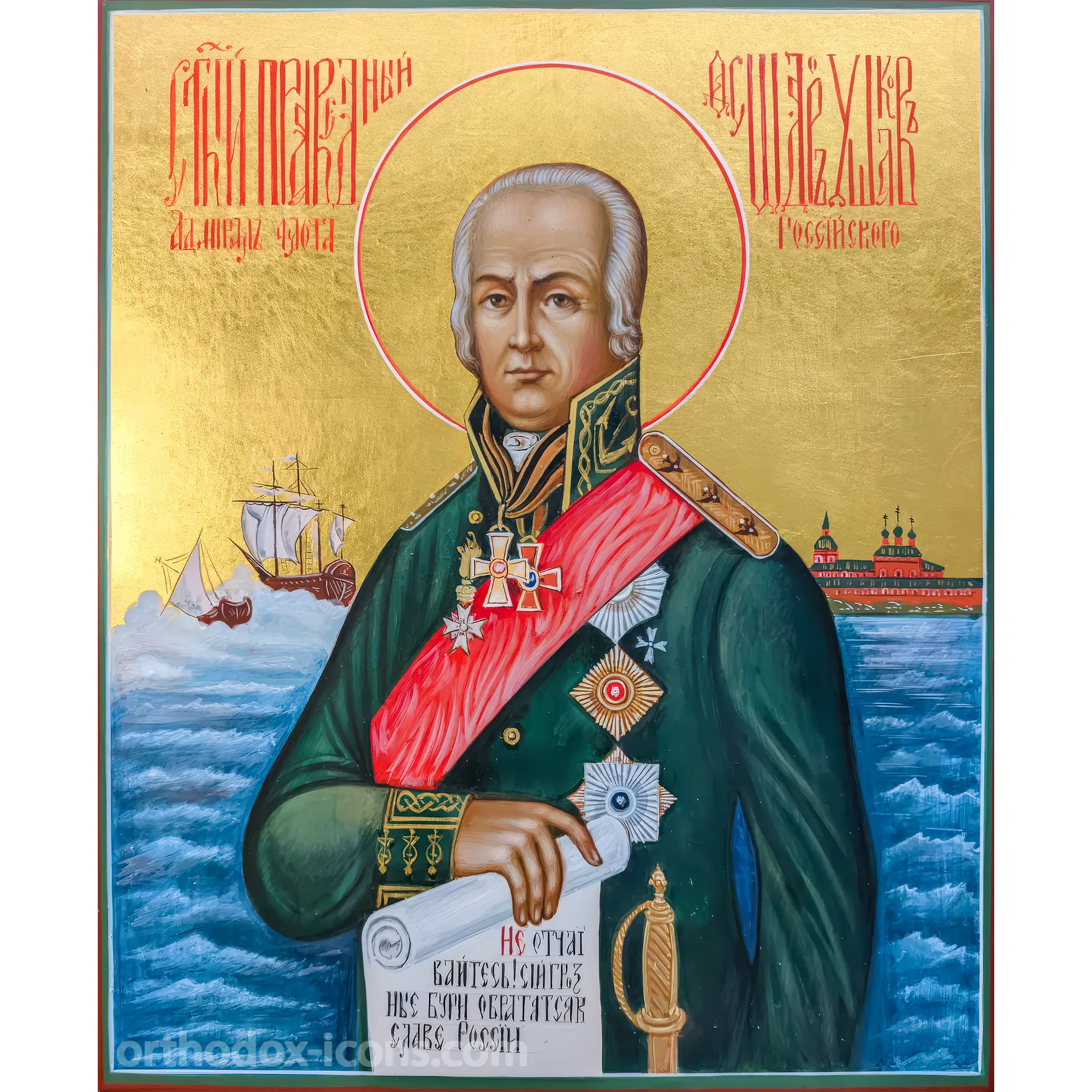
This hand-painted Icon of Saint Fyodor Ushakov is made to order in the traditional Orthodox icon-painting technique. Saint Theodore Fyodor Ushakov is shown as a righteous admiral and Orthodox saint, in a green naval uniform with gold epaulettes, orders, a scroll, a gilded halo, and a maritime background with sailing ships.
The icon is painted on a linden wood board with braces, pavoloka, chalk gesso, egg tempera, 23K gold leaf (960 purity), and a protective varnish. It is suitable for a home iconostasis, a naval chapel, a shipboard prayer space, or as a patron saint gift for someone named Theodore, Fyodor, or Feodor. Free international shipping is included. Payment is made after you receive and approve the icon.
It is possible to paint an image in any size to order
Free shipping worldwide
This hand-painted Icon of Saint Fyodor Ushakov presents one of the most distinctive images in modern Orthodox iconography: a saint in whom naval service, military courage, mercy, and Christian righteousness are joined. Saint Theodore Fyodor Ushakov, the renowned admiral of the eighteenth century, was canonized by the Russian Orthodox Church in 2001. He is remembered not only as an undefeated naval commander, but also as a man of prayer, mercy, discipline, and deep Orthodox faith.
The icon is made to order in the workshop in the traditional hand-painted technique. It is painted on a linden wood board with braces, pavoloka, chalk gesso, egg tempera on egg yolk, 23K gold leaf (960 purity), and a protective varnish. The image is suitable for a home iconostasis, a naval chapel, a shipboard prayer corner, a church connected with maritime service, or as a patron saint gift for someone named Theodore, Fyodor, or Feodor.
Available sizes are 20×24 cm (7.9×9.4 in), 27×31 cm (10.6×12.2 in), and 30×40 cm (11.8×15.7 in). The smaller sizes are practical for a cabin, study, or compact prayer corner. The 30×40 cm size gives more space for the admiral’s uniform, the scroll, the gilded halo, and the maritime background with sailing ships.
Life of Saint Theodore Fyodor Ushakov
Saint Righteous Theodore Fyodorovich Ushakov was born on February 24, 1745, in the village of Burnakovo in the Yaroslavl region, into a modest noble family. From childhood he was marked by religious seriousness, influenced in part by his uncle, Saint Theodore of Sanaksar, who was later glorified among the saints. This spiritual connection left a deep mark on the future admiral’s moral character and his understanding of service.
In 1766 Fyodor Ushakov entered the Naval Cadet Corps in Saint Petersburg, where he received a strong naval education. Already during his studies he showed remarkable ability in seamanship, navigation, artillery, and shipbuilding. After graduation he began service in the Baltic Fleet, gradually rising through the ranks because of his talent, fearlessness, discipline, and honorable reputation.
His greatest fame came during the Russo-Turkish wars of the late eighteenth century, when he commanded the Black Sea Fleet. Throughout his naval career Admiral Ushakov did not suffer a single defeat and did not lose a single ship, a remarkable fact in naval history. His name is connected with victories at Fidonisi, Tendra, Kaliakria, Corfu, and other operations.
Christian Virtues of the Holy Admiral
The special character of Saint Fyodor Ushakov lies in the union of military ability with Christian faith and mercy. He did not begin battle without prayer, regularly attended services, observed fasts, and respected the life of the Church. He was known for merciful treatment of prisoners and did not allow cruelty toward defeated enemies, providing care and medical help where possible.
He also showed fatherly concern for his sailors. He watched over their living conditions, food, and medical care, and the sailors answered him with deep loyalty. He visited sick seamen personally, helped families of the fallen, and organized support for the needy. This care was not merely good command practice; it was an expression of Christian love for neighbor.
After active service ended in 1807, Ushakov withdrew to his estate at Alekseyevka and lived a quiet, ascetic life. He gave away much of his property to the poor, cared for the sick, helped those in need, and spent much time in prayer. He often visited Sanaksar Monastery, where the relics of his uncle Saint Theodore rested, and where he himself was buried after his death on October 14, 1817.
Canonization and Church Veneration
The glorification of Saint Fyodor Ushakov took place on August 6, 2001, by decision of the Bishops’ Council of the Russian Orthodox Church. He was canonized as a righteous saint, a form of holiness associated with laypeople who reach sanctity while living in the world and fulfilling their earthly duties. His veneration is especially important because it shows that professional and even military service can become a path of Christian responsibility when joined to faith, mercy, justice, and self-control.
His feast is celebrated on August 5 according to the civil calendar used for fixed feasts in many Orthodox calendars. On this day, churches connected with naval service often remember him with special prayer. Saint Fyodor Ushakov is honored as a heavenly patron of the navy, sailors, and those who serve at sea. His relics rest at Sanaksar Monastery in Mordovia, which has become a place of pilgrimage for sailors and others who honor his memory.
Iconographic Features of This Image
In the presented icon, Saint Fyodor Ushakov is shown in a green admiral’s uniform with gold epaulettes and military orders, reflecting his rank and historical service. A red sash across the shoulder and the decorations on his chest point to his recognized merit. In his hand he holds a scroll with an inscription, emphasizing his role in the history of the fleet and the moral meaning of his service.
The background of the icon includes a maritime landscape with sailing ships of his era, recalling the naval victories associated with the saint. The gilded halo around his head is made with gold leaf and shows that the Church venerates him as a saint, not merely as a historical commander. The face combines resolve with spiritual concentration, bringing together the courage of a commander and the humility of a righteous Christian.
The color scheme joins green and gold, associated here with the naval uniform, with the blue and atmospheric tones of the sea. This gives the image a particular character: it is historical, maritime, and fully ecclesial at the same time. The Church Slavonic inscriptions are made in a traditional style and identify the sanctity of the person depicted.
Technology of the Hand-Painted Icon
The creation of a hand-painted icon of Saint Fyodor Ushakov requires special care, because it combines traditional icon painting with historical accuracy in the military uniform and maritime details. The work may include study of period portraits and documents, preparation of the linden board, application of pavoloka and layered gesso, a precise drawing of the figure, detailed painting of the uniform, orders, and regalia, and careful attention to the face.
The maritime background also requires a separate level of work, since the ships and sea setting should support the image without turning it into a secular historical painting. The gilded halo and sacred accents are made with gold leaf. Inscriptions are written in a traditional manner, and the final protective varnish helps preserve the painted surface.
Spiritual Meaning and Patronage
Saint Fyodor Ushakov is venerated as a patron of the navy, sailors, and military personnel. People may pray to God before his icon for protection at sea, a safe return from a voyage, courage, discipline, justice, and the ability to serve with a clean conscience. His example is especially meaningful for those who try to unite professional duty with Christian faith.
His life shows that holiness can be sought while remaining in the world and fulfilling one’s calling. Military service, leadership, and public responsibility do not exclude Christian life when they are carried out with mercy, self-control, justice, and prayer. For many believers connected with the armed forces or maritime service, Saint Fyodor Ushakov is an image of a Christian servant who remained humane even in severe circumstances.
People also turn in prayer for justice, protection of the weak, mercy toward enemies, and strength in difficult duties. His example teaches that true strength is not only victory, but also the preservation of humanity and conscience.
Veneration in Naval Churches
Icons of Saint Fyodor Ushakov hold a special place in churches connected with naval life. In maritime cities and naval chapels, prayers are offered before his icon for sailors leaving on long voyages and in thanksgiving after safe return. His image is also placed on ships, where it reminds crews of moral responsibility, courage, and prayer.
In naval schools and military settings, the icon of Saint Fyodor can also serve as a moral example for future officers. His life shows that command should be joined with discipline, mercy, care for subordinates, and a sense of responsibility before God.
When to Give This Icon
This icon is especially suitable as a gift for sailors, naval officers, military personnel, shipbuilders, maritime workers, cadets, teachers in naval schools, and families connected with sea service. It is also appropriate for men and boys named Theodore, Fyodor, or Feodor, as a patron saint icon for baptism, name day, birthday, graduation, departure for service, or a significant professional milestone.
The icon may also be given to civilians who venerate Saint Fyodor Ushakov, honor naval history, or value the example of Christian duty, courage, and mercy. It can stand in a home icon corner, office, study, chapel, shipboard space, or church.
Sizes and Custom Options
The available sizes are 20×24 cm, 27×31 cm, and 30×40 cm. For a shipboard icon corner or a cabin, 20×24 cm or 27×31 cm is often practical. For a more formal home iconostasis, chapel, office, or gift presentation, 30×40 cm gives the composition more space and dignity.
A custom maritime background with a particular ship or naval object can be discussed before painting, depending on the format and complexity. The approximate painting time is 25 to 40 days, depending on size and detail.
Care and Placement
The care is the same as for other hand-painted icons. Keep the icon away from moisture, direct sunlight, overheating, soot, and mechanical damage. Dust should be removed only with a soft dry cloth or brush, without pressure. If the icon is intended for a ship, chapel, or place where conditions may change, an icon case under glass is especially useful.
Free international shipping is included. Payment is made after you receive and approve the icon.
Questions and Answers
Who is Saint Fyodor Ushakov?
Saint Fyodor Theodore Ushakov (1745-1817) was a Russian naval commander and admiral, canonized by the Russian Orthodox Church in 2001 as a righteous saint and honored as a patron of the navy and seafarers.
When is Saint Fyodor Ushakov commemorated?
Saint Fyodor Ushakov is commemorated on August 5 according to the civil calendar used for fixed feasts in many Orthodox calendars.
What is Admiral Ushakov known for?
He is remembered for his naval victories, his care for sailors, mercy toward defeated enemies, personal piety, and his ascetic life after retirement.
Who especially venerates Saint Fyodor Ushakov?
He is especially venerated by sailors, naval officers, military personnel, people connected with maritime service, and those who seek to unite professional duty with Christian conscience.
Where are the relics of Saint Fyodor Ushakov?
The relics of Saint Fyodor Ushakov rest at Sanaksar Monastery in Mordovia, a place of pilgrimage connected with his memory.
What are the main features of this icon?
Saint Fyodor is shown in an admiral’s green uniform with gold epaulettes and orders, holding a scroll, with a gilded halo and a maritime background with ships.
What size is suitable for a ship or cabin?
For a shipboard icon corner or cabin, the compact 20×24 cm or 27×31 cm size is usually practical. The 30×40 cm size gives more space for the uniform and maritime background.
Can the maritime background be personalized?
A custom background with a particular ship or maritime object can be discussed before the icon is painted, depending on the format and complexity.
How long does such an icon usually take to paint?
The approximate painting time is 25 to 40 days, depending on size, detail, the uniform, orders, inscriptions, and maritime background.
Can this icon be given to civilians?
Yes. It may be given to anyone who venerates Saint Fyodor Ushakov, honors naval history, serves at sea, or bears the name Theodore, Fyodor, or Feodor.
| Dimensions | 20x24cm (7.9×9.4 in), 27x31cm (10.6×12.2 in), 30x40cm (11.8×15.7 in) |
|---|---|
| Name | Theodore |