George the Dragon-Slayer Orthodox Icon
Price range: $1000 through $1850
Available sizes: 27×31 cm (10.6×12.2 in), 30×40 cm (11.8×15.7 in), and iconostasis sizes by agreement.
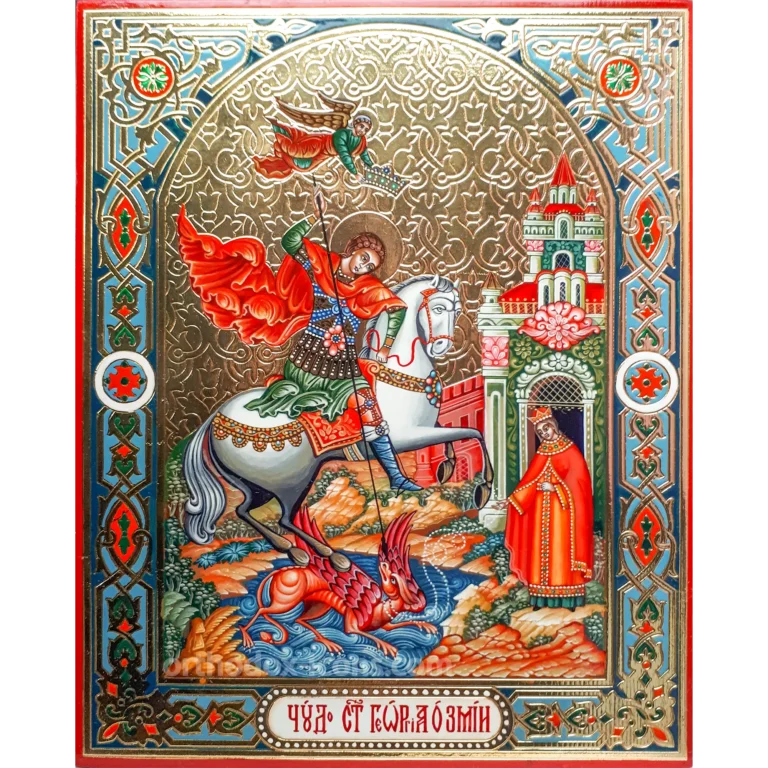
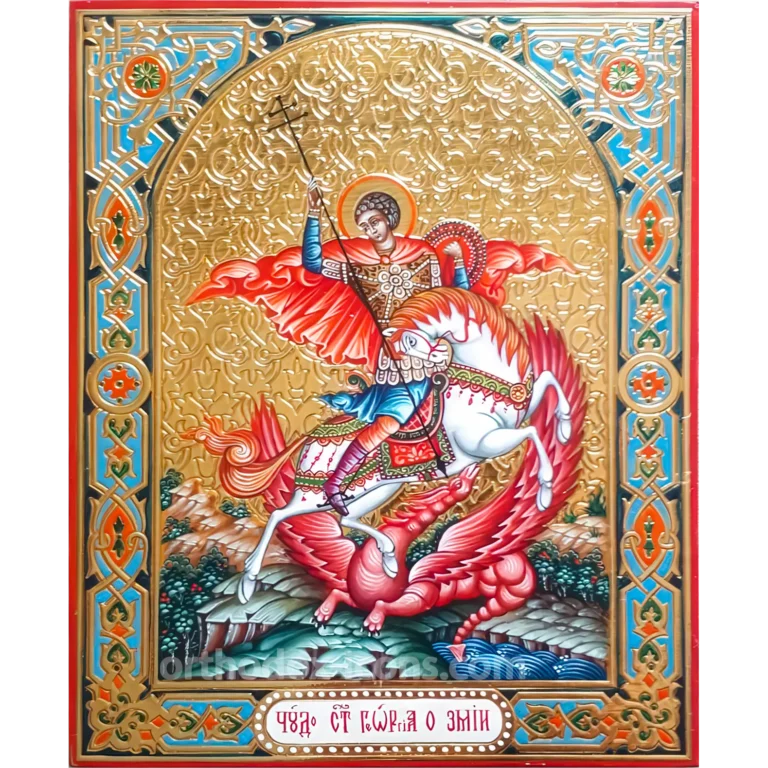
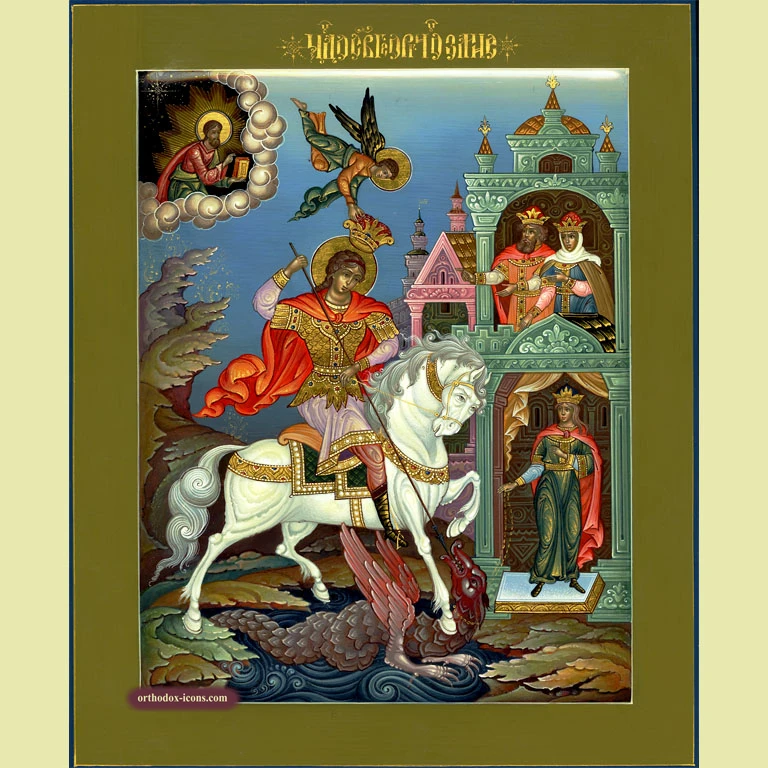
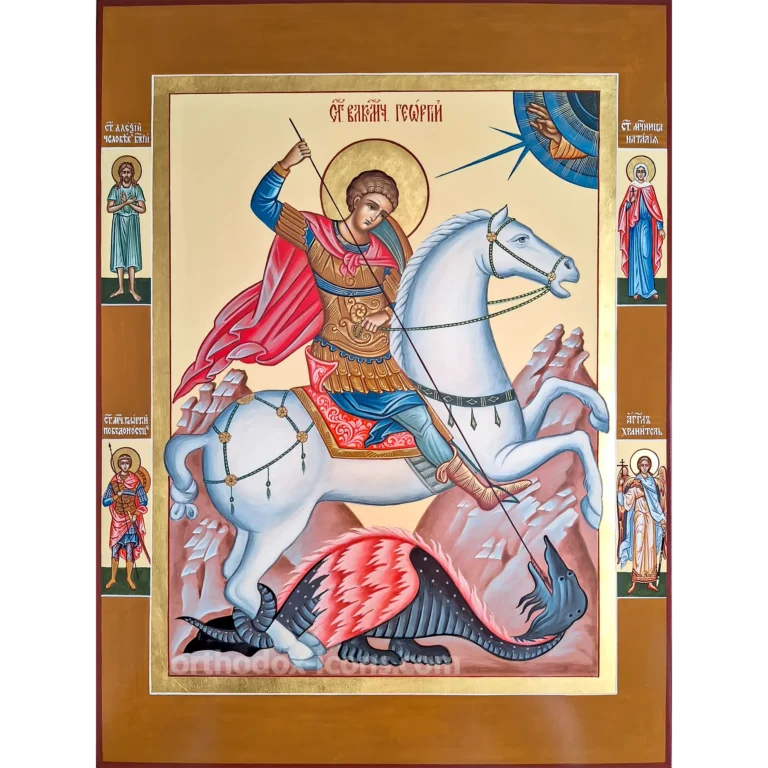
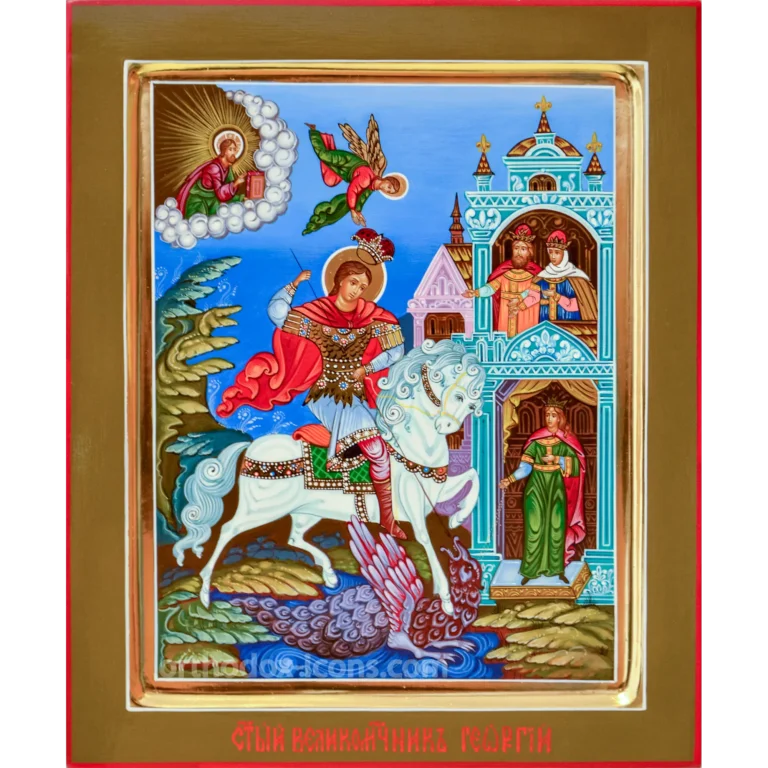
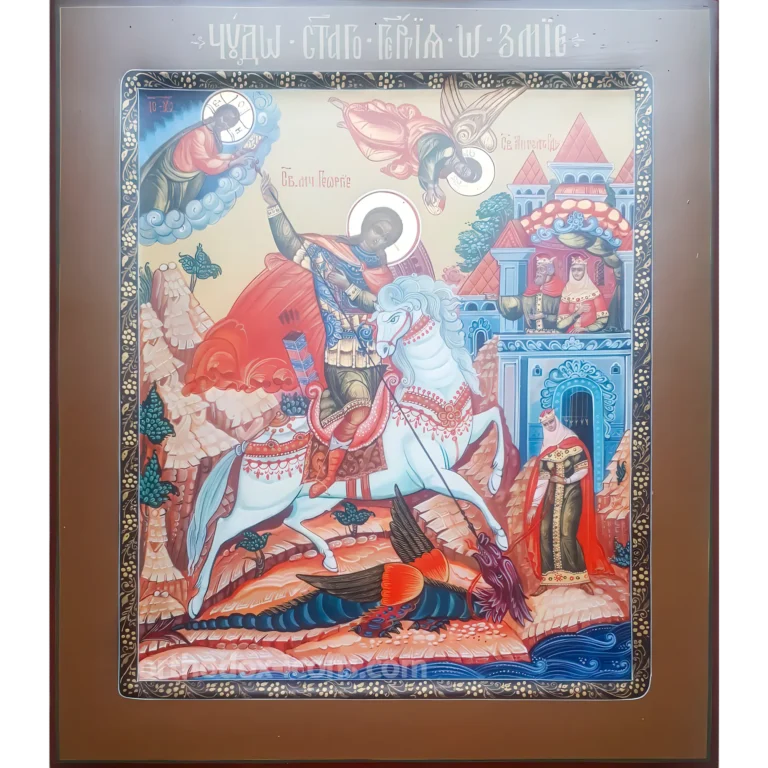
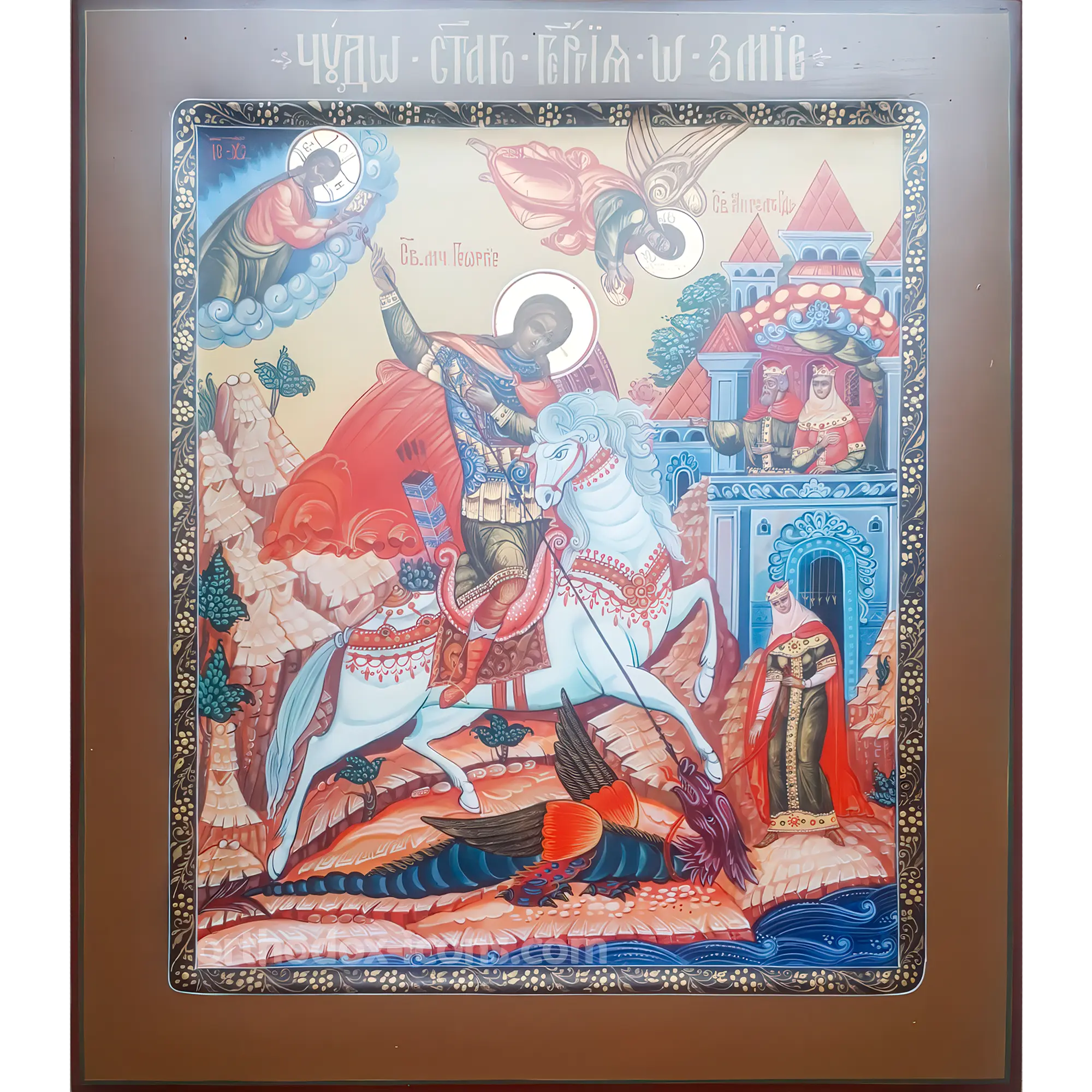
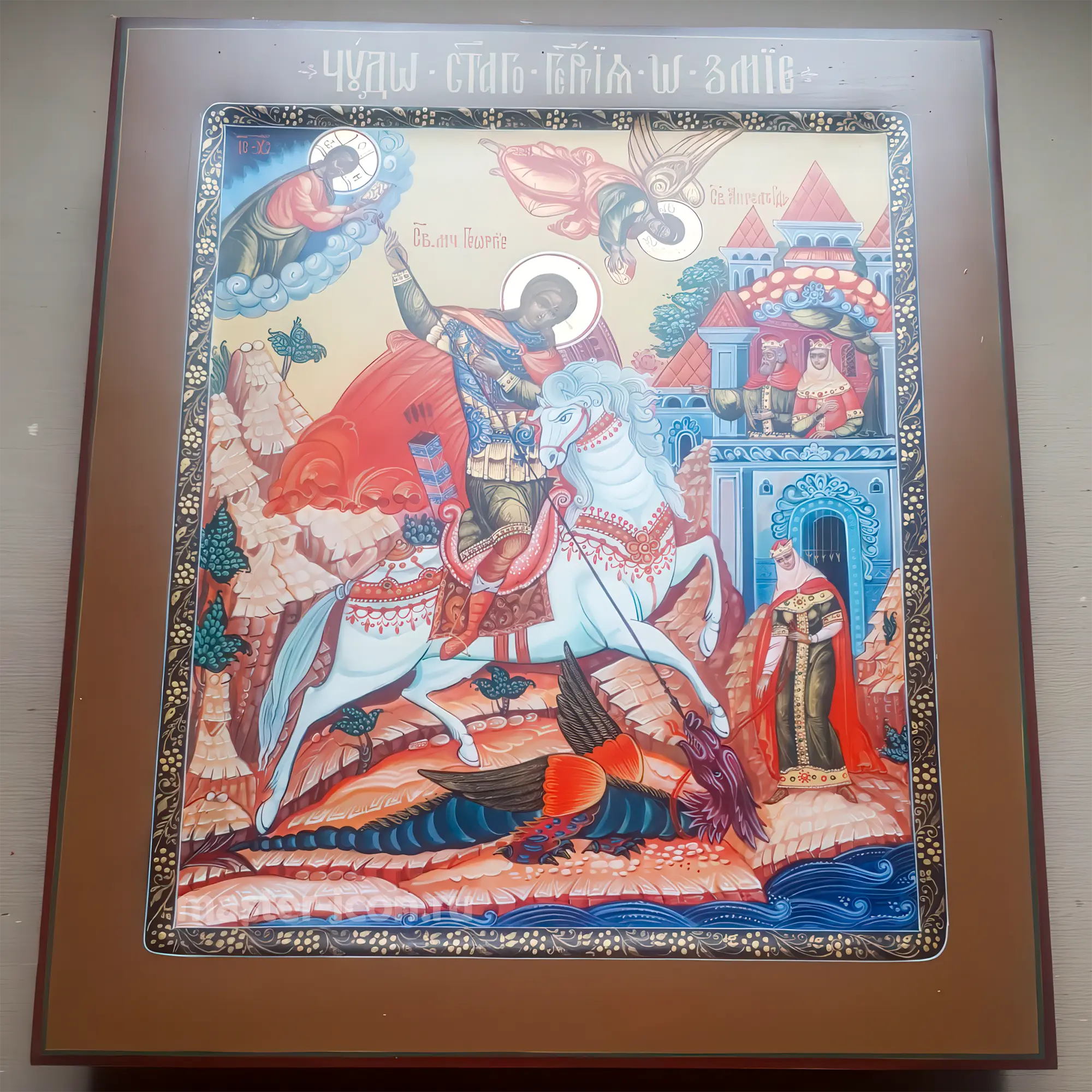
George the Dragon-Slayer Orthodox Icon is a hand-painted image of the Holy Great Martyr George, shown on a white horse as he defeats the dragon and frees the princess. This icon is painted in a vivid Mstyora style with red, blue, white, and ochre tones, a mountain landscape, city walls, heavenly blessing, angelic figures, and a dark ornamental border. It is made on a linden wood board with oak splines, levkas, mineral egg tempera, and 23K gold leaf (960 purity). Free international shipping is included, with payment after receiving and approving the icon.
It is possible to paint an image in any size to order
Free shipping worldwide
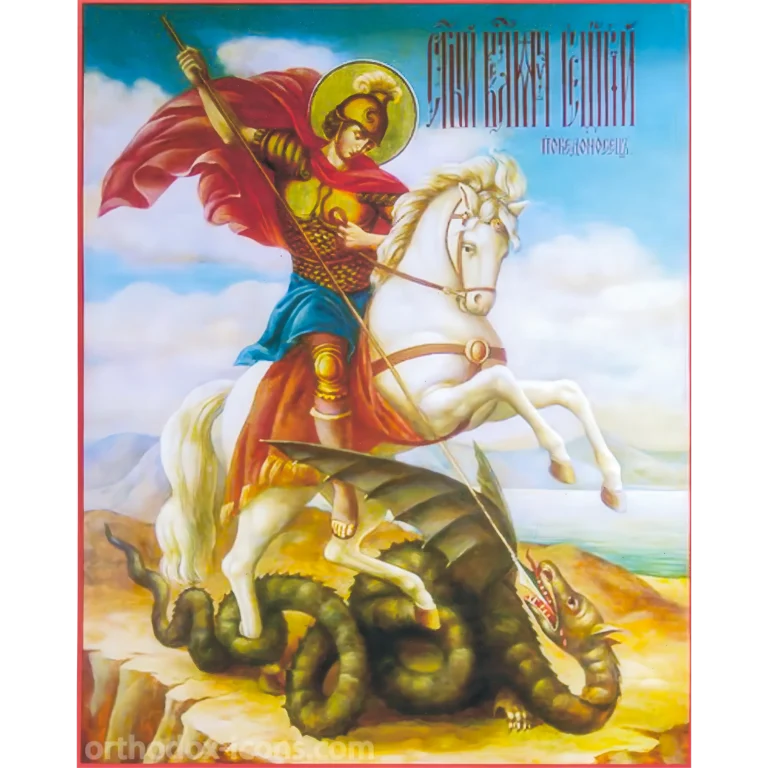
George the Dragon-Slayer Orthodox Icon is a hand-painted Orthodox image of the Holy Great Martyr George the Victory-Bearer. The icon presents one of the most beloved and recognizable scenes in Orthodox iconography: Saint George on a white horse, striking the dragon with his spear and freeing the princess. The image speaks of the victory of faith over evil, courage in danger, and God’s help in trials.
Before this icon, Orthodox Christians pray for the protection of family and home, help in dangerous circumstances, courage, support for soldiers and protectors, victory over fear, preservation of faith, and deliverance from destructive evil. The icon is especially meaningful as a patron saint image for George, Georgi, Yuri, and related names.
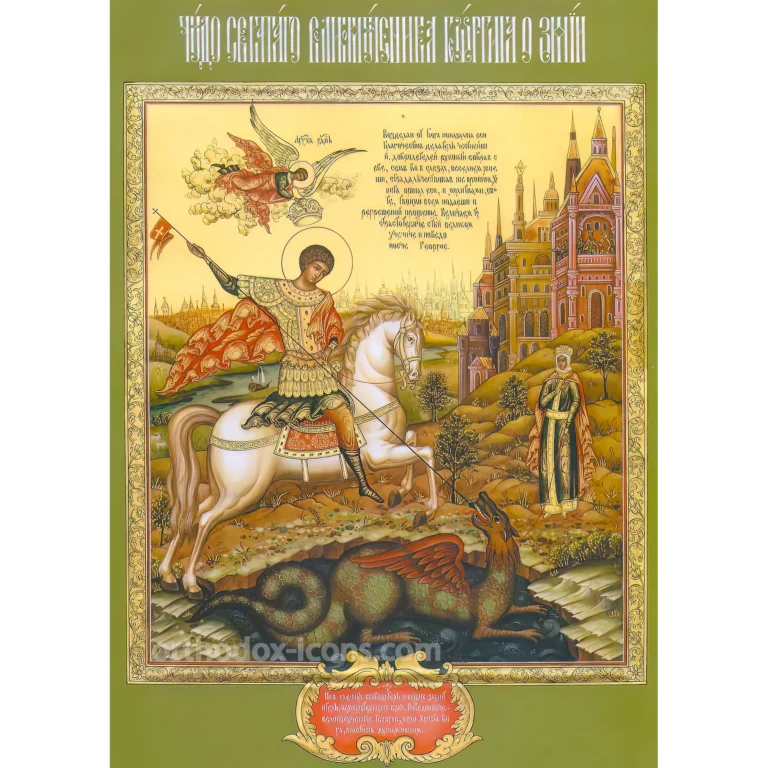
The composition is vivid and narrative. Saint George is shown in armor and a red cloak, mounted on a white horse. The dragon lies below, the princess stands near the city walls, and above the earthly scene there is heavenly blessing and angelic participation. The icon is painted in a rich Mstyora manner, with red, blue, white, and ochre tones, a mountain landscape, architecture, a dark ornamental frame, and broad warm borders.
Brief Description of the Icon
| Name | George the Dragon-Slayer Orthodox Icon |
| Saint depicted | Holy Great Martyr George the Victory-Bearer |
| Subject | The miracle of Saint George defeating the dragon and freeing the princess |
| Main meaning | Victory of faith over evil, courage, protection, and God’s help in trials |
| Available sizes | 27×31 cm (10.6×12.2 in), 30×40 cm (11.8×15.7 in), and iconostasis sizes by agreement |
| Purpose | For home prayer, a patron saint gift, a church, chapel, or iconostasis |
The Miracle of Saint George and the Dragon
The scene known as the Miracle of Saint George and the Dragon is not only a story of military courage. In Orthodox understanding, the dragon is an image of sin, fear, violence, spiritual darkness, and everything that enslaves the human person. Saint George is victorious not through pride or earthly self-confidence, but through faith in Christ.
According to the traditional story, a city was oppressed by a terrible dragon that demanded human victims. When the princess was given over to death, Saint George appeared, defeated the dragon by the power of God, and led many people toward faith. In iconography this miracle becomes a sign of liberation from fear, pagan darkness, and spiritual captivity.
This is why the icon has meaning not only for soldiers. Every person faces a personal dragon: fear, despair, addiction, injustice, hostility, danger, temptation, or inner weakness. Saint George’s image reminds the believer that Christian victory begins with prayer, faith, and the willingness to stand on the side of good.
Theological Meaning
The main theological meaning of the icon is the victory of Christ’s power over evil. Saint George is not shown as a heroic warrior seeking personal glory. His victory is spiritual. He acts as a witness of Christ, a martyr, and a warrior of light. The spear in his hand is therefore more than a weapon; it is a sign of truth directed against spiritual darkness.
The princess has an important role in the composition. She represents the soul, the human person, or a people held in fear and awaiting deliverance. Her presence shows that Saint George’s courage is not abstract combat. It is action for the salvation of another. In Christian life, true courage is joined with love, service, and responsibility for the vulnerable.
The white horse expresses purity, victory, and divine help. The horse moves forward, yet Saint George remains inwardly collected. This gives the icon a clear spiritual message: the struggle against evil requires resolution, but it should not become chaos, cruelty, or hatred. Saint George conquers calmly, as one who acts by faith.
The heavenly figures above the scene show that the miracle is not achieved by human strength alone. The blessing from above and the angelic presence place the earthly struggle within the providence of God. The believer is reminded that in serious trials one is not abandoned when faith remains alive.
What Is Seen on This Icon
- Saint George is shown on a white horse, striking the dragon with a spear.
- The defeated dragon appears in the lower part of the composition.
- The princess stands at the right near the city walls.
- The city includes towers, architecture, and people watching the miracle.
- A mountain landscape with trees and rocky ground appears on the left.
- The upper part of the icon includes heavenly blessing and angelic participation.
- The central image is surrounded by a dark ornamental border and broad warm fields.
Prayer Before the Icon
Before the icon of Saint George the Victory-Bearer, people pray for protection, courage, help in danger, and victory over evil. The image is especially close to soldiers, protectors, men named George or Yuri, and their families. Yet its meaning is wider than military service alone.
People also pray before this icon during serious trials, injustice, fear, conflict, or the need to protect loved ones. Saint George is asked for firmness in the Orthodox faith, courage without cruelty, strength without pride, and the ability to stand for good without hatred.
This icon may become a strong image for a home icon corner. It is often chosen as a patron saint icon for George, Georgi, Yuri, or Egor, and as a meaningful gift for a soldier, protector, son, godson, leader, or someone entering an important stage of life.
Artistic Features
This image is a developed narrative composition, not a quiet bust-length saint icon. The central figure is Saint George on the white horse. His red cloak forms a strong color accent and immediately draws the eye. The armor is written with careful ornamental detail, while the movement of the spear directs the viewer toward the dragon below.
The dragon is dark, elongated, and tense, with an open mouth. Its position at the bottom of the icon expresses the defeat of evil. Above it rises the white horse, light and dynamic, with red elements in the harness. This contrast between the white horse and the dark dragon makes the spiritual meaning of the icon especially clear: light tramples darkness, and faithfulness to Christ overcomes fear and destruction.
At the right, the princess is shown in red and golden garments. Behind her are city walls, towers, architecture in blue and rose tones, and small figures watching from the buildings. These details make the scene historically and narratively rich: the viewer sees not only the moment of victory, but also the city for whose deliverance the miracle occurs.
The frame also has meaning. Around the central scene is a dark decorative border with gold and white plant ornament. The wide outer fields are warm brown and ochre. The inscription at the top names the miracle of Saint George and the Dragon. Text, ornament, and painting work together as in an old narrative icon.
Materials and Technique
The icon is painted on a natural linden wood board. Linden is traditionally used in Orthodox icon painting because of its even structure and ability to receive the ground well. Oak splines strengthen the board and help preserve its shape over time.
The prepared board is covered with levkas, the traditional icon ground. For this composition, the quality of the ground is especially important, because the image includes many details: the saint’s face, horse, dragon, princess, city architecture, mountains, heavenly figures, inscription, and ornamental frame.
The painting is executed in mineral egg tempera. This technique is valued for its noble matte surface, durability, and layered method of work. The icon painter builds the composition from large color areas toward final highlights and details, keeping the scene dynamic but still prayerful.
Gold leaf of 23K quality (960 purity) is used for gilded elements such as halos, ornamental details, inscriptions, and parts of the frame. In Orthodox iconography, gold symbolizes divine light and heavenly glory rather than earthly luxury.
Icon Characteristics
| Name | George the Dragon-Slayer Orthodox Icon |
| Saint | Holy Great Martyr George the Victory-Bearer |
| Subject | Defeat of the dragon and rescue of the princess |
| Main spiritual meaning | Victory of faith over evil, protection, courage, and God’s help in trials |
| Board | Natural linden wood |
| Board reinforcement | Oak splines |
| Board structure | Flat board; kovcheg may be discussed for custom or iconostasis versions |
| Ground | Levkas |
| Painting | Mineral egg tempera |
| Gilding | 23K gold leaf (960 purity) |
| Available sizes | 27×31 cm (10.6×12.2 in), 30×40 cm (11.8×15.7 in), and iconostasis sizes by agreement |
| Purpose | For home prayer, a patron saint gift, a church, chapel, or iconostasis |
Who This Icon Is Suitable For
The George the Dragon-Slayer Orthodox Icon is especially suitable as a patron saint icon for George, Georgi, Yuri, or Egor. It may be given for baptism, a name day, birthday, jubilee, military service, return from service, house blessing, or another important life event.
The icon is also appropriate for families praying for soldiers, protectors, sons, husbands, fathers, and all who carry responsibility for others. In a home icon corner it reminds the family that the struggle with evil begins not only in the outer world, but also in the human heart.
In the 30×40 cm (11.8×15.7 in) size or in an iconostasis format, the story becomes especially expressive: the movement of the horse, the figure of Saint George, the princess, the city, the dragon, the heavenly images, and the ornament can all be seen more fully.
Advantages of This Icon
- One of the most recognizable Orthodox images of Saint George the Victory-Bearer.
- Suitable as a patron saint icon for George, Georgi, Yuri, and related names.
- Appropriate for prayer about protection, courage, and help in trials.
- Developed narrative composition with horse, dragon, princess, city, mountains, and heavenly figures.
- Available in larger and iconostasis sizes by agreement.
- Created according to traditional Orthodox icon painting technique.
Questions and Answers
Who is depicted in the George the Dragon-Slayer Orthodox Icon?
The icon depicts the Holy Great Martyr George the Victory-Bearer, shown on a white horse as he strikes the dragon with a spear and frees the princess.
What does the dragon symbolize in this icon?
The dragon symbolizes evil, sin, fear, spiritual darkness, and the destructive power from which a person needs God’s help and protection.
What can Orthodox Christians pray for before this icon?
People pray before Saint George for protection, courage, help in danger, strength in trials, victory over fear, defense of the family and home, and support for soldiers and protectors.
Why is Saint George shown on a white horse?
The white horse symbolizes purity, victory, light, and divine help in the struggle against evil.
What does the princess mean in the composition?
The princess recalls the person, soul, or people awaiting deliverance from fear, danger, and the power of evil.
Is this icon suitable as a patron saint icon for George or Yuri?
Yes. It is one of the most appropriate patron saint icons for George, Georgi, Yuri, and related names traditionally connected with Saint George.
Can this icon be given to a soldier or protector?
Yes. Icons of Saint George are often given to soldiers, protectors, people in dangerous professions, and their families as prayerful images of courage and protection.
What materials are used to paint the icon?
The icon is painted on a natural linden wood board with oak splines and levkas ground, using mineral egg tempera and 23K gold leaf (960 purity).
Does this icon have a kovcheg?
This icon is painted on a flat board; a kovcheg can be discussed for a custom or iconostasis version if needed.
Which sizes are available?
Available sizes are 27×31 cm (10.6×12.2 in), 30×40 cm (11.8×15.7 in), and larger iconostasis sizes by individual agreement.
| Dimensions | 27x31cm (10.6×12.2 in), 30x40cm (11.8×15.7 in) |
|---|---|
| Name | George, Georgi, Yuri |