Anna of Novgorod Orthodox Icon
Price range: $500 through $1350
Available sizes: 13×25 cm (5.1×9.8 in), 18×31 cm (7.1×12.2 in), 30×50 cm (11.8×19.7 in), with larger iconostasis sizes available by agreement.
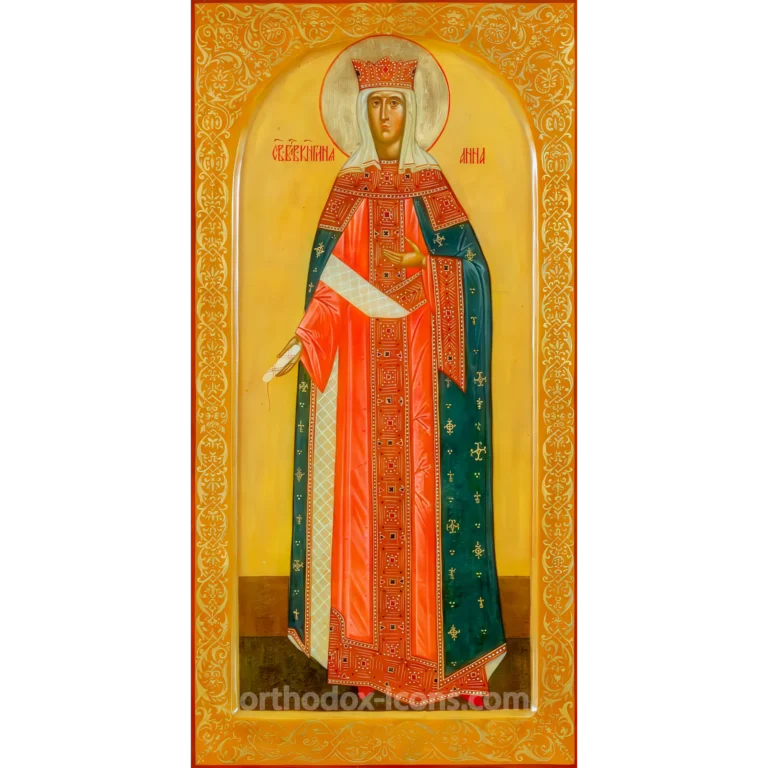
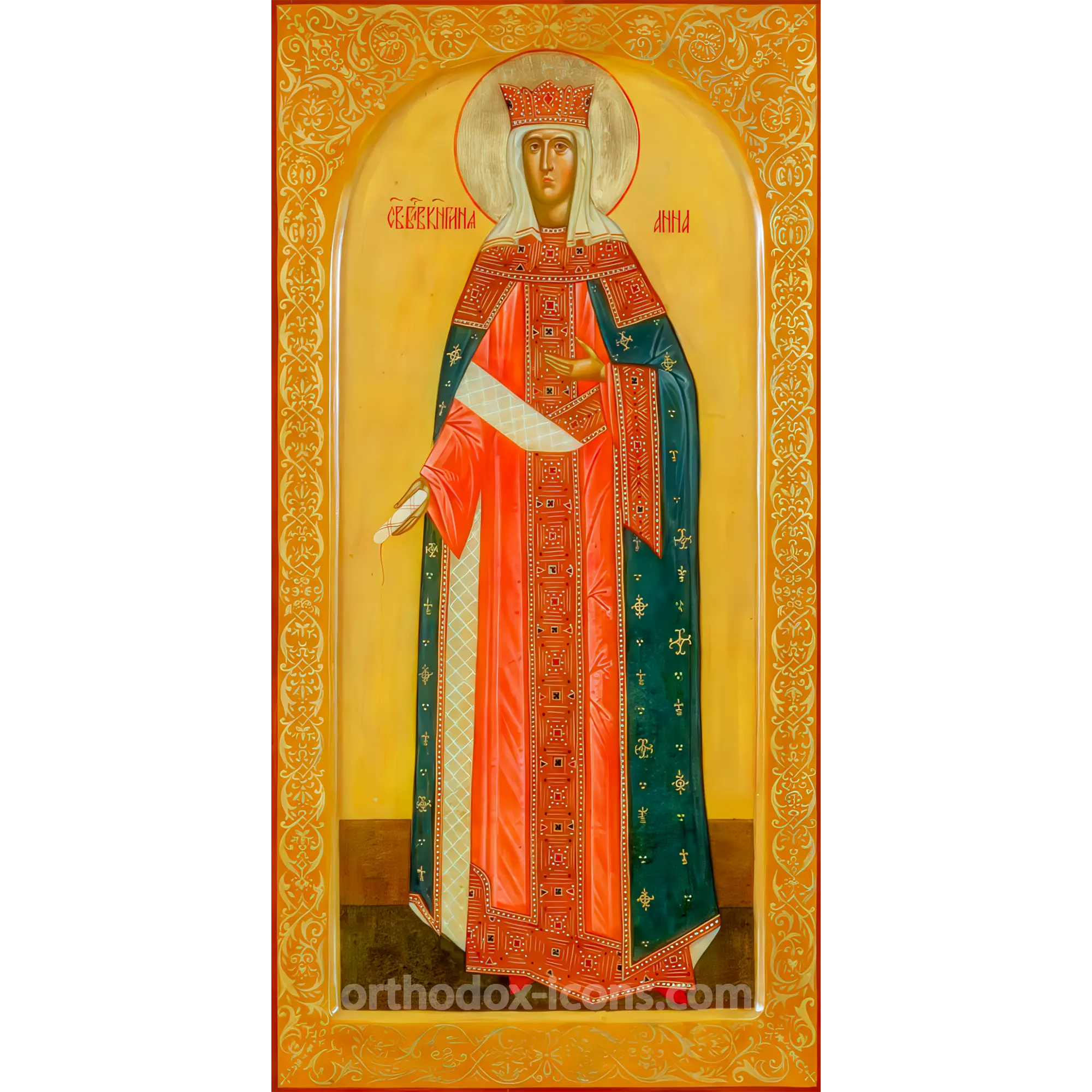
Anna of Novgorod Orthodox Icon is a hand-painted full-length icon of the Holy Right-Believing Princess Anna of Novgorod, wife of Yaroslav the Wise and one of the most remarkable women of early Rus’. She is shown in princely vestments, with a red patterned dress, dark green maphorion with gold assist, white veil, jeweled golden crown, and a folded scroll in her right hand.
The icon is painted on a linden board with an arched kovcheg, oak splines, linen canvas, chalk gesso, mineral egg tempera, 23K gold leaf (960 purity), gold assist, and protective varnish. The wide borders are decorated with a fine painted gold floral ornament that creates the effect of old basma-style metalwork.
It is possible to paint an image in any size to order
Free shipping worldwide
Anna of Novgorod Orthodox Icon is a hand-painted icon of the Holy Right-Believing Princess Anna of Novgorod. Before her monastic tonsure she was known as Ingegerd, a Swedish princess, and later as Irene, the wife of Grand Prince Yaroslav the Wise. In Orthodox memory she is honored as a wise Christian ruler, mother, and eventually one of the first great princesses of Rus’ to receive monastic tonsure.
The icon shows Saint Anna full-length, in a graceful princely image. She wears a bright red patterned dress, a dark green maphorion with gold assist, a white veil, and a high jeweled golden crown. Her left hand is pressed prayerfully to her chest, and in her lowered right hand she holds a folded white scroll. The figure stands within an arched kovcheg, surrounded by a gold background and wide ornamental borders.
Holy Princess and Mother
Saint Anna of Novgorod is remembered as a woman whose life united state wisdom, family care, and spiritual humility. She was the wife of Yaroslav the Wise and the mother of rulers and queens whose lives shaped both Rus’ and medieval Europe.
At the end of her earthly life she left princely glory and received monastic tonsure with the name Anna. For this reason her icon is not merely a historical image of a princess. It is a sacred image of a woman who offered earthly honor, family responsibility, and spiritual maturity to God.
Full-Length Arched Composition
Saint Anna is shown full-length, turned slightly to the left as if standing before the invisible throne of God. The arched kovcheg gives the composition architectural order and a sense of sacred space, like a heavenly chamber or church interior.
The ground beneath her feet is painted in warm brown-green tones. This detail connects the saint with earthly life and responsibility, while the gold background and arched form raise the image toward heavenly meaning.
Princely Garments and Color
The long red dress is decorated with a strict geometric pattern. In icon painting, red can speak of royal dignity, living energy, warmth, and sacrificial love. Here it emphasizes Saint Anna’s rank as a great princess and her maternal care for her family and people.
Over the red garment lies a deep green maphorion with a red lining. Green suggests life, spiritual renewal, and the action of the Holy Spirit. The visible surface of the maphorion is enriched with gold assist, small cross-shaped and floral ornaments that suggest divine light shining through the saint’s life.
Crown, Veil, and Folded Scroll
The white veil frames Saint Anna’s face and symbolizes purity of mind and heart. Above it rises a high golden crown, decorated with red stones and fine ornament. The crown recalls her princely rank and her historic service to the Christian state of Rus’.
The folded scroll in her right hand is one of the most meaningful details of the icon. In Orthodox iconography a scroll may symbolize divine wisdom, spiritual teaching, and a holy inheritance. For Saint Anna, who raised children who became rulers and queens, the scroll points to Christian education, maternal guidance, and the spiritual legacy she left to her descendants.
Gold Background and Basma-Style Borders
The field inside the arched kovcheg is covered with warm gold. In Orthodox icon painting, gold is not ordinary color; it is a sign of heavenly light and the Kingdom of God, where the saint now stands before the Lord.
The wide borders are one of the finest decorative features of the icon. On a warm orange-sand base, the icon painter creates a continuous gold floral ornament of stems, leaves, and flowers. This hand-painted work gives the visual impression of old basma-style metalwork or a jeweled cover, while remaining part of the painted icon itself.
Life of Saint Anna of Novgorod
Saint Anna was born as Ingegerd, daughter of the Christian king Olof Skotkonung of Sweden. In 1019 she married Yaroslav the Wise and came to Rus’, where she entered Orthodox Christian life with the name Irene. Their marriage became both a political alliance and a deep partnership in the building of Christian Rus’.
As grand princess, she supported her husband, helped resolve conflicts, and took part in the life of the state with courage and wisdom. Her greatest earthly labor was motherhood. She raised sons who became princes and daughters who became queens of France, Hungary, and Norway. Most importantly, she gave them a Christian formation.
Near the end of her life she went to Novgorod and received monastic tonsure with the name Anna. She reposed in 1050 and is venerated as a right-believing princess and monastic saint.
Prayer Before the Icon
Before an icon of Saint Anna of Novgorod, Orthodox Christians pray for wisdom in raising children, peace in the family, a good marriage for daughters, help in choosing a true spiritual path, consolation in maternal sorrows, and peace for the homeland.
This icon is especially meaningful for women and girls named Anna, for mothers, wives, daughters, and families who seek a prayerful patroness of Christian education, family harmony, wisdom, and faithful service.
Mstyora Materials and Technique
The icon is painted by hand according to traditional Mstyora methods. The base is a linden wood board with an arched kovcheg and oak splines. Linen canvas is applied to the surface, followed by layers of chalk gesso polished for egg tempera painting.
The image is painted in mineral egg tempera. The gilding, halo, gold assist on the garments, and fine border ornament are made with 23K gold leaf (960 purity) and painted gold work. The finished icon is protected with varnish. Small differences in the ornament, crown, colors, and facial expression are natural in hand-painted work.
Available Sizes
This icon is available in 13×25 cm (5.1×9.8 in), 18×31 cm (7.1×12.2 in), and 30×50 cm (11.8×19.7 in). Larger iconostasis sizes can be discussed individually before the icon is painted.
The elongated formats are especially suitable for a full-length figure. The 13×25 cm size is compact and easy to place on a small prayer shelf. The 18×31 cm and 30×50 cm sizes allow the gold assist, garment ornament, crown, scroll, and wide floral borders to be read with greater clarity.
Free international shipping is included. Payment is made after you receive and approve the icon.
Care for the Icon
A hand-painted icon with gold ornament should be protected from moisture, direct sunlight, heaters, humidifiers, kitchen steam, and sudden temperature changes. Do not use water, alcohol, sprays, or household cleaners.
Dust may be removed only with a dry soft brush or dry microfiber cloth, without pressure. For long-term preservation, especially with gold ornament and fine painting, a wooden kiot with glass is recommended.
Icon Characteristics
| Name | Anna of Novgorod Orthodox Icon |
| Saint | Holy Right-Believing Princess Anna of Novgorod |
| Iconographic type | Full-length princely image with folded scroll |
| Former names | Ingegerd, Irene, Anna |
| Visual details | Arched kovcheg, red dress, green maphorion, white veil, jeweled crown, folded scroll, gold background, floral borders |
| Materials | Linden wood board, arched kovcheg, oak splines, linen canvas, chalk gesso, mineral egg tempera |
| Gold and ornament | 23K gold leaf (960 purity), gold assist, painted floral borders in basma style |
| Available sizes | 13×25 cm, 18×31 cm, 30×50 cm; larger iconostasis sizes by agreement |
Questions and Answers
Why is Saint Anna shown with a crown if she became a nun?
In Orthodox iconography, right-believing princes and princesses who received monastic tonsure near the end of life may still be shown in princely garments. The crown recalls Anna’s high rank and her service to the Christian state.
Are Ingegerd, Irene, and Anna the same person?
Yes. Ingegerd was her Scandinavian birth name. After entering Orthodox Christian life in Rus’ she was known as Irene, and before her repose she received monastic tonsure with the name Anna.
What does the folded scroll mean?
The folded scroll symbolizes divine wisdom, spiritual teaching, and the inheritance of faith that Saint Anna passed to her children and descendants.
What does the red dress symbolize?
The bright red garment points to royal dignity, living energy, warmth, and sacrificial love. In this icon it also emphasizes Anna’s role as a Christian princess and mother.
Are the wide borders made of metal?
No. The borders are painted by hand with gold ornament so finely that they create the visual impression of old basma-style metalwork.
Who may receive this icon as a gift?
It is especially suitable for women and girls named Anna, for mothers, wives, daughters, and families who value Saint Anna as a patroness of wisdom, family life, and Christian upbringing.
What do Orthodox Christians ask Saint Anna of Novgorod to pray for?
They ask for wisdom in raising children, peace in the family, a good marriage for daughters, help in choosing a spiritual path, consolation in maternal sorrows, and peace for the homeland.
What sizes are available?
The icon is available in 13×25 cm, 18×31 cm, and 30×50 cm. Larger iconostasis sizes can be made by individual agreement.
What materials are used for this icon?
The icon is made on a linden wood board with an arched kovcheg, oak splines, linen canvas, chalk gesso, mineral egg tempera, 23K gold leaf (960 purity), gold assist, and protective varnish.
When is Saint Anna of Novgorod commemorated?
Saint Anna of Novgorod is commemorated on February 23 and also on July 3, the Synaxis of the Saints of Novgorod.
| Dimensions | 13x25cm (5.1×9.8 in), 18x31cm (7.1×12.2 in), 30x50cm (11.8×19.7 in) |
|---|---|
| Name | Anna |