St. Wenceslaus Orthodox Icon
$1600
Available size: 27×31 cm (10.6×12.2 in), with larger and iconostasis sizes available by agreement.
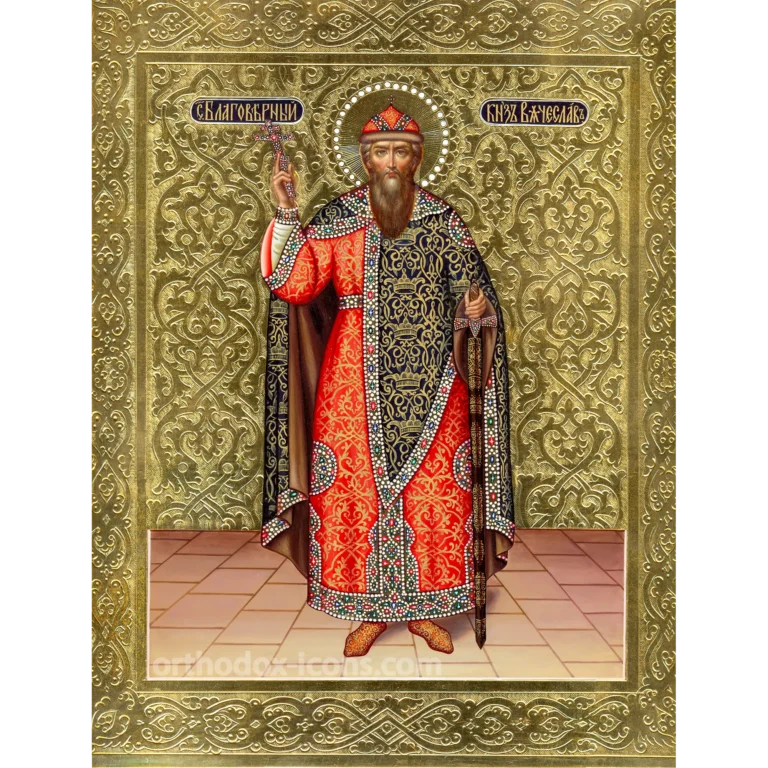
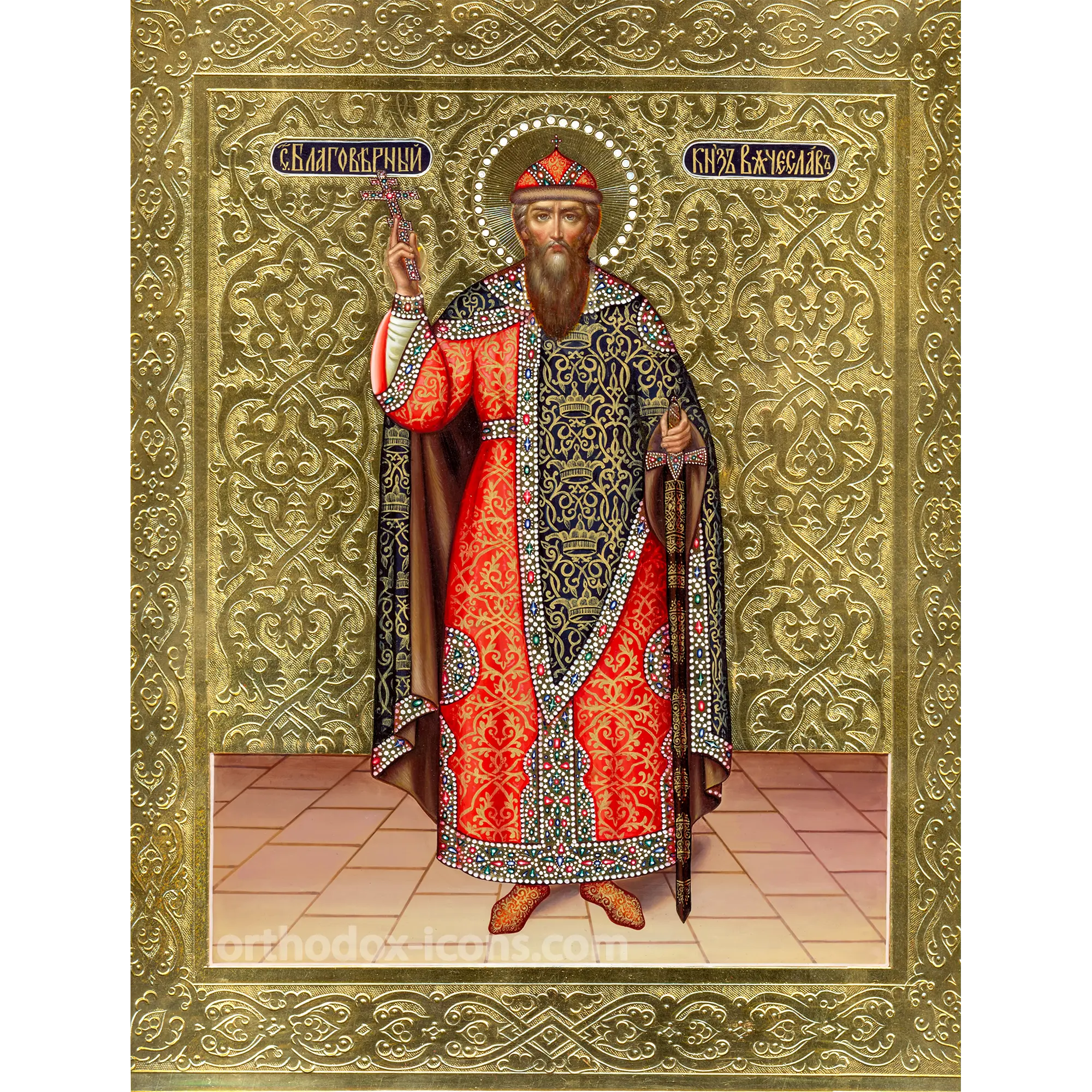
St. Wenceslaus Orthodox Icon is a hand-painted full-length icon of the Holy Right-Believing Prince-Martyr Wenceslaus of Bohemia, the heavenly patron of men named Vyacheslav. The saint is shown frontally in princely vestments, holding a raised cross in his right hand and a lowered sword in his left, against a richly hand-tooled gold background.
The icon is painted on a linden board with a kovcheg, oak splines, linen canvas, chalk gesso, mineral egg tempera, 23K gold leaf (960 purity), hand-tooled gold ornament, and protective varnish. The pearl-like halo, jeweled crown, red brocade garment, dark blue mantle, and gold ornament make this a solemn name-day icon and a dignified gift.
It is possible to paint an image in any size to order
Free shipping worldwide
St. Wenceslaus Orthodox Icon is a hand-painted full-length icon of the Holy Right-Believing Prince-Martyr Wenceslaus of Bohemia. In the Russian Orthodox tradition he is also connected with the name Vyacheslav, and this icon is especially meaningful as a name-day image for men who bear that name.
The saint is shown standing frontally, in princely vestments, with a raised cross in his right hand and a lowered sword in his left. Behind him is a rich hand-tooled gold background. The red brocade garment, dark blue princely mantle, ermine collar, jeweled crown, pearl-like halo, and finely painted ornaments give the icon a solemn and noble character.
Right-Believing Prince and Martyr
Saint Wenceslaus, known in Slavic tradition as Vyacheslav of Bohemia, was a Christian ruler of the tenth century. He is remembered not simply as a prince, but as a ruler whose authority was joined to service, mercy, and faithfulness to Christ.
His icon belongs to the tradition of holy rulers and prince-martyrs. It teaches that true power is not separated from responsibility before God and care for the people. The figure of the young prince stands with quiet dignity, not as a conqueror, but as a servant of Christ who chose the Cross over revenge.
Full-Length Composition
Saint Wenceslaus is shown full-length and strictly frontal. This iconographic posture expresses his steadfast standing before God and before the one who prays. The face is written in a warm academic Mstyora manner, with careful modeling, attentive eyes, and a short dark beard.
The whole composition is rich in detail, yet the meaning remains clear. The saint’s youth, calm bearing, cross, sword, crown, and princely garments together reveal him as a Christian ruler whose earthly dignity is transformed by martyrdom.
Princely Vestments and Crown
The long red brocade garment is covered with large gold ornament. In icon painting, red can speak both of royal dignity and of martyrdom. Over it lies a dark blue princely mantle with gold architectural patterns that recall arches and church forms, pointing to Saint Wenceslaus’s care for Christian worship and church building.
The borders of the mantle are decorated with colored stones and pearl-like beads. The ermine collar suggests purity and princely dignity. On his head is a grand-princely crown with white fur, red upper part, a small cross, and jeweled details painted with fine precision.
Cross and Sword
The cross in Saint Wenceslaus’s raised right hand is the central symbol of his faith and martyrdom. It recalls his final spiritual choice and his willingness to meet death as a Christian rather than answer betrayal with violence.
The sword in his lowered left hand has a different meaning. It represents princely authority and the duty to protect the people. Because the sword is not raised in threat, the icon shows power under obedience to the Cross. This is the heart of the image: earthly authority placed beneath Christian faith.
Hand-Tooled Gold Background
The background and fields are covered with 23K gold leaf (960 purity) and enriched with hand-tooled ornament. The relief floral pattern creates the effect of a precious liturgical surface and gives the icon a solemn, almost jewel-like appearance.
This is not decoration for its own sake. In Orthodox iconography, gold points to heavenly light and the transfigured reality of the Kingdom of God. The hand-tooled gold background surrounds the prince-martyr with the sign of heavenly glory.
Pearl-Like Halo
The halo of Saint Wenceslaus is especially distinctive. Fine golden rays spread from its center, and the outer edge is bordered with a chain of pearl-like white beads. This detail gives the icon a refined medieval character and emphasizes the saint’s heavenly dignity.
Pearl imagery in Christian symbolism is associated with purity, incorruption, and the beauty of the Kingdom of God. Here it is fitting for a young prince who kept faithfulness and mercy at the center of his life.
Life and Martyrdom of Saint Wenceslaus
Saint Wenceslaus was born around 907 in Prague and was the grandson of Saint Ludmila of Bohemia. She raised him in Christian piety and taught him the foundations of faith and learning. After the death of his father, Wenceslaus became ruler of Bohemia at a young age.
His rule combined firmness with meekness. He cared for churches, supported the poor, protected widows and orphans, and worked for peace. He brought the relics of Saint Vitus to Prague and founded the cathedral that remains one of the great holy places of the Czech lands.
According to tradition, Wenceslaus was betrayed by his brother Boleslav and killed near the entrance of a church in 935. Although he had strength and authority, he refused to answer brotherly betrayal with bloodshed. His martyrdom later became known in Rus’ and influenced the way Orthodox Christians understood the witness of the holy princes Boris and Gleb.
Prayer Before the Icon
Before an icon of Saint Wenceslaus, Orthodox Christians ask his intercession for the protection of the homeland, wisdom in leadership, justice, peaceful resolution of conflicts, success in study, strengthening of faith, and support for men named Vyacheslav.
The icon is especially appropriate for people in positions of responsibility: soldiers, public servants, leaders, managers, teachers, students, and anyone who needs to make decisions with justice, courage, and humility. It is also a dignified gift for a name day, baptism, jubilee, office, church, or family prayer corner.
Materials and Hand-Painted Work
The icon is painted on a solid linden wood board with a carved kovcheg and oak splines. Linen canvas is applied to the board, followed by layers of chalk gesso. The image is painted in mineral egg tempera, with carefully modeled face, vestments, gemstones, pearl-like beads, and gold ornament.
The background, halo, and fields are gilded with 23K gold leaf (960 purity) and worked by hand with tooled ornament. The finished icon is protected with varnish. Because every icon is painted by hand, small differences in the ornament, gold tooling, colors, jewels, and facial expression are natural.
Available Size
This icon is offered in 27×31 cm (10.6×12.2 in). Larger sizes, including representative and iconostasis formats, can be discussed individually before the icon is painted.
This image is not usually recommended in very small formats, because the iconography includes fine details: vestment ornaments, gemstones, pearl-like beads, hand-tooled gold, the cross, the sword, and the crown.
Free international shipping is included. Payment is made after you receive and approve the icon.
Care for the Icon
A gilded hand-painted icon should be protected from moisture, direct sunlight, heaters, humidifiers, kitchen steam, and sudden temperature changes. Do not use water, alcohol, sprays, or household cleaning products.
Dust may be removed only with a dry soft brush or dry soft cloth, without pressure. The hand-tooled gold background, halo, fields, painted stones, and pearl-like ornaments should not be rubbed.
Icon Characteristics
| Name | St. Wenceslaus Orthodox Icon |
| Saint | Holy Right-Believing Prince-Martyr Wenceslaus of Bohemia |
| Iconographic type | Full-length princely image with cross and sword |
| Painting style | Academic Mstyora style with rich ornamental detail |
| Materials | Linden wood board, kovcheg, oak splines, linen canvas, chalk gesso, mineral egg tempera |
| Gold and ornament | 23K gold leaf (960 purity), hand-tooled gold background and fields |
| Special details | Pearl-like halo, jeweled crown, red brocade garment, dark blue mantle, cross, lowered sword |
| Available size | 27×31 cm (10.6×12.2 in); larger sizes by agreement |
Questions and Answers
Who is Saint Wenceslaus of Bohemia?
Saint Wenceslaus was a tenth-century Christian ruler of Bohemia and a prince-martyr who was killed by the supporters of his brother Boleslav. He is venerated in the Orthodox Church as a right-believing ruler and martyr.
Why is Saint Wenceslaus shown young?
He died as a young ruler, around the age of twenty-eight. For this reason his iconography often shows him as a youthful prince rather than an elderly saint.
Why does he hold both a cross and a sword?
The sword signifies his earthly authority and duty to protect his people. The cross shows his spiritual choice: faith, mercy, and martyrdom over vengeance and violence.
Who is this icon especially suitable for?
It is especially suitable as a name-day icon for men named Vyacheslav, and also as a gift for soldiers, public servants, leaders, students, and those who seek a model of just Christian rule.
Why is Saint Wenceslaus venerated in the Orthodox Church?
His veneration reached Rus’ in the eleventh century, where his martyrdom became an important model for understanding the witness of the holy princes Boris and Gleb.
What does the hand-tooled gold background mean?
The hand-tooled gold ornament gives the icon solemnity and points to heavenly glory. It also recalls older decorative traditions in which gold was worked like a precious liturgical surface.
What does the pearl-like halo symbolize?
The pearl-like border of the halo suggests purity, incorruption, and heavenly dignity, fitting for a right-believing prince-martyr.
What do Orthodox Christians ask Saint Wenceslaus to pray for?
They ask his intercession for protection of the homeland, wisdom in leadership, justice, peaceful resolution of conflicts, strengthening of faith, and support for men named Vyacheslav.
What materials are used for this icon?
The icon is painted on a linden wood board with a kovcheg, oak splines, linen canvas, chalk gesso, mineral egg tempera, 23K gold leaf (960 purity), hand-tooled gold ornament, and protective varnish.
How should this gilded icon be cared for?
Keep it away from moisture, direct sunlight, heat, and sudden temperature changes. Dust it only with a dry soft cloth or brush, without rubbing the painted or gilded surface.
| Dimensions | 27x31cm (10.6×12.2 in) |
|---|---|
| Name | Wenceslaus |