Saint Alexander Nevsky Icon
$3000
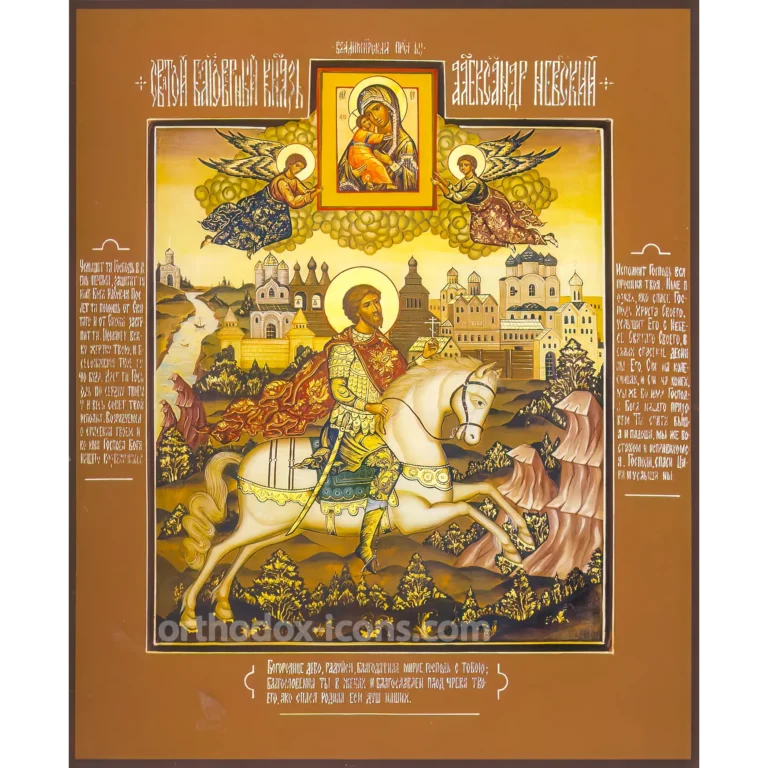
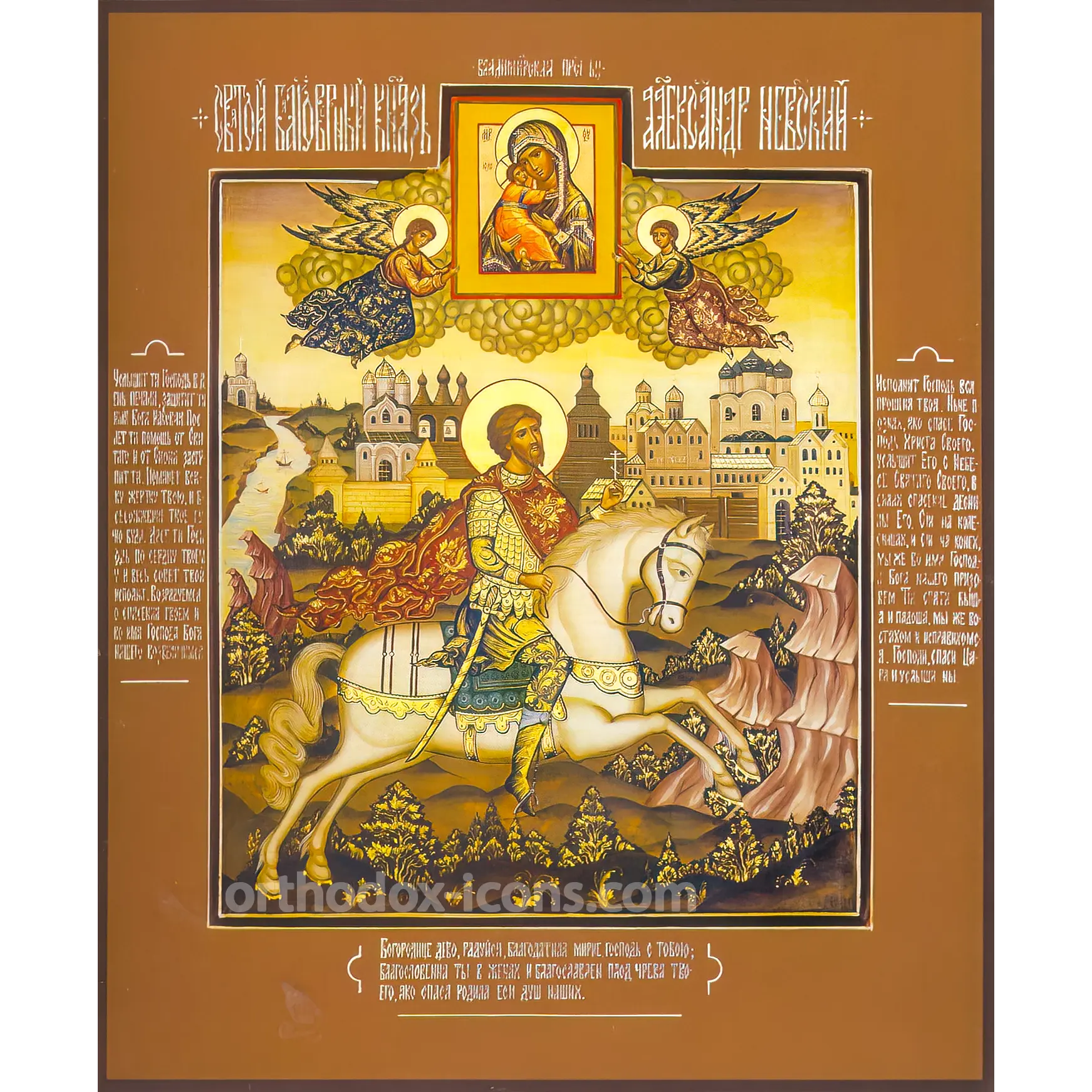
Saint Alexander Nevsky Icon, 30×40 cm (11.8×15.7 in), is a complex hand-painted equestrian icon of the holy right-believing prince Alexander Nevsky. The saint is shown on a white horse, in gold-highlighted armor and a red princely cloak, holding a cross while the sword rests at his side. Above him, the Vladimir Mother of God is shown in the heavens, supported by two angels. The icon is painted on a linden board with kovcheg, mineral egg tempera, 23K gold leaf assist (960 purity), and calligraphic prayer texts on the terracotta fields. Free international shipping is included. Payment is made after you receive and approve the icon.
It is possible to paint an image in any size to order
Free shipping worldwide
Saint Alexander Nevsky Icon
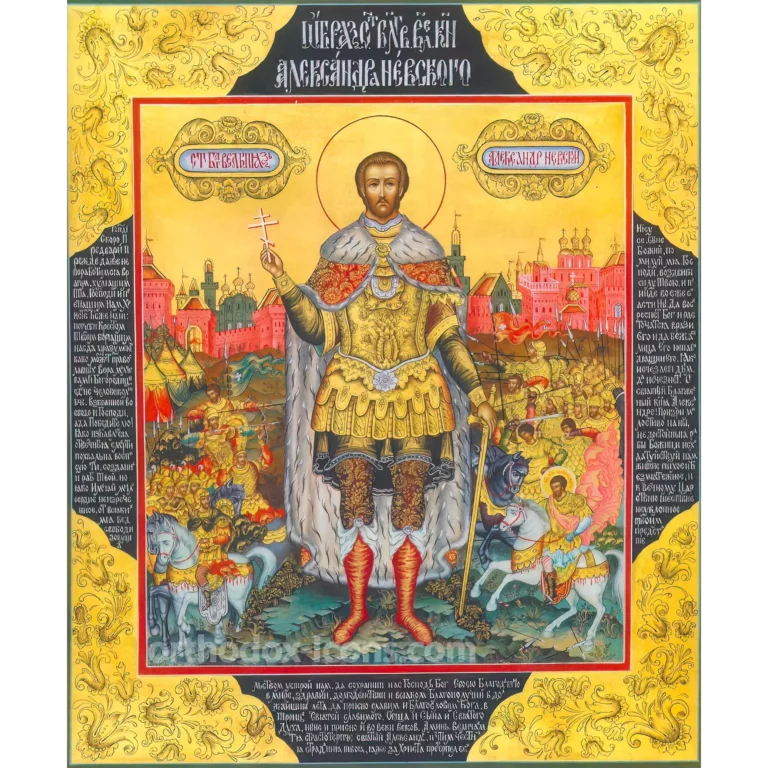
Saint Alexander Nevsky Icon is a complex hand-painted Orthodox icon of the holy right-believing Prince Alexander Nevsky, one of the most revered rulers and defenders in Russian Orthodox memory. This is not a simple portrait icon. It is a multi-scene composition that presents the saint as a Christian prince, military leader, diplomat, and servant of the Orthodox faith.
The saint is shown mounted on a white horse, wearing gold-highlighted armor and a red princely cloak. In his raised hand he holds a cross rather than a drawn sword, while the sword rests at his side. Above him, in the heavenly part of the icon, the Vladimir Mother of God is shown with two angels. The wide terracotta fields contain hand-written prayer texts in white calligraphy.
The listed size is 30×40 cm (11.8×15.7 in). Larger church and iconostasis sizes may be discussed individually before ordering.
Rare Equestrian Iconography
Saint Alexander Nevsky is often shown standing, half-length, in princely garments, or in monastic schema. This icon belongs to a rarer and more dynamic tradition: the equestrian image of the saint. The mounted composition expresses both princely authority and spiritual victory.
Alexander sits on a white horse that rises powerfully beneath him. The horse can be understood as a symbol of strength, movement, and the state entrusted to the prince’s care. The saint’s posture is firm and composed, showing not pride, but responsibility before God.
His armor is enriched with fine gold assist, and the red cloak moves behind him with a solemn, ceremonial rhythm. The sword is present, but it is not the central symbol. The raised cross makes the meaning of the image clear: the prince’s deepest victory is not merely military, but spiritual.
The Vladimir Mother of God and the Angels
The upper part of the icon reveals the heavenly meaning of the composition. In the clouds above the prince appears the Vladimir Icon of the Mother of God, held in a golden square field. This detail is especially significant because Alexander Nevsky was connected with the lands of Vladimir, and the Vladimir Mother of God is one of the great protectress icons of the Russian land.
Two angels descend at the sides of the Mother of God. Their wings are spread, and their hands are crossed in prayer. They serve the heavenly Queen and show that the prince’s earthly path is placed under the protection and intercession of the Theotokos.
This upper scene prevents the icon from becoming only a historical or military image. It places the events of earthly leadership, battle, and diplomacy within the larger reality of prayer and divine providence.
Landscape, City, and River
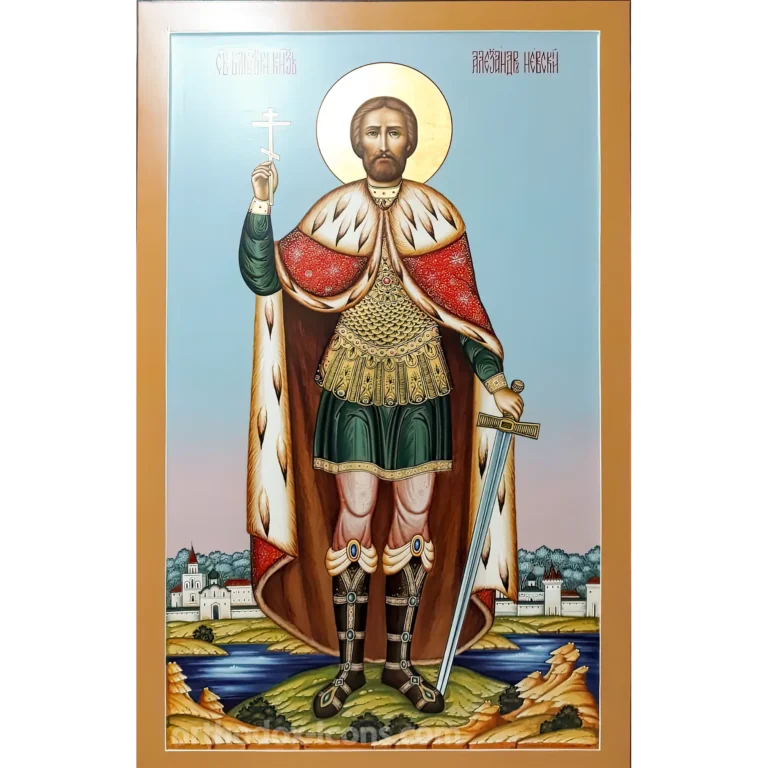
The background is a detailed old Russian landscape. A white-stone city or monastery rises in the distance with churches, towers, and defensive walls. This architectural setting symbolizes the lands, churches, and people that the prince was called to defend.
A blue river winds through the scene, recalling the Neva and the Battle of the Neva in 1240. Stones, hills, and trees fill the foreground. The crowns of the trees and parts of the armor are touched with gold assist, thin lines of gold laid over the painted surface. In icon painting, such gold light points to divine illumination passing through the visible world.
Prayer Texts on the Fields
A distinctive feature of this icon is its written border. The wide terracotta fields are filled with hand-written prayer texts in white calligraphy. These include prayers and liturgical texts connected with Saint Alexander Nevsky and the Mother of God.
The inscriptions make the icon not only an image to contemplate, but also a prayerful object that carries words of devotion directly on its surface. The title of the saint is written prominently at the top, while the side and lower fields complete the composition with text.
Historical Meaning of Saint Alexander Nevsky
Alexander Yaroslavich was born in 1221, during one of the most difficult periods in the history of Rus. From the east came the Mongol invasion and heavy tribute. From the west came armed pressure from Swedish and German crusading forces, threatening not only territory but also the Orthodox faith.
In 1240, the young prince defeated the Swedish forces on the Neva, after which he became known as Nevsky. In 1242 he defeated the Teutonic knights at the Battle on the Ice. These victories became symbols of the defense of the Orthodox people and their spiritual identity.
At the same time, Alexander’s path was not only military. Facing the power of the Horde, he chose difficult diplomacy in order to protect his people from complete destruction. Before his death in 1263, he received monastic tonsure with the name Alexy. The Church glorified him among the right-believing rulers, those who used authority for the defense of faith, people, and the Church.
What People Pray For Before Saint Alexander Nevsky
Orthodox Christians ask Saint Alexander Nevsky for intercession in matters connected with protection, service, leadership, courage, wisdom, and peace. The icon is not an amulet and does not guarantee earthly success. Prayer before an icon is prayer to God, with the saint depicted asked to intercede.
- For protection of soldiers, officers, and those serving in dangerous duties
- For wisdom, restraint, and justice in leadership
- For peaceful resolution of conflicts
- For courage during trials and pressure
- For strengthening of faith in difficult times
- For rulers, diplomats, commanders, and people carrying public responsibility
Mstyora Painting and Materials
This icon is painted by hand in the Mstyora tradition. The base is a solid linden board with a carved kovcheg and inset oak splines. The board is covered with cloth and chalk gesso, then carefully prepared for fine painting.
The image is painted with mineral egg tempera. This traditional medium allows detailed work on faces, architecture, landscape, armor, angelic garments, inscriptions, and the small image of the Vladimir Mother of God.
The gold details are made with 23K gold leaf assist (960 purity), a demanding technique in which very fine lines of gold are applied over the painted layer. The assist appears on the armor, garments, trees, and selected decorative elements, giving the image a luminous sacred quality without flattening the painted forms.
Materials and Characteristics
| Name | Saint Alexander Nevsky Icon |
| Saint depicted | Holy Right-Believing Prince Alexander Nevsky |
| Iconographic type | Equestrian multi-scene icon with the Mother of God, angels, landscape, and prayer texts |
| Painting style | Canonical-painterly Mstyora style |
| Board | Solid linden board with kovcheg and inset oak splines |
| Ground | Cloth and chalk gesso |
| Painting medium | Mineral egg tempera |
| Gold work | 23K gold leaf assist (960 purity) |
| Text work | Hand-written white calligraphy on terracotta fields |
| Available size | 30×40 cm (11.8×15.7 in); larger church and iconostasis sizes by agreement |
A Gift for Service, Leadership, and Faith
Because of its complexity, detail, and size, this icon is especially suitable as a solemn Orthodox gift. It may be chosen for a soldier, officer, commander, diplomat, public servant, leader, or a man named Alexander. It can also be a meaningful donation to a parish, military chapel, monastery, or church dedicated to Saint Alexander Nevsky.
The icon’s meaning is not limited to military courage. It also speaks of restraint, sacrifice, wise leadership, protection of the Church, and the hard work of preserving peace when possible. For this reason, it can be appropriate for anyone carrying responsibility for other people.
Care and Blessing
The icon may be blessed before shipping if requested, or after receiving it at your own parish church. A hand-painted icon should be kept away from moisture, direct sunlight, radiators, air conditioners, and sudden changes of humidity or temperature.
Dust should be removed only with a dry soft cloth or dry soft brush, without pressure. Do not use water, wet wipes, household cleaners, or polishing products, especially on the gold assist and calligraphic inscriptions.
Ordering and Shipping
The icon is painted by hand, so small differences in the architecture, river line, gold assist, calligraphy, landscape, and garment details are natural. These differences confirm that each icon is individually made. Free international shipping is included. Payment is made after you receive and approve the icon.
FAQ
Why is Saint Alexander Nevsky shown on a horse?
The equestrian composition symbolizes princely authority, movement, and spiritual victory. It presents Alexander Nevsky as a ruler and defender whose strength is placed under God.
What icon is shown in the heavens above the prince?
The upper part shows the Vladimir Mother of God, one of the most revered protectress icons of the Russian land, supported by two angels.
Why does Alexander Nevsky hold a cross instead of a drawn sword?
The raised cross shows that his deepest victory is spiritual. The icon emphasizes the defense of the Orthodox faith, not only military achievement.
What is written on the terracotta fields?
The fields contain hand-written prayer texts, including prayers and liturgical texts connected with Saint Alexander Nevsky and the Mother of God.
What city or monastery is shown in the background?
The background is a symbolic old Russian white-stone city or monastery, recalling the lands, churches, and people protected by the saint.
What is gold assist?
Gold assist is a fine icon-painting technique in which thin lines of 23K gold leaf are applied over painted areas such as armor, garments, trees, and decorative details.
Can this icon be made in a small size?
This composition has many small details, including angels, architecture, landscape, calligraphy, and gold assist. The recommended minimum size is 30×40 cm (11.8×15.7 in).
Why is Alexander Nevsky called right-believing?
Right-believing is a title used for holy Orthodox rulers who used their authority to protect the faith, the Church, and their people.
What materials are used?
The icon is painted on a linden board with kovcheg, oak splines, cloth, chalk gesso, mineral egg tempera, 23K gold leaf assist, and protective finish.
How should this icon be cared for?
Keep it away from moisture, direct sun, and sudden temperature changes. Dust it only with a dry soft cloth or brush, without pressure or household cleaners.
| Dimensions | 30x40cm (11.8×15.7 in) |
|---|---|
| Name | Alexander |