Hand-Painted Icon of Alexander Nevsky
$3000
Available size: 30×50 cm (11.8×19.7 in)
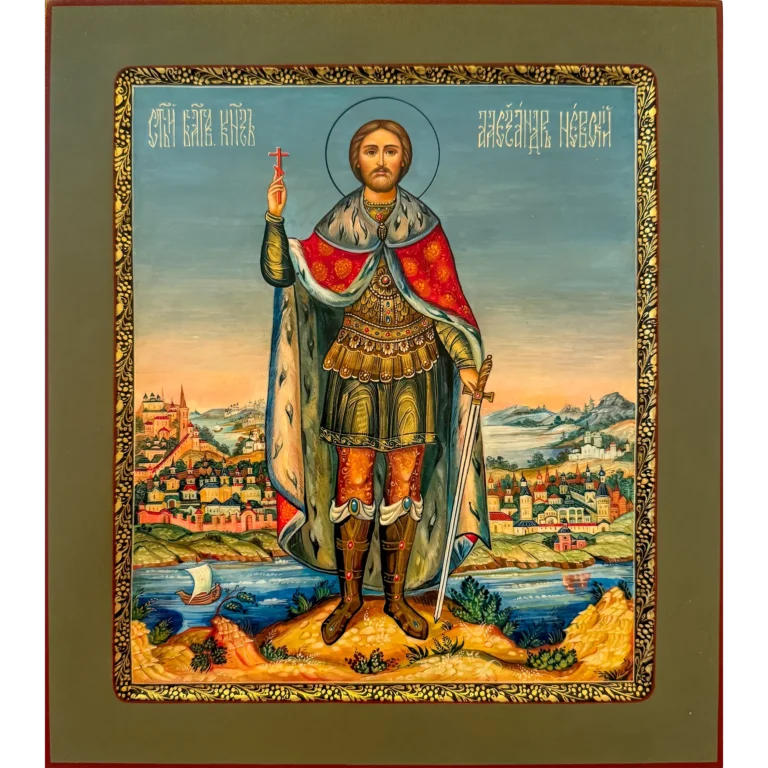
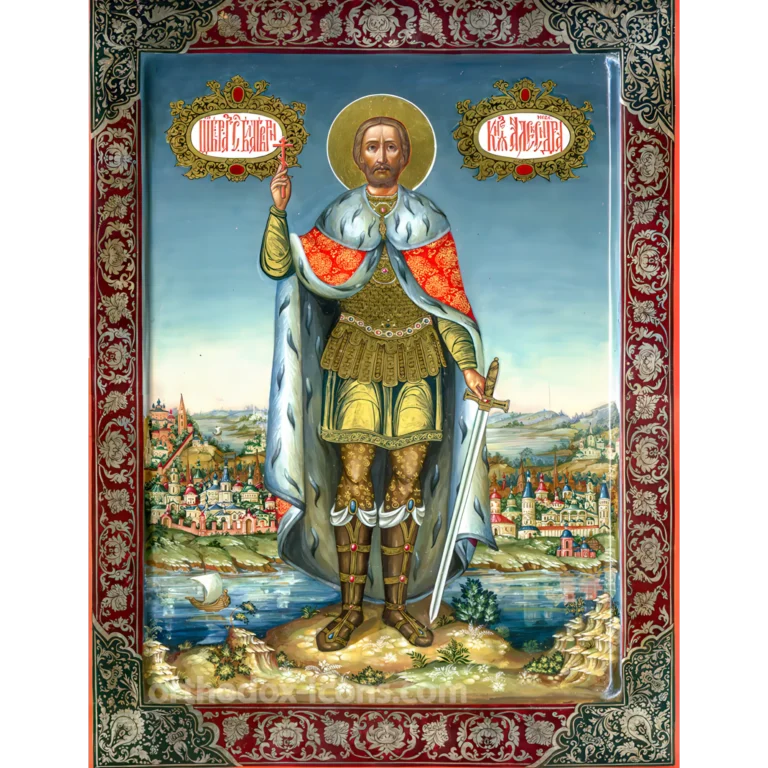
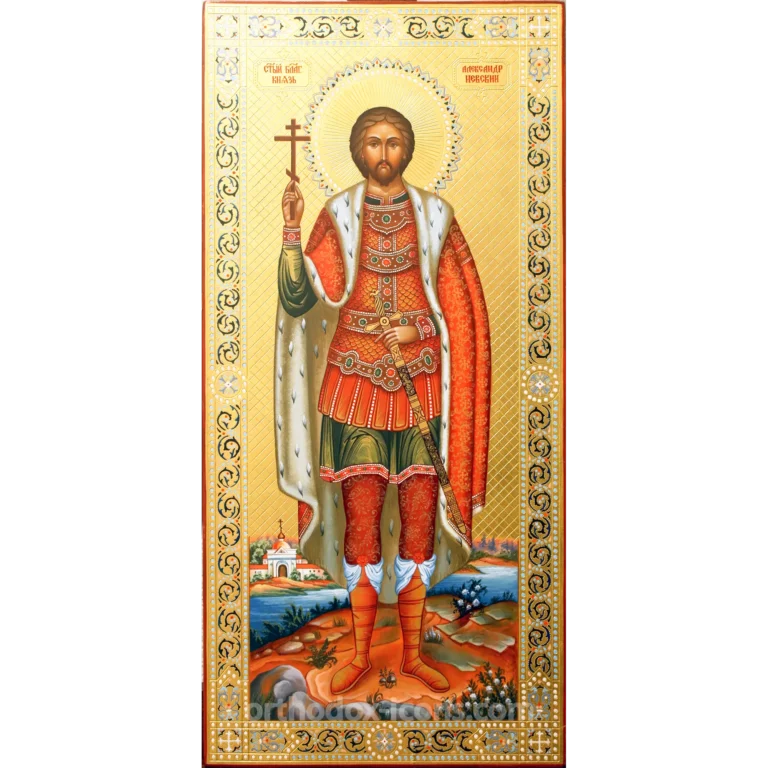
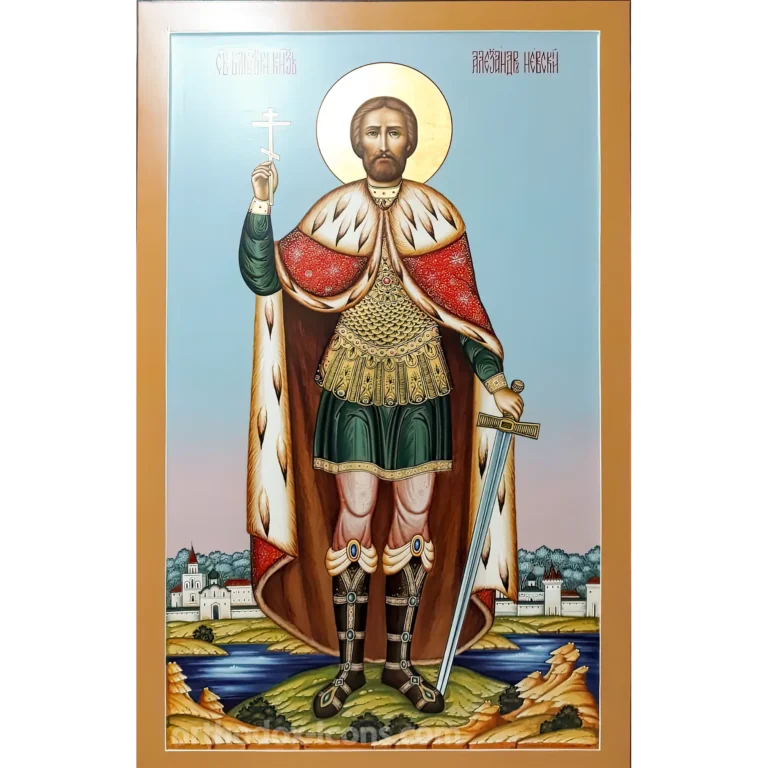
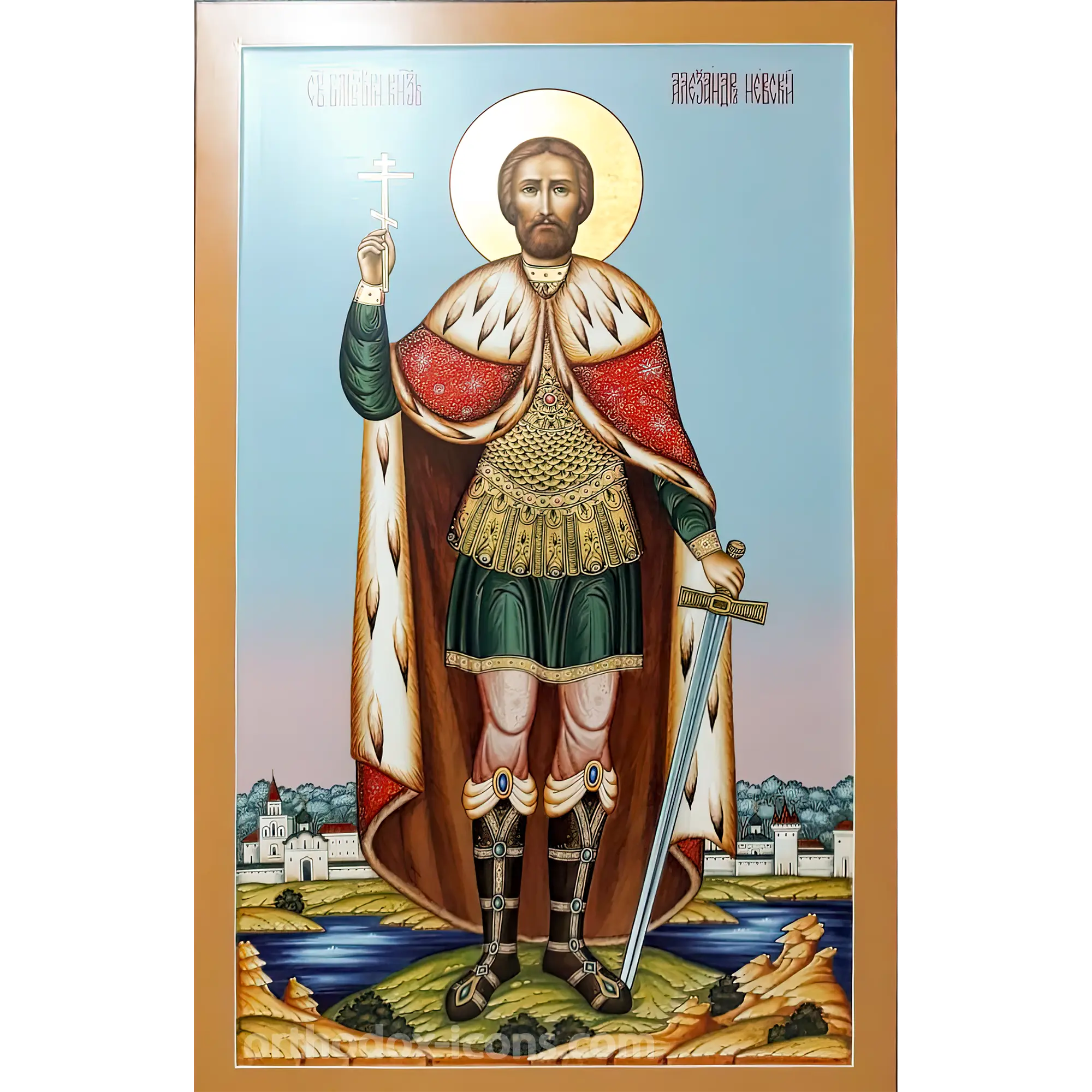
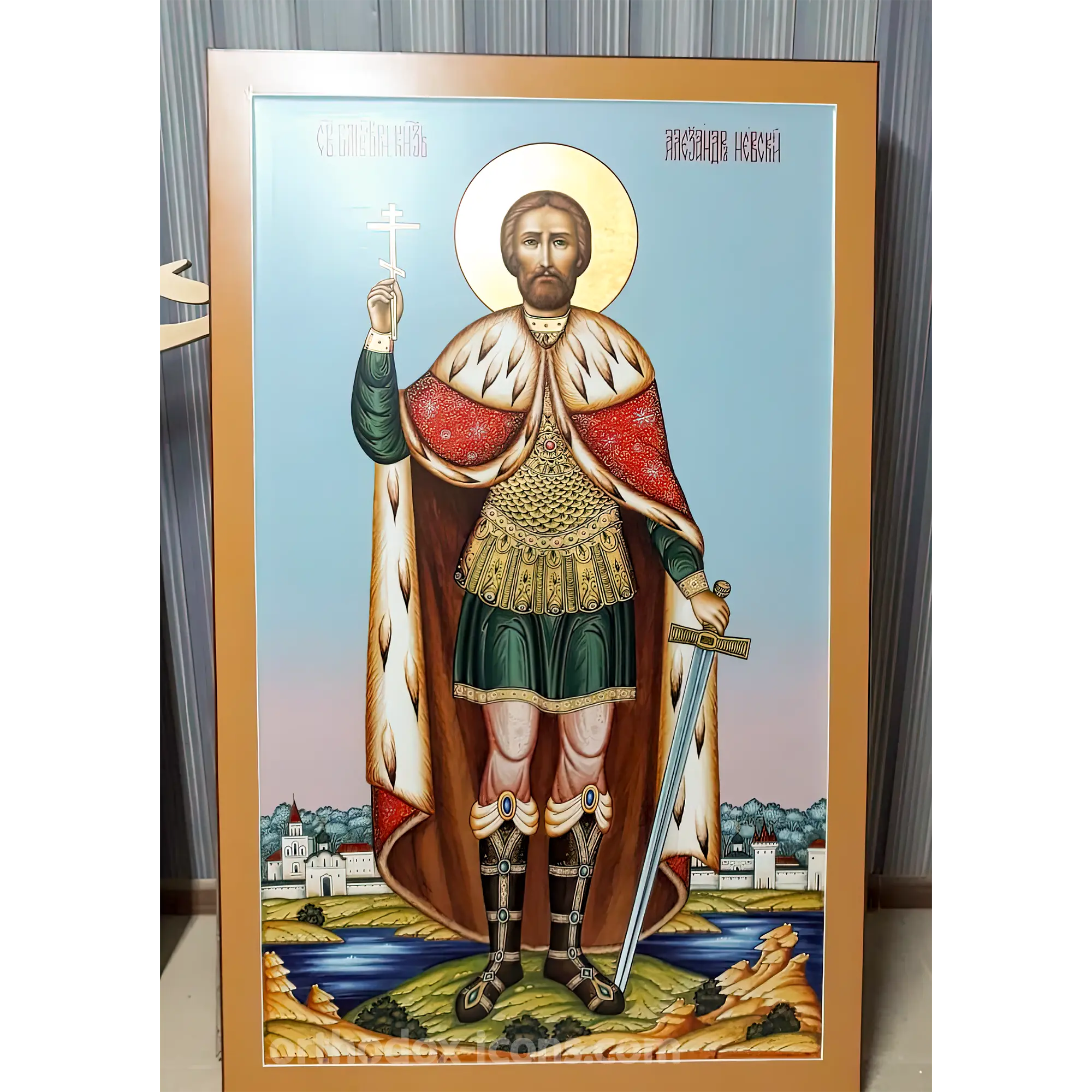
Hand-Painted Icon of Alexander Nevsky is a full-length Orthodox image of the holy right-believing prince, warrior, and defender of the Russian land. Saint Alexander is shown in princely military garments, with a fur-trimmed cloak, armor, a cross in his right hand, and a lowered sword in his left.
The lower part of the icon includes a landscape with a river, hills, and an ancient Russian city, emphasizing the saint’s earthly service, his defense of the people, and his faithfulness to Orthodox Christianity. The large vertical format allows the face, cross, sword, armor, cloak, halo, and background details to remain clear.
This icon is suitable as a patron saint icon for men and boys named Alexander, and as a meaningful Orthodox gift for soldiers, leaders, fathers, families, churches, and chapels. Free international shipping is included. Payment is made after you receive and approve the icon.
It is possible to paint an image in any size to order
Free shipping worldwide
Hand-Painted Icon of Alexander Nevsky presents the holy right-believing prince in a full-length composition: as a ruler, warrior, defender of the Russian land, and confessor of the Orthodox faith. On the icon, Saint Alexander Nevsky is shown in solemn princely and military garments, holding a cross in his right hand and a sword in his left. He wears armor and a rich cloak with fur trim. The image unites two sides of his calling: statesmanlike wisdom and spiritual faithfulness to Christ.
The icon is made in a large vertical format, 30×50 cm (11.8×19.7 in), which is especially fitting for a full-length image of the holy prince. In this size, the armor, sword, cross, cloak, halo, face, and lower landscape can be rendered clearly. At the bottom of the composition are a river, hills, and an ancient Russian city, so the image is perceived not as an abstract portrait, but as a prayerful reminder of Saint Alexander’s service to his land and people.
Saint Alexander Nevsky is venerated as a heavenly patron of soldiers, defenders, rulers, men named Alexander, and all who must make responsible decisions in difficult circumstances. His icon is appropriate for a home icon corner, study, military space, church, chapel, school, or as a meaningful spiritual gift for a son, father, husband, leader, or person who carries responsibility for family and homeland.
Features of the Presented Icon
On this icon, Alexander Nevsky is shown full-length. The saint’s figure stands on the central vertical axis of the composition and is painted frontally, calmly, and with dignity. This posture emphasizes not outward aggression, but spiritual steadiness. He appears not as a hero from a historical painting, but as a saint glorified by the Church for faithfulness to God, wisdom, self-sacrificial service, and care for his people.
In his right hand, the saint holds an Orthodox cross. This element is especially important: it shows that Alexander Nevsky’s chief victory was not only military or political, but spiritual. The cross points to his confession of Christ and to the fact that earthly authority, for the holy prince, was not an end in itself, but a service carried out before God.
In his left hand, the saint holds a sword lowered with the point down. This gesture is not aggressive. The sword is a sign of princely responsibility, protection, readiness to defend truth, and care for the land entrusted to him. It recalls Alexander Nevsky’s military service, but does not turn the icon into an image of earthly power for its own sake. The sword is subordinate to the cross: the saint’s military duty is interpreted through faith.
The garments of Alexander Nevsky are painted solemnly and in detail. The saint wears armor with golden scale-like elements, dark green clothing, and a princely cloak with red fabric and fur trim. The white and brown fur edging gives the image princely dignity, while the red cloak recalls authority, courage, sacrifice, and readiness to serve to the end.
The lower part of the icon contains a landscape: a river, rocky bank, hills, and an ancient Russian city in the distance. This detail is not accidental decoration. It helps reveal the meaning of the prince’s service: the defense of the Russian land, its cities, churches, people, and Orthodox faith.
Who This Icon of Alexander Nevsky Is For
The icon of the holy right-believing Prince Alexander Nevsky is especially appropriate for men and boys named Alexander. It may be ordered as a patron saint icon for baptism, nameday, birthday, coming of age, entry into school or service, appointment to a responsible position, or another important stage of life.
The image of the holy prince is often chosen for soldiers, officers, public servants, leaders, fathers, teachers, and all who carry responsibility for other people. Before his icon, people pray for courage, wisdom, protection from enemies, preservation of faith, and the ability to make decisions without pride, fear, or cowardice.
For a family, this icon can become an image of male heavenly patronage. It reminds the household of dignity, faithfulness to one’s word, responsibility before loved ones, and the need to unite strength with Christian conscience. It is fitting in a home icon corner near icons of Christ, the Mother of God, and the patron saints of the family.
In a church setting, the icon of Alexander Nevsky may be made in a larger or iconostasis format. A full-length image is readable from a distance, and the princely-warrior iconography makes it especially expressive among icons of right-believing princes, holy warriors, and defenders of the Orthodox faith.
Prayers Before Saint Alexander Nevsky
Before the icon of Saint Alexander Nevsky, Orthodox Christians pray for the protection of the homeland, family, home, soldiers, and all who are in danger. They also ask for help in difficult decisions, preservation of faith, reconciliation, wisdom, courage, and the ability to act honestly in complex circumstances.
Saint Alexander Nevsky is often asked for prayerful intercession for the protection of family, home, and homeland; help in military and public service; wisdom for leaders and those making important decisions; courage in trials and dangers; preservation of the Orthodox faith; reconciliation, restraint, and sound judgment; heavenly patronage for men named Alexander; and the upbringing of sons in faith, responsibility, and honesty.
Prayer before the image of the holy prince is not reduced to asking for outward victory. The icon of Alexander Nevsky reminds us that true Christian strength is joined to humility, faithfulness, patience, and responsibility before God. The saint knew when firmness was needed to defend faith and people, and when restraint was necessary to prevent greater suffering.
Brief Life of Alexander Nevsky
Saint Alexander Nevsky was born in the thirteenth century and entered history as one of the great defenders of Rus. His name is connected with the victory on the Neva River, after which he received the name Nevsky, and with the Battle on the Ice, where the Russian army stopped the advance of Western knights. Yet the Church’s veneration of Alexander Nevsky is not based only on military glory.
The time in which he lived was extremely difficult. The Russian land endured political pressure, threats from different sides, internal divisions, and external danger. Alexander Nevsky showed not only the courage of a commander, but also the wisdom of a ruler. He understood when it was necessary to fight and when diplomacy, patience, and preservation of the people from new disasters were required.
The central feature of his service was faithfulness to the Orthodox faith. The holy prince did not allow the spiritual submission of Rus to foreign church influence and defended not only borders, but also the religious integrity of his people. For this reason, he is shown on the icon not simply as a warrior, but as a right-believing prince: a ruler who sought to serve God in his earthly calling.
Before his repose, Alexander Nevsky accepted monastic tonsure with the name Alexy. This fact is important for understanding his sanctity: earthly fame, victory, and power ended in humble turning toward the monastic path. In Saint Alexander, princely dignity, military courage, political wisdom, and Christian humility are united.
Feast Days of Saint Alexander Nevsky
The memory of Saint Alexander Nevsky is celebrated several times during the year. The best-known dates are September 12, the translation of his relics, and December 6, the day of his repose, according to the modern calendar. These dates are often chosen for prayerful commemoration of the saint and for ordering a patron saint icon for someone named Alexander.
If the icon is ordered as a gift for a specific date, such as baptism, nameday, anniversary, entry into service, or a parish feast, the large format should be discussed in advance. A 30×50 cm icon requires time for preparing the panel, gilding, painting, rendering the face, armor, landscape, and applying the protective finish.
Iconography: Cross, Sword, and Princely Garments
The cross in Alexander Nevsky’s hand is the main spiritual accent of the icon. It shows that the holy prince was a defender not only of land, but of faith. In the iconography of right-believing princes, the cross often points to confession of Christ and readiness to follow the Gospel path even within power, war, and political responsibility.
The sword in the saint’s left hand reveals his military service. It recalls the defense of Rus, princely duty, and the courage required by authority. Yet the sword is lowered rather than raised for a blow. This is an important detail: the saint is not shown in the heat of battle, but in prayerful firmness. His strength stands under the sign of the cross.
The armor and princely cloak emphasize Alexander Nevsky’s earthly rank. He was a ruler and warrior, but the Church glorifies him not for external grandeur, but for righteous service within those circumstances. Therefore the rich garments are not decorative luxury for its own sake; they point to a high earthly duty that the saint sought to fulfill before God.
The landscape with river and city in the lower composition recalls the Russian land. The river may evoke the prince’s military fame and the victory on the Neva, while the city walls and churches recall the people and holy places he protected. This detail makes the image especially expressive for a home, church, military space, or commemorative gift.
Materials, Gilding, and Custom Options
The icon of Alexander Nevsky is painted on a wooden panel. A prepared board strengthened with splines is used for the hand-painted icon. Natural chalk gesso is applied under the painting, creating an even ground for egg tempera and helping preserve the clarity of the lines.
The image is painted in egg tempera. This technique makes it possible to render the calm face of the holy prince, the fur trim of the cloak, scale-like armor, cross, sword, gilded halo, landscape with river and city, and Church Slavonic inscriptions. In the presented version, gold plays an important role in the halo and warm golden border areas, giving the icon a solemn and noble appearance.
For an individual order, the size, background and border tone, degree of gilding, inscriptions, kiot, detail of the armor and landscape, and a larger church format may be discussed. Iconostasis sizes are selected separately, taking into account the height of the row, viewing distance, lighting, neighboring icons, and the general style of the church space.
Choosing the Size of the Icon
The 30×50 cm (11.8×19.7 in) size is an expressive format for a full-length icon of the holy prince. It allows the complete figure to be shown and preserves important details: cross, sword, armor, princely cloak, landscape, city, halo, and inscriptions. This size is suitable for a spacious home icon corner, study, family prayer room, chapel, or military space.
Larger sizes are chosen when the image must be readable from a distance. In a church or chapel, it is important that the face, cross, sword, and full silhouette of the saint remain visible not only close up, but also from the middle of the room. A larger format also gives more room for fine rendering of the armor, fur trim, folds of the cloak, city landscape, and decorative details.
Iconostasis formats are made individually. For such an order, the place of installation should be determined in advance: a separate kiot, analogion icon, parish gift, or part of a row of saints. The proportions of the board, level of detail, color solution, and character of gilding depend on this.
Blessing and Care for a Hand-Painted Icon
The icon of Saint Alexander Nevsky may be blessed in an Orthodox church after it is received. Once blessed, the image is intended for prayer, thanksgiving, and turning to God through the intercession of the holy prince.
A hand-painted icon should be placed away from direct sunlight, heaters, dampness, soot, and sudden temperature changes. The surface should not be wiped with wet tissues, alcohol, household chemicals, or rough cloth. The face, gilded halo, inscriptions, sword, cross, and fine landscape details require especially careful handling.
Dust is best removed with a dry soft brush or dry soft cloth, without pressure. For a large icon, especially one intended for a church, chapel, or spacious home icon corner, a kiot is recommended. It protects the painting from dust, accidental touch, moisture, soot, and mechanical damage.
Questions and Answers
Who is shown on this hand-painted icon of Alexander Nevsky?
The icon shows Saint Alexander Nevsky, a right-believing prince, warrior, defender of the Russian land, and Orthodox saint honored for faithfulness, wisdom, and service to his people.
Why is Alexander Nevsky shown with a cross?
The cross in his hand points to his faithfulness to Christ and the Orthodox faith. It shows that his princely and military service was understood as responsibility before God.
What does the sword mean on the icon?
The sword signifies defense, princely responsibility, and readiness to protect truth and the people entrusted to him. Because the sword is lowered, it emphasizes strength under the sign of the cross.
What do Orthodox Christians pray for before Alexander Nevsky’s icon?
People pray for protection of family and homeland, help for soldiers, wisdom for leaders, courage, preservation of faith, safety in danger, and right decisions in difficult circumstances.
Who is this icon of Alexander Nevsky suitable for?
It is suitable for men and boys named Alexander, soldiers, leaders, fathers, Orthodox families, churches, chapels, and anyone seeking a serious spiritual gift.
What size is available for this icon?
The listed size is 30×50 cm (11.8×19.7 in). Larger and iconostasis formats may be discussed individually for a church, chapel, or special commission.
Can this icon be ordered for a church?
Yes. The icon may be made in a larger or iconostasis size. Format, gilding, kiot, inscriptions, and level of detail can be discussed before work begins.
When is the feast day of Saint Alexander Nevsky?
The best-known commemorations are September 12, the translation of his relics, and December 6, the day of his repose, according to the modern calendar.
Why is the 30×50 cm size good for this icon?
The 30×50 cm format allows the full-length figure, princely garments, armor, sword, cross, landscape, halo, and inscriptions to be shown clearly.
How should a hand-painted icon be cared for?
Keep the icon away from moisture, direct sunlight, overheating, soot, and mechanical damage. Dust should be removed with a dry soft brush or cloth, without pressure.
| Dimensions | 30x50cm (11.8×19.7 in) |
|---|---|
| Name | Alexander |