Saint Alexander Nevski Icon
$3750
Available size: 30×40 cm (11.8×15.7 in) and larger; larger and iconostasis formats can be made by individual request.
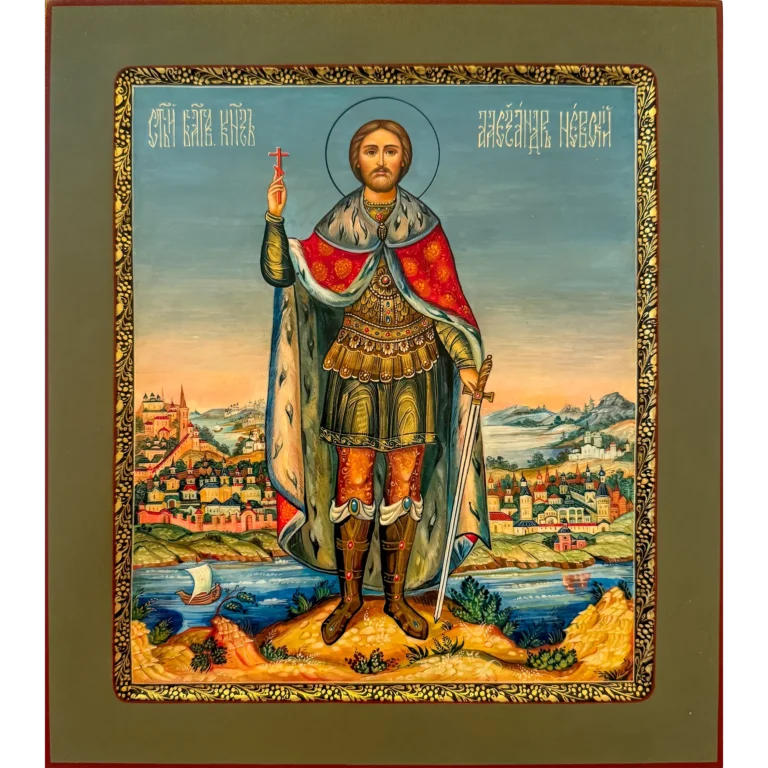
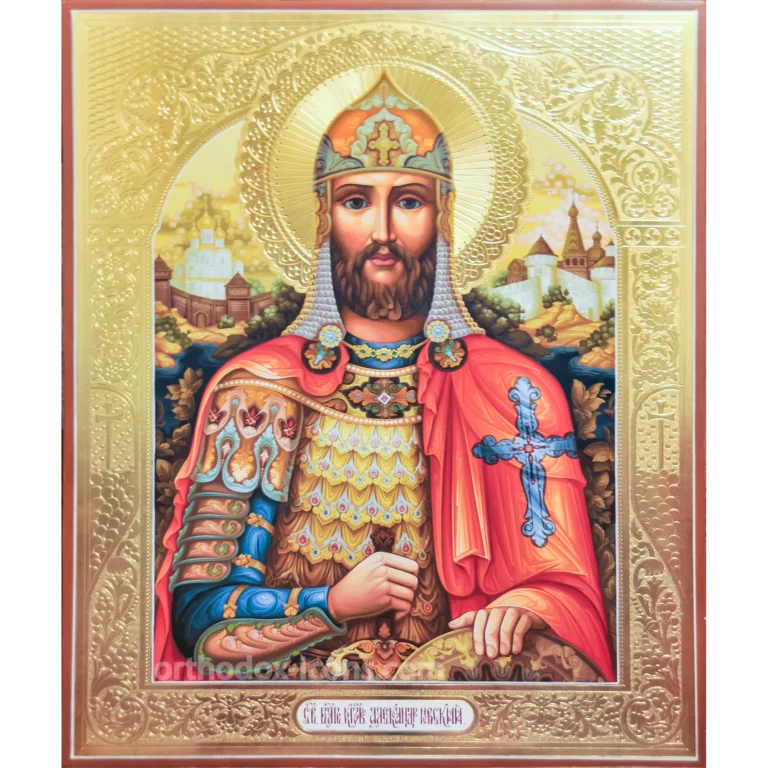
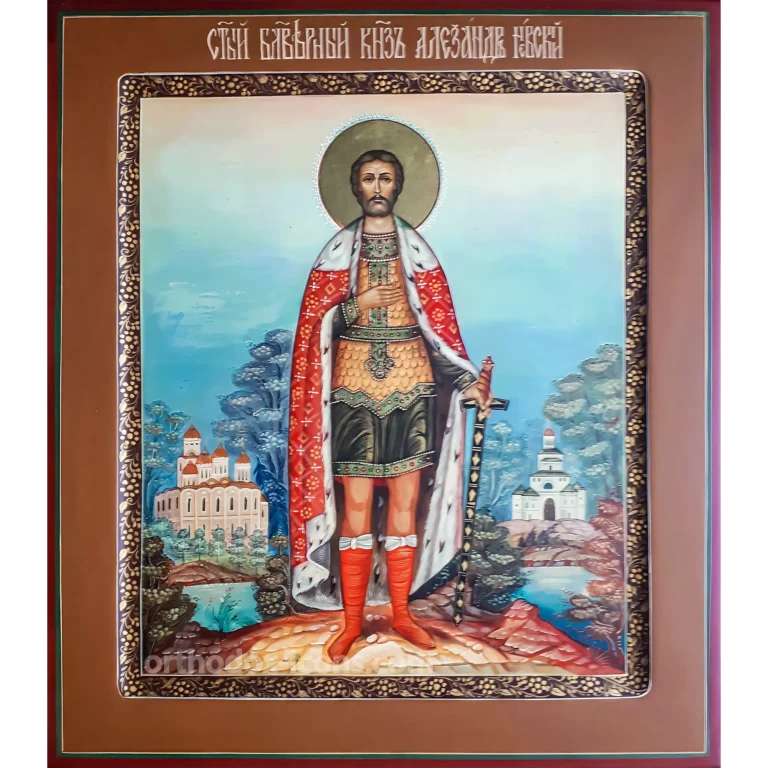
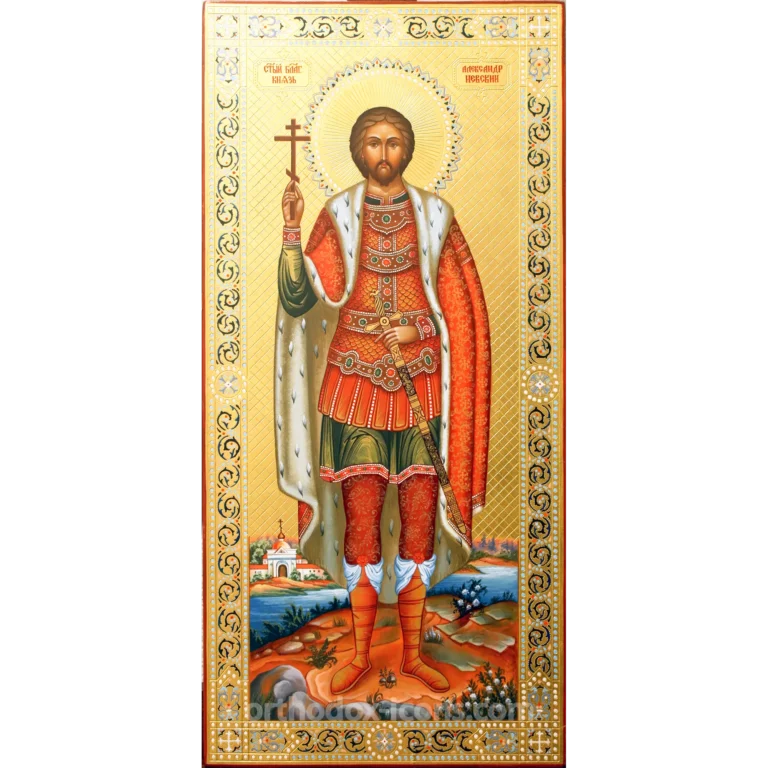
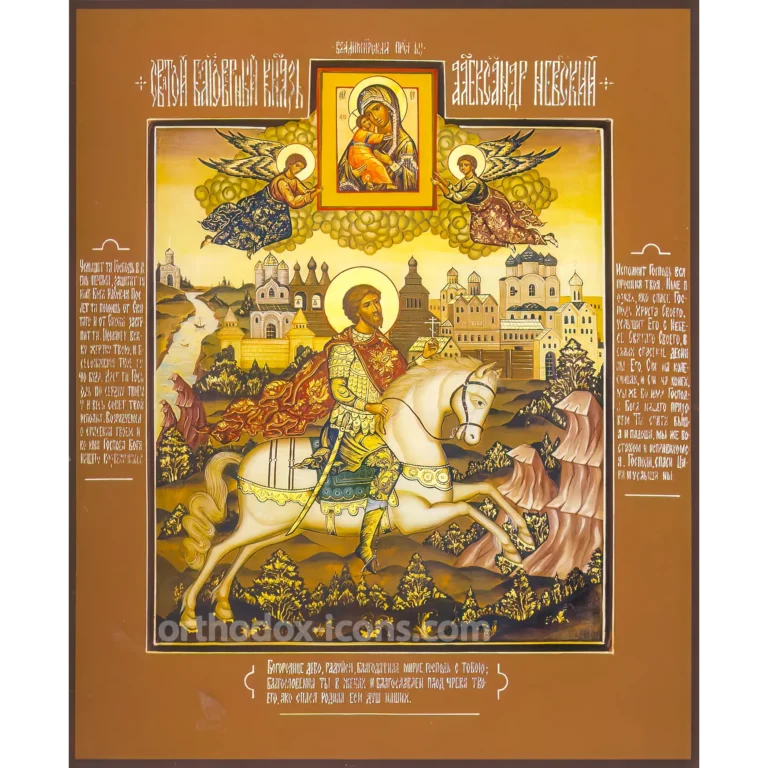
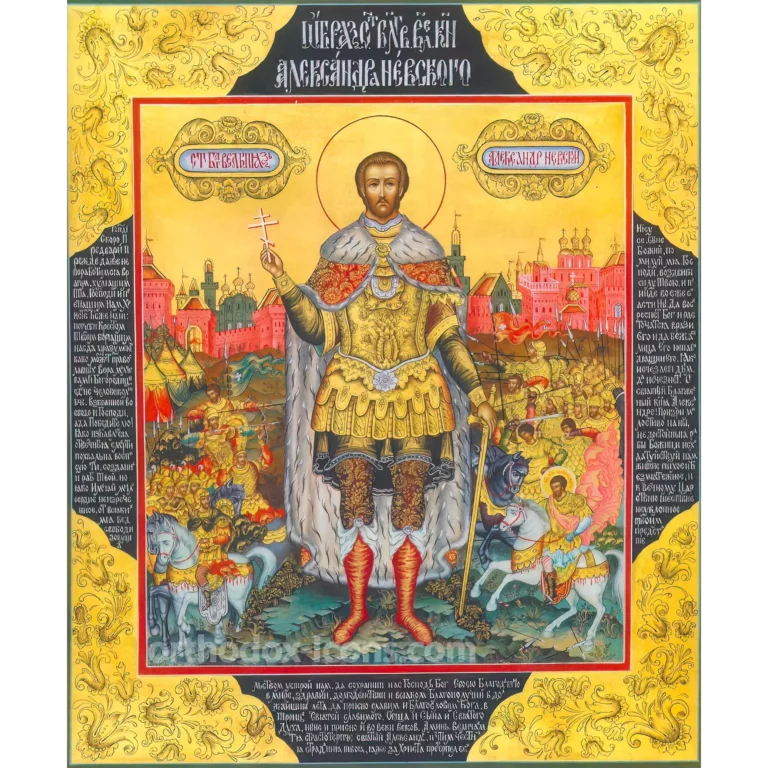
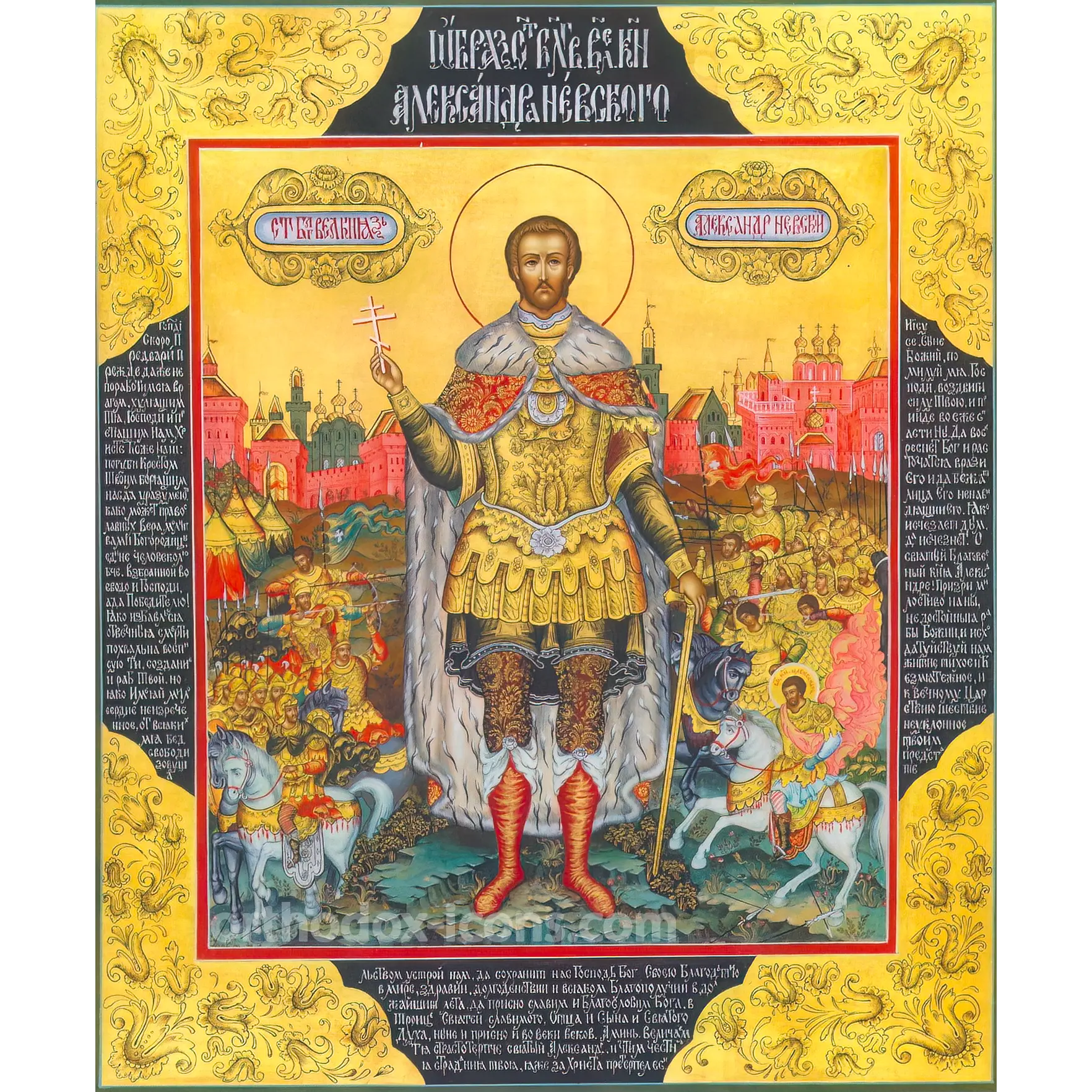
Saint Alexander Nevski Icon is a hand-painted full-length icon of the Holy Right-Believing Prince Alexander Nevsky, a Russian prince, warrior, and defender of the Orthodox faith. He is shown in princely military garments, holding a cross and a sword, with scenes of battle, an old Russian city, soldiers, riders, banners, and decorative inscription fields behind him.
Prayer focus: strengthening of faith, courage, protection of family and homeland, wisdom in decisions, peace, steadfastness, responsibility, and help for men named Alexander.
Materials: linden wood board, oak support slats, natural chalk gesso, egg tempera; gold leaf gilding and decorative finish are selected according to the chosen version.
Best suited for: men and boys named Alexander, soldiers, leaders, fathers, baptism, name day, jubilee, home icon corner, church, chapel, military unit, or Orthodox educational space.
It is possible to paint an image in any size to order
Free shipping worldwide
Saint Alexander Nevski Icon is a hand-painted Orthodox icon of the Holy Right-Believing Prince Alexander Nevsky, a Russian saint honored as a wise ruler, courageous defender of the land, and prince who united military firmness with Christian humility. The Church venerates Alexander Nevsky not simply as an outstanding historical figure, but as a right-believing prince: a ruler who bore responsibility for his people, made difficult decisions, and sought to preserve faith, peace, and the spiritual integrity of Rus.
In the presented icon Saint Alexander Nevsky is shown full-length, in richly ornamented princely military garments. In one hand he holds a cross, and in the other a sword. These details reveal the central meaning of the image: the prince’s military strength is subject to faith, and his earthly service is sanctified by a Christian choice. Behind him are an old Russian city, soldiers, battle scenes, riders, and banners. The icon is not only a patron saint image for a man named Alexander, but also a complex historical and iconographic composition about the protection of faith, homeland, and people.
The rich decorative treatment, golden fields, narrative scenes, inscriptions, and ornament make this icon especially expressive in a larger size. It is suitable for a home icon corner, study, church, chapel, military unit, Orthodox educational space, or memorial gift for a man named Alexander. Because the composition is detailed, the image is best revealed in 30×40 cm (11.8×15.7 in) and larger formats, including iconostasis sizes.
Icon Characteristics
| Full name | Saint Alexander Nevski Icon |
| Saint depicted | Holy Right-Believing Grand Prince Alexander Nevsky |
| Iconographic type | Full-length prince-warrior with cross, sword, and narrative battle scenes |
| Commemoration days | September 12 / August 30 according to the old calendar; December 6 / November 23 according to the old calendar |
| Visible features | Full-length saint, princely military garments, cross, sword, mantle, old Russian city, battle scenes, army, riders, inscription fields, golden ornament |
| Available size | 30×40 cm (11.8×15.7 in) and larger; iconostasis sizes by request |
Who This Icon Is For
The icon of the Holy Right-Believing Prince Alexander Nevsky is especially suitable for men and boys named Alexander. It can be ordered for baptism, name day, patron saint day, birthday, coming of age, entrance into study, military oath, jubilee, professional feast, or an important family occasion. Such a gift unites personal heavenly patronage, historical memory, and the image of courage grounded not in pride, but in responsibility before God and people.
The image of Alexander Nevsky is often chosen for soldiers, cadets, officers, leaders, fathers, mentors, and people whose lives are connected with protection, governance, serious decisions, and service to others. The holy prince is remembered as an example of firmness, discernment, loyalty to the Orthodox faith, and the readiness to protect those entrusted to him without losing inner dignity.
For a church, chapel, military unit, Orthodox school, or memorial space, this icon can become a central image of a Russian saintly prince-warrior. The narrative composition with city, army, battle scenes, and inscription fields is especially strong in a larger format, where both the saint’s face and the historical-iconographic setting can be read clearly.
Prayer Before the Icon of Alexander Nevsky
Before the icon of Saint Alexander Nevsky, Orthodox Christians pray for strengthened faith, courage, wisdom, protection of family and homeland, help in responsible service, peace, firmness in trials, and deliverance from cowardice. Men named Alexander, their parents, wives, relatives, soldiers, leaders, and people facing difficult decisions may turn to him in prayer.
Common prayer intentions before this icon include:
- strengthening of faith and faithfulness to the Orthodox path;
- wisdom in leadership, service, and decision-making;
- courage without hardness, and strength without pride;
- protection of family, home, and homeland;
- support for soldiers, defenders, and people in dangerous professions;
- help for men and boys named Alexander;
- peace, discernment, and overcoming hostility;
- help in difficult circumstances when honor and faith must be preserved.
An Orthodox icon is not a charm or a sign of external luck. Prayer before Saint Alexander Nevsky is a turning to God through the saint’s intercession. His image reminds us that true Christian strength is shown not only in victory over an outer enemy, but also in victory over fear, pride, confusion, weakness, and inner unfaithfulness.
Brief Life of Saint Alexander Nevsky
The Holy Right-Believing Prince Alexander Nevsky lived in the thirteenth century, one of the most difficult periods of Russian history. The Russian lands faced external threats, princely conflicts, and pressure from both west and east. In these conditions Alexander showed himself not only as a brave warrior, but also as a prudent ruler who sought to preserve his people, the Orthodox faith, and the unity of the land.
Alexander Nevsky’s name is connected with victory on the Neva, after which he received his famous title, and with the Battle on the Ice, where the Russian army stopped the advance of western knights. Yet the Church’s veneration of the holy prince is not limited to military victories. His life is remembered for loyalty to Orthodoxy, the ability to make difficult political decisions, care for the people, and the understanding that a ruler answers before God for those entrusted to him.
Before his death, Prince Alexander received monastic tonsure with the name Alexius. This fact is especially important for understanding his holiness: earthly glory, military victories, and princely dignity ended in a humble monastic step. The Church glorifies him as a right-believing prince, a ruler whose strength was united with faith and whose earthly service became a path toward Christ.
Commemoration Days
The Orthodox calendar especially honors two commemoration days of the Holy Right-Believing Prince Alexander Nevsky. September 12 according to the new calendar, or August 30 according to the old calendar, commemorates the translation of his relics. December 6 according to the new calendar, or November 23 according to the old calendar, marks the repose of the saint.
These dates may be considered when choosing a patron saint icon for someone named Alexander, a gift for a patron saint day, baptism, jubilee, military service, professional feast, family celebration, or church donation. If the icon is ordered for a specific date, it is best to agree in advance on the size, decorative detail, gilding, border treatment, and painting time.
Features of the Presented Icon
In this icon Alexander Nevsky is shown full-length at the center of a complex multi-figure composition. His figure is frontal and solemn: the saint stands as a prince and defender, but not as an ordinary historical warrior. The gold halo shows his glorification by the Church, while the cross in his hand reminds us that faith in Christ was the foundation of his service.
The saint’s clothing is richly and carefully painted. Golden armor, a princely mantle with fur trim, red boots, ornamental details, and a belt emphasize the dignity of a ruler. At the same time the image does not become mere ceremonial splendor. The sword, cross, and calm face reveal responsibility, authority, and Christian choice. Saint Alexander stands as a man entrusted with defending not only land, but spiritual truth.
Behind the prince are scenes of military service: soldiers, riders, banners, city walls, and old Russian churches. The architectural background creates a sense of a whole historical panorama. The composition shows not only victory and the movement of armies, but also the peaceful life being defended: the city, churches, people, and land. This makes the icon an image of a holy prince standing between prayer, authority, and responsibility for others.
The fields are decorated with golden ornament and inscription fragments. Dark inscription fields on the sides and below strengthen the old Russian character of the icon and create a sense of chronicle-like narration. The upper part, with its large inscription and decorative elements, gives the image a solemn character. This is not a minimal half-length saint icon, but a rich historical and prayerful composition intended for attentive viewing.
Iconography: Cross, Sword, Princely Garments, and Battle
The cross in Alexander Nevsky’s hand is one of the most important signs in this icon. It shows that the holy prince is perceived by the Church not only as a warrior and ruler, but first of all as a Christian who defended faith and people. In meaning, the cross stands above the sword: it shows that earthly strength must be subject to God’s truth.
The sword in the prince’s hand is connected with his earthly service and military responsibility. In the iconography of right-believing princes, the sword is not a sign of cruelty. It recalls protection, duty, responsibility for people, and the need to resist evil. In the image of Alexander Nevsky, the sword beside the cross reveals an important Christian meaning: courage must be joined with discernment, and strength with faith and self-control.
The princely garments and armor emphasize the historical status of the saint. Alexander Nevsky was a ruler, warrior, and statesman. The iconography therefore does not hide his earthly dignity, but shows it as service. The fur mantle, golden armor, red and golden details do not simply decorate the figure; they help reveal the holy prince as a man carrying a heavy responsibility.
The battle scenes and old Russian city in the background widen the meaning of the icon. They connect the saint with the history of Rus, the defense of faith, people, and churches. Such a background is especially important in a large hand-painted icon: it turns the image into a whole narrative about Alexander Nevsky’s service, where personal holiness is revealed through service to the homeland.
Materials, Gilding, and Finish Options
The icon of Alexander Nevsky is painted on a solid linden wood board with oak support slats. This base is well suited to hand-painted iconography and allows a strong surface to be prepared under gesso. A natural chalk gesso ground is applied before the image is painted in egg tempera.
In this composition, the accuracy of details is especially important: the saint’s face, armor, cross, sword, mantle, city walls, churches, army, riders, banners, inscription fields, and ornamental elements. Depending on the selected finish, gold leaf may be used on the halo, background, fields, decorative elements, or details of the garments.
Because the icon is complex and multi-figure, it is best ordered in 30×40 cm (11.8×15.7 in) and larger sizes. In a larger format, not only the face and central figure, but also the historical background, architecture, battle scenes, texts, and ornament can be seen more clearly. For a church, chapel, or iconostasis, the size is chosen individually according to the location, lighting, neighboring icons, and overall artistic order of the space.
How to Choose the Size and Format
The 30×40 cm (11.8×15.7 in) size can be considered the minimum comfortable format for this detailed composition. It is suitable for a home icon corner, study, prayer room, or memorial gift. At the same time, the smaller the format, the more intimate the narrative background, army, architecture, and inscriptions will appear.
Larger sizes make the image more solemn and allow the details to be read more fully. They better reveal the battle scenes, the saint’s face, the decorative elements of the armor, the cross, sword, ornament, and inscription fields. Such a format is appropriate for a spacious home, church, chapel, military unit, Orthodox school, or public prayer space.
Iconostasis sizes are agreed separately. For church placement, the height of the row, viewing distance, proportions of neighboring icons, lighting, and the general style of the iconostasis are considered. The level of detail, amount of gilding, border decoration, and inscriptions can also be discussed.
Blessing and Care
The icon of the Holy Right-Believing Prince Alexander Nevsky may be blessed in an Orthodox church after it is received, or brought for blessing at your parish. A blessed icon is not a decorative historical image, but a holy object for prayer, thanksgiving, and turning to God through the intercession of the saint.
A hand-painted icon should be cared for carefully. Dust may be removed with a dry soft brush or dry cloth without pressure. The icon should not be wiped with a wet cloth or placed in direct sunlight, near a heater, humidifier, hot lamp, or source of sudden temperature changes. Special care should be taken with gilded areas, inscription fields, small figures, architectural details, and the painted surface. For a large icon, a wooden kiot may be considered.
Free international shipping is included. Payment is made after you receive and approve the icon.
Questions and Answers
Who is shown on the Saint Alexander Nevski Icon?
The icon shows the Holy Right-Believing Prince Alexander Nevsky, a Russian prince, defender of the homeland, and Orthodox saint glorified for faithfulness and responsible service.
Why is Alexander Nevsky shown with a cross and sword?
The cross points to the Christian foundation of his life, while the sword signifies princely and military service. Together they show strength under the authority of faith.
What do Orthodox Christians pray for before this icon?
People pray for strengthened faith, courage, protection of family and homeland, wisdom in decisions, support for soldiers, peace, steadfastness, and help for men named Alexander.
Who is this icon suitable for?
It is suitable for men and boys named Alexander, soldiers, leaders, fathers, Orthodox schools, churches, chapels, and family icon corners.
When is Saint Alexander Nevsky commemorated?
The main commemoration days are September 12 and December 6 according to the new calendar.
Why is this icon best ordered in 30×40 cm or larger?
The composition includes many details: the full-length saint, army, city, battle scenes, inscriptions, and ornament. These elements read better in 30×40 cm and larger formats.
Can this icon be ordered for a church?
Yes. The icon can be painted in a larger or iconostasis format, with size, detail, gilding, and border decoration agreed individually.
Is this icon appropriate as a gift for a soldier?
Yes. It is a meaningful Orthodox gift for a soldier, cadet, officer, or anyone whose life is connected with responsibility, protection, and service.
What do the battle scenes mean?
The battle scenes recall Alexander Nevsky’s earthly service as defender of Rus. They give historical context and show him as a prayerful protector of his people.
How should a hand-painted icon of Alexander Nevsky be cared for?
Keep it away from moisture, direct sunlight, heaters, and sudden temperature changes. Dust it gently with a dry soft brush or dry cloth without pressure.
| Dimensions | 30x40cm (11.8×15.7 in) |
|---|---|
| Name | Alexander |