The Filigree Icon of St. Xenia
$950
Available size: 17×21 cm (6.7×8.3 in)
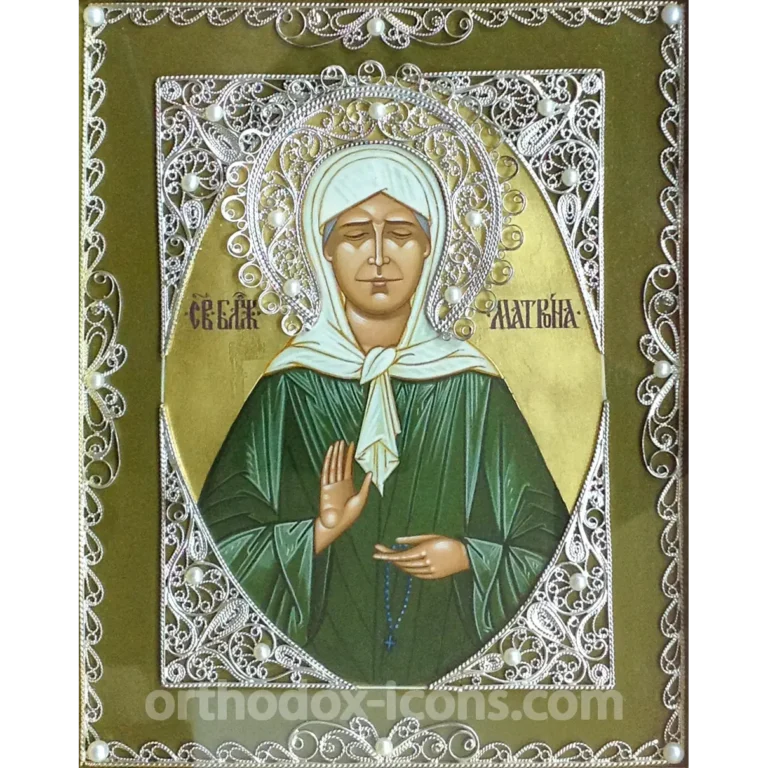
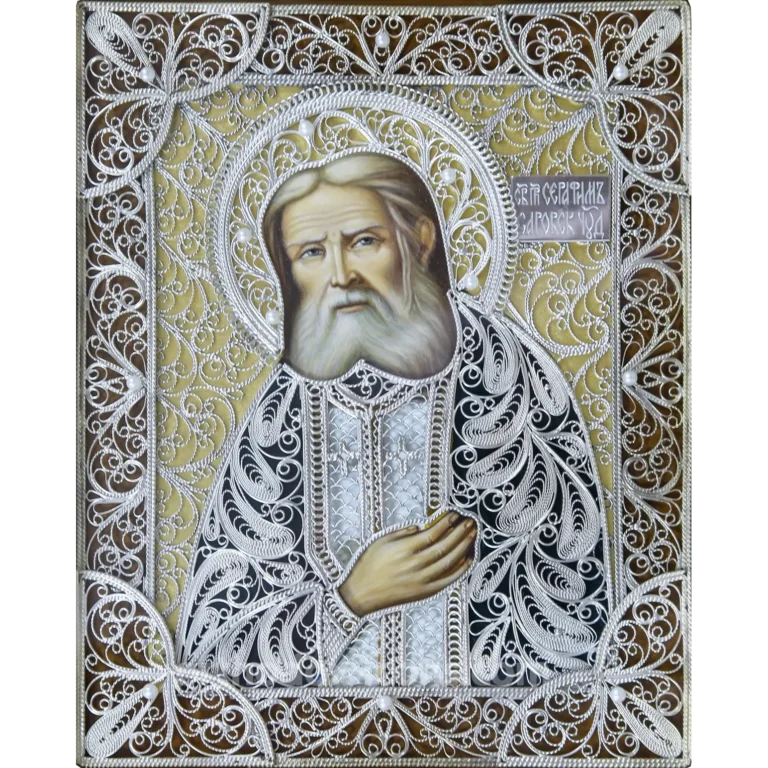
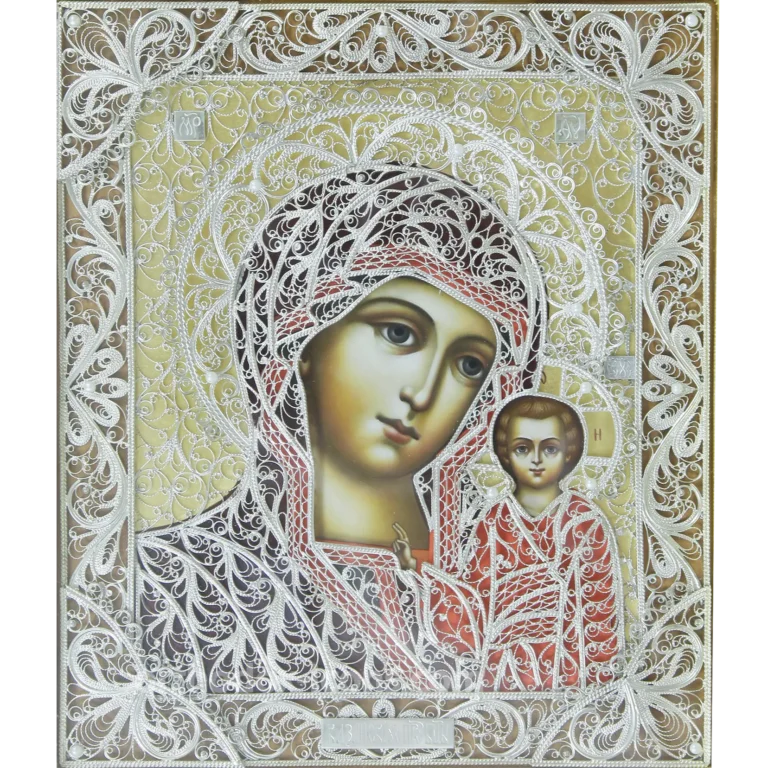
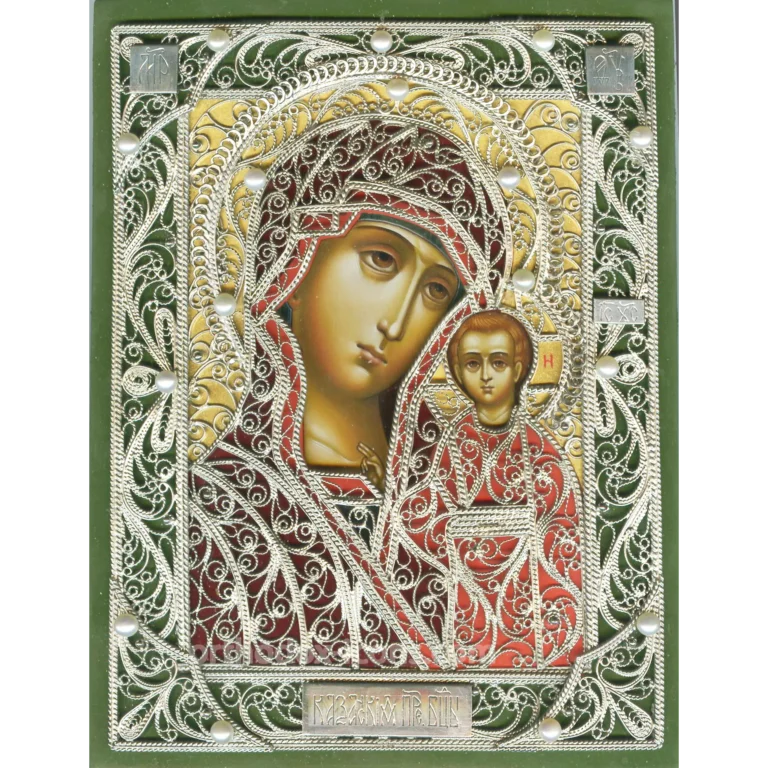
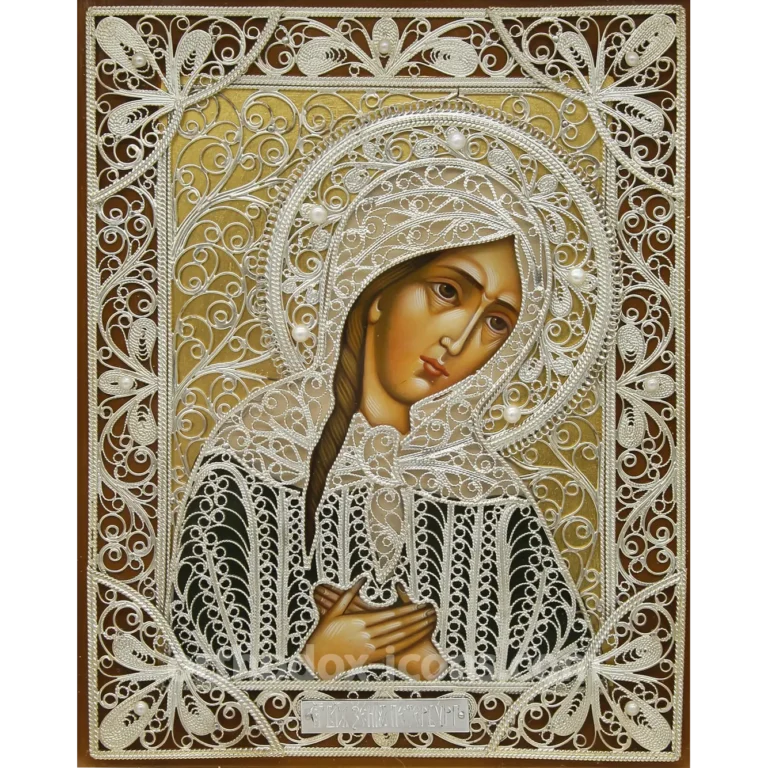
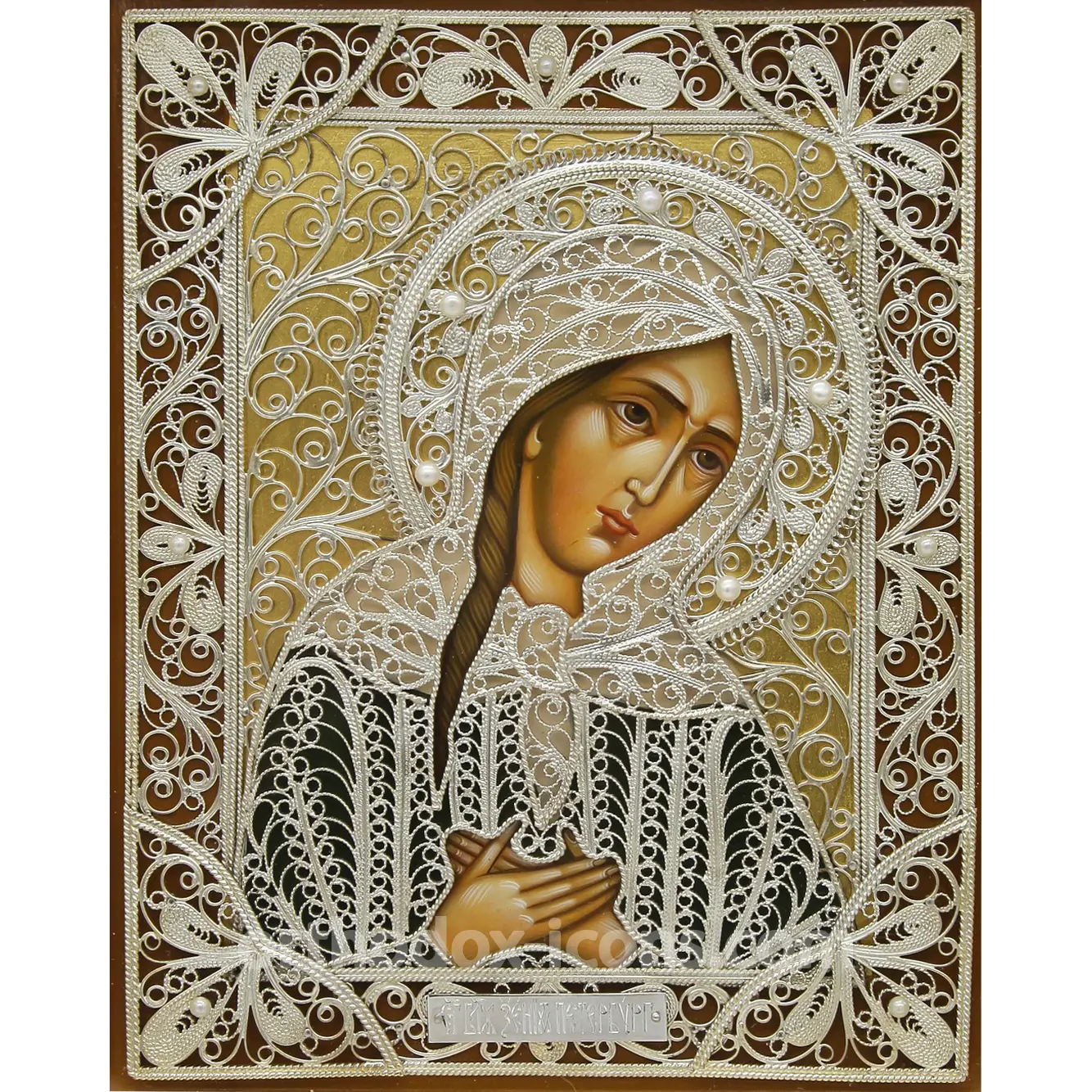
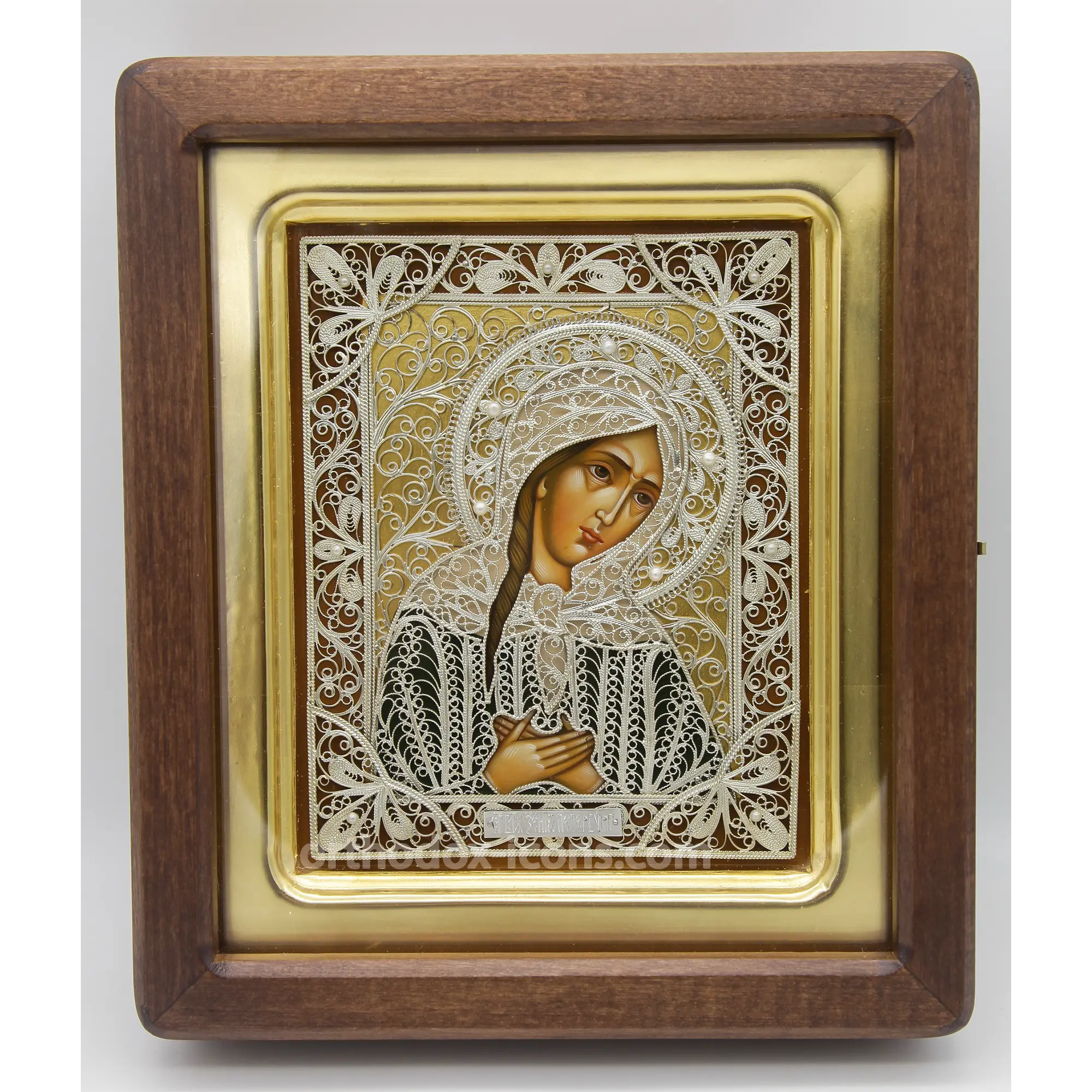
The Filigree Icon of St. Xenia is a hand-painted waist-length image of Blessed Xenia of Saint Petersburg in a delicate filigree setting. The saint is shown with her head slightly bowed, covered, and with her hands folded at her chest in a gesture of humble prayer.
The silver-toned filigree setting, with fine floral ornament, openwork curls, and pearl-like inserts, frames the face, halo, and borders without covering the spiritual center of the icon. The gold background and soft prayerful expression give the image a quiet, reverent character suitable for home prayer.
This icon is suitable as a patron saint icon for women and girls named Xenia, and as a meaningful Orthodox gift for baptism, nameday, birthday, housewarming, or a family occasion. Free international shipping is included. Payment is made after you receive and approve the icon.
Production time: about 2 months.
It is possible to paint an image in any size to order
Free shipping worldwide
The Filigree Icon of St. Xenia is a compact hand-painted image of Blessed Xenia of Saint Petersburg, a saint to whom Orthodox Christians often turn in family, everyday, and heartfelt needs. In this icon, Blessed Xenia is shown in a waist-length composition: her face is slightly bowed, her gaze is filled with quiet sorrow and inner prayer, and her hands are folded at her chest in a humble and concentrated gesture.
This image does not seek outward grandeur. Its strength lies in a gentle prayerful tone, in the sense that the saint is close to human grief, family concerns, and ordinary daily struggles. The 17×21 cm (6.7×8.3 in) size makes the icon convenient for a home icon corner, prayer shelf, bedroom, study, or small kiot. It is expressive without being visually heavy.
The filigree setting gives the icon special artistic value. Openwork curls, floral motifs, a light metallic sheen, and pearl-like inserts create a fine, almost lace-like frame around the image. At the same time, the filigree does not cover the spiritual center of the icon: the face of Blessed Xenia, her bowed head, and her hands folded in prayer remain open and clear.
Features of the Presented Icon
On this icon, Blessed Xenia of Saint Petersburg is shown with a covered head and dark garments. The figure is not full-length, but waist-length, so attention is focused on the face, the incline of the head, the position of the hands, and the saint’s inward state. This type of composition is especially suitable for home prayer because it does not distract the eye with many narrative details.
The face of the saint is painted with soft and sorrowful expression. Blessed Xenia is not shown as a distant historical figure, but as a close intercessor who endured deep personal loss and transformed sorrow into a life of self-denial for Christ. Her gaze is not direct or severe; it seems lowered into prayer. This makes the icon especially delicate and consoling.
The hands of Blessed Xenia are folded at her chest. This gesture can be understood as a sign of heartfelt prayer, humility, and inner standing before God. It corresponds well to her life: after the death of her husband, Xenia left the ordinary path of life, accepted the way of foolishness for Christ, and became a prayerful helper for many people.
The background is painted in a gold tone. In an icon, gold is not a sign of ordinary luxury, but an image of divine light and the Kingdom of Heaven. Against this background, the light filigree setting becomes especially expressive: it surrounds the saint’s face, halo, and borders, creating the impression of a fine spiritual treasure.
At the bottom of the icon is a name plaque identifying the saint. It is included in the filigree ornament and completes the composition. Painting, gold, halo, setting, and inscription work together as one prayerful image.
Filigree Setting and Openwork Frame
The main decorative feature of this icon is the filigree setting. Filigree is a fine openwork ornament made from delicate metal threads and curls arranged into a patterned composition. On this icon of Blessed Xenia, the filigree forms a broad frame, covers part of the garment, surrounds the halo, and creates an elegant arch around the saint’s face.
The ornament is built from floral motifs: curls, leaves, elongated petals, lace-like forms, and symmetrical corner elements. Because of this, the setting looks light and airy rather than heavy. It does not overpower the painting; it gently emphasizes it. Most importantly, the face of the saint remains open, because the face carries the main prayerful meaning of the icon.
The pearl-like inserts placed on the borders and around the halo add soft accents of light. They echo the brightness of the filigree and strengthen the sense of purity, quiet, and heavenly radiance. This kind of decoration makes the icon suitable as a gift, while still preserving its primary meaning as a holy image for prayer.
The filigree setting also helps protect parts of the painting and gives the icon a more solemn character. For the image of Blessed Xenia of Saint Petersburg, this execution is especially fitting: the delicate and restrained beauty of the setting harmonizes with the spiritual themes of humility, prayer, and compassionate help.
Who This Icon of Blessed Xenia Is For
The filigree icon of Blessed Xenia of Saint Petersburg is suitable for women and girls named Xenia. It may be given for baptism, nameday, birthday, graduation, marriage, housewarming, or another important life event. For a patron saint icon, the 17×21 cm size is especially convenient: the image is visible, yet personal, domestic, and prayerfully close.
Blessed Xenia is venerated as a swift helper in everyday circumstances. People turn to her during family difficulties, loneliness, the search for housing, trouble with work, uncertainty, or difficult choices. Therefore, this icon can become a meaningful gift not only because of a name, but also because of a life situation, as a sign of prayerful support and hope.
The image is suitable for a family icon corner. Blessed Xenia is close to many Orthodox families because her life is connected with marital love, widowhood, self-denial, help for the poor, and prayerful participation in people’s lives. Before her icon, people pray for peace at home, preservation of love, help in needs, patience, and strengthening of faith.
The filigree setting makes the icon especially appropriate as a commemorative gift. It may be given to a daughter, goddaughter, wife, mother, sister, close friend, or family that reverently honors Blessed Xenia. Yet the value of the icon is not only in its setting, but in the prayerful meaning of the saint herself.
Prayers Before Blessed Xenia of Saint Petersburg
Before the icon of Blessed Xenia of Saint Petersburg, Orthodox Christians pray for help in many different life circumstances. Her veneration is especially connected with the sense that she remains a close intercessor attentive to human sorrow, family concerns, and everyday needs.
People ask Blessed Xenia for prayerful help with family peace, love, and mutual understanding; marriage and the choice of a spouse; support for lonely people; finding housing, moving, housewarming, and arranging daily life; work and practical difficulties; protection of the home from quarrels, despondency, and division; patience, humility, and spiritual strength; and heavenly patronage for women and girls named Xenia.
Blessed Xenia is not approached as a fulfiller of wishes, but as a saint who helps a person pass through difficulty with faith, patience, and hope in God. Her image reminds us that even deep personal sorrow can be transformed into love, compassion, and prayerful service to others.
Brief Life of Blessed Xenia
Blessed Xenia of Saint Petersburg lived in the eighteenth century. After the death of her husband, she experienced deep grief and chose the path of foolishness for Christ. Giving away her possessions, she lived without ordinary earthly security, enduring poverty, mockery, and misunderstanding. What seemed strange outwardly concealed prayer, humility, and complete trust in God.
Saint Xenia walked through Saint Petersburg, helped people, prayed for those in need, comforted the sorrowful, warned of danger, and secretly took part in good works. Popular memory especially preserves her connection with the construction of the church at the Smolensk Cemetery: according to tradition, she carried bricks at night, remaining unnoticed.
After her repose, the grave of Blessed Xenia at the Smolensk Cemetery became a place of prayerful veneration. People came there with requests, sorrows, and gratitude. Over time, her veneration spread far beyond Saint Petersburg. Today Blessed Xenia is especially loved by Orthodox believers as a helper in family and everyday needs.
Blessed Xenia of Saint Petersburg is commemorated on February 6 according to the modern calendar. Her glorification is also remembered on June 6. These dates are often considered when choosing a patron saint icon or nameday gift.
Iconography: Face, Covering, and Prayerful Gesture
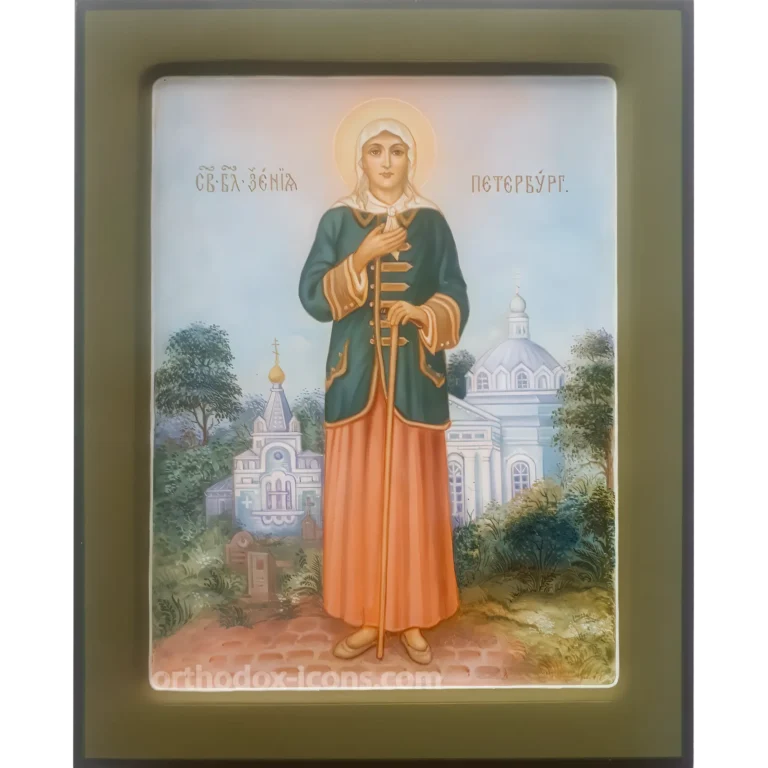
On this icon, Blessed Xenia is presented in a waist-length image. This type helps the viewer focus on the main details: the saint’s face, covered head, folded hands, and bright halo. Unlike full-length images, which may include a Petersburg landscape or the Smolensk Cemetery, this composition is more intimate and inward.
The covered head of the saint points to humility, chastity, and freedom from worldly vanity. The garments are restrained and not overly colorful. This corresponds to the spiritual character of Blessed Xenia, whose path was not one of outward prosperity, but of voluntary self-denial, prayer, and hidden ascetic labor.
The bowed face is especially important. It speaks of inner prayer, compassion, and quiet standing before God. There is no harsh severity in it; rather, the image feels consoling and close. Before such an icon, it is natural to pray about personal, family, and heartfelt needs.
The hands folded at the chest emphasize heartfelt prayer. This gesture helps us see Blessed Xenia as a saint who not only hears people’s requests, but shares in their suffering. Together with the filigree setting, gold background, and bright halo, the composition becomes especially gentle and reverently complete.
Materials, Filigree, and Execution
The icon is made on a wooden panel with prepared icon ground. Gesso is applied beneath the painting, creating a smooth surface for the image. The saint’s face and open parts of the icon are painted in egg tempera, the traditional technique that allows soft transitions, fine facial features, expressive eyes, and the warm tone of the gold background.
The most important feature of this version is the filigree setting. It forms an openwork frame along the borders, surrounds the halo, and covers part of the saint’s garment. The ornament is made in a light silver tone and is built from fine curls, floral motifs, and symmetrical elements. Pearl-like inserts complete the setting and create soft highlights.
The gold background behind the saint’s face strengthens the prayerful character of the image. Together with the filigree, it creates a delicate contrast: warm gold and light openwork ornament reveal the icon as solemn, yet not heavy. The 17×21 cm size preserves the intimacy of the image while still showing the beauty of the filigree work.
For an icon with filigree, careful handling is especially important: openwork elements should be protected from mechanical damage, while the painting and gilding should be protected from moisture, overheating, and direct sunlight.
Placement, Blessing, and Care
The icon of Blessed Xenia may be placed in a home icon corner near icons of Christ, the Mother of God, Saint Nicholas, the Guardian Angel, and the patron saints of the family. The compact 17×21 cm size is convenient for a small prayer shelf, kiot, or personal prayer place.
The icon may be blessed in an Orthodox church after it is received. Once blessed, it is intended for prayer, thanksgiving to God, and turning to Saint Xenia as a heavenly intercessor.
An icon in a filigree setting should be protected from direct sunlight, dampness, soot, heaters, and sudden changes of temperature. The surface should not be wiped with wet tissues, alcohol, household chemicals, or rough cloth. The filigree and pearl-like inserts require especially careful handling.
Dust is best removed with a dry soft brush, without pressure. Do not catch the openwork elements with cloth or try to clean the setting with hard objects. For additional protection, a glazed kiot is recommended; it helps preserve the painting, gold, filigree, and fine details from dust, accidental touch, and mechanical damage.
Questions and Answers
Who is shown on this filigree icon of Saint Xenia?
The icon shows Blessed Xenia of Saint Petersburg, an Orthodox saint especially loved as a prayerful helper in family and everyday needs.
What does the filigree setting mean on this icon?
The filigree setting is a delicate openwork frame made of fine metal curls and floral ornament. It surrounds the borders, halo, and part of the garment, giving the icon a solemn and reverent appearance.
What size is this icon?
The icon size is 17×21 cm (6.7×8.3 in), a compact format suitable for a home icon corner, prayer shelf, kiot, or patron saint gift.
What do Orthodox Christians pray for before Saint Xenia’s icon?
People ask Blessed Xenia for prayerful help with family peace, everyday difficulties, finding a home or work, marriage, protection of the household, patience, and spiritual strengthening.
Is this icon suitable for someone named Xenia?
Yes. It is a patron saint icon for women and girls named Xenia and may be given for baptism, nameday, birthday, or another important life event.
Why is Blessed Xenia shown with folded hands?
The hands folded at her chest express heartfelt prayer, humility, and inward standing before God, matching the spiritual character of Blessed Xenia’s life.
Can this icon be given as a housewarming gift?
Yes. An icon of Blessed Xenia is often chosen for a housewarming gift because people ask her intercession for housing, household peace, family life, and protection of the home.
When is the feast day of Blessed Xenia of Saint Petersburg?
Blessed Xenia of Saint Petersburg is commemorated on February 6 according to the modern calendar. Her glorification is also remembered on June 6.
Should the icon be blessed after receiving it?
The icon may be blessed in an Orthodox church after delivery. Once blessed, it is used for prayer and reverent veneration at home.
How should an icon with a filigree setting be cared for?
Keep the icon away from moisture, direct sunlight, overheating, and mechanical damage. Dust should be removed with a dry soft brush, without pressure; a glazed kiot is recommended.
| Dimensions | 17x21cm (6.7×8.3 in) |
|---|---|
| Name | Xenia |