St. Seraphim of Sarov Filigree Icon
$950
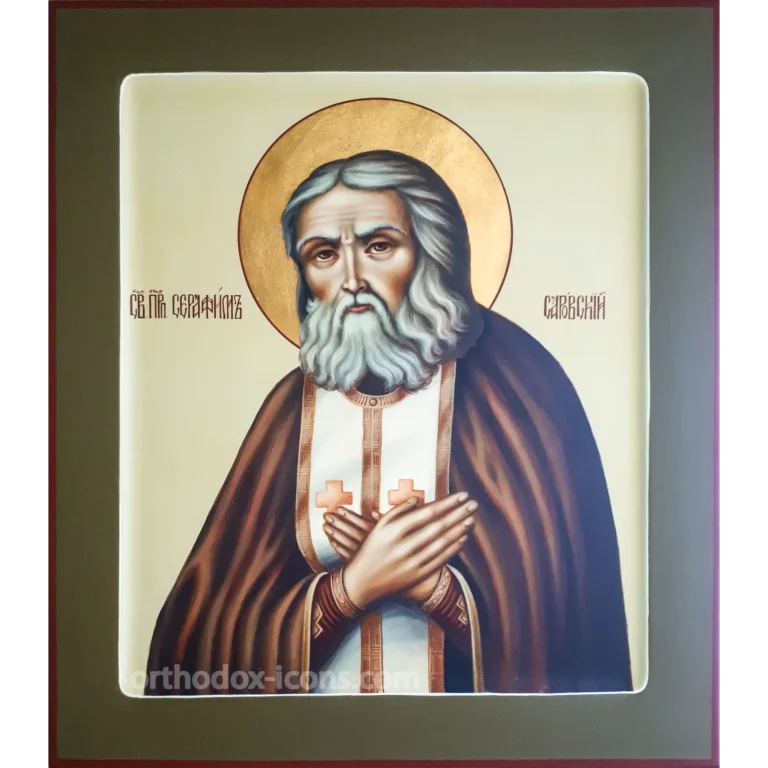
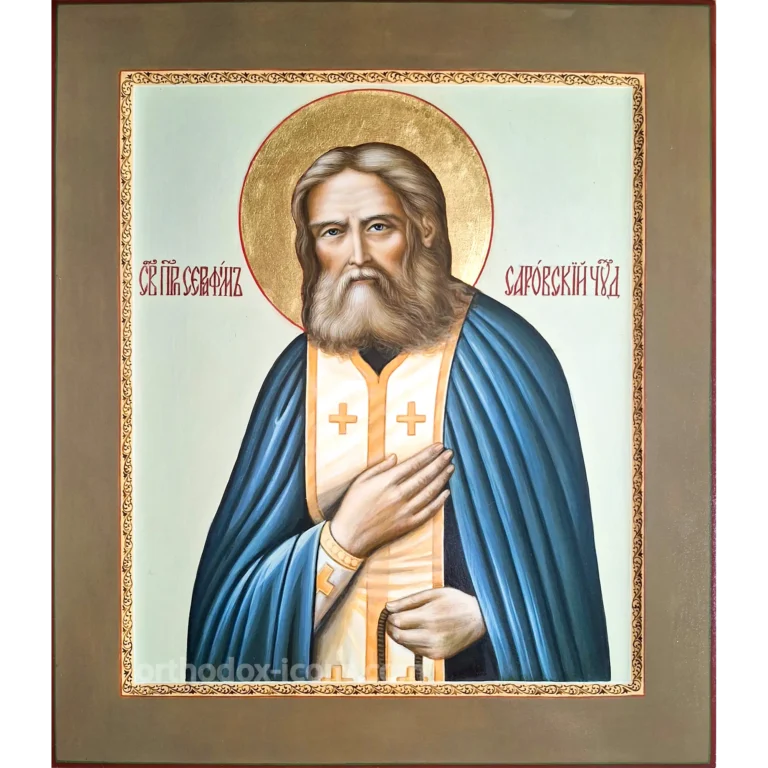
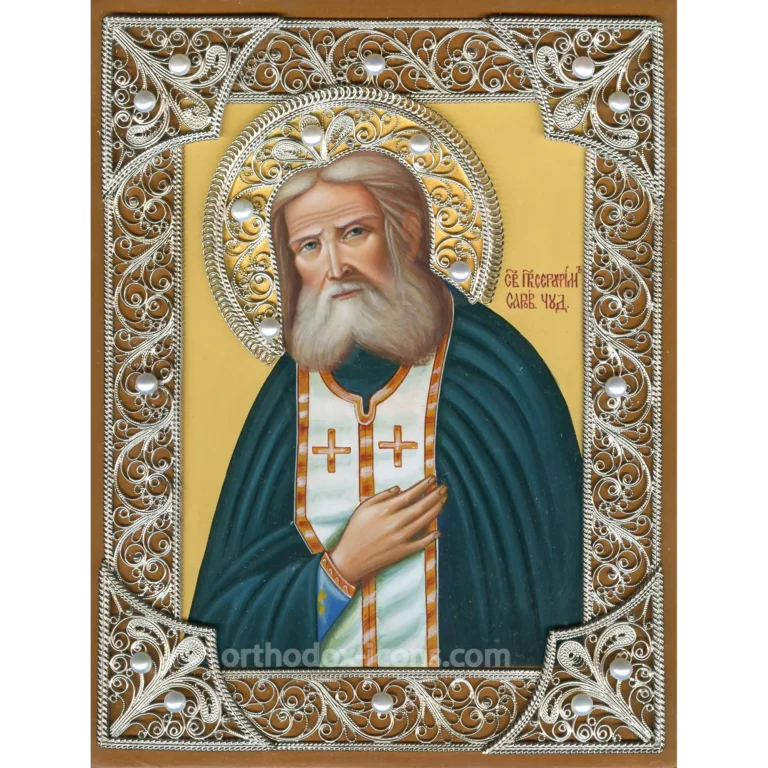
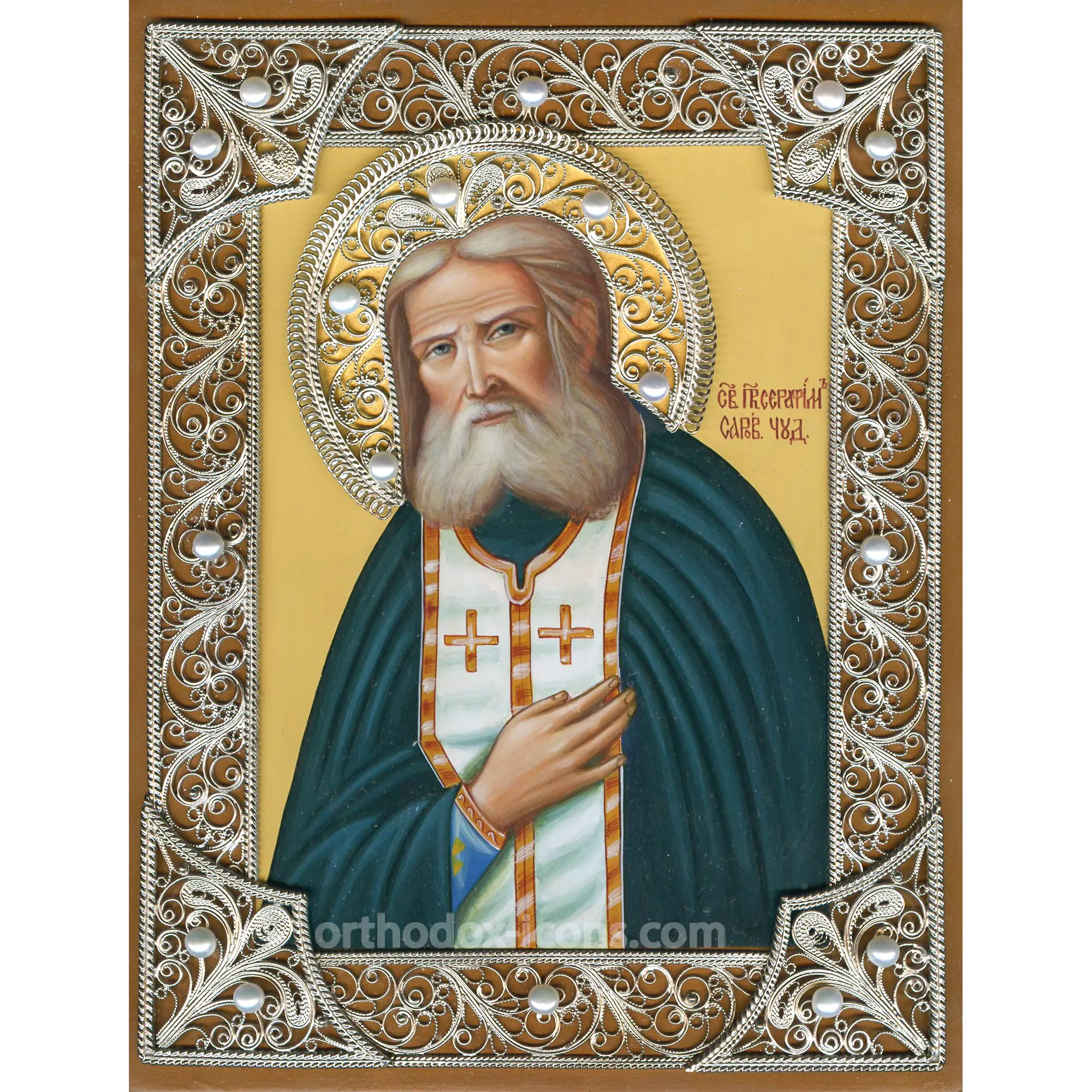
St. Seraphim of Sarov Filigree Icon, 17×21 cm (6.7×8.3 in), is a hand-painted Orthodox icon of Saint Seraphim of Sarov in a solemn filigree setting. The saint is shown half-length in a dark monastic mantle and light epitrachelion with crosses, with one hand placed on his chest. The icon has a gold background, a large halo with an openwork filigree crown, decorative inserts, and filigree ornament along the fields. Painted on a linden board with egg tempera and gold leaf, this icon is made for prayer, veneration, and a meaningful Orthodox gift. Free international shipping is included. Payment is made after you receive and approve the icon.
It is possible to paint an image in any size to order
Free shipping worldwide
St. Seraphim of Sarov Filigree Icon is a hand-painted Orthodox icon of Saint Seraphim of Sarov, one of the most beloved Russian saints, elders, ascetics, and comforters of the sorrowful. This version is made in a festive filigree setting, joining traditional icon painting with openwork ornamental decoration.
Saint Seraphim is shown half-length, in a dark monastic mantle and a light epitrachelion marked with crosses. One hand is placed on his chest in a gesture of heartfelt prayer and humility. The gold background, large halo, filigree crown around the halo, and openwork ornament along the fields give the icon a solemn and memorable appearance.
The listed size is 17×21 cm (6.7×8.3 in). Larger church and iconostasis sizes may be discussed individually before ordering. The production time for a filigree icon is about 2 months.
Filigree Ornament and Gold Background
The main decorative feature of this icon is its filigree setting. Fine openwork ornament frames the icon along the fields and forms a decorative crown around the saint’s halo. Small decorative inserts add a festive accent while preserving the prayerful character of the image.
The gold background and large halo give the icon a luminous sacred space. In Orthodox iconography, gold is not simply a sign of richness. It points to heavenly light and the transfigured life of the saints in God.
The filigree does not cover the face or the main painted image. It frames the icon and makes it more solemn, while the center remains the calm face of Saint Seraphim, his monastic clothing, and the hand placed on his chest.
The Image of Saint Seraphim
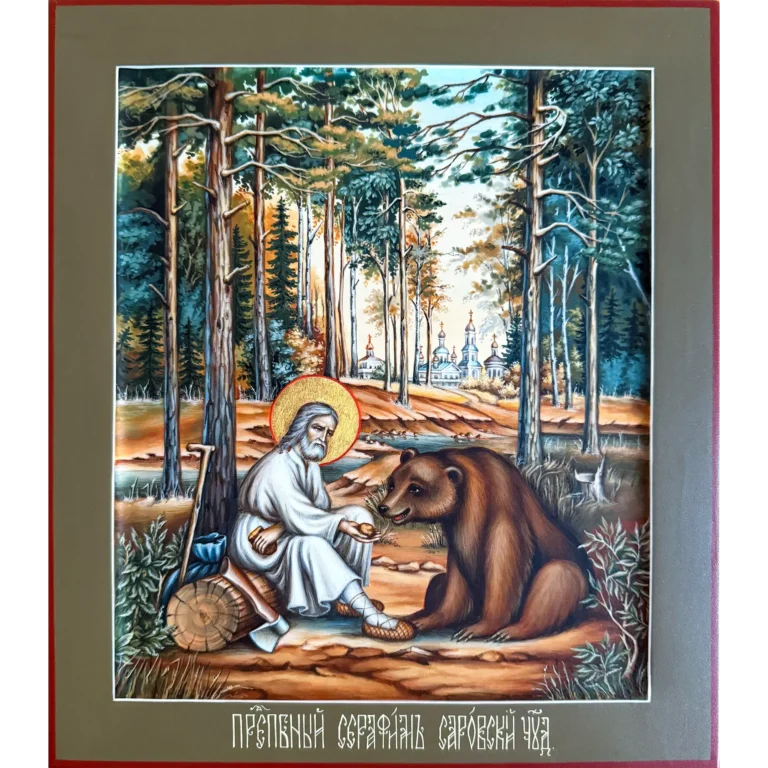
The half-length composition is especially suitable for personal prayer because it brings the viewer close to the face of the saint. The elder’s gray hair, beard, attentive gaze, and slightly inclined head recall a life formed by prayer, solitude, humility, and spiritual fatherhood.
The dark monastic mantle points to renunciation of worldly vanity and the inner labor of monastic life. The light epitrachelion with crosses recalls Saint Seraphim’s spiritual care for people who came to him for counsel, blessing, and consolation.
The hand placed on the chest expresses heartfelt prayer, repentance, humility, and inward spiritual attention. This gesture makes the icon personal and direct: Saint Seraphim appears not as a distant historical figure, but as a prayerful elder to whom a believer may turn in illness, anxiety, sorrow, despondency, and uncertainty.
Iconography and Meaning
Saint Seraphim of Sarov is remembered as a monk, ascetic, elder, and teacher of spiritual joy. He taught that the aim of the Christian life is the acquisition of the Holy Spirit. His icon therefore speaks not only of help in outward troubles, but also of inner peace, repentance, patience, and trust in God.
The gold halo shows his glorification in the Church. The filigree crown around it gives the image a festive character, but the saint’s face remains quiet and sober. This balance makes the icon appropriate both for a home icon corner and for a special Orthodox gift.
Materials and Filigree Work
The icon is painted on a linden board strengthened with oak splines. The board is prepared with natural chalk gesso, and the image is painted with egg tempera, a traditional Orthodox icon-painting medium valued for depth, clarity, and durability.
The gold background and halo are made with gold leaf. The filigree setting is added as a delicate openwork ornament along the fields and around the halo. Because this work is handmade, small differences in the rhythm of the ornament and decorative details are natural.
The filigree setting makes the icon more solemn and gift-worthy, while keeping the painted image visible and prayerful.
Available Size
The listed size is 17×21 cm (6.7×8.3 in). This compact format is suitable for a home icon corner, personal prayer shelf, study, monastic cell, or name-saint gift.
Larger church and iconostasis formats may be discussed individually. In a larger size, the face of Saint Seraphim, the epitrachelion, the filigree halo crown, and the openwork fields can be made more expressive.
What People Pray For Before Saint Seraphim
Orthodox Christians ask Saint Seraphim of Sarov for his intercession in illness, sorrow, despondency, family difficulty, loneliness, anxiety, and difficult life circumstances. The icon is not an amulet and does not replace church life. Prayer before an icon is prayer to God, with the saint depicted asked to intercede.
- For health and strength during illness
- For consolation in grief and heaviness of soul
- For preservation of faith and trust in God
- For help against despondency, anxiety, and despair
- For peace in the family and reconciliation
- For spiritual joy and gratitude
- For monastics and those seeking a spiritual path
- For patience, humility, and inner collectedness
For Whom This Icon Is Suitable
This filigree icon is suitable for an Orthodox family, home icon corner, monastic cell, chapel, church, or prayer room. It is often chosen for homes where people pray for the sick, for elderly relatives, for family peace, and for spiritual support in difficult seasons.
As a name-saint icon, it is especially suitable for men and boys named Seraphim. Because of the filigree setting, it also works well as a solemn gift for a priest, monk, spiritual father, godfather, father, grandfather, benefactor, or anyone who especially venerates Saint Seraphim of Sarov.
Feast Days of Saint Seraphim of Sarov
Two feast days of Saint Seraphim of Sarov are especially honored in Orthodox tradition. January 15 according to the new calendar, or January 2 on the old calendar, commemorates his repose. August 1 according to the new calendar, or July 19 on the old calendar, commemorates the uncovering of his relics.
These dates may be considered when choosing a name-saint icon, name-day gift, church donation, or family shrine. Since a hand-painted icon with filigree setting requires time for board preparation, gesso, painting, gilding, filigree work, drying, and finishing, it is best to order in advance for a specific date.
Short Life of Saint Seraphim
Saint Seraphim of Sarov, in the world Prokhor Moshnin, was born in Kursk in the eighteenth century. From youth he desired monastic life and later entered the Sarov monastery, where he passed through obedience, prayer, solitude, fasting, and spiritual struggle.
After years of ascetic labor and seclusion, Saint Seraphim received the ministry of eldership. People came to him for counsel, consolation, and prayer. He greeted many with paschal joy and taught that the aim of Christian life is the acquisition of the Holy Spirit.
Saint Seraphim is closely connected with the Diveyevo monastery, which he spiritually guided and cared for. Today he is venerated as one of the greatest Russian saints, a helper of the sick, a comforter of the sorrowful, and a teacher of spiritual joy.
Materials and Characteristics
| Name | St. Seraphim of Sarov Filigree Icon |
| Saint depicted | Venerable Seraphim of Sarov |
| Iconographic type | Half-length image of the elder in monastic garments |
| Feast days | January 15 / January 2 old calendar; August 1 / July 19 old calendar |
| Board | Linden board with oak splines |
| Ground | Natural chalk gesso |
| Painting medium | Egg tempera |
| Gilding | Gold leaf background and halo |
| Decoration | Openwork filigree setting around the halo and fields, decorative inserts |
| Available size | 17×21 cm (6.7×8.3 in); larger formats by agreement |
| Production time | About 2 months |
Care and Blessing
The icon may be blessed before shipping if requested, or after receiving it at your own parish church. A hand-painted icon with filigree setting should be handled especially carefully.
Dust should be removed only with a dry soft brush, without pressure, especially on the openwork filigree. Do not use water, wet wipes, household cleaners, or polishing products. Keep the icon away from direct sunlight, moisture, radiators, humidifiers, and sudden temperature changes.
Ordering and Shipping
The icon can be painted in the listed size or in larger church and iconostasis formats by individual agreement. Free international shipping is included. Payment is made after you receive and approve the icon.
FAQ
Who is shown on the St. Seraphim of Sarov Filigree Icon?
The icon shows Venerable Seraphim of Sarov, a beloved Russian elder, monastic ascetic, wonderworker, and comforter of the sorrowful.
What does filigree mean on this icon?
Filigree is an openwork decorative setting made from fine ornamental elements. On this icon it frames the fields and forms a decorative crown around the halo.
What do people pray for before Saint Seraphim of Sarov?
People ask for health, spiritual joy, consolation in sorrow, help against despondency, strengthening of faith, family peace, patience, and support in difficult circumstances.
Why is Saint Seraphim shown in a monastic mantle?
The monastic mantle points to his life of asceticism, prayer, solitude, humility, and service to God.
What does the hand on the chest mean?
This gesture suggests heartfelt prayer, repentance, humility, and inward spiritual attention.
Who is this icon suitable for as a gift?
It is suitable for an Orthodox family, a sick person, monastics, clergy, spiritual fathers, and men or boys named Seraphim.
When are the feast days of Saint Seraphim of Sarov?
His feast days are January 15, or January 2 on the old calendar, and August 1, or July 19 on the old calendar.
What size is this icon?
The listed size is 17×21 cm (6.7×8.3 in). Larger formats may be discussed individually.
What materials are used?
The icon is painted on a linden board with oak splines, natural chalk gesso, egg tempera, gold leaf, and openwork filigree decoration.
How should this filigree icon be cared for?
Keep it away from moisture, direct sunlight, and sudden temperature changes. Dust the filigree and painted surface only with a dry soft brush, without pressure.
| Dimensions | 17x21cm (6.7×8.3 in) |
|---|---|
| Name | Seraphim |