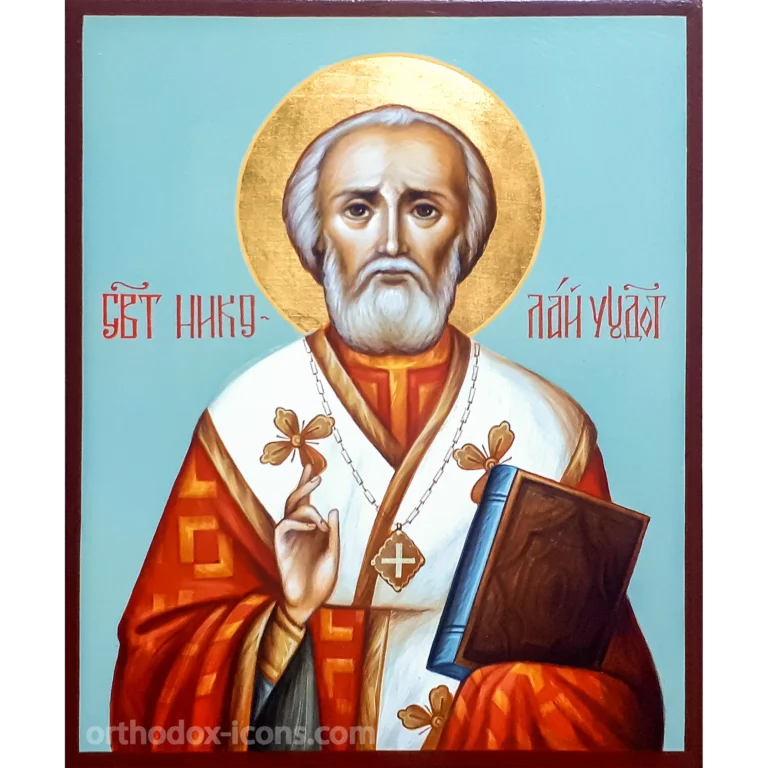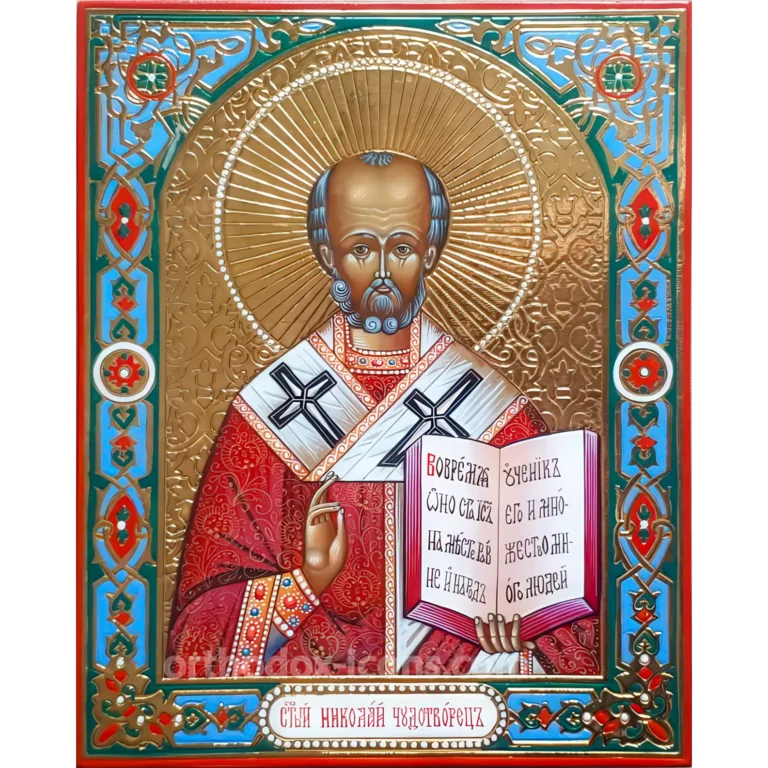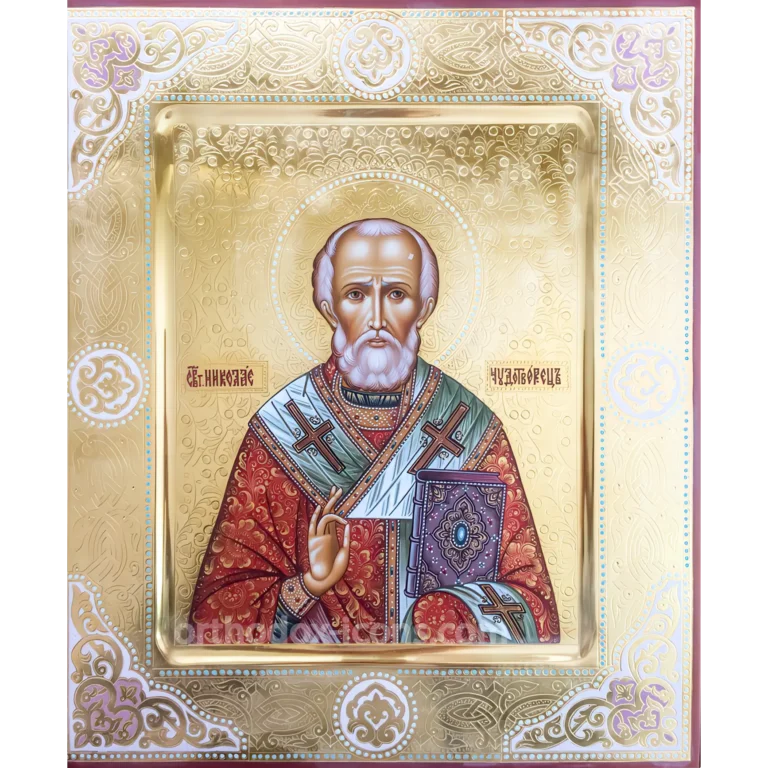
Filigree Icon Nicholas the Wonderworker
$950
Available size: 17×21 cm (6.7×8.3 in)
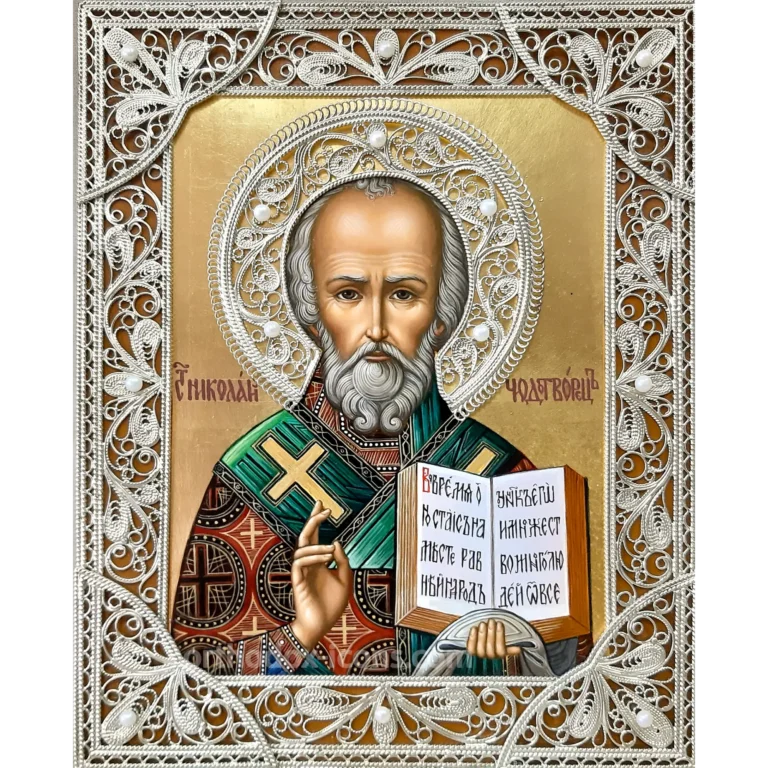
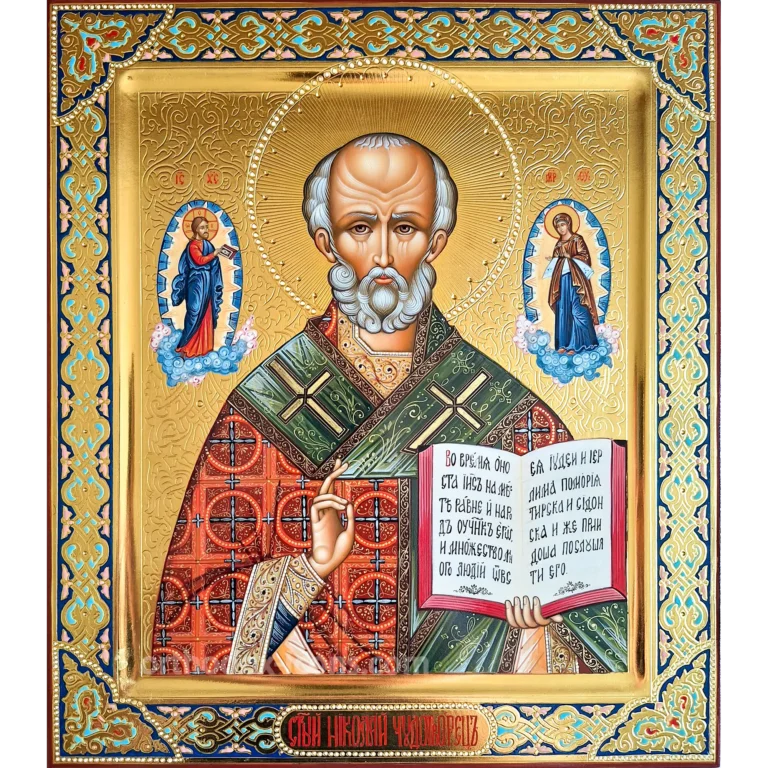
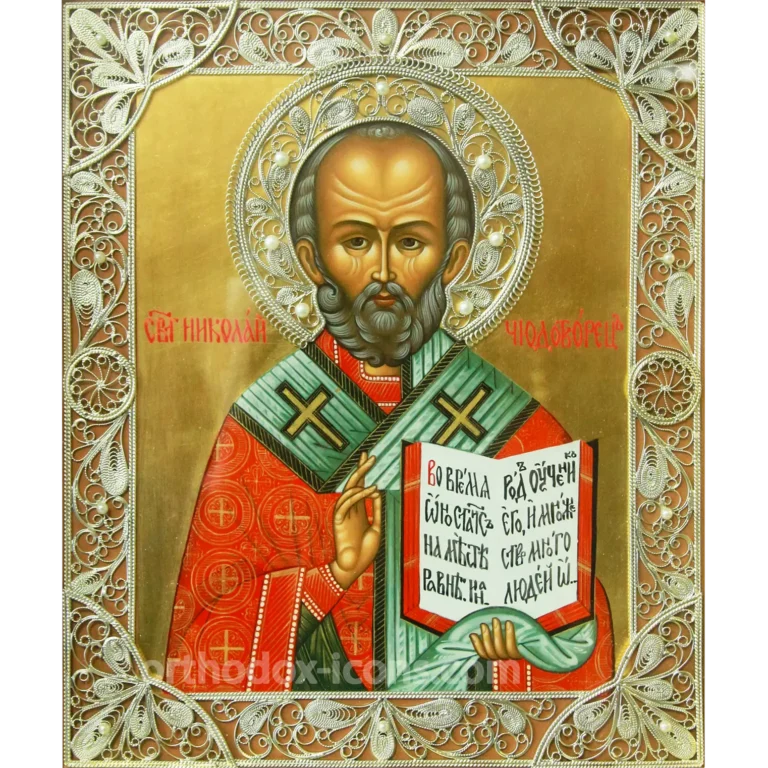
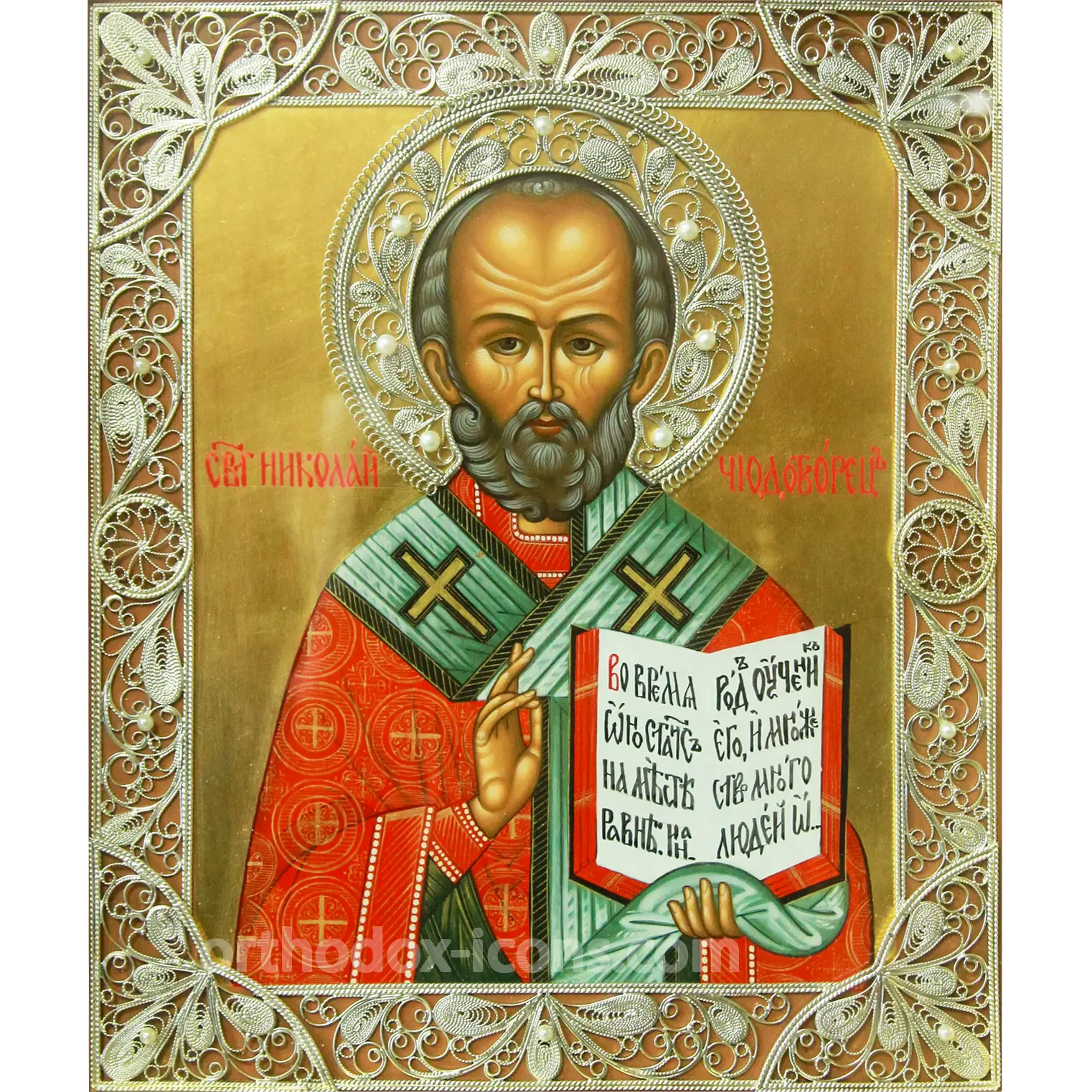
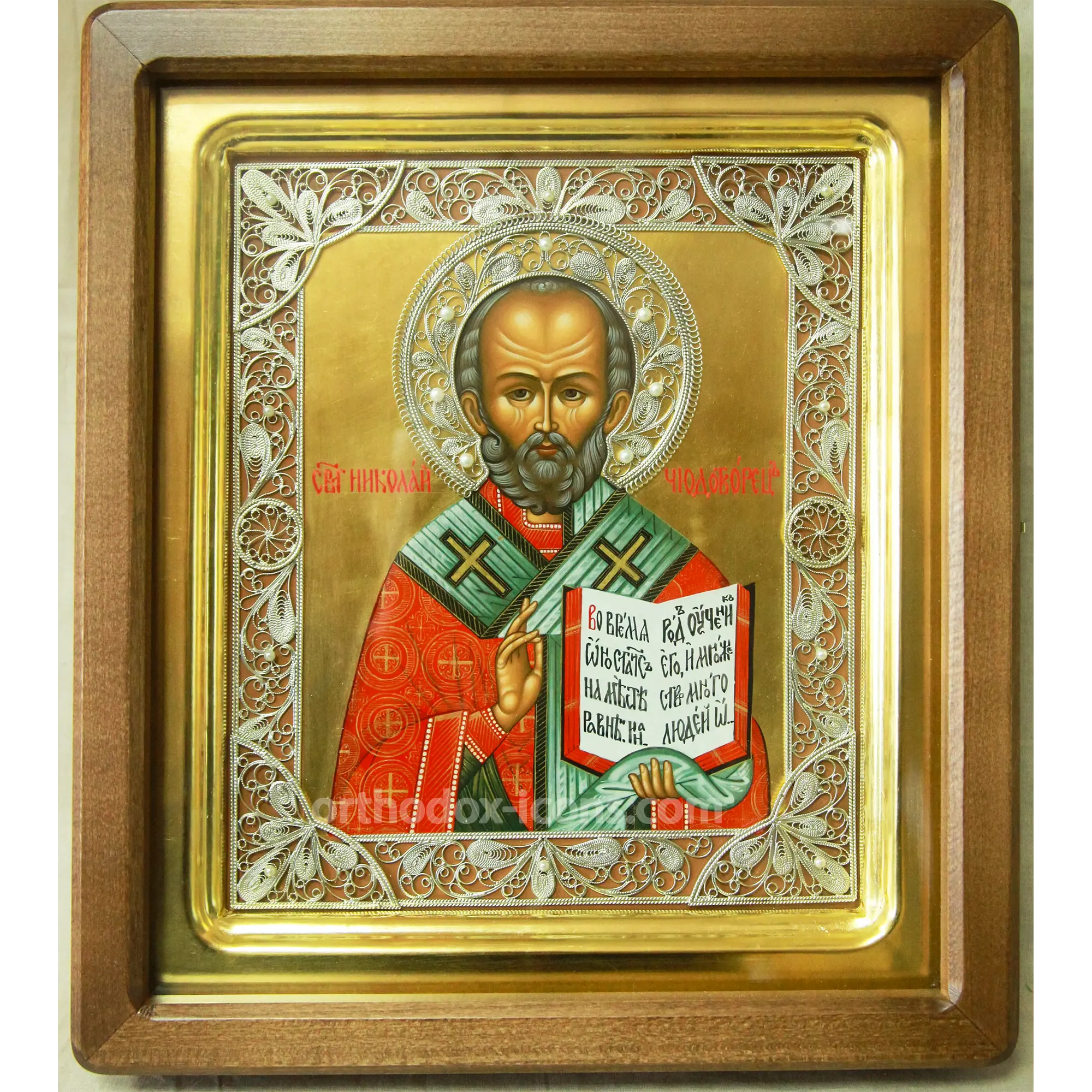
Filigree Icon Nicholas the Wonderworker is a hand-painted Orthodox icon of Saint Nicholas, shown as a holy bishop with his right hand raised in blessing and an open Gospel in his left hand. The painted image is framed with delicate filigree ornament: the openwork setting surrounds the borders and halo without covering the face, hands, Gospel, omophorion, or episcopal vestments.
The icon is painted on a prepared wooden panel with gesso and egg tempera, with a gold background, filigree metal setting, decorative inserts, and a protective finish. It is suitable for a home icon corner, a chapel, a parish space, or as a meaningful nameday, baptismal, wedding, or commemorative gift for someone named Nicholas.
Saint Nicholas is prayerfully remembered as a merciful intercessor, protector of travelers and families, helper of children, sailors, and those facing hardship or injustice. Free international shipping is included. Payment is made after you receive and approve the icon.
Production time: about 2 months.
It is possible to paint an image in any size to order
Free shipping worldwide
Filigree Icon Nicholas the Wonderworker is a solemn hand-painted Orthodox image of one of the most beloved saints of the Church. Saint Nicholas is shown in episcopal vestments: his right hand is raised in blessing, and his left hand holds an open Gospel. The composition immediately reveals the main meaning of the image: Saint Nicholas stands before us as a bishop, shepherd, teacher of the faith, and merciful intercessor to whom Orthodox Christians turn in many needs of life.
The distinctive feature of this icon is its rich filigree setting. The openwork ornament frames the borders of the icon and the saint’s halo with a fine pattern that resembles jeweled lace. At the same time, the filigree does not cover the essential parts of the icon: the face, the blessing hand, the Gospel, the crosses on the omophorion, or the episcopal vestments. Because of this, the icon remains clear for prayer while also receiving a festive and precious appearance.
The 17×21 cm (6.7×8.3 in) format is well suited to this half-length image of Saint Nicholas. In this size, the face, gray beard, gentle turn of the head, red inscriptions, open book, gold background, and filigree frame remain readable. Larger formats can be discussed individually when a more detailed rendering of the face, Gospel text, vestments, gilded background, and filigree ornament is desired.
Who This Filigree Icon of Saint Nicholas Is For
This filigree icon of Saint Nicholas the Wonderworker is suitable for a home icon corner, family prayer space, study, chapel, parish church, or meaningful Orthodox gift. Saint Nicholas is venerated as a swift helper, merciful intercessor, protector of travelers, patron of children, families, sailors, those unjustly treated, and all who need support in difficult circumstances.
The icon is especially appropriate as a patron saint icon for a man, young man, or child named Nicholas. It may be given for baptism, nameday, birthday, wedding, anniversary, house blessing, the beginning of independent life, before a long journey, or as a gift of gratitude. The filigree setting gives the icon a more ceremonial character, so it is also suitable as a special gift for parents, godparents, a priest, a family, or a parish.
In a home, the image of Saint Nicholas is often placed near icons of Christ, the Mother of God, and the patron saints of the family. The silver-toned filigree on the gold background makes the icon visually expressive, but it does not turn the image into a decorative object. The central meaning remains prayer: before the icon, a person turns to God and asks for help through the intercession of Saint Nicholas.
For a church or chapel, the icon may be made in a larger or iconostasis format. A half-length image of Saint Nicholas is readable from a distance, and the filigree frame can help distinguish the icon within a liturgical space without disturbing canonical restraint. Size, proportions, kiot, degree of ornament, inscriptions, and the intended placement may be discussed before work begins.
Prayers Before the Icon of Nicholas the Wonderworker
Before an icon of Saint Nicholas the Wonderworker, Orthodox Christians pray for help on the road, protection of the family, deliverance from misfortune, support in hardship, reconciliation, strengthening of faith, and mercy. His popular veneration is connected with the sense of swift intercession: people turn to him when they need living help in a concrete situation, not abstract comfort alone.
Saint Nicholas is often asked for prayerful help with safe travel and protection for those on the road; help for sailors, drivers, pilgrims, and those who travel often; protection of children and families; reconciliation and softening of hearts; support in material difficulties and everyday needs; consolation in illness, grief, loneliness, and anxiety; protection from injustice, slander, and danger; and the gift of wisdom, mercy, and a right decision.
The image of the saint with the open Gospel reminds us that his help is not separated from the truth of the Gospel. Saint Nicholas is not venerated as a fulfiller of wishes, but as a holy archpastor who teaches mercy, faithfulness to Christ, care for one’s neighbor, and responsibility before God. Prayer before his icon joins a request for help with gratitude, repentance, and the desire to do good.
Brief Life of Saint Nicholas
Saint Nicholas, Archbishop of Myra in Lycia, lived in the third and fourth centuries. From his youth he was known for love of God, compassion for people, and attention to the suffering of others. Having received an inheritance, he did not seek earthly wealth for himself, but helped those in need, often secretly, so that the person receiving help would not be humiliated and the giver would not seek praise.
One of the best-known traditions tells how Saint Nicholas saved three young women from shame and poverty when their father had no means for their marriage. The saint secretly gave gold to the family and helped arrange their future. For this reason, Saint Nicholas is honored as a merciful helper in family needs, a protector of the poor, and a patron of those who find themselves in desperate circumstances.
As archbishop, Saint Nicholas cared for his flock, defended the innocent, helped travelers, and was known as a man of firm faith. His veneration spread throughout the Christian world. In the Russian Orthodox tradition he is especially loved as Nicholas the Wonderworker, a swift helper and intercessor.
The icon of Saint Nicholas with the Gospel and blessing hand presents him as an archpastor. He does not simply help in earthly difficulties; he leads the person toward Christ. The open book in his hand recalls the word of God, and the blessing gesture recalls pastoral prayer, protection, and spiritual guidance.
Feast Days of Saint Nicholas
In the Orthodox calendar, Saint Nicholas is commemorated several times during the year. The most widely known dates are December 19, the day of his repose; May 22, the translation of his relics from Myra in Lycia to Bari; and August 11, the Nativity of Saint Nicholas, according to the liturgical dates used in the Russian tradition.
These dates are especially important for people named Nicholas. The icon may be ordered for a nameday, baptism, family memorial date, patronal feast, or as an offering of gratitude for prayerful help. If the icon is needed by a specific date, the size, filigree setting, kiot, and production time should be discussed in advance.
Features of the Presented Icon
On this icon, Saint Nicholas is depicted half-length and frontally, in episcopal vestments. His face is strict and gentle at the same time: the high forehead, gray beard, attentive gaze, and restrained expression point to the saint’s spiritual wisdom. The face does not aim at outward emotion; it addresses the person praying with calmness and inner concentration.
The right hand of Saint Nicholas is formed in a blessing gesture. The left hand supports an open Gospel with Church Slavonic text. This detail is especially important: Saint Nicholas appears not only as a wonderworker and intercessor, but also as a bishop who preserves and proclaims the word of God. The Gospel in his hands reminds the viewer that the saint’s mercy is always joined to the truth of Christ.
The red episcopal garment is decorated with fine ornament and crosses. Over it is an omophorion in a greenish turquoise tone with large crosses. The omophorion is a sign of episcopal ministry, pastoral responsibility, and care for the Church. The contrast of red vestment, light omophorion, gold background, and silver-toned filigree makes the image festive and easy to read.
The background is made in a warm gold tone. The saint’s name is written in red letters. This gold field does not overload the composition; it creates a space of light around the figure of Saint Nicholas. Against it, the openwork halo and wide filigree border are especially expressive.
Filigree Setting and Openwork Ornament
Filigree is a fine decorative technique based on the creation of openwork ornament from thin metal elements. In this icon, the filigree setting forms a decorative border around the painted image and a separate frame around the halo. The ornament is built from curls, plant forms, petal motifs, and small decorative inserts, giving the frame a light, airy, and precious character.
It is important that the filigree does not hide the face of Saint Nicholas, the blessing hand, or the Gospel. This is the right solution for a prayer icon: the decorative setting emphasizes solemnity, but it does not compete with the painted image. The visual center remains where it should be: on the saint’s face, the blessing, and the open word of God.
The filigree setting makes the icon suitable for a special gift. It may be chosen for a family blessing, anniversary, parish gift, memorial occasion, or offering of gratitude. The filigree is perceived as a sign of reverence for the holy image: it frames the icon like a precious riza while preserving its canonical character.
Iconography: Blessing, Gospel, and Episcopal Vestments
The blessing right hand of Saint Nicholas is one of the main elements of the image. It points to his archpastoral ministry and prayerful intercession. Before such an icon, the viewer does not see an abstract symbol, but a holy bishop who blesses, teaches, and supports.
The open Gospel in the left hand shows that Saint Nicholas was not only a wonderworker, but also a guardian of the Church’s truth. The book is open on the icon, visibly turned toward the one who prays. The word of God is not hidden; it is offered openly and calls for a response from the human heart.
The omophorion with crosses points to the saint’s episcopal rank. In Orthodox iconography, the omophorion recalls the shepherd who bears care for the people entrusted to him. For this reason, the icon of Nicholas the Wonderworker is especially close to those who seek not only deliverance from trouble, but also wise spiritual direction.
The gold halo around the saint’s head signifies his glorification in the Kingdom of Heaven. In the filigree version, the halo is additionally emphasized by openwork ornament, creating a sense of radiance. Even with rich ornament, however, the halo does not become an independent decorative feature; it serves the meaning of the whole image.
Materials, Filigree, and Custom Options
This icon of Saint Nicholas the Wonderworker is painted on a prepared wooden panel. Traditional gesso is applied under the painting, and the image is written in egg tempera. Tempera allows the iconographer to render the soft transitions of the face, gray beard, red episcopal garment, greenish turquoise omophorion, open Gospel, blessing hand, inscriptions, and fine ornamental details.
In the presented version, the icon has a gold background and a filigree setting. The openwork ornament is placed on the broad borders and around the halo, creating the impression of a precious frame. The filigree is especially visible along the edges: curls, plant elements, and airy forms create a festive border that emphasizes the solemn character of the image of Saint Nicholas.
For an individual order, the size, format, filigree setting, background tone, inscriptions, kiot, and larger church version may be discussed. Iconostasis sizes are selected separately with attention to placement, viewing distance, lighting, neighboring icons, and the general decorative solution. In a larger format, the face, Gospel, vestments, and filigree ornament can be rendered in greater detail.
Choosing the Size of the Icon
The available size, 17×21 cm (6.7×8.3 in), is suitable for a home icon corner, small prayer shelf, study, or personal prayer space. In this format, the main elements remain clear: the face of Saint Nicholas, the blessing gesture, the Gospel, the omophorion, the gold background, and the filigree frame.
Larger sizes can reveal the painting and openwork ornament in more detail. The larger the panel, the more expressive the filigree curls, halo pattern, Gospel text, folds of the vestments, inscriptions, and decorative inserts may become. Such an icon is appropriate for a spacious home, family prayer room, chapel, parish, or commemorative gift.
Iconostasis formats are discussed individually. For church use, it is important to consider the proportions of the row, the distance from the viewer, lighting, and the relationship with nearby icons. A filigree icon of Saint Nicholas may be made as a separate holy image, an analogion icon, a parish gift, or part of a broader row of saints.
Blessing and Care for an Icon with Filigree
The icon of Saint Nicholas the Wonderworker may be blessed in an Orthodox church after it is received. Once blessed, the image becomes a holy object for prayer, thanksgiving, and turning to God through the intercession of Saint Nicholas.
An icon with a filigree setting should be protected from moisture, direct sunlight, soot, overheating, and sudden temperature changes. The openwork elements require especially careful handling: they should not be rubbed with rough cloth, cleaned with household chemicals, or wiped with wet tissues.
Dust is best removed with a dry soft brush, without pressure, especially around the fine filigree pattern, halo, and edges of the icon. For stronger protection of the painting and filigree, a wooden glazed kiot is recommended. It helps protect the icon from accidental touch, dust, mechanical damage, and environmental exposure.
Questions and Answers
Who is shown on this filigree icon of Nicholas the Wonderworker?
The icon shows Saint Nicholas the Wonderworker, Archbishop of Myra in Lycia. He is depicted in episcopal vestments, blessing with his right hand and holding an open Gospel in his left hand.
What does the filigree setting mean on this icon?
The filigree setting is a delicate openwork ornament made from fine metal elements. On this icon it forms a festive border and halo frame, giving the image a solemn, precious appearance while leaving the painted face and hands visible.
What do Orthodox Christians pray for before an icon of Saint Nicholas?
Saint Nicholas is asked for help in travel, protection of the family, support in difficult circumstances, deliverance from danger, reconciliation, mercy, and intercession for children, travelers, sailors, and those who suffer injustice.
Who is this icon of Saint Nicholas suitable for?
It is suitable for men and boys named Nicholas, Orthodox families, travelers, sailors, drivers, chapels, parishes, and anyone looking for a serious spiritual gift rather than a decorative souvenir.
Why does Saint Nicholas hold an open Gospel?
The open Gospel points to his ministry as a bishop and teacher of the Church. It reminds the viewer that Saint Nicholas is honored not only as a wonderworker, but also as a shepherd who bears witness to the word of Christ.
What does the blessing hand of Saint Nicholas signify?
The blessing gesture presents Saint Nicholas as a bishop and prayerful intercessor. It speaks of pastoral care, spiritual guidance, and the saint’s compassionate help for those who turn to God in prayer.
What size is available for this icon?
The listed size is 17×21 cm (6.7×8.3 in). Larger and iconostasis sizes may be discussed individually when the icon is ordered.
Can this filigree icon be ordered for a church?
Yes. The icon may be made in a larger or iconostasis format for a parish, chapel, analogion, or church gift. Size, inscriptions, filigree details, kiot, and placement can be discussed before work begins.
How should an icon with a filigree setting be cared for?
Keep the icon away from moisture, direct sun, soot, overheating, and sudden temperature changes. Dust should be removed gently with a dry soft brush; wet wipes, alcohol, household chemicals, and rough cloth should not be used.
Should the icon be blessed after receiving it?
The icon may be blessed in an Orthodox church after delivery. Once blessed, it is used for home or church prayer, turning to God through the intercession of Saint Nicholas.
| Dimensions | 17x21cm (6.7×8.3 in) |
|---|---|
| Name | Nicholas |