Orthodox Icon Virgin Mary of Tolga
Price range: $700 through $2000
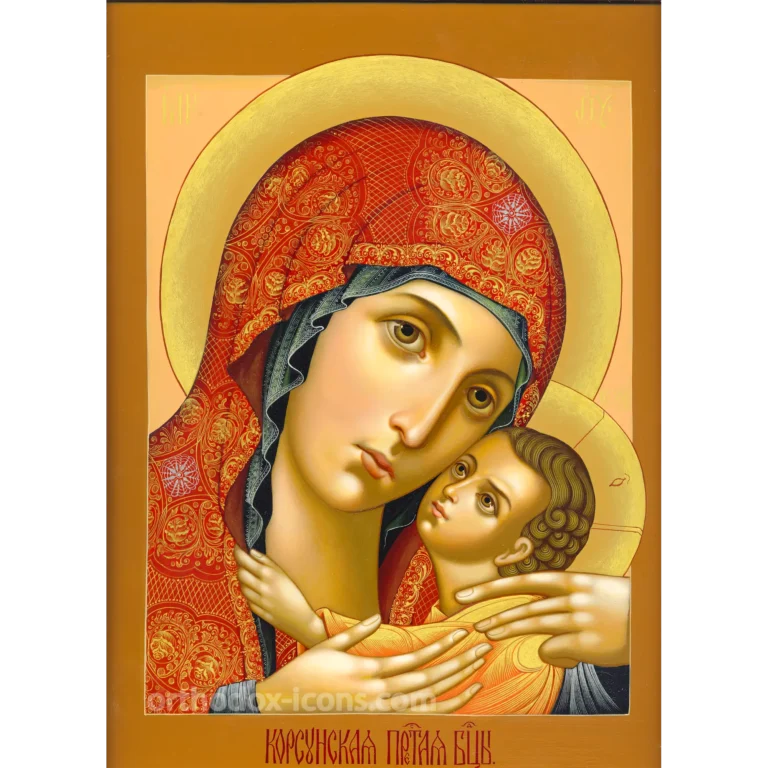
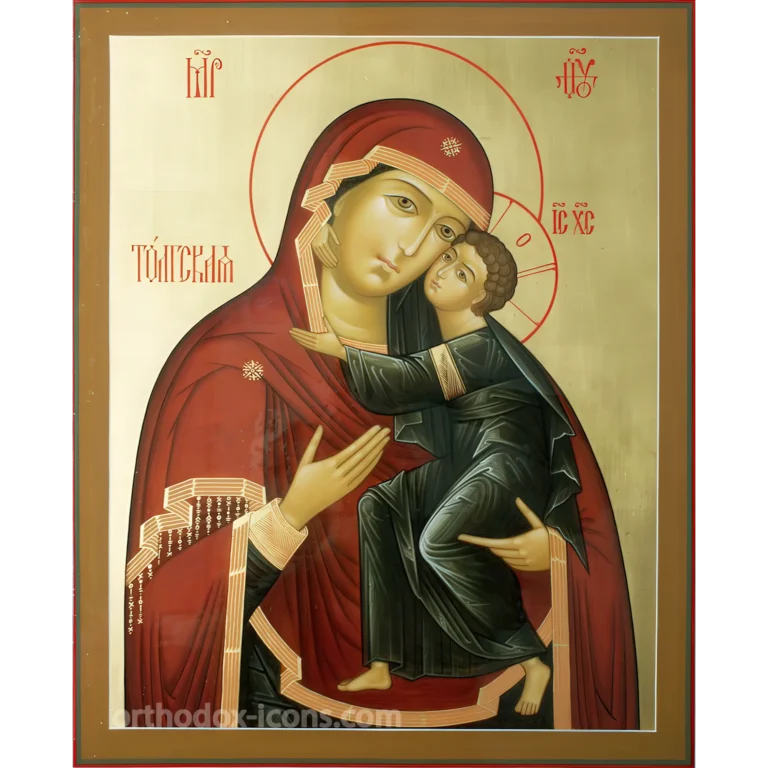
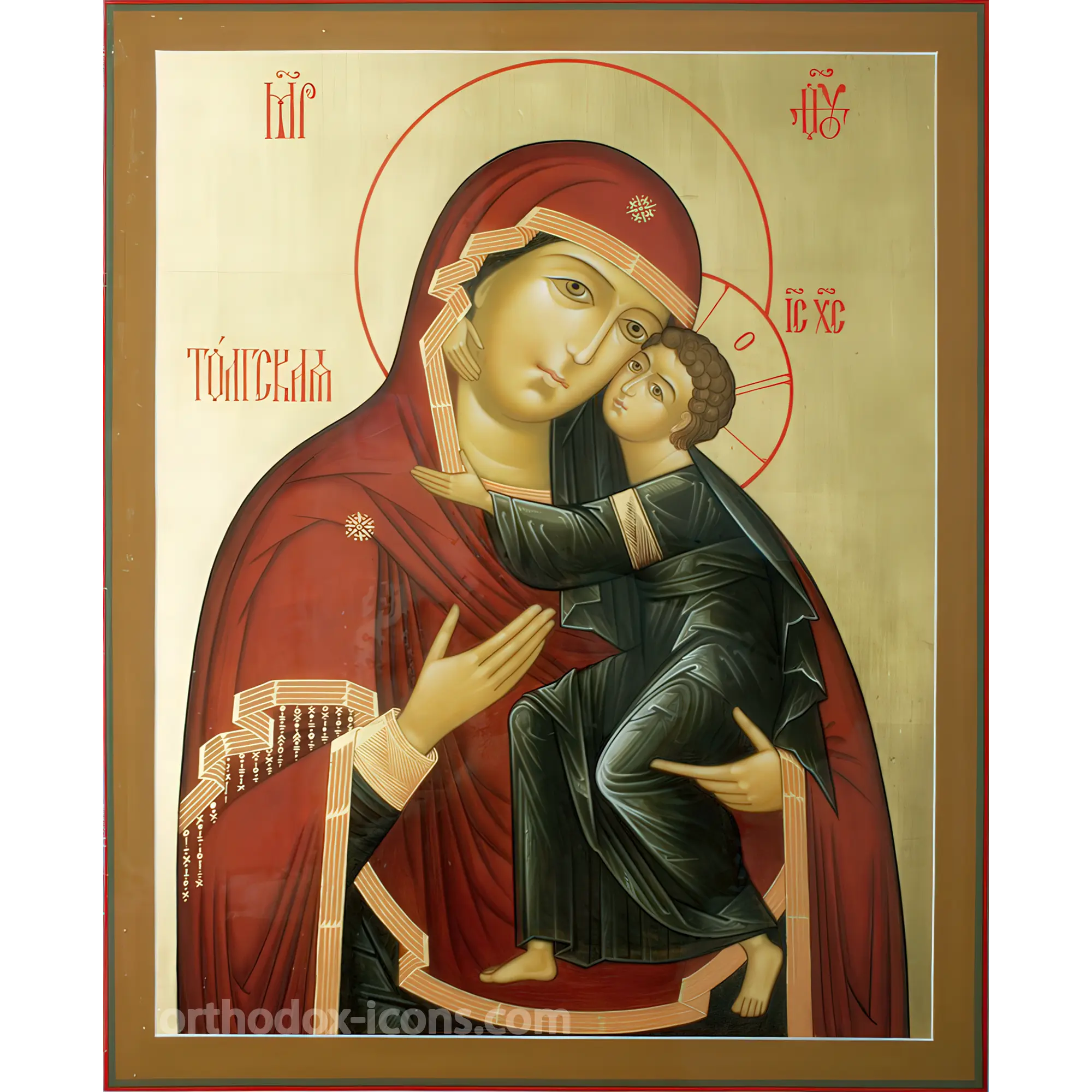
Orthodox Icon Virgin Mary of Tolga is a hand-painted Tolga Mother of God icon, an Eleusa image known for its tender yet solemn Mother-and-Child composition.
Available sizes: 17×21 cm (6.7×8.3 in), 20×24 cm (7.9×9.4 in), 27×31 cm (10.6×12.2 in), 30×40 cm (11.8×15.7 in).
Materials: linden board with oak braces, linen pavoloka, polished chalk levkas, mineral egg tempera, 23K gold leaf, gold assist, and protective finish.
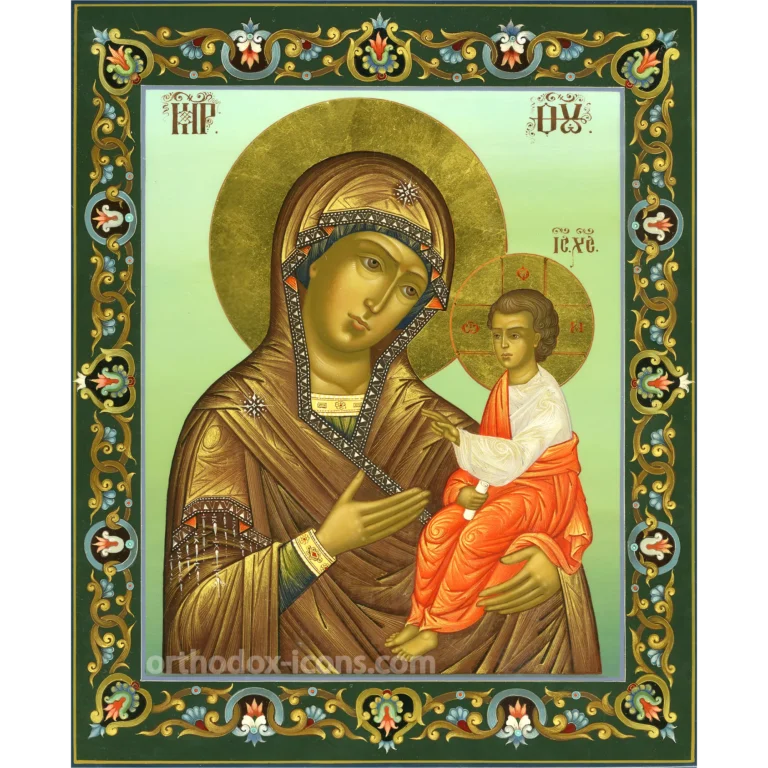
Details: wine-red maphorion, blue-green cap, emerald garments of Christ, gold ornament imitating pearl embroidery, and warm gilded background.
It is possible to paint an image in any size to order
Free shipping worldwide
Orthodox Icon Virgin Mary of Tolga is a hand-painted icon of the Tolga Mother of God, one of the most revered Eleusa images in Russian Orthodox tradition. The icon is known for its tender yet solemn composition, where the Christ Child presses His cheek to the face of the Mother of God and embraces her neck.
The Tolga icon has been venerated for centuries as an image of consolation, protection, healing, and maternal intercession. This hand-painted version preserves the strict, deep color harmony of the ancient image: a wine-red maphorion of the Theotokos, dark green garments of Christ, rich gold assist, and a warm gilded background.
The icon is painted in the Mstyora tradition on a linden board with inset oak braces, linen pavoloka, polished chalk levkas, mineral egg tempera, 23K gold leaf, and protective finish. Available sizes are 17×21 cm (6.7×8.3 in), 20×24 cm (7.9×9.4 in), 27×31 cm (10.6×12.2 in), and 30×40 cm (11.8×15.7 in).
Miraculous Appearance: A Fiery Pillar over the Volga
The history of the Tolga Icon of the Mother of God is connected with the year 1314, a difficult period for Rus. According to tradition, Bishop Prokhor of Rostov, later known in schema as Tryphon, was returning from a visit to his diocese and stopped for the night on the right bank of the Volga, near the small Tolga River, not far from Yaroslavl.
At midnight, Bishop Prokhor awoke and saw an extraordinary sight. Across the Volga, above the forest, a dazzling fiery pillar was shining. Taking his staff, he approached the river and found that a miraculous bridge had appeared from one bank to the other.
Crossing to the opposite bank, he came to the source of the light and saw an icon of the Most Holy Theotokos with the Christ Child, suspended above the trees. The bishop prayed there with tears for a long time, then returned to his tent, accidentally leaving his staff on the other side.
In the morning, when his companions could not find the staff, Prokhor told them to cross the river and search in the place he indicated. There they found not only the staff, but also the icon itself, now standing on the ground among the trees. News of the miracle quickly reached Yaroslavl.
That same day, with the help of clergy and people, a small wooden church was built and consecrated in honor of the Entrance of the Mother of God into the Temple. Bishop Prokhor then founded a monastery at the holy place, later known as the Tolga Holy Entrance Monastery.
Miracles and Veneration
From the first days of its appearance, the Tolga icon became known through accounts of healing and help. In 1392, during a morning service, the icon began to exude fragrant myrrh, and many faithful people received healing.
The chronicles also preserve an account of a child being restored to life after the parents brought him to the monastery for burial and prayed with tears before the icon. Later, when fire destroyed the wooden church, the icon was found unharmed in the monastery grove, untouched by the flames.
The Tolga Mother of God was also venerated in prayers during drought, epidemics, and danger. From the seventeenth century onward, after the icon was included in printed church calendars, its veneration became known throughout Russia.
Iconography: The Gaze of the Christ Child
The Tolga Icon belongs to the Eleusa, or Tenderness, type, rooted in Byzantine iconography of the twelfth and thirteenth centuries. It is close in composition to the Vladimir Mother of God, but has its own clear and recognizable features.
The Christ Child sits on the left arm of the Mother of God. He presses His cheek to hers and embraces her neck with His left hand. His right hand is lowered. The Mother of God supports Him with both hands.
A distinctive feature of the Tolga icon is that the Child’s gaze is directed not at His Mother, as in many Tenderness icons, but directly toward the person praying. The eyes of the Mother of God are filled with deep sorrow, as she foresees the Passion of her divine Son and humbly bears her cross.
Colors and Artistic Details
This hand-painted version carefully preserves the strict and deep color of the Tolga image. The Most Pure Virgin wears a rich wine-red, almost burgundy, maphorion, symbolizing royal dignity and maternal suffering. Beneath it a blue-green cap is visible.
Christ is dressed in a dark green, emerald-toned himation and blue chiton. The contrast between the wine-red garment of the Mother of God and the deep green garments of Christ gives the icon a solemn and powerful visual character.
The borders of the maphorion and the cuffs are richly decorated with geometric and floral ornament painted in gold assist. This ornament imitates old embroidery with gold thread, pearls, and precious stones. The stars of the ever-virginity of the Mother of God are also painted with fine golden rays.
The faces are painted in the traditional Mstyora layered technique, with mineral egg tempera and careful highlights. This gives the faces a warm, living radiance against the smooth background of genuine 23K gold leaf.
Prayer Before the Tolga Mother of God
For centuries, the Tolga icon has been venerated as a quick helper in severe and seemingly hopeless trials. The faithful turn to the Mother of God before this image with many prayerful needs.
- For healing: prayer for those suffering from serious illness, especially illnesses of the legs, joints, spine, and severe injuries.
- For deliverance from destructive habits: families pray for loved ones struggling with alcohol, drugs, or other harmful dependencies.
- For children: couples pray for the gift of children and for the health of newborns.
- For protection: the icon is venerated in prayers against drought, hail, fire, and other disasters.
- For faith: prayer for strength during despondency, fear, temptation, and loss of hope.
Materials and Mstyora Technique
The icon is painted according to traditional Mstyora methods. The base is a well-dried linden board, a wood long used in Russian icon painting because of its stability and suitability for fine ground and paint layers.
Inset oak braces are placed into the back of the board to help prevent deformation caused by changes in humidity. The front is covered with linen pavoloka and 10 to 15 layers of natural chalk levkas, then polished until smooth.
The background and halos are gilded with genuine 23K gold leaf. The painting is made with mineral egg tempera, prepared from natural pigments and egg-yolk emulsion. Tempera creates a durable, light-bearing paint layer with depth and clarity.
The final protective finish helps preserve the painted surface. A glass-front wooden kiot is recommended for long-term protection from dust, candle soot, humidity changes, and accidental contact.
Available Sizes
- 17×21 cm (6.7×8.3 in): compact size for a home prayer corner, bedroom, child’s room, or personal gift.
- 20×24 cm (7.9×9.4 in): convenient home size with more space for the garment ornament.
- 27×31 cm (10.6×12.2 in): classic family size, with the face painting and gold ornament clearly visible.
- 30×40 cm (11.8×15.7 in): large solemn format for a central home icon, spacious room, or parish gift.
- Iconostasis sizes: larger church formats may be discussed before painting.
Icon Characteristics
| Name | Orthodox Icon Virgin Mary of Tolga |
|---|---|
| Traditional title | Tolga Icon of the Mother of God |
| Iconographic type | Eleusa, Tenderness, Tolga version of the Yaroslavl school |
| Main meaning | Maternal intercession, healing, consolation, protection, and strengthening in faith |
| Historical origin | Miraculous appearance near the Volga in 1314 |
| Board | Solid linden wood with inset oak braces |
| Preparation | Linen pavoloka and natural chalk levkas |
| Painting | Mineral egg tempera on egg emulsion |
| Gold | 23K gold leaf on background, halos, and gold assist |
| Decoration | Gold ornament on the maphorion border, imitating pearl embroidery |
| Available sizes | 17×21 cm, 20×24 cm, 27×31 cm, 30×40 cm, and church formats |
| Purpose | Home icon corner, family shrine, church gift, wedding or anniversary gift |
| Shipping | Free international shipping is included; payment is due upon delivery. |
Questions and Answers
How is the Tolga icon different from the Vladimir icon?
Both belong to the Eleusa, or Tenderness, type. In the Tolga icon, Christ sits on the left arm of the Mother of God, embraces her neck, and looks directly toward the person praying, while His right hand is lowered.
When is the Tolga Icon of the Mother of God commemorated?
The Orthodox Church commemorates the Tolga Icon on August 21, or August 8 according to the old calendar, in memory of its miraculous appearance near the Volga in 1314.
What is the story of the Tolga icon’s appearance?
According to tradition, Bishop Prokhor of Rostov saw a fiery pillar over the forest across the Volga. There he found the icon of the Mother of God with Christ, and the Tolga monastery was later founded at that place.
What does the gold ornament on the maphorion mean?
The rich ornament on the border and cuffs of the maphorion is painted with gold assist. It imitates old embroidery with gold thread, pearls, and precious stones, emphasizing the solemnity of the Mother of God.
What prayers are offered before the Tolga Mother of God?
The faithful pray before the Tolga icon for healing, help in severe trials, deliverance from destructive habits, the gift of children, protection from disasters, and strengthening in faith.
What materials are used for this icon?
The icon is painted on a linden board with inset oak braces, linen pavoloka, polished chalk levkas, mineral egg tempera, 23K gold leaf, gold assist on the garments, and protective finish.
Will the gold background darken over time?
The background and halos are gilded with 23K gold leaf. With proper care, high-purity gold keeps its warm brightness and does not oxidize like imitation metal leaf.
Which size is best for a home icon corner?
For a small shelf, 17×21 cm or 20×24 cm is convenient. For a central family icon, 27×31 cm shows the face painting and gold ornament more fully.
Can the Tolga icon be given as a gift?
Yes. It is suitable as a meaningful Orthodox gift for family prayer, a home icon corner, a wedding, name day, birthday, or church donation.
Is free international shipping included?
Yes. Free international shipping is included; payment is due upon delivery. The icon is painted to order and packed carefully after completion.
| Dimensions | 17x21cm (6.7×8.3 in), 20x24cm (7.9×9.4 in), 27x31cm (10.6×12.2 in), 30x40cm (11.8×15.7 in) |
|---|---|
| Name | Mary |