Nativity of Virgin Mary Orthodox Icon
$3000
Available size: 30×40 cm (11.8×15.7 in); larger church and iconostasis sizes by agreement.
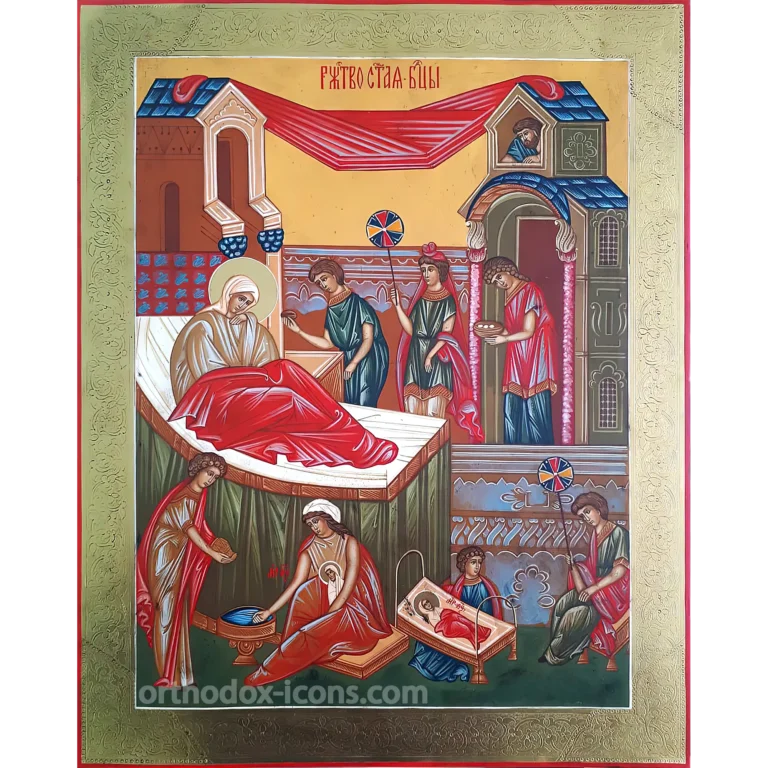
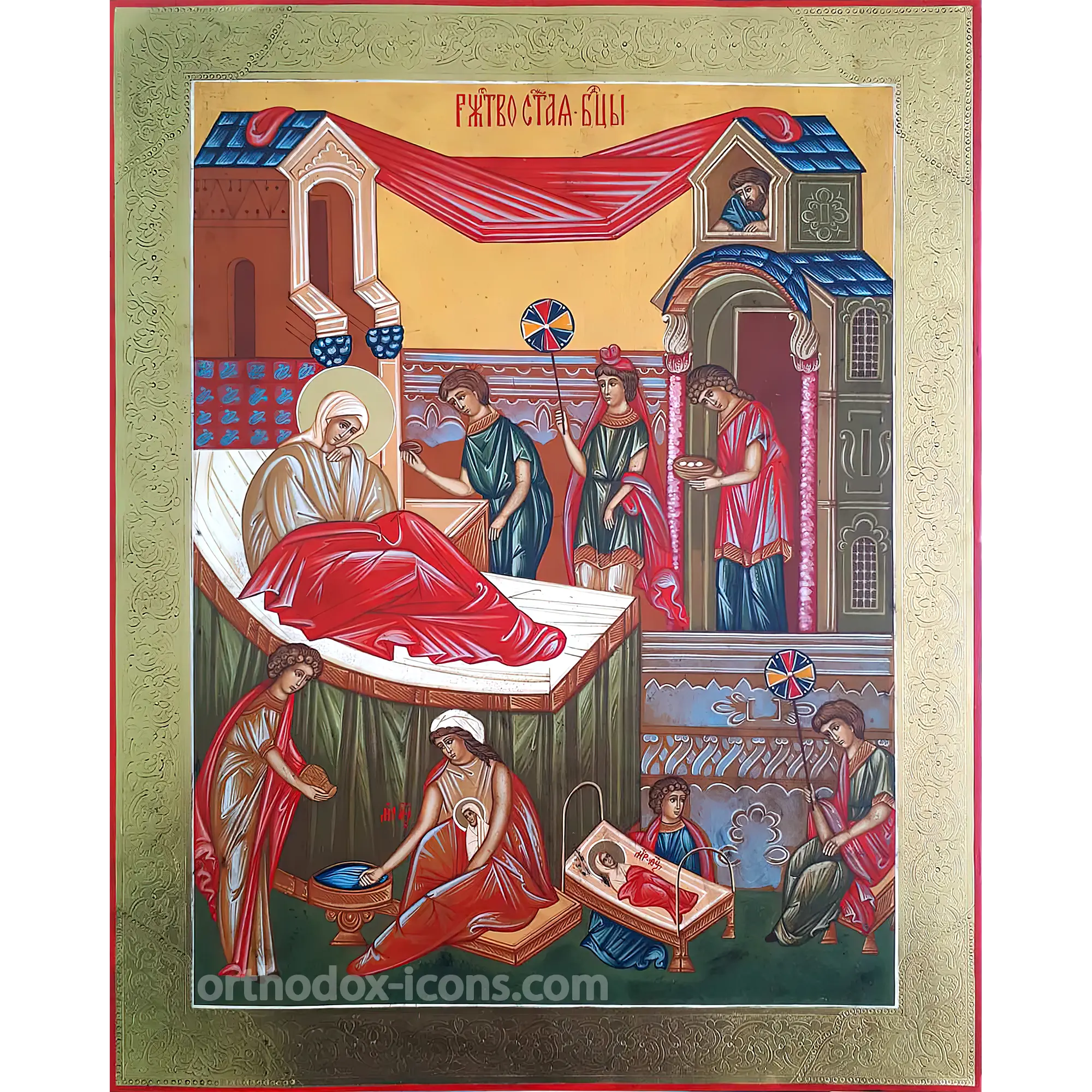
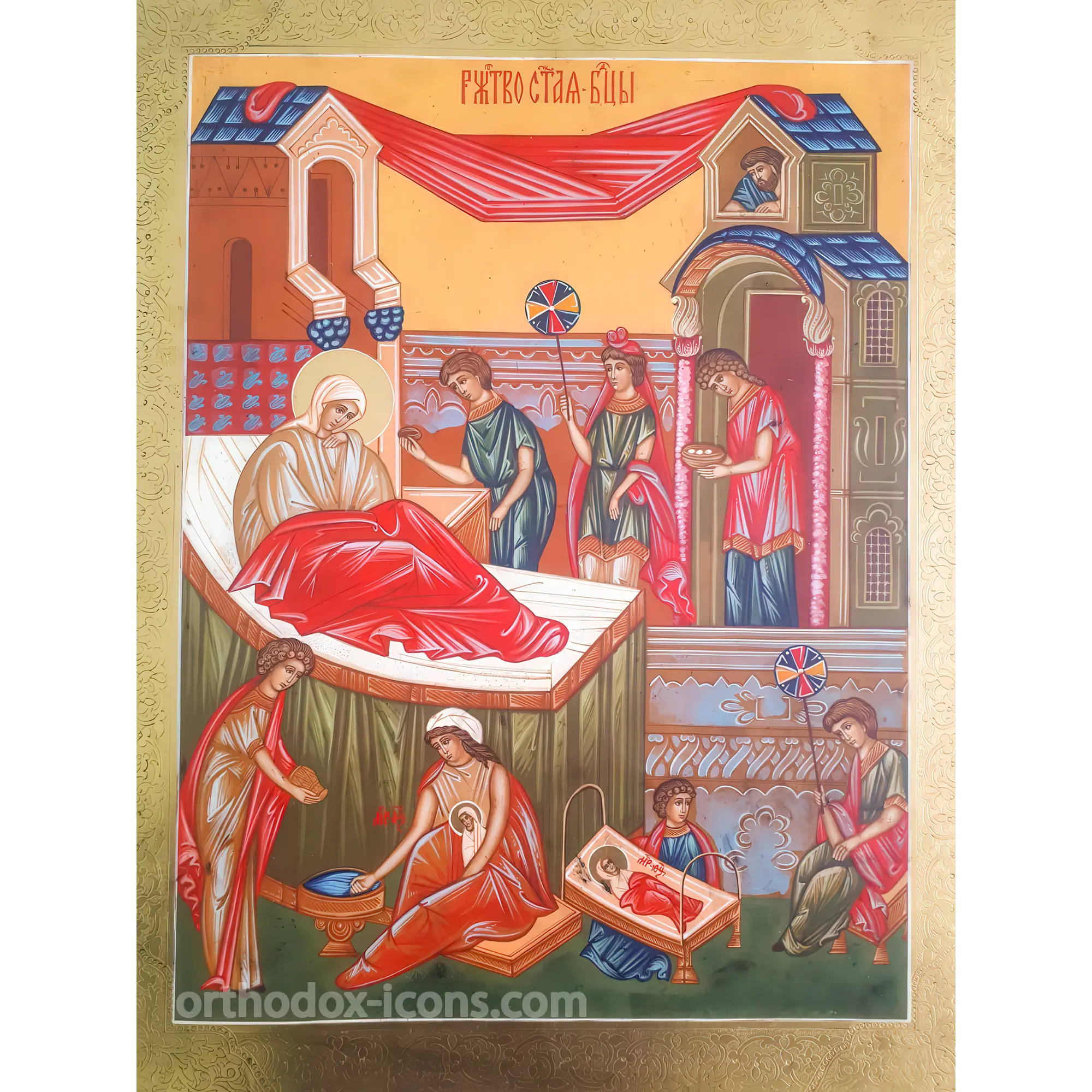
The Nativity of Virgin Mary Orthodox Icon depicts the birth of the Theotokos, the opening feast of the Orthodox liturgical year and the beginning of the history of salvation. This multi-figure hand-painted icon shows righteous Saint Anna reclining on a high bed beneath a red velum, servant maidens bringing gifts and fans, the first washing of the newborn Virgin Mary in the lower scene, and the infant in a cradle. Painted in the Mstyora Byzantine tradition with mineral egg tempera, 23K gold leaf, and hand-tooled floral gold ornament on the fields, this icon is especially meaningful for prayers for children, pregnancy, childbirth, and family peace. Free international shipping is included; payment is due upon delivery.
It is possible to paint an image in any size to order
Free shipping worldwide
The Nativity of Virgin Mary Orthodox Icon depicts the birth of the Most Holy Theotokos, the first great feast in the Orthodox liturgical year. This is deeply symbolic: the birth of the one who would become the living dwelling place of the uncontainable God is the dawn of humanity’s salvation and the beginning of the New Testament hope.
The feast is not described in the canonical Gospels. Its details come from ancient Church tradition, especially the Protoevangelium of James from the second century. The icon is therefore not merely a domestic birth scene. It is a theological hymn to life, hope, answered prayer, and the divine power that overcomes the limits of fallen nature.
This hand-painted Mstyora icon is a rich multi-figure composition in the Byzantine tradition. It shows righteous Saint Anna on her bed after giving birth, servant maidens with gifts and fans, the first washing of the newborn Virgin Mary, the infant in a cradle, architectural chambers, a red velum, 23K gold leaf, and hand-tooled floral ornament on the gold fields.
Nativity of Virgin Mary Orthodox Icon – The Answer to Joachim and Anna
According to tradition, righteous Joachim and Anna lived in Nazareth. Joachim came from the royal line of David, and Anna from the priestly line of Aaron. They were righteous before God, but they reached old age without children. In Old Testament Israel, childlessness was often regarded as a sign of disgrace, and they endured sorrow and reproach from those around them.
One day, during a great feast, the high priest in the Jerusalem Temple refused to accept Joachim’s offering, saying that he was unworthy because he had left no offspring in Israel. Deeply grieved, Joachim did not return home. He went into the wilderness, where he fasted and prayed for forty days.
When Anna learned what had happened, she too prayed fervently in her garden. She promised that if the Lord gave her a child, she would dedicate that child to God. Their prayer was heard. Archangel Gabriel appeared to both Joachim and Anna and announced that they would have a daughter through whom salvation would come to the whole world.
Joachim and Anna met at the Golden Gate of Jerusalem, and in due time the Virgin Mary was born in their home. Her birth was the first light before the rising of the Sun of Righteousness, Jesus Christ. The feast itself was established in the Church by the fifth or sixth century and became closely connected with the growing veneration of the Theotokos after the Council of Ephesus.
Iconography of the Nativity of the Theotokos
The iconography of the Nativity of the Mother of God developed over several centuries and reached its classical Byzantine form around the eleventh and twelfth centuries. It joins theological meaning with warm human details from family life.
The central figure is righteous Saint Anna, the mother of the Theotokos. She reclines on a high, richly arranged bed, resting on one arm. Her figure is clothed in a traditional maphorion. Above the buildings of the house is a wide red velum. In iconography, this cloth indicates that the event is taking place indoors, in the quiet interior of Joachim’s house, even though the architecture is shown as if from outside.
Servant maidens approach Anna’s bed. Their garments are painted in bright, joyful colors, such as green, red, and blue. One brings a bowl of food, another carries a vessel, and another fans the new mother with a round flabellum, a detail known from ancient and Byzantine visual culture. These figures bring movement and a sense of festive domestic care into the composition.
In the upper chamber, the face of righteous Joachim may be shown in prayerful contemplation, beholding the miracle that has occurred in his house.
The First Washing of the Newborn Virgin Mary
In the lower part of the icon, a separate scene shows the first washing of the newborn Virgin Mary. One midwife, traditionally named Salome in some accounts, holds the swaddled infant on her knees. Another pours water into the basin. The child is shown with a halo and with the monogram of the Mother of God.
This humble domestic scene has deep theological meaning. It emphasizes the reality of the human birth of the Mother of God. She was born as a real child, in a real family, and needed care like every infant. At the same time, her birth stands at the threshold of the Incarnation, because she would become the Mother of Christ.
Nearby, the newborn Lady may also be shown in a cradle, while a servant sits beside her, spinning or rocking the cradle. These details do not diminish the holiness of the image. They show that divine providence enters human life quietly, through family, childbirth, care, and prayer.
Gold Background and Mstyora Ornament
The icon is richly finished with 23K gold leaf. The background and wide fields are covered with gold, which in Orthodox iconography signifies divine light and the heavenly joy of the feast. The gold is not only decorative; it reveals that this ordinary-looking family event is part of God’s saving plan.
The gold fields are decorated with hand-tooled floral ornament. The gilder works the pattern into the gold with special tools, creating a relief design that catches the light. This ornament gives the icon a festive and royal appearance, suitable for one of the Twelve Great Feasts.
Prayer Before This Icon
Because the feast is connected with the miraculous end of the long childlessness of Joachim and Anna, the Nativity of the Theotokos icon is especially loved by couples praying for children. Those who have struggled with infertility may pray before this icon with hope, asking the Mother of God for help, patience, and the gift of parenthood if it is God’s will.
Expectant mothers also pray before this icon for a healthy pregnancy, protection of the unborn child, and safe childbirth. Families ask for peace between spouses, healing of wounds within the household, and protection from quarrels, infidelity, and harmful influences.
Parents may pray before the Nativity of the Virgin Mary icon for wisdom in raising children, that they may grow in obedience, kindness, faith, and love of God. The icon is also a source of consolation for those who suffer public judgment, sorrow, depression, or long waiting.
Materials and Icon Painting Technique
This multi-figure icon is painted according to the Mstyora school of icon painting. The base is a seasoned linden board strengthened on the back with inserted oak braces. Linen is applied to the front, and up to fifteen layers of natural chalk gesso are built up and polished to a smooth, stable surface.
The background and fields are gilded with 23K gold leaf. After gilding, the ornament is tooled by hand into the gold. The painted scene is made with mineral egg tempera. The icon painter prepares natural mineral pigments, including colors traditionally associated with lapis, cinnabar, ocher, and malachite tones, and mixes them with egg emulsion.
The garments are enriched with fine gold assist, expressing the presence of divine light. The many figures, architectural details, bed, servants, bathing scene, cradle, and ornament require careful miniature work and a sufficiently large board.
Available Size
The listed size from the workshop is 30×40 cm (11.8×15.7 in). This is the recommended size for this icon because the Nativity of the Theotokos is a detailed multi-figure composition. The larger surface allows the icon painter to show the faces, architecture, servants, bathing scene, cradle, and gold ornament clearly.
Larger 40×50 cm (15.7×19.7 in), 50×60 cm (19.7×23.6 in), and church or iconostasis formats can be discussed individually for a feast-day analogion or church setting.
Free international shipping is included; payment is due upon delivery.
Icon Characteristics
| Feature | Description |
|---|---|
| Feast | Nativity of the Most Holy Theotokos, one of the Twelve Great Feasts |
| Main figures | Righteous Anna, Joachim, servant maidens, midwives, and the newborn Virgin Mary |
| Composition | Anna on a high bed, red velum, architecture, first washing of the infant, cradle |
| Board | Linden wood with linen, natural gesso, and inserted oak braces |
| Painting | Mineral egg tempera in the Mstyora Byzantine tradition |
| Gold and decoration | 23K gold leaf background and hand-tooled floral ornament on the fields |
| Available size | 30×40 cm (11.8×15.7 in), with larger formats by agreement |
| Prayer use | Prayer for children, fertility, healthy pregnancy, safe childbirth, family peace, consolation |
The Nativity of Virgin Mary Orthodox Icon is a bright image of life, hope, and answered prayer. It is especially meaningful for families praying for children, for expectant mothers, and for anyone seeking consolation and renewed trust in the providence of God.
Questions and Answers
When is the Nativity of the Virgin Mary celebrated?
The Orthodox Church celebrates the Nativity of the Most Holy Theotokos on September 21 according to the new calendar, September 8 according to the old calendar.
Who are the parents of the Virgin Mary?
Her parents are righteous Joachim, from the royal line of David, and righteous Anna, from the priestly line of Aaron.
Why is Saint Anna shown on a bed?
Saint Anna is shown reclining after giving birth, while servants come to her with gifts and care. This is the central domestic scene of the feast icon.
What does the red velum mean?
The red velum stretched across the architecture indicates that the event takes place inside the house of Joachim, even though the buildings are shown outwardly.
What is shown in the lower part of the icon?
The lower part shows the first washing of the newborn Virgin Mary by midwives, emphasizing that the Mother of God was born in a real human way.
What are people accustomed to pray for before this icon?
People pray before this icon for the gift of children, healing from infertility, a healthy pregnancy, safe childbirth, family peace, and the wise upbringing of children.
Why is this icon recommended in a larger size?
The Nativity of the Theotokos is a detailed multi-figure composition with architecture, servants, the bathing scene, and gold ornament, so a larger board allows the details to be painted clearly.
What materials are used?
The icon is painted on a linden board with linen, natural gesso, mineral egg tempera, 23K gold leaf, and hand-tooled gold ornament.
What size is available?
The listed size from the workshop is 30×40 cm (11.8×15.7 in). Larger church and iconostasis formats can be discussed individually.
Do you ship internationally?
Yes. Free international shipping is included, and payment is due upon delivery.
| Dimensions | 30x40cm (11.8×15.7 in) |
|---|---|
| Name | Mary |