Nativity of the Theotokos Orthodox Icon
$4250
Available size: 30×40 cm (11.8×15.7 in); larger church and iconostasis sizes by agreement.
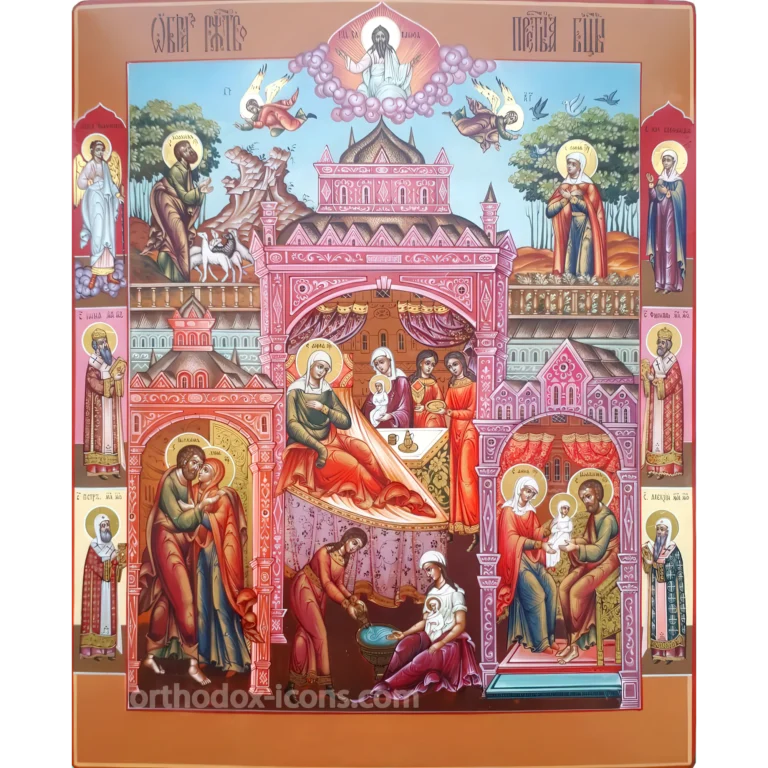
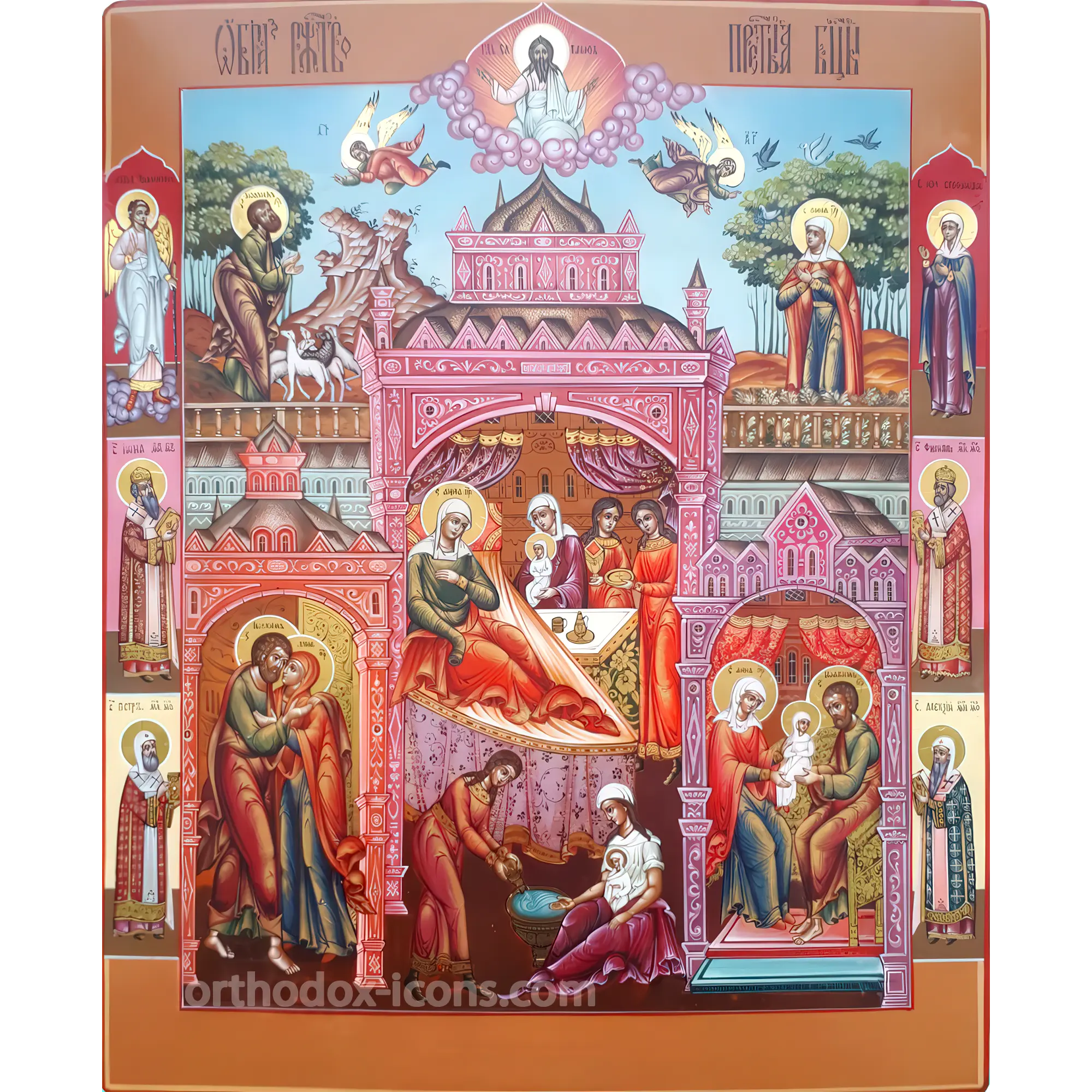
The Nativity of the Theotokos Orthodox Icon is a large hand-painted feast icon with life scenes, or kleima, telling the story of Joachim and Anna before the birth of the Mother of God. The central panel shows Saint Anna after childbirth, servant maidens with gifts, the first washing of the newborn Mary, and Joachim and Anna tenderly holding their long-awaited daughter. Around the center are scenes of Joachim praying in the wilderness, the Annunciation to Anna, and the meeting at the Golden Gate. Above, God the Father is shown in clouds with angels. Painted with mineral egg tempera and 23K gold assist. Free international shipping is included; payment is due upon delivery.
It is possible to paint an image in any size to order
Free shipping worldwide
The Nativity of the Theotokos Orthodox Icon is a large hand-painted feast icon with life scenes, or kleima. It does not show only one moment from the feast. It unfolds a whole visual sermon about the birth of the Mother of God, the faith of Joachim and Anna, the answer to long prayer, and the beginning of the New Testament hope.
The Nativity of the Most Holy Theotokos opens the yearly liturgical cycle of the Orthodox Church. This is fitting, because the birth of the Virgin Mary stands at the threshold between the Old and New Testaments. The one who would become the Mother of God is born, and the history of salvation begins to move visibly toward the Incarnation of Christ.
This icon follows a complex multi-part composition characteristic of Russian art from the sixteenth and seventeenth centuries. In the spacious central panel, the feast itself is shown in richly colored architectural chambers. Around it, smaller narrative scenes reveal the earlier story of Joachim and Anna. At the top, God the Father is shown in clouds with angels, blessing the miracle taking place on earth.
Nativity of the Theotokos Orthodox Icon – A Feast with Life Scenes
The canonical Gospels do not describe the birth of the Virgin Mary. The Church preserves the story through sacred tradition, especially in the Protoevangelium of James from the second century. According to this tradition, righteous Joachim and Anna lived in Nazareth. Joachim came from the royal line of David, while Anna came from the priestly line of Aaron.
They were righteous and merciful, but they reached old age without children. In the Old Testament world, childlessness was often seen as a sign of the absence of divine blessing. During a great feast, the high priest publicly refused Joachim’s offering, considering him unworthy because he had no offspring.
Overcome with sorrow, Joachim did not return home but went to his flocks in the wilderness. There he fasted and prayed for forty days. Anna, hearing of her husband’s humiliation, prayed in her garden. In answer to their unshaken faith, Archangel Gabriel announced to both of them that they would have a daughter through whom the whole world would be blessed.
Joachim and Anna met joyfully at the Golden Gate of Jerusalem. In due time, the Virgin Mary was born in their house. Her birth was not only the resolution of a family sorrow, but the beginning of the divine plan for the salvation of humanity.
The Central Panel
The central part of the icon shows the Nativity itself in beautiful pink architectural chambers with towers and arches. Under the central arch, righteous Saint Anna reclines on a high bed after giving birth. Servant maidens approach her: one holds a vessel, another brings gifts on a round dish.
In the lower left part of the central scene is the traditional bathing scene. A midwife pours water into a round basin, preparing to wash the newborn Mary. This detail emphasizes that the Mother of God was born in a real human way and was cared for as an infant, while also being marked by a unique divine calling.
In the lower right, a tender scene shows the holy ancestors of God, Joachim and Anna, seated together and reverently holding their swaddled newborn daughter. This gives the icon a deeply family-centered and contemplative tone: the miracle is not abstract, but received with love by real parents who had waited for many years.
The Life Scenes Around the Center
The surrounding kleima, or narrative panels, tell the story that leads to the feast. In the upper left, against a rocky landscape, Joachim is shown praying in the wilderness. An angel descends toward him with the good news.
In the upper right, among trees, is the Annunciation to Anna. Righteous Anna stands in the garden with her hands raised in prayer, looking toward the angel who brings the news of her coming motherhood.
In the lower left, beneath a separate arch, Joachim and Anna meet at the Golden Gate. They embrace with joy after learning that their prayers have been heard. This meeting is traditionally connected with the conception of the Virgin Mary.
Together, these scenes turn the icon into a spiritual narrative. The faithful do not see only the birth, but the whole movement of prayer, waiting, revelation, reunion, and joy.
God the Father, Angels, and Patron Saints
At the very top of the icon, in a heavenly segment of clouds, God the Father, Sabaoth, is shown as an elder. Rays of divine light descend from Him, blessing the house of Joachim and the miracle happening on earth. Angels and white doves appear nearby, pointing to the presence of the Holy Spirit and the purity of the newborn Mary.
The wide fields of the icon include standing patron saints. Their exact composition can be personal: families often ask to have their heavenly patrons, or the saints whose names they bear, painted on the borders. This makes such an icon not only a feast image, but also a family shrine and heirloom.
Prayer Before This Icon
The Nativity of the Theotokos is closely connected with the end of the long childlessness of Joachim and Anna. For this reason, couples who long for children often pray before this icon for the gift of a child, healing from infertility, patience, and hope.
Expectant mothers pray before the icon for safe pregnancy and childbirth. Families ask for peace between spouses, healing of conflicts, and help in raising children in faith. The example of Joachim and Anna shows faithful love, patient endurance, and trust in God through years of suffering.
The icon also brings consolation to those who are weary from waiting, sorrow, public reproach, or discouragement. It reminds the faithful that the Lord can bring joy from a place that seemed barren and hopeless.
Materials and Mstyora Technique
Creating an icon with such a complex multi-part composition requires great skill and patience. The base is a seasoned linden board strengthened with inserted oak braces on the back. Linen is applied to the front, and natural chalk gesso is polished until it becomes smooth and firm.
The faces, chambers, garments, landscapes, and small narrative scenes are painted with mineral egg tempera. The icon painter prepares natural mineral pigments and mixes them with egg emulsion. This traditional method gives the icon lasting color, depth, and a noble surface.
Gold is used for halos and selected backgrounds, while fine gold assist is applied to garments, thrones, and architectural details. These delicate gold rays express the presence of divine, uncreated light within the event.
Available Size
The listed size is 30×40 cm (11.8×15.7 in). This is the minimum and most appropriate size for a life-scenes icon of this complexity. The composition includes the central feast, several kleima, architecture, landscapes, many figures, inscriptions, and standing saints on the fields. A smaller board would not allow the details to be painted clearly.
Larger church and iconostasis formats, including 40×50 cm (15.7×19.7 in), 50×60 cm (19.7×23.6 in), 80×100 cm (31.5×39.4 in), and other sizes, can be discussed individually.
Free international shipping is included; payment is due upon delivery.
Icon Characteristics
| Feature | Description |
|---|---|
| Feast | Nativity of the Most Holy Theotokos with life scenes of Joachim and Anna |
| Icon type | Multi-part feast icon with kleima around the central panel |
| Main scenes | Birth of Mary, washing of the infant, Joachim in the wilderness, Annunciation to Anna, meeting at the Golden Gate |
| Heavenly image | God the Father in clouds with angels, blessing the miracle |
| Board | Linden wood with linen, natural gesso, and inserted oak braces |
| Painting | Mineral egg tempera in the Mstyora tradition |
| Gold | 23K gold leaf for halos and selected details, with gold assist on garments and architecture |
| Available size | 30×40 cm (11.8×15.7 in), with larger formats by agreement |
| Prayer use | Prayer for children, fertility, pregnancy, childbirth, family peace, and consolation |
The Nativity of the Theotokos Orthodox Icon is a rich visual narrative about faith, patience, and the birth of hope. It is a meaningful family shrine for prayer, thanksgiving, and trust in God’s providence.
Questions and Answers
What is a life-scenes icon?
A life-scenes icon, or icon with kleima, has a central scene surrounded by smaller narrative panels that tell the story leading to the main event.
What feast does this icon depict?
It depicts the Nativity of the Most Holy Theotokos, the feast that opens the Orthodox liturgical year and marks the beginning of the New Testament hope.
What is shown in the central panel?
The central panel shows Saint Anna after childbirth, servant maidens with gifts, the washing of the newborn Mary, and Joachim and Anna holding their daughter.
Which scenes are shown around the center?
The surrounding scenes include Joachim praying in the wilderness, the Annunciation to Anna in the garden, and the meeting of Joachim and Anna at the Golden Gate.
Who is shown at the top of the icon?
At the top, God the Father, or Sabaoth, is shown in clouds with angels, blessing the miracle taking place on earth.
Can family patron saints be painted on the fields?
Yes. The wide fields can include standing patron saints chosen by the family, making the icon a personal family shrine.
Why is this icon recommended in a large size?
The composition includes many scenes, figures, inscriptions, architecture, and saints, so it needs a larger board for the details to remain clear.
What are people accustomed to pray for before this icon?
People pray before this icon for the gift of children, healing from infertility, safe pregnancy, easy childbirth, family peace, and consolation.
What size is available?
The listed size is 30×40 cm (11.8×15.7 in). Larger church and iconostasis formats can be discussed individually.
Do you ship internationally?
Yes. Free international shipping is included, and payment is due upon delivery.
| Name | Mary |
|---|---|
| Dimensions | 30x40cm (11.8×15.7 in) |